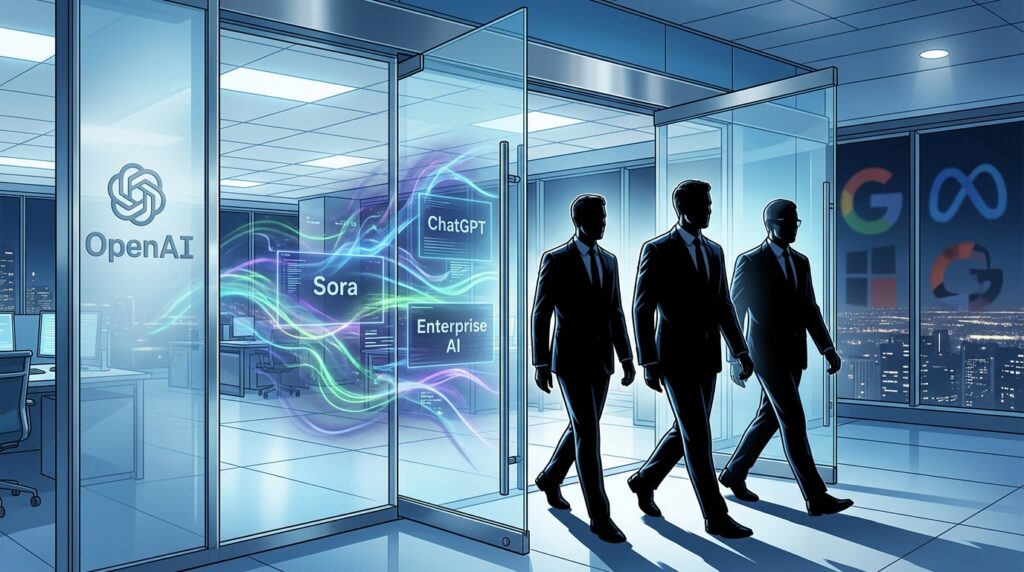
The Day Three Executives Said Goodbye
Picture this. It’s a regular Friday at OpenAI. Then — boom. Three senior executives announce they’re leaving. All on the same day.
That’s exactly what happened on April 18, 2026. Kevin Weil, the former Chief Product Officer turned head of OpenAI for Science, posted his farewell. Bill Peebles, the researcher who literally built Sora from the ground up, said his goodbyes too. And then there was Srinivas Narayanan, the Chief Technology Officer of enterprise applications, who quietly announced internally that he was stepping away to spend time with family.
Three executives. One Friday. One very loud message.
This wasn’t a coincidence. It was a symptom. OpenAI is going through a massive identity shift — and the people who helped build its most ambitious projects are walking out the door as a result.
Who Were These People, Anyway?
Let’s break it down, because these aren’t just random names on an org chart.
Kevin Weil is a big deal. He came to OpenAI in June 2024 from Instagram, where he was a key product executive. At OpenAI, he rose to Chief Product Officer before pivoting to lead OpenAI for Science — an internal research initiative focused on using AI to accelerate scientific discovery. His team built Prism, an AI workspace for scientists, and just one day before his departure, they released GPT-Rosalind, a model designed to speed up life sciences research and drug discovery. Talk about going out with a bang.
Weil’s farewell post was gracious. “It’s been a mind-expanding two years,” he wrote. But the subtext was clear. The initiative he was hired to lead no longer exists as a standalone unit.
Bill Peebles built Sora. Full stop. He described the experience as “the honour and adventure of a lifetime.” He’s not wrong — Sora was genuinely groundbreaking. It could generate realistic video clips from simple text prompts. The demos blew people’s minds. Peebles himself argued that Sora “sparked a huge amount of investment in video across the industry.” That’s a legacy worth owning.
But Sora is dead now. More on that in a moment.
Srinivas Narayanan spent three years at OpenAI. He helped ship ChatGPT, he helped build the API, he grew the applied engineering team from roughly 40 people into a major operation. His departure was quieter — no dramatic social media post, just an internal announcement about family time. But his exit matters just as much.
The Death of the “Side Quests”
Here’s the thing you need to understand to make sense of all this. OpenAI has been on a mission to kill what it internally calls “side quests.”
These are the consumer-facing moonshot projects. The ambitious bets. The stuff that made OpenAI feel like a research lab with a soul. And one by one, they’re getting cut.
Sora is being discontinued. The web and app versions shut down on April 26. The API follows on September 24. Why? Because it was costing roughly $1 million per day to operate. It peaked at around one million users, then collapsed to fewer than 500,000. The Motion Picture Association had also flagged intellectual property infringement on the platform. The economics just didn’t work.
OpenAI for Science is being “decentralized” — which is corporate speak for dismantled. The team’s work gets absorbed into other research groups. The dedicated initiative Weil was hired to lead? Gone.
Wired reported that OpenAI is folding the roughly 10-person Prism team under the head of Codex, Thibault Sottiaux, with plans to incorporate Prism’s capabilities into the desktop Codex app. The goal? Turn Codex into an “everything app.” OpenAI wants fewer products, not more.
The message from leadership is clear. Stop exploring. Start executing.
The Bigger Picture: A Two-Year Exodus
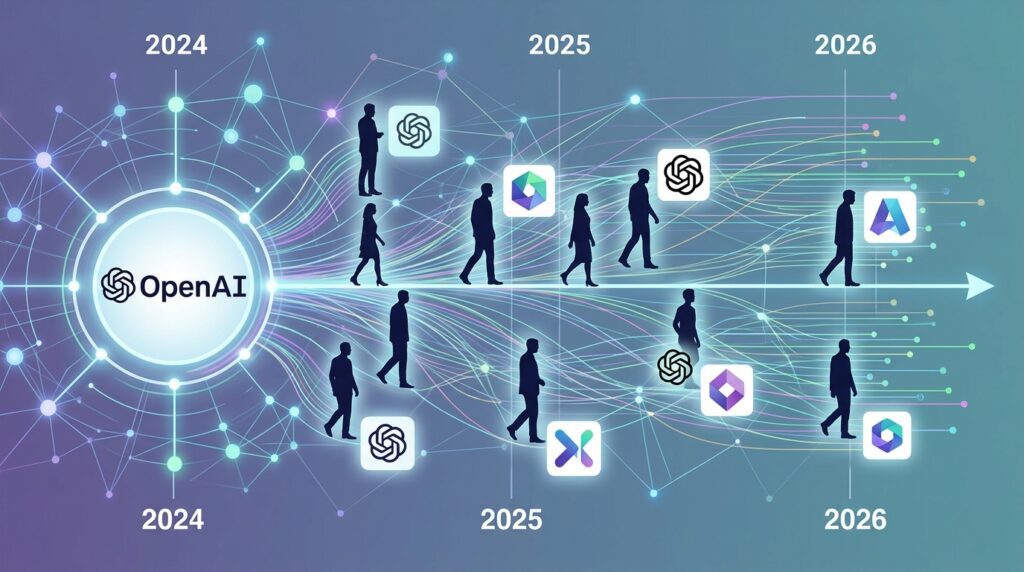
Now here’s where it gets really wild. This isn’t a one-off Friday drama. This is part of a pattern that has been building for two years.
The Next Web reported that of OpenAI’s 11 co-founders, only two remain: Sam Altman and Greg Brockman. Let that sink in. Nine of eleven co-founders are gone.
The list of departed leaders reads like a who’s who of AI royalty. Co-founder and chief scientist Ilya Sutskever. CTO Mira Murati. Chief research officer Bob McGrew. VP of research Barret Zoph. Co-founder John Schulman. Chief communications officer Hannah Wong. Chief people officer Julia Villagra. Board member Lawrence Summers. At least 12 senior executives left in 2025 alone.
And where did they go? That’s the really interesting part.
John Schulman went to Anthropic. Tim Brooks, who co-led Sora before Peebles, went to Google DeepMind and then to Meta’s Superintelligence Labs. Shengjia Zhao, a key architect of ChatGPT and GPT-4, became chief scientist at Meta Superintelligence Labs. Approximately seven additional researchers followed the same path to Meta. Liam Fedus, VP of research, left to co-found Periodic Labs.
These people aren’t retiring. They’re going to build competing products — with the same skills, the same knowledge, and in some cases, the same ideas.
Why Are They Really Leaving?
The official reasons vary. Family time. New adventures. Personal growth. But the real story is more complicated.
Some executives left over ethical concerns about a Defense Department AI contract. Others described a cultural shift — from ambitious research bets toward the operational grind of making ChatGPT faster and more reliable for Microsoft and enterprise customers. The vibe changed. The mission felt different.
Sam Altman himself acknowledged the turbulence in a recent blog post. “I am also very aware that OpenAI is now a major platform, not a scrappy startup, and we need to operate in a more predictable way now,” he wrote. “It has been an extremely intense, chaotic, and high-pressure few years.”
That’s a remarkably candid admission. OpenAI grew up fast. And not everyone who joined the scrappy startup wanted to work at the major platform.
The Leadership Vacuum Gets Worse
The timing of these three departures makes things even messier. OpenAI’s leadership bench is thinner than it’s been in years.
Fidji Simo, the Chief of Product and Business — one of the most senior hires in OpenAI’s history — took medical leave in early April due to a worsening neuroimmune condition. Greg Brockman is temporarily overseeing product in her absence. Brad Lightcap, the Chief Operating Officer, has been shifted to leading “special projects.” Kate Rouch, the Chief Marketing Officer, is departing to focus on cancer recovery.
That’s a lot of empty chairs at the table.
OpenAI did add Denise Dresser, the former CEO of Slack, as Chief Revenue Officer. That hire signals exactly where the company’s priorities lie. Revenue. Enterprise. Scale.
But the net effect of the past 18 months is a leadership team that has been almost entirely rebuilt around business execution — with the research-oriented visionaries who defined OpenAI’s early identity largely gone.
The Money Math Doesn’t Lie
Here’s the paradox at the heart of all this. OpenAI is simultaneously thriving and struggling.
Monthly revenue has reached approximately $2 billion. The annualized run rate exceeds $25 billion. The company closed a $122 billion funding round in April at an $852 billion valuation. It has more than 900 million weekly active ChatGPT users. Enterprise revenue now accounts for more than 40% of the total.
Those are staggering numbers. By any measure, OpenAI is a success story.
But the cost side is brutal. OpenAI projects $14 billion in losses on $25 billion in revenue this year. Cumulative spending through 2029 is estimated at $115 billion. The company expects to reach cash-flow positive by 2029 and targets $200 billion in revenue by 2030.
That’s an aggressive bet. And it requires everything to go right.
The Competition Is Closing In
Meanwhile, the competitive landscape has shifted dramatically. Anthropic’s annualized revenue has reached $30 billion — while spending roughly a quarter of what OpenAI spends on training. Google’s Gemini models are embedded across its enterprise suite. Meta is building a superintelligence lab staffed significantly by former OpenAI researchers.
The moat that OpenAI built through first-mover advantage in consumer AI is narrowing fast. Anthropic’s Claude, and particularly Claude Code, has been gaining serious ground in developer adoption. That competitive pressure is exactly why OpenAI is doubling down on near-term product execution — and cutting the exploratory projects that don’t contribute directly to revenue.
It’s a classic big-company move. Consolidate. Cut. Execute. Repeat.
What This All Means
Three executives leaving on the same Friday is not, in isolation, a crisis. Companies lose people. Leaders move on. That’s normal.
But this isn’t normal. This is a pattern. A two-year pattern of talent flowing out of OpenAI and into competitors, startups, and research labs. A pattern of ambitious projects getting killed. A pattern of the company that defined the generative AI era becoming something fundamentally different.
Bill Peebles said it best in his farewell post: “Cultivating entropy is the only way for a research lab to thrive long-term.” He was making a case for the kind of exploratory, chaotic research that produced Sora. OpenAI, it seems, has decided it can no longer afford that entropy.
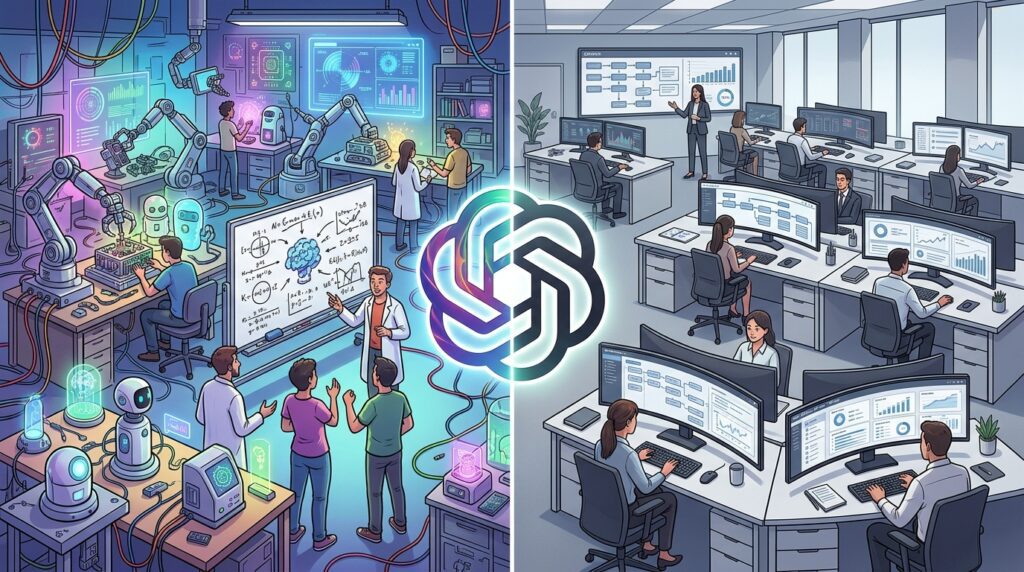
The company that once felt like the most exciting place in tech — the place where researchers dreamed of AGI and built video generators and science platforms — is becoming a very large, very well-funded enterprise software company.
That might be the right business decision. It might even be the only sustainable path forward given the economics.
But it’s a different OpenAI. And the people who built the original one are, one by one, walking out the door.
Sources
- The Next Web — Three more senior executives leave OpenAI as the company kills its side quests
- The Decoder — OpenAI loses three executives in one swoop as restructuring reshapes its product lineup
- TechCrunch — Kevin Weil and Bill Peebles exit OpenAI as company continues to shed ‘side quests’
- Wired — OpenAI Executive Kevin Weil Is Leaving the Company
- The Tech Portal — OpenAI sees major leadership exits as three top executives leave together
The Kingy Brief
Get the next Kingy Brief.
Source-checked AI changes, original tests and one practical thing to try.
Free · Choose your subjects · Double opt-in · Unsubscribe anytime