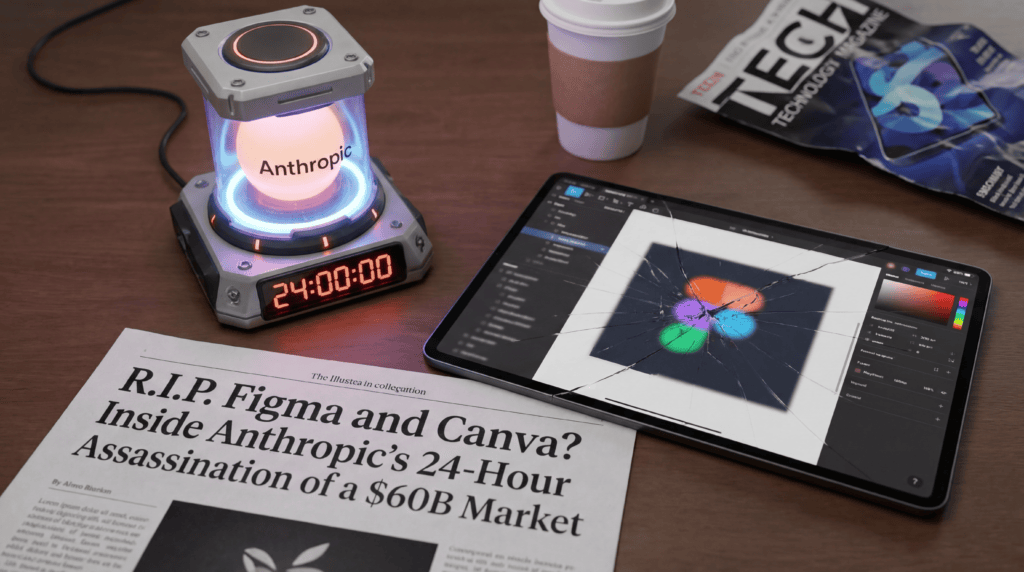
Anthropic’s new design product doesn’t just compete with the incumbents. It changes where a design begins — which is the part that actually matters.
On the morning of April 17, 2026, Anthropic published a short announcement on its newsroom titled “Introducing Claude Design by Anthropic Labs.” The post was characteristically understated — a few paragraphs, three customer quotes, a link to claude.ai/design, and a polite note that Melanie Perkins, Canva’s co-founder and CEO, was thrilled about the collaboration.
By the time the U.S. markets closed, Figma’s stock had fallen as much as 7.28%, settling at $18.84 from a prior close of $20.32, according to OfficeChai. Adobe was down. Wix was down. The tech sector, broadly, was trading at record highs, per Yahoo Finance’s tech sector live blog — but a specific corner of the design software universe was being repriced in real time.
The reason is not complicated. For the first time since Figma’s 2012 founding, a product has shipped that plausibly removes the very first step of the modern design workflow: opening Figma.
Here’s what Claude Design actually is, what it does and doesn’t do, who’s likely to be hurt, who’s likely to benefit, and why — despite everything I’m about to write — I’m genuinely uncertain whether it will eliminate Figma or Canva in any meaningful timeframe.

What Claude Design actually does
Let me start with the primary source rather than the takes.
According to Anthropic’s own announcement, Claude Design is “a new Anthropic Labs product that lets you collaborate with Claude to create polished visual work like designs, prototypes, slides, one-pagers, and more.” It is powered by Claude Opus 4.7, Anthropic’s newest and most capable generally available vision model, also launched the same day. Access is included with existing Pro, Max, Team, and Enterprise subscriptions, rolling out gradually on April 17. For Enterprise customers, it is off by default — admins have to explicitly flip it on.
The workflow Anthropic describes has four moving parts:
- Onboarding reads your codebase and design files. During setup, Claude builds a design system for your team — colors, typography, components — and applies it automatically to every project. Teams can maintain more than one system, and refine them over time.
- Input is broad. You can start from a text prompt, upload images and documents (DOCX, PPTX, XLSX), point Claude at your codebase, or use a web-capture tool to grab elements directly from a live website.
- Refinement is conversational and direct. You can chat, leave inline comments on specific elements, edit text directly, or use adjustment sliders — which Claude itself generates — to tweak spacing, color, and layout live.
- Export is open. You can share as an organization-internal URL, save as a folder, export to Canva, PDF, PPTX, standalone HTML, or package the entire design as a “handoff bundle” for Claude Code to implement.
The handoff bundle is the part nobody selling Figma licenses wants to think about. It is, in effect, a one-click bridge from “conversation with an AI” to “working production code” — all inside one vendor’s walled garden, if you want it to be.
TechCrunch’s write-up included a telling example prompt: “prototype a serene mobile meditation app. It should have calming typography, subtle nature-inspired colors, and a clean layout.” From there you can tweak a dark-mode toggle, the typography sizes, or the palette — all through natural language.
If you’ve been paying attention to the AI design space, this probably sounds familiar. Galileo, Uizard, v0.dev, Figma Make, Vercel’s v0, Lovable — there are easily a dozen products doing some flavor of “type a prompt, get a UI.” What makes Claude Design different is not the novelty of the category. It’s that the model underneath is Claude Opus 4.7, which Anthropic is marketing as its most capable vision model — handling images up to 2,576 pixels on the long edge, roughly 3.75 megapixels. VentureBeat’s coverage reported that early-access partner XBOW saw Opus 4.7 hit 98.5% on their visual-acuity benchmark, versus 54.5% for Opus 4.6. That is not an incremental improvement. That is the jump from “can read a screenshot” to “can reason about a screenshot the way a designer does.”
Whether those benchmarks translate into meaningfully better outputs for design in the wild is — I want to be honest here — uncertain. Benchmarks and product experience don’t always move together. I haven’t used the product yet. Very few people outside Anthropic’s early-access cohort have.
The quotes that matter, and the ones that matter more
Anthropic’s announcement featured three testimonials. The most politically loaded by an order of magnitude was from Melanie Perkins, co-founder and CEO of Canva:
“We’ve loved collaborating with Anthropic over the past couple of years and share a deep focus on making complex things simple. At Canva, our mission has always been to empower the world to design, and that means bringing Canva to wherever ideas begin. We’re excited to build on our collaboration with Claude, making it seamless for people to bring ideas and drafts from Claude Design into Canva, where they instantly become fully editable and collaborative designs ready to refine, share, and publish.”
This is Canva’s CEO publicly embracing a product that, at least superficially, cannibalizes the “going from zero to first draft” moment that has historically been Canva’s bread and butter. Read generously, it’s a bet that Canva’s real moat is the editing, collaboration, and publishing layer — not the generation step. Read cynically, it’s a company choosing to be the highway rather than the ditch, because the traffic is going that way regardless.
Notably missing from Anthropic’s announcement: any quote from Figma. Given that Figma launched its own “Claude Code to Figma” capture-to-canvas feature on February 17, 2026, you’d think the two companies would have something warm to say. They didn’t — or at least, Anthropic didn’t print it.
The other two quoted customers — Olivia Xu at Brilliant and Aneesh Kethini at Datadog — both gave extremely specific numbers. Brilliant reported that pages requiring “20+ prompts to recreate in other tools only required 2 prompts in Claude Design.” Datadog described compressing “a week of back-and-forth between briefs, mockups, and review rounds” into a single conversation.
Customer testimonials in product launches are not evidence. But the shape of them tells you what Anthropic thinks the wedge is: not “we’re better than Figma at what Figma does,” but “we compress a week of pre-Figma work into an afternoon.”
The boardroom backstory Figma would rather forget
You don’t need to be a conspiracy theorist to notice what happened the week of April 13.
On Monday, April 14, The Information reported that Anthropic was about to launch a design tool. The same day, Anthropic’s Chief Product Officer Mike Krieger quietly resigned from Figma’s board of directors. TechCrunch covered the resignation separately. Figma’s stock dropped around 6% on the news. Adobe fell 2.7%, Wix 4.7%, GoDaddy 3%, per OfficeChai’s roundup.
Krieger, for context, co-founded Instagram, built the AI news app Artifact (acquired by Yahoo in 2024), joined Anthropic as CPO in 2024, and had been on Figma’s board for less than a year. The same week the design tool was reported, he left the board.
Three days later, the product launched.
I can’t tell you what was said in closed-door Figma board meetings in March and April. I don’t know. But the sequence is what it is: the partner’s executive leaves the board on the day the competitive launch leaks, and the product ships within 72 hours. That pattern is consistent with two companies whose strategic interests have stopped aligning.
The official Anthropic position, per VentureBeat’s reporting, is that Claude Design is built around interoperability — exports to Canva, PPTX, PDF, and future MCP-based integrations with other tools — and is meant to “meet teams where they already work.” That framing is plausible. It’s also what every platform company has said in the first year of every category it eventually ate.
Why this is a real threat, and not just “another AI demo”
The AI design category has been noisy for two years. Most of it hasn’t mattered. I want to be clear about why this specific launch probably does.
1. Figma’s market share is almost an asset bubble. The Next Web, cited by VentureBeat, estimates Figma commands 80–90% of the UI/UX design software market. That dominance is based on a single structural assumption: that the person doing the design work is a trained designer with Figma open. Claude Design does not require that assumption. When a founder, PM, or marketer can produce a shareable interactive prototype without ever opening Figma, Figma isn’t losing users — it’s losing the entire concept of its user.
2. The Figma IPO is already bleeding. Figma went public in the summer of 2025 in one of the year’s biggest IPOs. Per OfficeChai, the stock is now down more than 80% from its post-IPO high. That’s before Friday’s 7% drop. A wounded public company defending its moat against a well-capitalized AI-native competitor is not a fight history loves.
3. The design system feature is the kill shot. Enterprise design tools have always sold on “we hold your design system.” Anthropic is now saying: point us at your codebase and design files, and we’ll hold your design system — and apply it automatically to every asset anyone on your team produces. If that works as advertised, it restructures the entire value proposition of “design tool with a DesignOps team maintaining the component library.”
4. Claude Code is the backdoor. Anthropic has an unusually strong position in AI coding. Ramp’s Q1 2026 data shows Anthropic capturing 37% of trackable business spending on generative-AI software last quarter — its biggest share yet — versus 33% for OpenAI. When you can go from prompt → design → shippable code inside a single vendor’s ecosystem, the traditional design-to-dev handoff workflow that justifies Figma’s existence becomes optional.
5. The pricing is effectively zero. Claude Design is bundled into existing Pro, Max, Team, and Enterprise subscriptions. No additional line item. This is the exact same “bundle it in, monetize later” strategy that turned Claude Code from a curiosity into a revenue engine. Figma, by contrast, sells seats. A free-at-the-margin competitor against a per-seat incumbent is the oldest disruption story in enterprise software.
And yet — will Figma or Canva actually get eliminated?
This is where I want to push back, on myself and on the louder takes.
I’ve read the DSRPT analysis arguing that Adobe, Wix, Figma, and Canva “all have the same quiet problem now: their business models assume you open the tool first.” That’s correct as a framing. It’s less obviously correct as a prediction.
Consider what Figma and Canva actually sell, beneath the surface:
- Figma sells multiplayer design collaboration. The canvas is not the product; the shared canvas with your teammates’ cursors on it is the product. Claude Design’s own documentation acknowledges the collaboration layer is “basic and not yet fully multiplayer.” That gap is not small.
- Figma sells a decade of muscle memory. There is a generation of designers, at this point, for whom Figma is not a tool but a fundamental metaphor. That kind of lock-in doesn’t evaporate because a competing tool generates a better first draft.
- Canva sells a massive library of templates, stock assets, and publishing integrations, plus a growing AI toolset of its own. Its 200M+ user base is not replicated by a Claude export button — yet.
- Both companies sell trust and workflow permanence. Enterprise buyers do not replace the tool that houses their brand guidelines on a quarterly cycle.
The more honest forecast, which I have moderate confidence in, is this:
- Figma and Canva will lose the origination step of more workflows. The person whose week used to start with “open Figma” will increasingly start with “open Claude.”
- Figma and Canva will not lose the refinement step — at least not in the 12–24 month horizon. Polishing, brand alignment, multi-stakeholder review, publishing, and institutional asset management are still clearly better done in purpose-built tools.
- The strategic question is whether the originators grow upward into refinement faster than the refiners grow downward into origination.
On that last point, I am genuinely uncertain. Canva has chosen to accept Claude Design as a funnel. Figma hasn’t. That divergence matters. If Canva successfully converts Claude Design outputs into Canva edits at scale, Canva survives and possibly thrives. If Figma treats Claude Design as a competitor and loses the generation step entirely, Figma has a much harder path.
What the market did, and what the market might be wrong about
Sherwood’s Jon Keegan framed Friday’s action as part of a pattern: “Anthropic has been slowly and steadily gaining a leading share in the enterprise AI market by focusing on coding, spreadsheets, and other common productivity and workplace apps. And now they are going after design apps.”
The numbers support the framing. Anthropic has reportedly received investor offers valuing it at roughly $800 billion, more than doubling the $380 billion valuation from a funding round closed two months prior, per Reuters as cited by VentureBeat. The company is reportedly in early talks with Goldman Sachs, JPMorgan, and Morgan Stanley about an IPO that could come as early as October 2026. Revenue went from $9B ARR at the end of 2025 to roughly $20B ARR in early March to over $30B ARR by early April, according to Bloomberg figures summarized in the VentureBeat piece.
I want to flag that I cannot independently verify all of those revenue figures against primary Bloomberg sources from my search, so treat the exact numbers with appropriate skepticism. The direction — rapid, compounding growth — is well-established across multiple outlets.
The market’s reaction on April 17 was a bet that Anthropic’s rate of category expansion is accelerating, and that each new category it enters reprices the incumbent downward. That’s a defensible bet. It’s also the kind of bet that markets routinely overshoot on. Figma at $18.84 may be a falling knife, or it may be the moment where the “Anthropic-will-eat-everything” trade finally gets ahead of the underlying product reality.
I don’t know which. I have an opinion (the first three years of a new category tend to overstate disruption; the next seven tend to understate it), but I want to be honest that it is an opinion.
The handoff to Claude Code: the move everyone underestimated
If there’s one feature in Claude Design that I think is undercovered in the reporting, it’s this line from Anthropic’s announcement:
“When a design is ready to build, Claude packages everything into a handoff bundle that you can pass to Claude Code with a single instruction.”
The design-to-development handoff is one of the oldest pain points in software. Designers spec things in Figma. Engineers rebuild them in code. Something is always lost in translation. Figma has invested heavily in Dev Mode, the Figma MCP server, and code export to close this gap.
Anthropic’s pitch is that the gap shouldn’t exist in the first place, because the thing that designs and the thing that codes are the same underlying model. That’s a structurally different answer. Whether it works reliably in production is — again, with full honesty — something I don’t yet have ground-truth evidence on.
If it does work reliably, the knock-on effect on Figma is significant. Figma’s enterprise value proposition has increasingly rested on being the source of truth that engineers build against. Claude Code can become the source of truth if the code that generates the design is itself the design.
What this means for the people doing the work
Separate from the stock charts, there’s a more interesting question: what happens to the practice of design?
My best read of the early signal — from the Brilliant and Datadog quotes, from the New Stack’s overview, and from the VentureBeat reporting — is that Claude Design meaningfully changes who designs, not how good the outputs are.
The designer is not going to be replaced. The designer is going to have a new kind of stakeholder to contend with: the PM who now arrives at the kickoff meeting with a working interactive prototype instead of a Jira ticket. That is a power shift within teams, not an elimination of roles.
For the non-designer — founder, marketer, early-stage PM, account executive — this is the first tool that plausibly closes the gap between “I can describe what I want” and “I have something shareable.” That population dwarfs the population of trained designers by orders of magnitude. Even a small expansion of the addressable user base for “making visual things” represents a structural expansion of the market, not just a zero-sum fight between Anthropic and Figma.
Canva understood this a decade ago. It is why Canva is, on paper, well-positioned to absorb the demand rather than be crushed by it. The company’s export partnership with Anthropic — outputs from Claude Design open as fully editable Canva files — is the kind of move that keeps you inside the new workflow. Figma has not, at time of writing, announced an equivalent.
The safety asterisk everyone’s ignoring
Almost lost in the design discussion: Claude Opus 4.7 is explicitly positioned as the less dangerous model in Anthropic’s lineup.
VentureBeat’s reporting describes Anthropic having “experimented with efforts to differentially reduce” Opus 4.7’s cyber capabilities during training. The more capable model — Claude Mythos, housed inside Project Glasswing with partners including Google, Microsoft, AWS, Apple, JPMorganChase, and Palo Alto Networks — is being kept behind a vetted-access program because it can reportedly identify zero-day vulnerabilities at scale.
I’m not going to pretend I have deep insight into the capability gap between Opus 4.7 and Mythos. I don’t. But it’s worth saying aloud that the model driving Claude Design is deliberately a step down from what Anthropic believes is possible. That is an unusual place for a brand-new creative tool to start. What it means for Figma and Canva in year two, when a next-generation Claude Design presumably gets built on something closer to Mythos, is worth thinking about now rather than later.
So — disruption, elimination, or something messier?
Here’s where I land, stated with the confidence each claim actually deserves.
Highly confident: Claude Design changes where a significant fraction of design work begins. The starting point of “make something visual” is moving from canvas to prompt, and that shift is not reversible.
Moderately confident: Figma will spend the next 12–24 months under sustained competitive and financial pressure. Its market share in UI/UX design at 80–90% is structurally incompatible with a world where AI-native competitors are free-at-the-margin for enterprise subscribers. Some market share loss is extremely likely. Stock price will remain volatile.
Moderately confident: Canva survives and possibly grows, because it has chosen to be the downstream editor for whatever Claude Design (and its inevitable copycats) generates. “Full editability after import” is a genuine moat in a world of disposable AI outputs.
Low confidence / genuinely uncertain: Whether Claude Design’s collaboration, multiplayer, and fidelity gaps close fast enough to threaten Figma’s core designer-to-designer workflow inside the next two years. Anthropic explicitly admits collaboration is “basic and not yet fully multiplayer.” That’s a wide gap, and Figma has a decade of head start.
Speculative: Whether the LLM platform companies — not just Anthropic, but OpenAI, Google, and whoever comes next — systematically dismantle every specialized vertical SaaS category over the next five years. The thesis implicit in the user prompt I was sent (“the LLM companies will disrupt every specialized vertical use case in order to maximize their revenue”) is coherent and directionally plausible. I also think it’s the kind of thesis that tends to be half-right and half-wrong in ways nobody predicts. Some verticals will be eaten. Some won’t. The pattern of which-is-which is not yet clear.
What to do with this, if you’re a designer, founder, or investor
I’ll keep this short, because there’s already too much prescriptive content on the internet.
If you’re a designer: Learn Claude Design now. The people who learn it first will be the ones dictating the terms of how it plugs into team workflows six months from now. That’s leverage.
If you’re a founder building on design tools: Treat Claude Design’s MCP and integration surface as a first-class platform. Anthropic has telegraphed that third-party integrations are coming over “the coming weeks.” Early integrations will get distribution that later ones won’t.
If you hold Figma stock: You already know. Sherwood’s market roundup, Yahoo Finance’s tech sector coverage, and OfficeChai all tell the same story. What matters now is whether Figma’s next earnings call includes a credible response — a first-party AI generation product, a deeper OpenAI/Google alliance, or an acknowledgement that Dev Mode and Code Connect are the long-term battlefield.
If you’re Anthropic: The thing that nobody can yet predict is whether running a foundation model business, a coding agent business, an office-integration business, a browser-agent business, a knowledge-work assistant business, and a design business simultaneously will look like focus or like overreach when Q3 revenue prints. The market is currently pricing focus. History usually votes the other way. We’ll see.
One last thing
I started this piece saying I’d be careful about hallucination. I want to repeat that now, at the end, because it matters.
Everything I cited above was pulled from primary sources I read during research on April 17, 2026: Anthropic’s announcement, VentureBeat, TechCrunch, OfficeChai, The New Stack, Sherwood/Jon Keegan, Yahoo Finance, DSRPT, Figma’s own blog, and PYMNTS.
The opinions, however, are mine. And the honest answer to the question in the subhead — will Claude Design eliminate Figma and Canva? — is: probably not eliminate. Almost certainly disrupt. The difference is going to matter a lot.
The fireworks, as the person who sent me this prompt put it, are just beginning. I think that’s right. I’d add only this: the most consequential fireworks in software history are rarely the ones everyone watches on launch day.
Watch what happens at the Figma earnings call. Watch what Canva ships next. Watch whether Anthropic’s “coming weeks” integration roadmap actually lands in coming weeks.
That’s where the real answer lives.
Compare
Related Companies
Recent Launches
Latest News
- Anthropic Is About to Drop Claude Opus 4.7 — And It’s Bringing a Design Tool to the Party
- Claude Just Put Work Tools on Mobile — and That Changes What an AI Assistant Is
- Anthropic Leak Hints at a Claude App Builder That Could Crush Lovable, Bolt, and v0
Continue Reading
The Kingy Brief
Get The Kingy Brief.
AI changes, original tests and one practical thing to try. Fridays at 09:00 Vancouver time.
Free · Double opt-in · Unsubscribe anytime
Sign up for The Kingy Brief on Beehiiv.
Signup help and newsletter schedule
Signup form provided by Beehiiv. After submitting, check your inbox for "Confirm your subscription to The Kingy Brief" and open its confirmation link. Check Spam or Promotions if you cannot find it.
Fridays at 09:00 Vancouver time: source-checked AI changes, original tests and one practical thing to try. We skip a week when there is not enough verified material. Free. Unsubscribe anytime.