
A brilliant researcher. A bold startup. And a bet that AI can crack the code of human physiology.

Meet the Man Behind the Billion-Dollar Idea
Let’s start with the person at the center of all this buzz.
James Zou is not your average tech entrepreneur. He’s an associate professor of biomedical data science at Stanford. He studied at Cambridge as a Gates Scholar, He did his PhD at Harvard and held a Simons fellowship at Berkeley. He sits on Amgen’s scientific advisory board. The man has more accolades than most people have LinkedIn connections.
And now? He wants to raise $100 million at a $1 billion valuation for a startup called Human Intelligence — a company that applies AI to research on the human body.
Yes, you read that right. A billion dollars. For a company that, as far as anyone knows publicly, has no product and no disclosed revenue. Just a Stanford professor, a decade of groundbreaking research, and a market that is absolutely throwing money at AI-biology right now.
According to Bloomberg, the deal is in motion. And if you know anything about Zou’s track record, you’d understand why investors aren’t laughing — they’re writing checks.
What Has This Guy Actually Built?
Here’s where it gets genuinely exciting. Zou isn’t just a theorist. He builds things. Real things. Things that work.
Take EchoNet. It’s a deep learning model that reads echocardiograms — those ultrasound scans of your heart — and assesses cardiac function. The FDA cleared it after a blinded randomized clinical trial showed it outperformed human sonographers. Let that sink in. An AI that reads your heart better than a trained human specialist.
Then there’s the Virtual Lab, published in Nature in July 2025. Zou assembled a team of large language model agents — led by an AI “principal investigator” — that designed 92 novel nanobody binders against SARS-CoV-2 variants. Two of them showed improved binding in experimental validation. This wasn’t a simulation. This was real science, done by AI agents working as a virtual research team.
And if that wasn’t enough, his Virtual Biotech framework, posted as a preprint in February 2026, mimicked an entire pharmaceutical company’s hierarchy using 11 specialized AI agents. Those agents spawned 37,000 sub-agents to annotate nearly 56,000 clinical trials. The findings? Drugs targeting cell-type-specific genes are 48% more likely to reach market and show 32% lower adverse event rates. That’s not a small finding. That’s the kind of data that changes how drug companies operate.
Oh, and his lab also helped create Gradio — the open-source machine learning demo library used by over a million developers — which was acquired by Hugging Face in 2021. The man’s fingerprints are everywhere.
So What Exactly Is “Human Intelligence” the Startup?
Great question. And honestly, the answer is still a little fuzzy — which is part of what makes this story so fascinating.
What we know is this: Human Intelligence will apply AI to research on the human body. Based on Zou’s published work, the company’s pitch seems to be that multi-agent AI systems, structured like virtual research organizations, can compress the entire arc of biomedical discovery. We’re talking about going from identifying a drug target, to designing a molecule, to predicting its clinical outcome — all faster, all smarter, all with AI doing the heavy lifting.
Most AI health startups pick one lane. A diagnostic model here. A drug target predictor there. Zou’s approach is different. He’s not building a tool. He’s building a methodology — a way of doing science itself, faster and better, using AI agents that collaborate like a research team.
Eric Topol, the Scripps Research cardiologist and one of the most widely read voices in medical AI, has called Zou “one of the most prolific and creative A.I. researchers in both life science and medicine.” That’s a serious endorsement from a serious person.
Tech in Asia reports that the startup is actively seeking that $100 million raise, signaling that the fundraising process is well underway.
The Market Is Absolutely On Fire Right Now

Let’s zoom out for a second and look at the landscape, because the timing of this raise is no accident.
The US AI-in-healthcare market was valued at $18.1 billion in 2025. It’s projected to hit $223 billion by 2033. In just the first quarter of 2026 alone, AI-enabled drug discovery and diagnostics raised $11 billion. Global venture capital hit a record $297 billion in Q1 2026, with AI capturing roughly 80% of the total. Forty-seven new unicorns were minted in that single quarter.
This is not a bubble. Well — okay, maybe it’s a little bubbly. But the underlying demand is real. Big Tech has decided that AI and human health belong together. Microsoft launched Copilot Health in March 2026. OpenAI launched ChatGPT Health in January. Anthropic unveiled Claude for Healthcare the same week. Google DeepMind’s AlphaFold underpins drug design engines across the industry.
The platform companies are arriving with billions in capital and billions of users. The question is whether a startup — even one led by a Stanford superstar — can carve out a meaningful position in that landscape.
The Fei-Fei Li Playbook
If you want to understand why investors might hand Zou $100 million for a company with no product, look at what happened with Fei-Fei Li’s World Labs.
Li, another Stanford AI legend, founded World Labs in 2024. It reached a $1 billion valuation within four months of founding. Its initial round of approximately $100 million was led by NEA. It’s now reportedly valued above $10 billion.
The structure is almost identical to what Zou is attempting. A Stanford professor with foundational research starts a company. The market prices it not on revenue — which doesn’t exist yet — but on the researcher’s track record and the breadth of the technology’s potential.
Anthropic’s $400 million acquisition of Coefficient Bio — a biotech AI startup with fewer than ten employees and no disclosed product — makes the same point even more bluntly. The team is the product. The research is the moat. And in this market, that’s apparently worth a billion dollars before you’ve shipped a single thing.
The Competition Is Not Sleeping
Now, let’s be real. Zou isn’t walking into an empty room.
Xaira Therapeutics has raised $1.3 billion. Isomorphic Labs, the DeepMind spinoff led by Nobel laureate Demis Hassabis, raised 508 million euros and signed nearly $3 billion in partnerships with Eli Lilly and Novartis. Recursion Pharmaceuticals absorbed Exscientia to consolidate its public-market position. Insilico Medicine — which produced the first AI-discovered drug to reach a Phase II clinical trial — filed for a Hong Kong Stock Exchange listing in December 2025. Hippocratic AI reached a $1.64 billion valuation. OpenEvidence raised $210 million at $3.5 billion.
These are not small players. These are well-funded, fast-moving companies with serious science behind them.
But here’s the thing none of them have done: demonstrated that AI can reliably replace the core scientific judgment that drives drug development from target to patient. The FDA has cleared 295 AI medical devices in a single year. But no AI-discovered drug has completed a pivotal Phase III trial. The gap between what AI can do in a lab and what it has delivered to actual patients is still very, very wide.
Zou’s pitch — that multi-agent AI systems can compress timescales across discovery, design, and clinical prediction simultaneously — is a direct shot at that gap. Whether it lands is the billion-dollar question.
The Wearable Connection Nobody’s Talking About
Here’s an angle that doesn’t get enough attention. WHOOP, the fitness wearable company, just hit a $10 billion valuation through a $575 million Series G that closed in March 2026. It has 2.5 million members and a bookings run rate of $1.1 billion. It collects heart rate, heart rate variability, blood pressure, and sleep data — then layers AI insights on top.
WHOOP is the consumer-facing version of what Zou’s research tackles from the scientific side. Both are trying to make sense of physiological signals at scale. The difference? WHOOP has revenue, customers, and an FDA-cleared ECG. Human Intelligence has a Stanford professor and a body of research.
But in this market, that might genuinely be enough to get started. The wearable-to-AI pipeline is proving that people want AI to understand their bodies. Zou is betting that the scientific establishment wants the same thing — and is willing to pay for it.
The Bottom Line
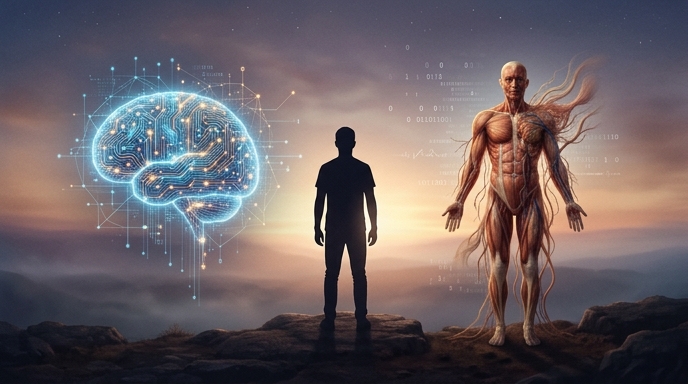
James Zou has spent a decade building AI systems that do science. He’s cleared the FDA He’s published in Nature. He’s built tools used by millions of developers. And now he’s betting that all of it adds up to something worth a billion dollars.
Maybe it does. Maybe it doesn’t. The market right now is historically accommodating — $11 billion into AI drug discovery in a single quarter is not a number that invites skepticism. And Zou’s credentials are about as strong as they come in this space.
But here’s the honest truth: no amount of venture capital can answer the question that actually matters. Only data from human bodies — not AI models trained on them — will eventually tell us whether Human Intelligence lives up to its name.
And that’s what makes this story worth watching.
Sources
- The Next Web — The Stanford professor behind an FDA-cleared cardiac AI wants $1 billion for his next company
- Bloomberg — Stanford Professor Targets $1 Billion Valuation for AI-for-Physiology Startup
- Tech in Asia — Stanford AI Startup Human Intelligence Seeks $100M
The Kingy Brief
Get the next Kingy Brief.
Source-checked AI changes, original tests and one practical thing to try.
Free · Choose your subjects · Double opt-in · Unsubscribe anytime