The most unlikely tech partnership of 2026 is finally becoming real — and your iPhone is about to get a whole lot smarter.
The Announcement Nobody Saw Coming (But Everyone Suspected)
Picture this. You’re at Google Cloud Next 2026 in Las Vegas. The lights dim. Google Cloud CEO Thomas Kurian walks on stage. And then — right there on the giant screen behind him — an Apple logo appears.
That’s not a glitch. That’s history.
Kurian didn’t waste any time. He told the packed auditorium exactly what was happening: “Earlier this year, we announced a monumental partnership with one of the most iconic brands that will bring the power of our technology to users everywhere around the world. We’re collaborating with Apple as their preferred cloud provider to develop the next generation of Apple Foundation Models based on Gemini technology. These models will now power future Apple Intelligence features, including a more personalized Siri coming later this year.”
And just like that, the worst-kept secret in tech became official.
Google’s Gemini is powering Siri. Apple — the company that built its entire identity around doing things its way — went to its biggest rival for help. And honestly? It makes total sense when you look at the full picture.
According to Heise, Kurian confirmed the timeline at the Cloud Next keynote, describing Google Cloud as Apple’s “preferred cloud provider” and saying the upgraded Siri will arrive “later this year.” No exact date. But the message was clear: this thing is happening.
Siri’s Long, Painful Road to This Moment
Let’s be honest. Siri has had a rough few years.
When ChatGPT exploded onto the scene in late 2023, it exposed just how far behind Apple’s assistant had fallen. Siri couldn’t hold a conversation. It fumbled basic tasks. It sent you to a web search when you asked something a five-year-old could answer.
Apple knew it had a problem. At WWDC 2024, the company showed off a dazzling vision of a new Siri — one that could read your emails, check your messages, understand your on-screen context, and respond like an actual intelligent assistant. The demo looked magical.
It never shipped.
Apple officially delayed the feature in March 2025. Internal reports painted a grim picture: the Siri codebase was so tangled that engineers had to tear it down and rebuild it from scratch on a large language model foundation. That’s not a small fix. That’s a full renovation.
Meanwhile, Apple Intelligence — the broader AI suite that did ship — landed with a thud. Notification summaries sometimes invented news stories. Writing tools were fine but forgettable. The one thing users actually wanted — a genuinely smart, conversational Siri — kept getting pushed back.
As put it bluntly: “The part users actually wanted, a genuinely smart assistant, kept slipping.”
Something had to give. And in January 2026, it did.
The Deal That Shocked Silicon Valley
On January 12, 2026, Apple and Google dropped a joint statement that sent shockwaves through the tech industry.
“Apple and Google have entered into a multi-year collaboration under which the next generation of Apple Foundation Models will be based on Google’s Gemini models and cloud technology. These models will help power future Apple Intelligence features, including a more personalized Siri coming this year.”
Reuters called it “a major win for Alphabet.” Alphabet’s stock jumped. Its market valuation crossed $4 trillion on the day of the announcement.
The financial terms weren’t officially disclosed. But Bloomberg and other outlets reported that Apple is paying roughly $1 billion per year for a custom version of Gemini. To put that in perspective — Apple earns about twenty times that amount annually just from its existing search deal with Google. So yes, it’s expensive. But it’s also a bargain compared to building a competitive frontier AI model from scratch.
WebProNews noted that the custom model is reportedly a 1.2 trillion-parameter version of Gemini — built specifically for Apple’s needs. That’s not an off-the-shelf product. That’s a bespoke AI engine, tuned for the world’s most privacy-conscious tech company.
Even Elon Musk weighed in, calling it “an unreasonable concentration of power for Google.” But the deal was done.
So How Does This Actually Work?
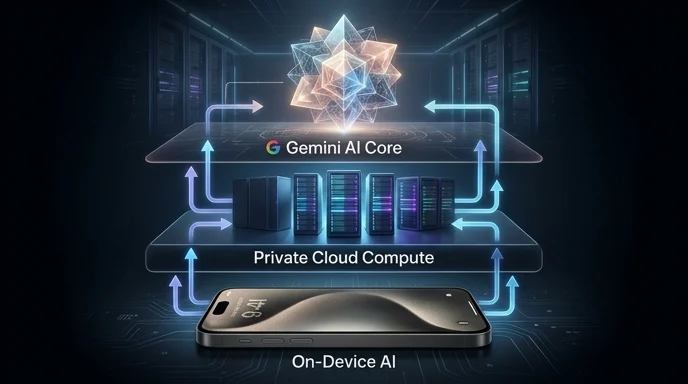
Here’s where it gets genuinely interesting. Because this isn’t just Google slapping a Gemini sticker on Siri and calling it a day. The architecture is more layered — and more clever — than that.
Think of it as a three-tier system, designed to balance intelligence with privacy:
Tier 1 — On-Device Apple Intelligence: Simple stuff stays local. Setting a timer, opening an app, basic dictation — Siri handles all of that directly on your iPhone using Apple’s own models. Your data never leaves your device.
Tier 2 — Private Cloud Compute: Moderately complex tasks go to Apple’s own cloud servers. Still Apple-controlled. Still private.
Tier 3 — The Gemini Layer: This is where the magic happens. Heavy reasoning, world knowledge, complex multi-step queries — these hit a custom Gemini model running on infrastructure that Apple controls. Gemini is the engine. Siri is still the face.
As explained it: “Apple insists its privacy posture is intact. Gemini, in this setup, is the engine. Siri is still the face.”
Apple has also reportedly asked Google to investigate setting up dedicated servers in Google data centers to handle the surge in cloud demand that a smarter Siri will inevitably create. The infrastructure build-out is real. This isn’t vaporware.
What’s Actually Changing for You
So what does a Gemini-powered Siri actually do differently? Quite a lot, if the roadmap holds.
Gone are the days of Siri saying “I found this on the web” every time you ask something remotely complex. The new Siri is expected to handle chained queries — meaning you can ask something like, “Find the flight info from my email, check if it’s delayed, and text my Uber driver the update,” and Siri will actually do it. All of it. In one go.
There’s also a standalone Siri app in the works. Think less voice button, more ChatGPT-style interface — persistent chat history, back-and-forth dialogue, context that carries across conversations. Apple is reportedly testing this for iOS 27.
Deeper cross-app awareness is coming too. Siri will know what’s on your screen, what’s in your calendar, what’s in your messages — and it’ll use all of that to give you answers that actually make sense for your life.
WebProNews summed it up well: “Imagine Siri planning trips, summarizing emails, all tuned to you.”
That’s the vision. And for the first time in years, it feels achievable.
Why Google Said Yes — And Why It’s a Massive Win for Them
Let’s not pretend this is purely altruistic on Google’s part. This deal is a strategic goldmine for Alphabet.
Google already powers iPhone search. Now it powers iPhone intelligence too. That’s an extraordinary level of reach into Apple’s ecosystem — two billion active devices, all potentially running on Gemini under the hood.
Samsung already uses Gemini for Galaxy AI. Now iOS joins. Whether you’re on Android or iPhone, there’s a real chance Google’s AI is working behind the scenes. That’s not just market share. That’s infrastructure dominance.
There’s also the enterprise angle. By getting Apple — the most privacy-obsessed company in tech — to publicly validate Gemini, Google sends a powerful message to every CIO and enterprise buyer in the world: if Apple trusts us, you can too. That’s marketing money can’t buy.
As noted: “Google getting this partnership on a keynote slide, in front of its entire cloud customer base, is a flex.”
The Privacy Question Everyone Is Asking
Of course, the elephant in the room is privacy. Apple has built its brand on the promise that your data stays yours. So what happens when Google — a company whose entire business model is built on data — gets involved?
Apple insists the answer is: nothing changes.
The Gemini layer runs on Apple-controlled infrastructure. Apple’s Private Cloud Compute architecture remains central. Google doesn’t get access to user data. The custom Gemini model is isolated, purpose-built, and operating under Apple’s strict privacy standards.
“Apple Intelligence will continue to run on Apple devices and Private Cloud Compute, while maintaining Apple’s industry-leading privacy standards,” Google said in its January statement.
Whether you believe that is, frankly, a matter of personal trust. But Apple has staked its reputation on it. And given that Apple earns far more from user trust than from any single product line, they have every incentive to keep that promise.
What to Watch at WWDC 2026
Mark your calendars: June 8, 2026. That’s when Apple’s Worldwide Developers Conference kicks off, and it’s almost certainly where we’ll get our first real look at the Gemini-powered Siri in action.
Expect iOS 27 to be the centerpiece. The new Siri features — the standalone app, the conversational interface, the deep cross-app awareness — will likely debut there as a preview. Developers and public beta testers will then spend July and August putting it through its paces before a wider rollout in September alongside the iPhone 18.
Heise confirmed that Apple has until December 31, 2026 to deliver on its promises. WWDC is the most logical stage for the reveal.
One thing worth noting: Apple reportedly plans not to advertise the Gemini integration prominently. Don’t expect a “Powered by Gemini” badge on your iPhone. Apple wants users to experience a better Siri — not think about the plumbing underneath.
The Bigger Picture: What This Means for AI
Step back for a second and look at what’s actually happening here.
Two of the most powerful companies in tech — longtime rivals in phones, assistants, and services — have decided that shipping a great AI assistant matters more than ego. Apple admitted its models weren’t cutting it. Google offered its best technology. And together, they’re building something that could genuinely change how billions of people interact with their devices.
That’s not a small thing.
For years, the AI race looked like a battle between closed ecosystems. Apple vs. Google vs. OpenAI vs. everyone else. But this partnership suggests a different future — one where the best AI wins, regardless of who built the hardware.
As put it: “For Apple, it is a pragmatic admission: shipping a great assistant matters more than shipping one built entirely in-house.”
And for users? It means the assistant you’ve been waiting for — the one that actually understands you, remembers context, and gets things done — might finally be arriving.
WWDC will tell us whether the wait was worth it. But for the first time in a long time, there’s real reason to be excited about Siri.
Sources
- Heise: Google Cloud CEO hints at Siri’s Gemini integration timeline
- WebProNews: Google’s Gemini Takes Siri’s Reins: Inside Apple’s Cloud Gamble for 2026 AI Overhaul
- Reuters: Apple, Google strike Gemini deal for revamped Siri in major win for Alphabet
- MacRumors: Google Confirms Gemini-Powered Siri Coming Later This Year
Apple Siri AI
Apple Gemini Siri
Apple AI Roadmap
Apple AI Partnerships
Kingy Launch Brief
Put the week’s verified AI launches in your inbox.
One source-checked edition every Friday, with a clear try, watch or skip verdict. After subscribing, check your inbox and confirm your address.
Free · Fridays · Double opt-in · Unsubscribe anytime