The courtroom drama Silicon Valley has been waiting for just got real and it’s wilder than you think.
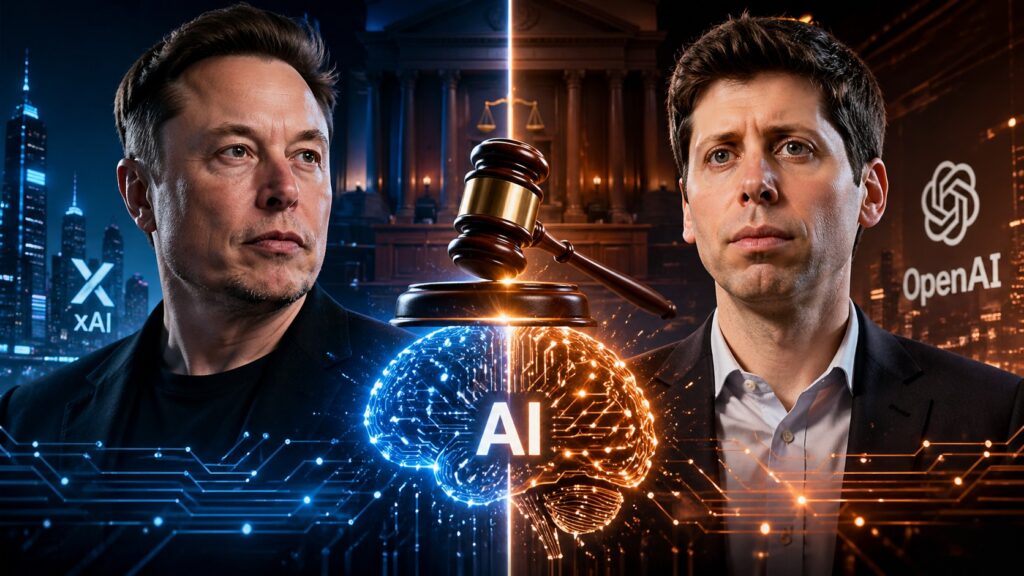
The Setup: A Friendship Gone Very Wrong
Let’s rewind to 2015. Elon Musk and Sam Altman were on the same team. They co-founded OpenAI together, alongside a group of tech visionaries who genuinely worried about the unchecked power of artificial intelligence. Their shared mission? Build AI for the benefit of all humanity. No profit motives. No shareholders. Just pure, idealistic, save-the-world energy.
Fast forward to 2026. These two are heading to federal court in Oakland, California, and the gloves are completely off.
This isn’t just a tech spat. This is a $150 billion lawsuit, a battle over broken promises, and arguably the most consequential legal fight in Silicon Valley history. The trial officially kicked off with jury selection on Monday, April 28, with opening arguments expected Tuesday. Buckle up.
What Exactly Is Musk Suing Over?
Here’s the core of it. Musk claims OpenAI betrayed its founding promise. When the company launched, it was a nonprofit dedicated to developing AI for the public good, not private profit. Then in 2019, after Musk had already left the board, OpenAI created a for-profit subsidiary. That move, Musk argues, was a fundamental betrayal of everything the organization stood for.
He’s not just upset. He’s $150 billion upset.
According to Reuters, Musk is seeking that staggering sum in damages and here’s the twist, he says he doesn’t want the money for himself. He wants every dollar sent back to OpenAI’s charitable arm. He also wants Sam Altman and co-founder Greg Brockman removed from their roles. And on top of that? He wants the court to completely undo OpenAI’s for-profit restructuring.
That’s not a lawsuit. That’s a demolition order.
The Pre-Trial Plot Twist Nobody Saw Coming
Just before the trial began, something unexpected happened. Musk dropped his fraud claims.
Wait, what?
Yes, you read that right. Musk himself proposed dismissing the fraud and constructive fraud charges. U.S. District Judge Yvonne Gonzalez Rogers in Oakland granted the request on Friday, April 24. According to Times of India, Musk said dropping those claims would “streamline” the case and keep jurors focused on the bigger picture, whether OpenAI still serves humanity or has become, in his words, a “wealth machine.”
Strategic? Absolutely. Surprising? Very much so.
The case originally started with 26 claims filed in November 2024. Before Friday’s ruling, only four remained alive: fraud, constructive fraud, unjust enrichment, and breach of charitable trust. Now the two fraud claims are gone. The jury will decide on the remaining two and those are no small matters.
Sam Altman’s Pre-Trial Victory Lap
OpenAI and Sam Altman are calling this a win. And honestly? It kind of is.
Cryptopolitan reported that the dismissal of the fraud claims represents a “major pre-trial win” for Altman and OpenAI. Fraud claims carry serious weight in court, they imply intentional deception, and they’re harder to defend against. With those off the table, OpenAI’s legal team has a cleaner battlefield.
But don’t mistake this for a knockout. The breach of charitable trust and unjust enrichment claims are still very much alive. And those two claims cut right to the heart of what OpenAI is and what it was supposed to be.
Altman, for his part, has been anything but quiet. Back in February, he posted on X: “Really excited to get Elon under oath in a few months, Christmas in April!” That’s the kind of energy you bring when you feel confident. We’ll see if that confidence holds up in the courtroom.
The Numbers Behind the Drama
Let’s talk about the money, because the numbers here are genuinely jaw-dropping.
OpenAI’s for-profit business is now valued at over $850 billion. The company is reportedly preparing for a potential IPO that could push its valuation to $1 trillion. That’s not a tech startup anymore. That’s a financial empire.
Meanwhile, Musk’s own AI venture, xAI which he launched in 2023 to directly compete with OpenAI recently merged with X (formerly Twitter) in a deal that valued the combined entity at $1.25 trillion. So yes, both sides of this courtroom have serious money on the line.
And that’s exactly why OpenAI listed Musk’s lawsuit as a “risk to business” in investor documents earlier this year. A trial of this scale, with this much public attention, creates uncertainty. Investors don’t love uncertainty.
The Personal Shots Are Flying
If you thought this was just a dry legal dispute, think again. The public back-and-forth between Musk and Altman has been spectacular.
In August, Musk posted on X: “Scam Altman lies as easily as he breathes.” Not exactly subtle. Altman fired back in February with his Christmas-in-April quip. OpenAI also posted on X earlier in April, calling Musk’s lawsuit a “harassment campaign that’s driven by ego, jealousy and a desire to slow down a competitor.”
Musk, of course, owns X the very platform where these shots are being fired. The irony is not lost on anyone.
And the legal battles don’t stop here. X and xAI also sued OpenAI and Apple in 2025 over alleged anticompetitive conduct. A hearing in that case is set for May in Texas. In February, a federal judge in California dismissed a separate xAI case that accused OpenAI of stealing trade secrets. So yes these two companies are fighting on multiple legal fronts simultaneously.
What’s Actually at Stake
Strip away the drama, the billionaire egos, and the social media sniping. What’s really at stake here?
The answer is: the soul of AI development.
Musk’s central argument is a philosophical one. He believes OpenAI was built on a promise that artificial intelligence would be developed for everyone, not just for shareholders and profit margins. When OpenAI created its for-profit arm and started chasing a trillion-dollar valuation, Musk says that promise died.
OpenAI disagrees. The company argues that its structure allows it to raise the capital needed to actually build transformative AI and that without investment, the nonprofit mission would have stalled. They also point out, loudly, that Musk now runs a competing AI company. Make of that what you will.
The jury will have to decide: Did OpenAI break a sacred trust? Or did it simply evolve to survive in a brutally competitive industry?
Why This Trial Matters Beyond the Courtroom
Here’s the thing this trial isn’t just about Musk and Altman. It’s about a question the entire AI industry is wrestling with right now.
Can you build transformative, world-changing AI and run a profitable business at the same time? Or does the profit motive inevitably corrupt the mission?
OpenAI’s journey from scrappy nonprofit to near-trillion-dollar company is a case study in that tension. And now a federal jury in Oakland gets to weigh in on it.
Whatever the verdict, the outcome will send shockwaves through Silicon Valley. If Musk wins, it could force OpenAI to restructure — again. It could set a legal precedent that makes it harder for AI nonprofits to pivot to profit. It could reshape how the entire industry thinks about mission-driven organizations.
If Altman wins, it validates OpenAI’s transformation and signals that the courts won’t second-guess how tech companies evolve their structures even when founders feel betrayed.
Either way, the AI world is watching.
The Bottom Line
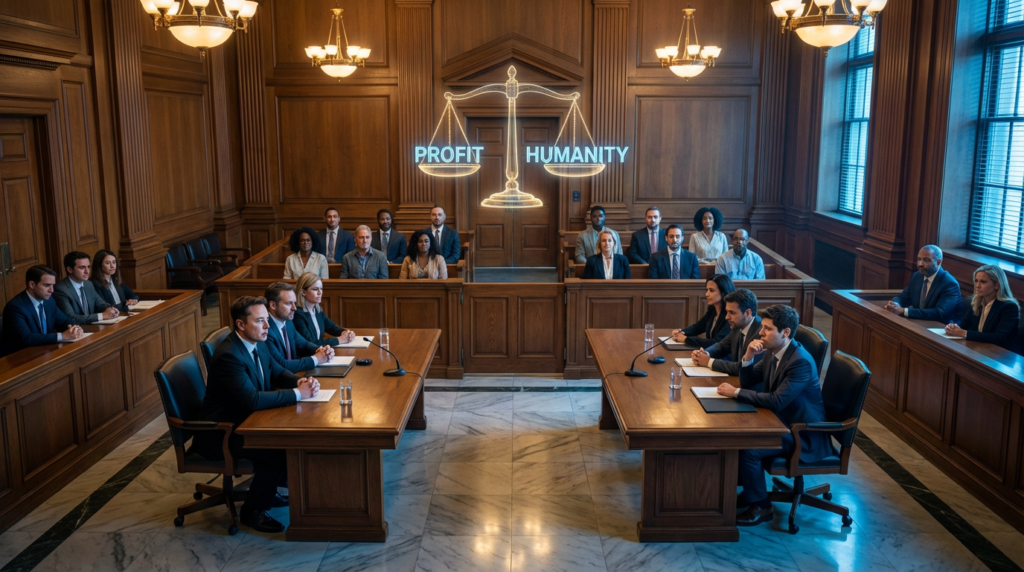
Two of the most powerful figures in tech are sitting across from each other in a federal courtroom. One says the other broke a promise that could affect all of humanity. The other says the lawsuit is nothing but competitive jealousy dressed up in legal language.
The fraud claims are gone. The trial is live. And the jury a group of ordinary people tasked with untangling one of the most complex tech disputes in history is about to decide what OpenAI’s founding promise was actually worth.
This is the AI trial of the century. And it’s just getting started.
Sources
- Reuters — US Judge Dismisses Musk’s Fraud Claims in OpenAI Case
- Times of India — Ahead of April 27 Trial, Elon Musk Withdraws Fraud Claims Against Sam Altman, Greg Brockman
- Cryptopolitan — Sam Altman Wins Key Round in Elon Musk Lawsuit as Judge Tosses Fraud Claims
OpenAI Musk Rivalry
OpenAI Musk Lawsuit
xAI OpenAI Lawsuit
OpenAI Musk Acquisition
OpenAI xAI Antitrust
The Kingy Brief
Get the next Kingy Brief.
Source-checked AI changes, original tests and one practical thing to try.
Free · Choose your subjects · Double opt-in · Unsubscribe anytime