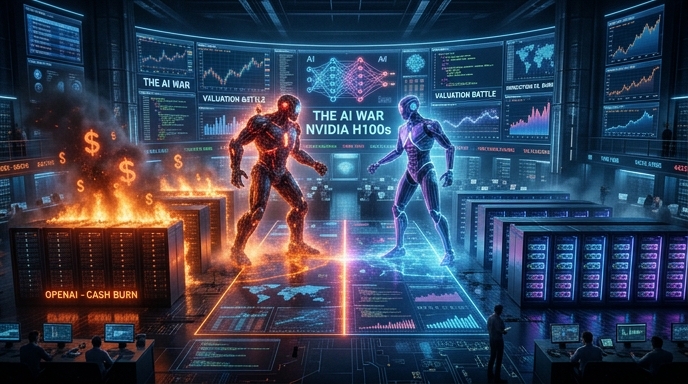

The artificial intelligence industry has entered its “burn money now, dominate later” phase. Silicon Valley has seen this movie before. Uber did it. Amazon did it. Netflix practically turned it into performance art. But the scale of today’s AI spending war makes those earlier battles look almost quaint.
At the center of the storm sits OpenAI. The company behind ChatGPT has become the face of the generative AI boom, the fastest-growing consumer technology platform in recent memory, and arguably the most influential software company on Earth right now.
And yet, beneath the glossy demos and billion-dollar partnerships, the economics are brutal.
According to reporting cited by Crypto Briefing, OpenAI lost roughly $1.22 for every dollar it generated in revenue, even after excluding stock-based compensation.
That number should make investors sweat.
Because despite generating more revenue than chief rival Anthropic, OpenAI still appears trapped inside an extraordinarily expensive business model. Meanwhile, Anthropic is suddenly doing something almost nobody expected from a frontier AI company this early: approaching profitability.
The result? The AI race just shifted from a technology competition into something nastier and more complicated: an infrastructure war, a capital war, and possibly a survival war.
OpenAI Still Leads. But the Gap Is Narrower Than It Looks
On paper, OpenAI remains ahead.
Reports indicate the company generated approximately $5.7 billion in first-quarter revenue, beating Anthropic’s estimated $4.8 billion by about $1 billion.
That sounds decisive. It isn’t.
A billion-dollar lead matters less when both companies are operating at hyperscale and torching cash to expand. More importantly, the growth trajectories tell a different story.
Anthropic reportedly expects second-quarter revenue to exceed $10.9 billion. That would represent more than double its prior quarter sales. Reuters also reported the company may post an operating profit of roughly $559 million. (Reuters)
That is an astonishing number for an AI lab.
For years, the assumption surrounding frontier AI companies was simple: massive losses were inevitable because training and running large models cost absurd amounts of money. GPUs are expensive. Electricity is expensive. Talent is expensive. Data centers are expensive. Everything in AI currently costs a fortune.
Yet Anthropic suddenly looks like the adult in the room.
Meanwhile, OpenAI’s user growth appears to be slowing. Reports suggest weekly active users stabilized around 905 million, while paid subscribers rose from 47 million to 55 million.
Those are still gigantic figures. Almost absurdly gigantic. But Wall Street hates deceleration. Hypergrowth companies get rewarded for momentum, not merely scale.
And that changes the conversation.
The Dirty Secret of AI Economics
The public narrative around AI still revolves around intelligence. Smarter models. Better reasoning. Faster coding assistants. Human-level agents. Artificial general intelligence.
But the real battle increasingly revolves around economics.
Every time someone asks an AI chatbot a question, real infrastructure spins into action. Servers activate. GPUs process tokens. Data centers consume electricity. Cooling systems roar to life. Networking hardware routes requests across continents.
AI feels weightless to users. It is anything but.
The problem for companies like OpenAI is that inference costs remain painfully high. Even if models become more efficient, demand rises alongside those gains. People simply use AI more.
That creates a vicious cycle.
A better model attracts more users. More users require more compute, more compute requires more infrastructure spending. More infrastructure spending pressures margins. Lower margins require higher prices or more fundraising.
And customers are already pushing back against pricing.
The industry now faces what some analysts call an “AI token pricing crisis.” Companies want frontier-level intelligence at commodity-level prices. That tension may define the next decade of AI economics.
Consumers got spoiled quickly. They expect magic for twenty bucks a month.
Unfortunately for AI labs, magic is expensive.
Anthropic’s SpaceX Deal Changes Everything
Then things became even crazier.
Anthropic reportedly agreed to pay approximately $1.25 billion per month to SpaceX for AI computing infrastructure tied to the Colossus and Colossus II data centers.
Read that sentence again.
Per month.
Not per year.
That deal alone could reach roughly $15 billion annually if fully realized. It signals something profound about the future of AI: compute capacity may become more valuable than the models themselves.
For years, people assumed the moat in AI would come from algorithms. Increasingly, the moat looks physical.
Power generation.
Semiconductor access.
Data centers.
Networking.
Cooling.
Supply chains.
The AI industry now resembles the railroad industry during the industrial revolution. The companies controlling infrastructure may ultimately wield the most power.
That also explains why NVIDIA became one of the most important corporations on Earth almost overnight. AI labs need GPUs the way oil companies need drilling rigs.
And right now, everybody is scrambling for capacity.
OpenAI’s Biggest Problem Might Be Success
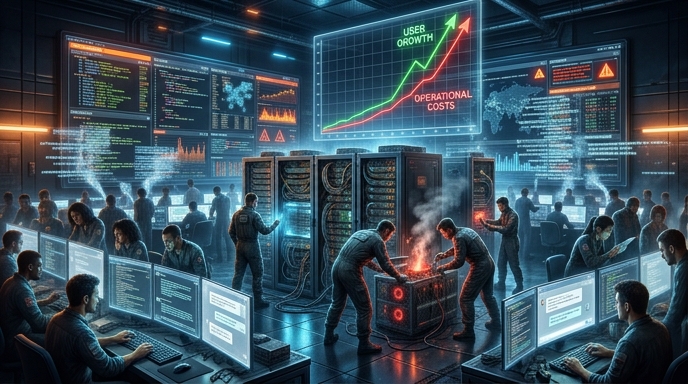
OpenAI faces a paradox.
It became too successful too quickly.
ChatGPT transformed AI from a niche technology into a mainstream product almost overnight. The company achieved unprecedented scale faster than nearly any software platform in history. That sounds wonderful until you realize massive usage can become financially dangerous when serving each request remains expensive.
In traditional SaaS businesses, scaling users usually improves margins.
AI flips that logic upside down.
Each additional user creates ongoing computational costs. Heavy users become expensive customers. Viral adoption can strain infrastructure faster than monetization catches up.
That may explain why OpenAI keeps expanding premium offerings, enterprise services, developer tools, and API pricing tiers. Consumer subscriptions alone probably cannot support the infrastructure demands required for frontier AI systems.
Enterprise revenue matters more because enterprise customers spend vastly more money and tend to stick around longer.
Anthropic appears especially strong there.
Some industry observers estimate roughly 80% of Anthropic’s revenue comes from enterprise usage.
That is not a trivial distinction.
Consumer AI is flashy. Enterprise AI is profitable.
Silicon Valley’s New Religion: Spend First, Profit Later
To understand what is happening, you have to stop viewing AI companies as normal software firms.
They are closer to nation-state infrastructure projects.
The leading labs now spend like governments. Their fundraising rounds resemble sovereign wealth operations. Their compute demands rival industrial manufacturing sectors.
OpenAI reportedly explored valuation scenarios approaching $1 trillion. Anthropic’s valuation discussions reportedly surged above $900 billion.
Those numbers sound insane because they are insane.
But investors are betting on something bigger than chatbots. They are betting AI becomes the foundational operating layer for the global economy.
If that happens, current losses may eventually look rational.
If it does not happen, history may remember this period as one of the largest capital bonfires ever created.
There is very little middle ground.
The Talent War Is Becoming Savage
Money alone is not enough anymore.
Now the AI giants are fighting for researchers like sports franchises chasing superstar athletes.
The recent move by Andrej Karpathy from OpenAI circles into Anthropic’s orbit drew enormous attention because elite AI researchers remain incredibly scarce.
A handful of researchers can influence billion-dollar outcomes.
That reality creates bizarre labor economics. Compensation packages now resemble hedge-fund payouts mixed with lottery tickets. Top researchers command leverage once reserved for celebrity CEOs.
And companies are desperate.
Because whoever builds the best models first may lock in ecosystems, enterprise contracts, developer loyalty, and regulatory influence for years.
The stakes are existential.
The Industry Is Starting to Split Into Two Camps
A philosophical divide is also emerging.
One camp prioritizes aggressive scaling and rapid deployment. The other emphasizes safety, alignment, and more controlled commercialization.
OpenAI originally positioned itself heavily around AI safety and broad human benefit. Anthropic also markets itself around responsible AI development and constitutional AI principles.
But as competition intensifies, idealism increasingly collides with commercial pressure.
The market rewards growth.
And growth rewards deployment speed.
That creates tension inside every frontier lab. Move too cautiously and rivals may overtake you. Move too recklessly and regulators, governments, or catastrophic failures could intervene.
Meanwhile, political influence is growing rapidly. AI companies now shape legislation, lobbying campaigns, and national strategy discussions.
This industry stopped being “just tech” a while ago.
It is now geopolitics.
Why Profitability Matters More Than Ever
For years, tech investors tolerated enormous losses because capital remained cheap. That environment changed.
Today, profitability matters again.
Even in AI.
That is why Anthropic’s apparent path toward operating profit matters so much psychologically. It challenges the assumption that frontier AI must remain permanently unprofitable.
If Anthropic can approach profitability while continuing rapid growth, investors may begin demanding similar discipline from OpenAI.
And that creates a dangerous pressure point.
Because OpenAI appears structurally committed to gigantic spending. Training next-generation models requires astronomical capital expenditures. Expanding global infrastructure requires even more.
The company may eventually need to choose between:
- Slower growth,
- Higher prices,
- Reduced compute intensity,
- Massive ongoing fundraising,
- Or deeper dependence on strategic partners.
None of those options are painless.
The AI Bubble Debate Is Missing the Point
Critics love calling AI a bubble.
That may be partially true. Hype clearly exists. Wild valuations clearly exist. Irrational investor behavior clearly exists.
But bubbles sometimes build real infrastructure.
The railroad bubble built railroads.
The dot-com bubble built the internet.
The telecom bubble built fiber networks.
Even if many AI companies fail, the infrastructure being constructed right now may permanently transform the global economy.
That is the important distinction.
The question is not whether AI matters. It obviously does.
The real question is which companies survive long enough to dominate the mature phase of the industry.
Right now, OpenAI still looks like the leader.
But leadership in technology can evaporate with shocking speed. Just ask Yahoo, Nokia, Blackberry, or MySpace. Dominance during an early platform shift guarantees nothing.
And increasingly, Anthropic looks less like a challenger and more like a legitimate threat.
The Bottom Line
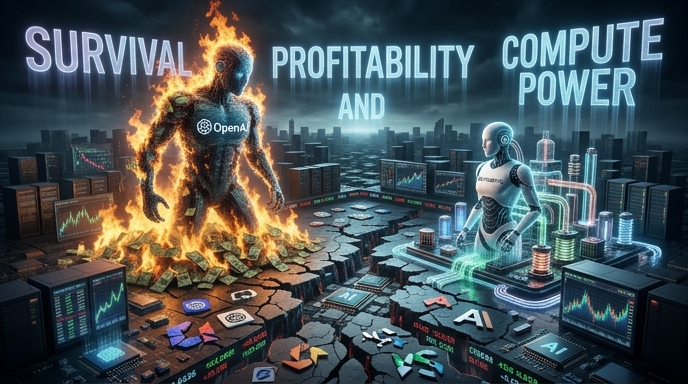
OpenAI still commands the spotlight. It remains the defining consumer AI brand, it still generates more revenue than Anthropic. It still shapes public perception of artificial intelligence more than any competitor.
But the financial picture underneath the hype is messy.
Losing $1.22 for every dollar earned is not a sustainable long-term equation.
Meanwhile, Anthropic is scaling rapidly, strengthening enterprise positioning, approaching profitability, and locking down massive compute infrastructure.
That changes the dynamics completely.
The AI race is no longer just about who builds the smartest model.
It is about who can survive the economics of building the future.
Sources
- The Decoder article on OpenAI’s losses
- Crypto Briefing report on OpenAI and Anthropic revenue
- Reuters reporting on Anthropic profitability and SpaceX compute deal
AI Pricing War
AI Economics
AI Capex Economics
Anthropic Valuation
Anthropic Finance
Anthropic Cloud Deals
Anthropic Competition
The Kingy Brief
Get The Kingy Brief.
AI changes, original tests and one practical thing to try. Fridays at 09:00 Vancouver time.
Free · Double opt-in · Unsubscribe anytime
Signup help and newsletter schedule
Signup form provided by Beehiiv. After submitting, check your inbox for "Confirm your subscription to The Kingy Brief" and open its confirmation link. Check Spam or Promotions if you cannot find it.
Fridays at 09:00 Vancouver time: source-checked AI changes, original tests and one practical thing to try. The weekly restart begins October 9, 2026. We skip a week when there is not enough verified material. Free. Unsubscribe anytime.