
NVIDIA Stops Playing Defense
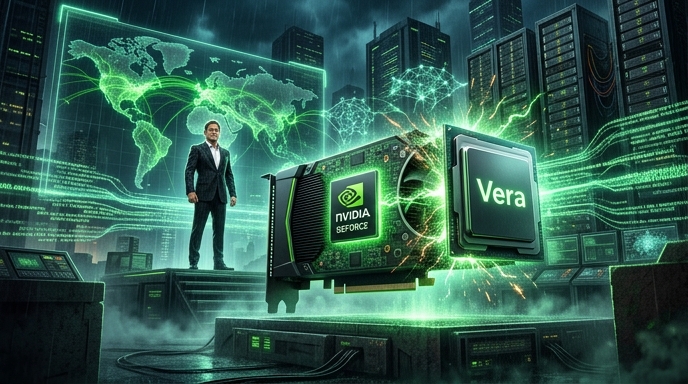
For years, NVIDIA dominated artificial intelligence by selling the GPUs that powered the AI explosion. Every major breakthrough seemed to run through the company’s silicon. ChatGPT? NVIDIA. Autonomous driving? NVIDIA. Massive AI clusters? Again, NVIDIA.
But the company no longer wants to remain “just” the GPU king.
Now it wants the CPU market too.
That shift became crystal clear when NVIDIA unveiled Vera, its new custom CPU architecture designed specifically for agentic AI workloads. The announcement landed with the force of a thunderclap across the tech industry. NVIDIA isn’t nibbling around the edges anymore. It’s marching directly into territory historically controlled by Intel and AMD.
And it’s doing so with astonishing confidence.
According to reports, NVIDIA believes it could generate roughly $20 billion in CPU sales this year alone. That number sounds absurd at first glance. CPUs have long been a mature market. Growth usually moves at the speed of cold molasses. But AI changes everything. Suddenly, the old rules look shaky.
The bigger story here isn’t just about another chip launch. It’s about a power shift inside the global computing industry. AI has rewritten the economics of data centers, and NVIDIA wants to sit at the center of that rewrite.
This time, Jensen Huang isn’t selling shovels during a gold rush.
He’s trying to own the entire mine.
Vera Isn’t a Traditional CPU
The easiest mistake people can make is assuming Vera is simply another general-purpose processor. It isn’t.
NVIDIA designed Vera for a very specific future. A future where AI agents perform autonomous tasks, communicate with each other, and continuously process enormous amounts of contextual data.
That workload behaves differently from traditional enterprise computing. AI agents demand ultra-fast communication between CPUs and GPUs. Bottlenecks become catastrophic. Every microsecond matters.
NVIDIA’s answer is vertical integration.
Vera pairs tightly with NVIDIA’s GPUs and networking technologies. The company wants every part of the AI stack talking in perfect synchronization. CPUs, GPUs, memory systems, and interconnects all move as one machine.
That matters because modern AI systems no longer operate as isolated chips. They function as giant distributed organisms. The efficiency of communication between components often determines performance more than raw processing power alone.
NVIDIA understands this deeply.
The Vera architecture reportedly builds upon lessons learned from the Grace CPU platform while pushing harder into AI-native optimization. The company sees agentic AI as the next computing revolution, and it wants infrastructure built specifically for that environment.
This isn’t about replacing your laptop processor.
This is about constructing the nervous system for future AI civilizations.
Yes, that sounds dramatic. But look around. AI already writes software, generates video, analyzes research papers, and manages workflows. The infrastructure beneath those systems becomes more valuable every day.
NVIDIA wants to own that infrastructure from top to bottom.
Jensen Huang Personally Delivered Vera Systems
The rollout itself looked less like a product launch and more like a political summit.
Reports indicate that NVIDIA executives personally delivered the first Vera CPU systems to companies including Anthropic, OpenAI, SpaceX, and Oracle. Jensen Huang himself reportedly took part in some deliveries.
That detail matters.
When a CEO personally hand-delivers hardware, it signals strategic importance. This wasn’t ordinary enterprise shipping. It was theater. Calculated theater.
And frankly, it worked.
The image of Huang carrying AI infrastructure directly to the world’s most influential AI companies reinforces NVIDIA’s growing status as the kingmaker of the AI age.
These aren’t random customers either.
OpenAI helped ignite the modern AI arms race. Anthropic has become one of the fastest-growing AI labs in the world. Oracle continues building massive AI cloud infrastructure. SpaceX increasingly depends on advanced AI systems for autonomous operations and engineering workloads.
NVIDIA placed Vera directly into the hands of organizations shaping the future.
That creates momentum. It also creates dependency.
The deeper these firms integrate NVIDIA’s full-stack ecosystem, the harder it becomes to leave. CUDA already locked many AI developers into NVIDIA’s software ecosystem. Vera could deepen that moat substantially.
This strategy resembles Apple’s vertical integration model, but on an industrial scale.
Control the chips.
Control the software.
Control the ecosystem.
Control the future.
Simple. Ruthless. Effective.
The AI Infrastructure Gold Rush Has Entered a New Phase

Most people still think of AI as chatbots and image generators.
That’s outdated.
The real money now sits inside infrastructure. Data centers. Networking. Power delivery. High-bandwidth memory. Specialized processors. AI orchestration systems. Cooling technology. Entire digital supply chains are being rebuilt around machine intelligence.
NVIDIA understands where the market is heading better than almost anyone else.
The company no longer behaves like a semiconductor firm. It behaves like a geopolitical force.
Countries scramble to secure AI chips. Cloud providers spend billions expanding GPU clusters. Sovereign AI initiatives emerge worldwide. Entire economies now worry about access to computational power.
That’s why Vera matters beyond technical specifications.
NVIDIA sees a world where AI agents become permanent participants inside business operations. These agents will analyze contracts, coordinate logistics, manage research, automate programming, and make decisions in real time.
Traditional computing infrastructure struggles under those demands.
Agentic AI systems require persistent memory access, rapid inference, low-latency communication, and massive scalability. NVIDIA believes integrated CPU-GPU systems optimized specifically for AI workloads will dominate the next generation of computing.
And honestly, the company has strong evidence supporting that theory.
AI workloads already reshaped data center economics at breathtaking speed. Companies that ignored the shift got steamrolled. Intel learned that lesson painfully. AMD adapted faster, but NVIDIA still captured enormous strategic ground.
Now NVIDIA wants to extend its dominance beyond accelerators into foundational computing architecture itself.
That ambition should terrify competitors.
Intel Faces an Existential Problem
Intel’s challenge isn’t merely competitive anymore.
It’s structural.
For decades, Intel ruled traditional CPU markets because computing revolved around general-purpose workloads. Enterprise servers, office software, web hosting, and consumer PCs all relied on CPUs as the primary computational engine.
AI flipped that hierarchy upside down.
GPUs suddenly became the center of gravity for modern computing. CPUs still matter, but increasingly as supporting infrastructure for AI accelerators.
That shift weakened Intel’s historical advantage.
Now NVIDIA threatens to absorb even more territory by building CPUs designed specifically to complement AI infrastructure. If hyperscalers increasingly adopt tightly integrated NVIDIA ecosystems, Intel risks becoming marginalized inside the fastest-growing sector of technology.
That’s a nightmare scenario.
Intel still generates massive revenue, of course. It remains an engineering powerhouse with enormous manufacturing expertise. But momentum matters in technology markets, and right now momentum belongs overwhelmingly to NVIDIA.
The difference in perception between the companies feels staggering.
NVIDIA projects inevitability.
Intel projects recovery.
Those are not the same thing.
AMD sits in a more flexible position because it competes aggressively in both CPUs and GPUs. But even AMD faces pressure if NVIDIA successfully turns integrated AI infrastructure into a dominant platform model.
The next five years could reshape the semiconductor hierarchy more dramatically than anything since the smartphone revolution.
Possibly more dramatically.
NVIDIA’s $200 Billion Opportunity
Some analysts now believe NVIDIA’s CPU ambitions could unlock a market opportunity approaching $200 billion.
That figure sounds inflated until you consider what’s happening globally.
Every major technology company races to build AI infrastructure simultaneously. Governments do the same. Startups raise billions. Cloud providers spend like drunken emperors. Demand for AI computation keeps exploding faster than supply.
And agentic AI may increase infrastructure demand even further.
Unlike static AI systems, AI agents operate continuously. They interact dynamically. They chain reasoning processes together. They perform ongoing contextual analysis. That requires sustained computational throughput.
More agents mean more infrastructure.
More infrastructure means more chips.
More chips mean more leverage for NVIDIA.
The company’s strategy also benefits from timing.
AI adoption still sits relatively early in its lifecycle. Many enterprises remain in experimentation phases. Once large-scale deployment accelerates, infrastructure requirements could surge again.
NVIDIA wants to position Vera before that wave fully arrives.
That’s smart.
Historically, infrastructure companies that establish standards early tend to dominate entire eras of computing. Microsoft did it with operating systems. Amazon did it with cloud services. Apple did it with mobile ecosystems.
NVIDIA wants to do it with AI infrastructure.
The company’s executives clearly believe the opportunity extends far beyond GPUs alone.
And frankly, they may be right.
The Bigger Question: Can Anyone Stop NVIDIA?
This is where things become uncomfortable for the broader tech industry.
Competition appears increasingly fragile.
NVIDIA controls critical AI hardware.
It dominates AI software ecosystems.
It leads in networking infrastructure.
Now it aggressively enters CPU markets.
That level of vertical integration creates immense strategic advantages.
Customers gain performance benefits from unified systems. Developers optimize for NVIDIA environments because that’s where the market lives. Enterprises adopt NVIDIA infrastructure because everyone else already uses it.
Positive feedback loops form quickly in technology markets.
That doesn’t guarantee permanent dominance. Technology history punishes arrogance eventually. IBM looked unstoppable once. So did Nokia. So did Cisco during parts of the internet boom.
But NVIDIA currently operates from an unusually strong position.
The company also benefits from something harder to quantify: cultural momentum.
Developers admire NVIDIA.
Investors trust NVIDIA.
AI startups depend on NVIDIA.
Governments court NVIDIA.
That creates gravitational pull.
The real threat to NVIDIA may not come from traditional competitors alone. It could emerge from entirely different paradigms. Custom AI accelerators. Open-source hardware ecosystems. Quantum computing breakthroughs. Radical efficiency improvements reducing hardware demand.
But those possibilities remain speculative.
Right now, NVIDIA looks like the company defining the architecture of the AI era in real time.
And Vera may become one of the clearest symbols of that transition.
The Era of AI-Native Computing Has Started

The biggest takeaway from the Vera launch isn’t technical.
It’s philosophical.
For decades, computers were designed primarily for humans. We clicked icons. Typed commands. Opened applications. Machines waited for instructions.
AI-native computing changes that relationship.
Future systems increasingly operate autonomously. AI agents will communicate with each other, coordinate tasks, and execute workflows with minimal human intervention. Infrastructure built for human-centric computing may prove inefficient for that world.
NVIDIA sees that transition coming.
Vera represents an attempt to design infrastructure specifically for machine-driven ecosystems rather than traditional software environments. That’s a profound shift.
And if NVIDIA’s bet succeeds, historians may eventually view this moment the same way they view the rise of cloud computing or smartphones.
Not as a product launch.
As the beginning of a new computing architecture.
The stakes are enormous. The money involved is almost comically large. And the pace of change keeps accelerating.
One thing seems increasingly clear:
NVIDIA no longer wants to participate in the AI revolution.
It wants to govern it.
Sources
- Artificial Intelligence News – NVIDIA Vera chip could unlock $200 billion market
- Electronics For You – NVIDIA rolls out Vera CPU for agentic AI workloads
- Yahoo Finance – NVIDIA says it expects $20 billion in CPU sales this year
- VM Virtual Machine – NVIDIA personally delivers first Vera CPUs to OpenAI, Anthropic, SpaceX, and Oracle
- VM Virtual Machine – NVIDIA exec hand-delivers first Vera CPU systems to AI heavy hitters
Related Companies
NVIDIA AI Strategy
NVIDIA Enterprise AI
AI Inference Hardware
NVIDIA AI Systems
NVIDIA AI Infrastructure
NVIDIA Vera Platform
The Kingy Brief
Get The Kingy Brief.
AI changes, original tests and one practical thing to try. Fridays at 09:00 Vancouver time.
Free · Double opt-in · Unsubscribe anytime
Signup help and newsletter schedule
Signup form provided by Beehiiv. After submitting, check your inbox for "Confirm your subscription to The Kingy Brief" and open its confirmation link. Check Spam or Promotions if you cannot find it.
Fridays at 09:00 Vancouver time: source-checked AI changes, original tests and one practical thing to try. The weekly restart begins October 9, 2026. We skip a week when there is not enough verified material. Free. Unsubscribe anytime.