OpenAI just released GPT-5.5 Instant, and the most important thing about it is not the version number. It is where the model sits: GPT-5.5 Instant is now ChatGPT’s default model.
According to OpenAI’s official launch post, GPT-5.5 Instant is rolling out to all ChatGPT users and is replacing GPT-5.3 Instant as the default experience. OpenAI’s ChatGPT release notes say the same thing: GPT-5.5 Instant “replaces GPT-5.3 Instant for all ChatGPT users” and improves everyday answers across accuracy, clarity, conciseness, image understanding, STEM questions, and web-search decisions.
That makes this a bigger release than it may look at first glance.
GPT-5.5 Instant is not being framed as the deepest research model, the most expensive professional model, or the one you select only when you have a complex technical task. It is the model most people will use first when they open ChatGPT and ask a normal question. OpenAI calls Instant the “daily driver for hundreds of millions of people,” which means even small improvements can change the feel of ChatGPT for an enormous number of users.
The short version: ChatGPT’s default mode is now supposed to be more accurate, more concise, more personalized, better with images, better at STEM questions, and better at knowing when to search the web.
And if OpenAI’s claims hold up in real-world use, GPT-5.5 Instant may be one of those updates that matters less because it is flashy and more because it makes the thing people use every day feel noticeably better.
The Main Upgrade: Fewer Hallucinations
The headline claim around GPT-5.5 Instant is factuality.
In its official announcement, OpenAI says GPT-5.5 Instant produced 52.5% fewer hallucinated claims than GPT-5.3 Instant on internal high-stakes prompts covering areas like medicine, law, and finance. OpenAI also says the model reduced inaccurate claims by 37.3% on especially challenging conversations that users had previously flagged for factual errors.
That is a meaningful claim, but it needs to be framed carefully.
This does not mean GPT-5.5 Instant no longer hallucinates. It does not mean users should blindly trust it on medical, legal, financial, scientific, or breaking-news questions. It means OpenAI is reporting a large relative reduction in hallucinated and inaccurate claims on its internal evaluations.
The Verge’s coverage makes the same distinction, reporting that OpenAI “claims” the new model hallucinates less and noting that the 52.5% and 37.3% figures come from OpenAI’s internal evaluations, not independent public testing. You can read that coverage at The Verge.
That caveat matters. AI companies often release benchmark or internal-evaluation results alongside model launches, and those numbers are useful, but they are not the same as independent replication. For high-stakes usage, the right takeaway is not “trust everything now.” The right takeaway is: OpenAI is trying to make the default ChatGPT model more factually reliable in exactly the areas where factual mistakes hurt the most.
That is a product-level shift. Most users are not testing frontier benchmarks. They are asking for explanations, summaries, recommendations, help with work, help with school, and quick answers. The everyday failure mode is not usually “the model cannot solve an Olympic math problem.” It is “the model confidently said something wrong.”
GPT-5.5 Instant appears aimed directly at that problem.
The Second Big Change: Less Rambling
The other major theme of GPT-5.5 Instant is concision.
OpenAI says the model gives “clearer, more concise answers” and reduces clutter like overformatting and “gratuitous emojis.” In the launch post, OpenAI compares GPT-5.3 Instant and GPT-5.5 Instant on a workplace advice prompt: “how do i tell my coworker to quit yapping all the time.” OpenAI says GPT-5.5 Instant used 30.2% fewer words and 29.2% fewer lines, while still giving a stronger answer for the user’s casual intent.
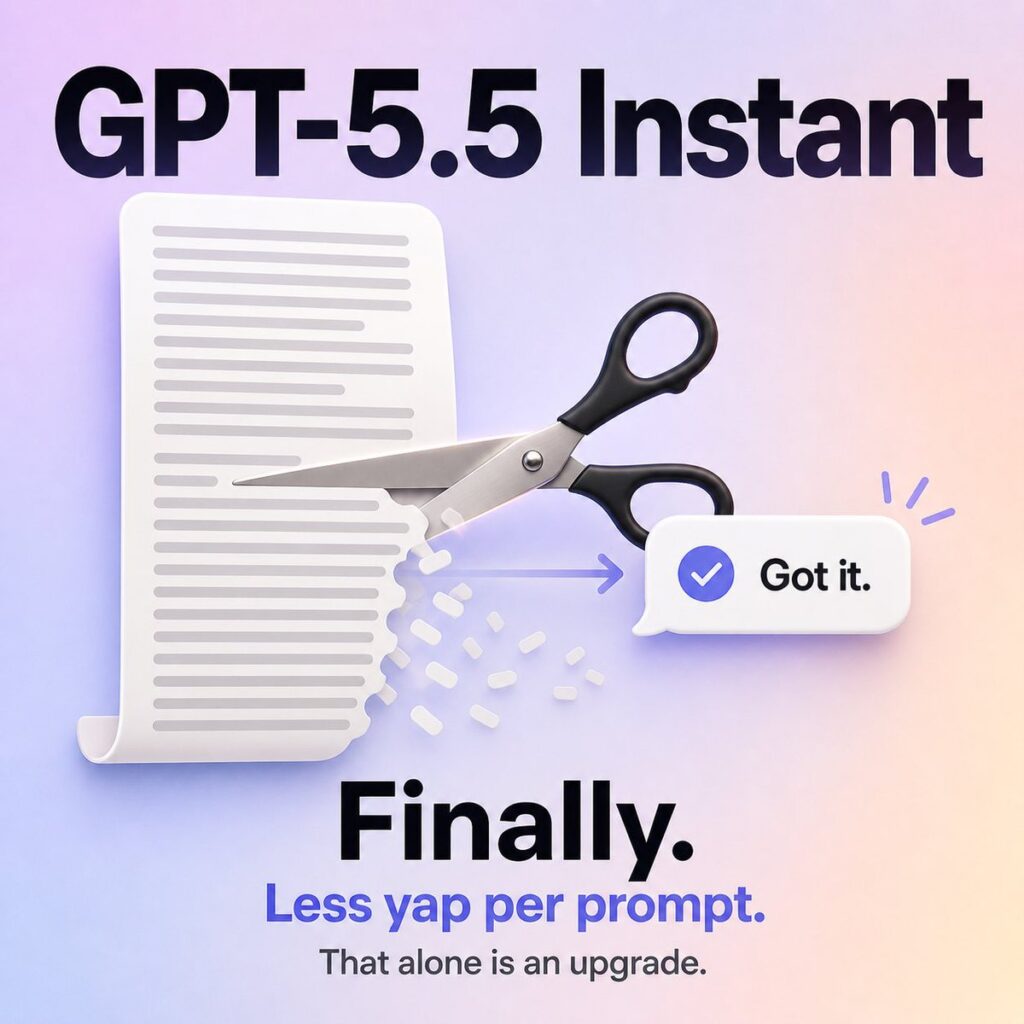
That example is revealing because it is not a hardcore reasoning benchmark. It is exactly the kind of normal, informal prompt people throw into ChatGPT all day.
Older ChatGPT responses often tended to overbuild. A simple question could trigger a mini consulting memo: five sections, ten bullets, three disclaimers, a closing offer to tailor the answer further, and sometimes an emoji or two. That style could be useful for complex tasks, but for casual help it often felt like the model was trying too hard.
GPT-5.5 Instant is tuned toward a different default: answer the question, keep it useful, and stop before it becomes clutter.
That may sound minor, but it is one of the most user-visible changes a model can make. A model that is slightly more capable but still verbose may not feel better. A model that gets to the point faster can feel dramatically better, even if the underlying benchmark jump is not obvious to the average user.
9to5Mac summarized this angle well, writing that GPT-5.5 Instant makes ChatGPT “smarter with fewer emoji” and highlighting OpenAI’s promise of tighter, more direct responses. You can read that piece at 9to5Mac.
Personalization Is Becoming a Core Feature
GPT-5.5 Instant is also part of a broader personalization push.
OpenAI says GPT-5.5 Instant can more effectively use context from past chats, files, and connected Gmail, where available, to make responses more relevant. According to the ChatGPT release notes, this enhanced personalization is rolling out first to Plus and Pro users on web. OpenAI says it can help ChatGPT tailor suggestions, pick up ongoing work, and reduce the need for users to repeat context across conversations.
This is important because it changes the role of ChatGPT.
A blank chatbot answers one prompt at a time. A persistent assistant understands your projects, preferences, writing style, files, and recurring goals. GPT-5.5 Instant seems designed to make that second experience more natural.
The official launch post gives an example around tea recommendations. GPT-5.3 Instant gives broader recommendations based on location. GPT-5.5 Instant, by contrast, uses more personal context: the user’s past preference for Asha Tea House, cleaner Taiwanese or high-mountain tea vibes, and less sugary boba. The result is a recommendation that feels less like a generic local list and more like something tailored to the person asking.
That kind of personalization can be powerful. It can also feel opaque if users do not know what context the model used. OpenAI appears to understand that, because the company is also rolling out memory sources.
Memory Sources: A Small UI Change With Big Trust Implications
Alongside GPT-5.5 Instant, OpenAI is introducing memory sources across ChatGPT consumer plans. The release notes say users will be able to tap a Sources icon below a response to see relevant saved memories, past chats, and custom instructions that helped personalize it. Plus and Pro users may also see referenced files from their library and emails from a connected Gmail account.
This matters because personalization needs transparency.
If ChatGPT says, “Since you prefer X…” or “Based on your previous work…” the obvious user question is: Where did that come from?
Was it a saved memory? A prior chat? A file? A connected email? Something outdated? Something the user wants deleted?
OpenAI says users can correct, delete, or mark information as not relevant. The company also says memory sources are only shown within the user’s account experience, and if a chat is shared, those sources are not shown in the shared chat.
That is a useful control layer. It does not make personalization perfect, and OpenAI says memory sources may not show every factor that shaped a response. But it makes the system less mysterious. For a product increasingly built around long-term context, that is crucial.
Better Images, STEM, and Web-Search Decisions
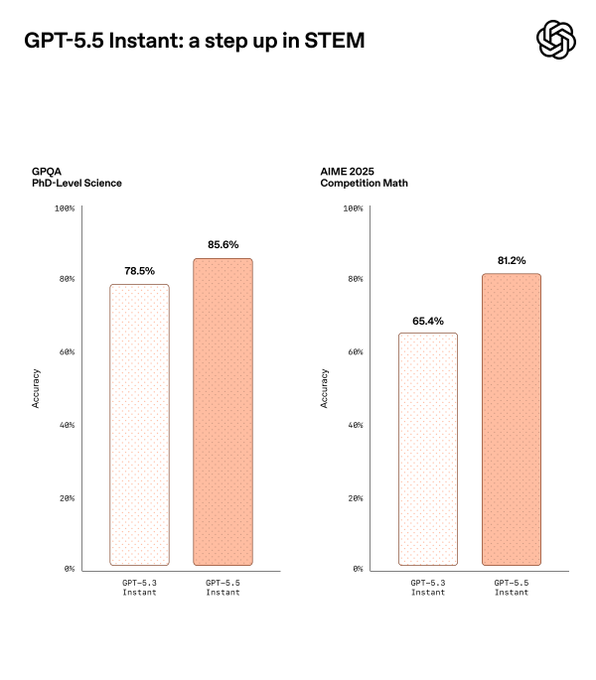
OpenAI also says GPT-5.5 Instant is better across everyday tasks, including analyzing photo and image uploads, answering STEM-related questions, and deciding when to use web search.
That last part is especially important.
A lot of AI failures happen because the model answers from stale memory when it should browse, or browses unnecessarily when the answer is stable and already known. Better routing between internal knowledge and live search is one of the most practical improvements an AI assistant can make.
The launch post frames GPT-5.5 Instant as more capable at deciding when web search would provide a more useful answer. TechCrunch also noted that the new model places emphasis on context management and can use search to refer back to past conversations, files, and Gmail for more personalized answers. You can read TechCrunch’s coverage here: OpenAI releases GPT-5.5 Instant, a new default model for ChatGPT.
This is one of the areas where real-world testing will matter most. If GPT-5.5 Instant reliably searches when a question is current, checks sources when accuracy matters, and avoids unnecessary browsing when it is not needed, the user experience could improve significantly.
How GPT-5.5 Instant Fits Into the GPT-5.5 Family
GPT-5.5 Instant is not the only GPT-5.5 model. OpenAI introduced the broader GPT-5.5 family in April, describing GPT-5.5 as a model designed for real work across coding, research, data analysis, computer use, document creation, spreadsheets, and multi-step workflows. In that earlier announcement, OpenAI said GPT-5.5 was rolling out to Plus, Pro, Business, and Enterprise users in ChatGPT and Codex, with GPT-5.5 Pro available to Pro, Business, and Enterprise users. The broader release is covered in OpenAI’s post, Introducing GPT-5.5.
GPT-5.5 Instant plays a different role.
If GPT-5.5 Thinking and GPT-5.5 Pro are for harder reasoning and more demanding work, GPT-5.5 Instant is the front door. It is the fast, everyday model. The Help Center page for GPT-5.5 in ChatGPT describes Instant as the default for logged-in users and part of a single auto-switching system. It also says Instant may switch to GPT-5.5 Thinking for more complex tasks and apply deeper reasoning before answering.
That points to a larger product direction: users should not always have to understand model menus. Increasingly, ChatGPT is being designed to route tasks automatically between speed, reasoning, tools, search, and personalization.
In other words, GPT-5.5 Instant is not just a standalone model. It is part of a system that is trying to make the default ChatGPT experience smarter without forcing users to micromanage which model does what.
Availability, Limits, and the GPT-5.3 Transition
OpenAI says GPT-5.5 Instant is rolling out starting May 5, 2026, to all ChatGPT users. It replaces GPT-5.3 Instant as the default model. Paid users can continue using GPT-5.3 Instant for three months through model configuration settings before it is retired, according to both the official launch post and ChatGPT release notes.
For developers, OpenAI says GPT-5.5 Instant is available in the API as chat-latest. That is an important distinction: chat-latest points to the latest Instant model used in ChatGPT, but because it can update over time, developers who need stable, reproducible behavior may prefer fixed snapshots when available.
There is also a small documentation nuance worth noting. The user-facing Help Center page for GPT-5.5 in ChatGPT says GPT-5.5 Instant is the default for logged-in users, but one line in the model-picker section still says “Instant — fast responses for everyday questions (GPT-5.3 Instant).” Given that OpenAI’s May 5 launch post and ChatGPT release notes both explicitly say GPT-5.5 Instant replaces GPT-5.3 Instant as the default, the launch post and release notes should be treated as the stronger, newer source.
The same Help Center page lists usage limits and context windows. It says Free users can send up to 10 messages with GPT-5.5 every 5 hours before switching to a mini version until the limit resets. Plus and Go users can send up to 160 messages every 3 hours before switching to the mini version. It also lists GPT-5.5 Instant context windows as 16K for Free, 32K for Plus and Business, and 128K for Pro and Enterprise.
As always, availability and limits may vary by plan, region, and rollout timing, so the Help Center is the best place to check the current details.
Why This Release Matters More Than the Name Suggests
The name “GPT-5.5 Instant” sounds incremental. It is easy to look at it and think: another model update, another version bump, another set of internal metrics.
But this one matters because it changes the baseline.
Most people do not manually select the most advanced model for every task. They use whatever ChatGPT gives them by default. That default model shapes the feel of the product: how verbose it is, how often it searches, how much context it remembers, how well it handles screenshots, and how often it makes things up.
GPT-5.5 Instant is aimed at the friction points users feel every day:
- answers that are too long,
- facts that need verification,
- context that has to be repeated,
- images that need careful interpretation,
- current questions that require search,
- advice prompts that need the right tone,
- and ongoing projects that benefit from memory.
That is why this release may be more significant than a benchmark-focused launch. A more capable “Pro” model is useful for demanding users. A better default model is useful for almost everyone.
The Real Test Starts Now
The most important tests for GPT-5.5 Instant will not be OpenAI’s examples. They will be normal user workflows.
Does it actually hallucinate less on messy real-world questions? Does it search at the right time? Does it give shorter answers without becoming shallow? Does personalization feel helpful rather than intrusive? Do memory sources make users more confident in the system? Does image analysis improve enough that users notice?
Those are the questions that will determine whether GPT-5.5 Instant feels like a real upgrade.
For now, the facts are clear: OpenAI has released GPT-5.5 Instant as ChatGPT’s new default model; it is replacing GPT-5.3 Instant; it is rolling out to all users; it is designed to be more accurate, concise, personal, and capable across everyday tasks; and OpenAI is claiming substantial reductions in hallucinated and inaccurate claims on internal evaluations.
The verdict is simple: GPT-5.5 Instant is not the flashiest GPT-5.5 model, but it may be the one most users actually feel.
When the default model gets better, the whole product gets better.
Latest News
- Inside GPT-5.4: The AI That Codes, Thinks, and Controls Your Computer
- GPT-5.5 Is Here — And It’s Playing a Whole New Game
- OpenAI Pushes Boundaries Again: A Comprehensive Look at GPT-4.5
- GPT-4.1 ChatGPT Update: Smarter Coding, Faster Responses
- OpenAI Prepares to Launch GPT-5: The Next AI Revolution
- OpenAI GPT-4.1: Inside OpenAI’s Evolution and Roadmap
- GPT-5 is Here: OpenAI Launches Its Most Advanced AI Model
Related Guides
The Kingy Brief
Get future Kingy Brief editions.
Source-checked AI changes, original tests and one practical thing to try.
Free · Choose your subjects · Double opt-in · Unsubscribe anytime
Regular sending is paused; no restart date is set.