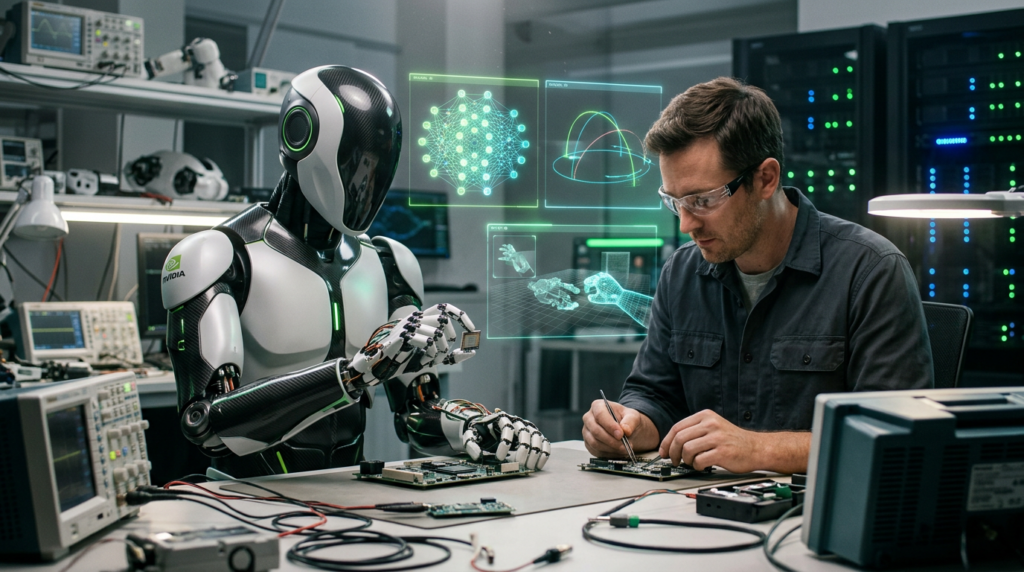
NVIDIA Just Made Robot Training a Lot More Interesting
Imagine teaching a robot to assemble a complicated device.
Normally, engineers must program movements, collect training data, and spend considerable time correcting mistakes.
Now imagine showing the robot how a human performs the task.
That’s the future NVIDIA wants to accelerate.
On November 9, 2026, NVIDIA introduced GR00T 2 at the Conference on Robot Learning (CoRL) in Austin, Texas.
The technology represents a significant advancement in how artificial intelligence systems learn to interact with the physical world.
Unlike conventional robotic systems that depend heavily on task-specific programming, GR00T 2 can learn manipulation skills from human demonstrations and transfer knowledge between different robot designs.
NVIDIA also highlighted Isaac Lab 3.0, improvements to simulation technology, and new benchmarks for measuring robotic capabilities.
According to NVIDIA’s official announcement, GR00T 2 completed 40 out of 50 evaluated tasks at least once without demonstrations specific to the target robot.
After receiving five demonstrations per task, its average success rate reportedly increased to 95%.
Those figures come from NVIDIA’s own evaluations, but they illustrate the technology’s ambition.
The goal isn’t simply to create robots that follow instructions.
It’s to develop machines that learn, adapt, and perform increasingly complicated physical tasks.
And that could reshape robotics.
Meet GR00T 2: NVIDIA’s New Robot Intelligence
So, what exactly is GR00T 2?
Despite its memorable name, it isn’t a physical robot.
GR00T 2 is an artificial intelligence foundation model designed to control robotic systems.
More specifically, NVIDIA calls it a world-action model.
That terminology describes a system capable of predicting how its surroundings might change while simultaneously planning the actions needed to accomplish a task.
Traditional robotic control systems frequently concentrate on predicting movements.
GR00T 2 takes a broader approach.
It considers visual information, instructions, and the robot’s current state before generating predictions about future scenes and physical actions.
The model builds on NVIDIA Cosmos, the company’s technology for developing AI systems that understand and simulate physical environments.
Importantly, GR00T 2 supports different robotic bodies.
These include robotic arms with simple grippers, advanced hands with multiple fingers, and humanoid robots.
That flexibility could reduce the need to develop completely separate intelligence systems for every machine.
However, supporting different robot designs doesn’t mean every skill transfers perfectly.
Mechanical differences, sensors, and operating environments still matter.
NVIDIA’s innovation lies in giving researchers a more adaptable foundation for developing robotic behavior.
Instead of starting from scratch every time, developers can build on previously learned physical knowledge.
Robots Are Learning by Watching Humans
Humans learn countless skills through observation.
Children watch adults tie shoelaces, prepare meals, or handle everyday objects.
Eventually, they attempt those actions themselves.
NVIDIA wants robots to benefit from a similar learning process.
GR00T 2 was trained using extensive collections of human activity videos alongside demonstrations captured through robotic systems.
The company’s research documentation describes more than 400,000 hours of first-person human video in its training mixture.
It also includes demonstrations collected through handheld grippers and robot teleoperation.
NVIDIA has made 100,000 hours of human video openly available to support research.
These recordings help AI systems understand how physical interactions unfold.
For example, watching someone manipulate a tool can reveal information about grip placement, object movement, and the sequence of actions.
Of course, watching isn’t the same as doing.
A robot must translate observed human behavior into movements compatible with its own mechanical structure.
That’s where GR00T 2 becomes particularly interesting.
It learns relationships between visual outcomes and physical actions, helping bridge the gap between human demonstrations and robotic execution.
The result could make training new robotic skills significantly less labor-intensive.
The Secret Is Predicting What Happens Next
Most people associate predictive AI with text generation.
A language model examines words and predicts what should come next.
GR00T 2 applies a related concept to the physical world.
Instead of predicting only text, it predicts future video frames alongside robotic actions.
Think about a robot attempting to insert a cable into a connector.
It must understand where the cable belongs, how the connector is positioned, and what movements could complete the insertion.
The system predicts how the scene should change as it acts.
This helps it connect intended outcomes with physical movements.
NVIDIA uses a diffusion-transformer architecture to generate those predictions.
A diffusion model progressively refines possible outputs, while the transformer processes relevant information.
GR00T 2 combines these techniques to plan actions and anticipated visual changes together.
However, predicting a successful action doesn’t guarantee flawless execution.
Real environments contain unexpected friction, imprecise positioning, and objects that behave differently than anticipated.
The model must repeatedly observe its surroundings and adjust its actions.
That’s what makes the approach promising.
Rather than relying entirely on predetermined movement sequences, GR00T 2 attempts to connect perception, prediction, and physical control.
Five Demonstrations Can Make a Remarkable Difference
Training robots traditionally demands substantial amounts of task-specific data.
Researchers may need to demonstrate an action repeatedly before a machine performs it reliably.
NVIDIA’s latest results suggest that requirement could shrink dramatically.
The company evaluated GR00T 2 on 50 tasks the target robot had never practiced.
Without task-specific demonstrations, the model achieved a 40% average success rate.
Importantly, it successfully completed 40 of the 50 tasks at least once.
Those measurements describe different things.
Completing a task once doesn’t mean the robot can perform it consistently.
After researchers provided one demonstration per task and fine-tuned the model, average success reportedly reached 71%.
Five demonstrations increased that figure to 95%.
NVIDIA says the five demonstrations required less than three minutes of robot data per task.
Fine-tuning could then take approximately 30 minutes on a single RTX 5090 GPU.
These results are encouraging.
However, they apply to NVIDIA’s specific experimental setup, not every possible robotic task.
Independent testing will be essential.
Still, the prospect of teaching complicated skills using only a handful of examples could dramatically change robot development.
Why Robot Hands Are Surprisingly Difficult to Train
Picking up an object sounds simple.
For humans, it usually is.
For robots, the same task can become an engineering nightmare.
Consider inserting a delicate electronic component into a narrow slot.
The robot must position its fingers correctly, control pressure, maintain alignment, and avoid damaging the component.
A small mistake can ruin the entire operation.
NVIDIA’s research emphasizes dexterous manipulation, the ability to perform precise movements involving objects and tools.
GR00T 2 demonstrated several demanding tasks using robotic hands with numerous independently controlled joints.
One experiment involved installing GB300 memory modules.
NVIDIA reported an 85% success rate in that task.
Another experiment involved assembling a toy truck, where the system achieved 65% success under the reported conditions.
These results show both progress and remaining limitations.
Even successful demonstrations don’t mean robotic hands have reached human-level dexterity.
People still outperform robots in many unpredictable manipulation scenarios.
Nevertheless, improving fine motor control is essential for industrial robotics.
Machines capable of handling delicate components could eventually assist with more complicated manufacturing and laboratory procedures.
That possibility makes dexterity one of the most important areas of robotics research.
Isaac Lab 3.0 Gives Robots a Virtual Training Ground
Learning physical skills through real-world experimentation can become expensive.
Robots consume electricity, mechanical components wear down, and equipment can break.
Experiments also take time.
NVIDIA’s Isaac Lab framework offers another approach.
Instead of practicing every movement on physical hardware, developers can train robots inside simulated environments.
At CoRL, NVIDIA showcased Isaac Lab 3.0, an updated version of its open-source robot-learning framework.
The software allows researchers to create training environments, configure experiments, and refine robotic behavior through reinforcement learning.
Isaac Lab 3.0 supports NVIDIA PhysX alongside Newton, an open-source physics engine.
These tools simulate how objects move and interact.
Researchers can also use AI agents to help prepare training environments and organize experiments.
That’s particularly useful when developing complicated manipulation skills.
A robot might practice grabbing an object thousands of times in simulation before attempting the action physically.
However, virtual training remains an approximation of reality.
Unexpected materials, imperfect sensors, and real-world contact forces can still create difficulties.
Isaac Lab aims to make the transition from simulation to physical deployment more reliable.
And that could reduce development time considerably.
Newton Brings More Realistic Physics Into Robot Training
Rigid objects are relatively straightforward to simulate.
Flexible objects are another story.
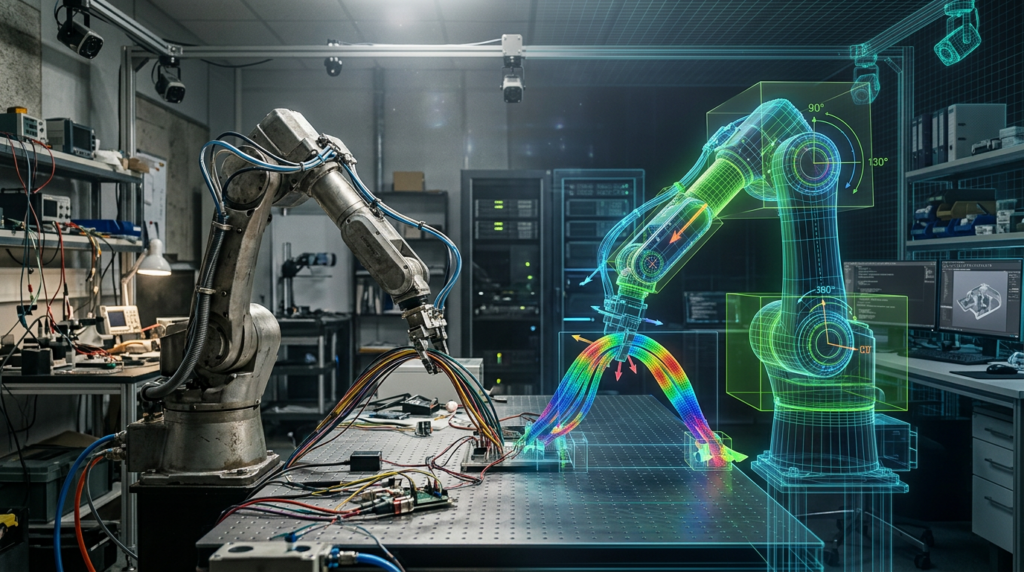
Imagine teaching a robot to fold fabric, manipulate electrical cables, or squeeze a soft object without damaging it.
These tasks involve constantly changing shapes and complicated physical interactions.
NVIDIA’s integration of Newton into Isaac Lab 3.0 helps address such challenges.
The physics engine supports simulations involving deformable materials and complex articulated systems.
That includes flexible cables, cloth, and robotic hands containing many interacting joints.
Researchers can create virtual scenarios that more closely resemble real-world manipulation problems.
NVIDIA says Isaac Lab 3.0 running with Newton achieved up to 2.5 times the training throughput of Isaac Lab 2.3 using PhysX in a particular dexterous-manipulation benchmark.
That’s a potentially important efficiency improvement.
Higher throughput means researchers can perform more simulated training work within a given period.
However, the comparison involves specific software configurations and workloads.
It shouldn’t be interpreted as a universal speed improvement across all robotics applications.
Even so, better physics simulation could help robots learn tasks that previously required extensive real-world experimentation.
And those capabilities matter when precision becomes more important than raw strength.
Robots Could Become Better at Fixing Their Own Mistakes
What happens when a robot drops an object?
Traditional automation systems may stop working or require human intervention.
NVIDIA is exploring a more adaptable approach.
GR00T 2 can operate alongside higher-level AI reasoning agents.
These agents decide what needs to happen, monitor progress, and coordinate individual skills.
Meanwhile, GR00T 2 handles the physical manipulation.
Imagine an agent instructing a robot to assemble a small toy.
The robot picks up a component but accidentally drops it.
Instead of immediately abandoning the task, the supervising agent can identify the problem and initiate a recovery procedure.
NVIDIA’s research demonstrated this approach using robotic assembly tasks.
With agent assistance, the system successfully assembled a toy plane in 98 out of 100 trials.
It completed toy tractor and toy car assembly in 97 out of 100 trials each.
These were controlled experiments rather than evidence of general-purpose autonomous repair.
Nevertheless, the results illustrate a valuable direction.
Future robots may become better at recognizing mistakes, adjusting their plans, and continuing interrupted tasks.
That could make automation considerably more practical in environments where everything doesn’t go perfectly.
NVIDIA Introduces New Ways to Measure Robot Intelligence
Robotics demonstrations can look spectacular.
A carefully selected video might show a robot completing an impressive task without revealing how often it failed beforehand.
That’s why standardized benchmarks matter.
NVIDIA introduced additional tools for evaluating robotic capabilities through Isaac Lab-Arena.
The framework allows researchers to create repeatable tests and compare performance across different conditions.
One benchmark, DexBench, was developed with RLWRLD.
It includes 15 manipulation tasks across settings involving retail, logistics, manufacturing, and hospitality.
Another benchmark, VABAR, was developed with researchers from the University of California, Berkeley.
It focuses on industrial manipulation challenges with standardized variations and measurable outcomes.
These tests help researchers investigate how reliably robots perform tasks when conditions change.
For example, moving an object slightly or changing its initial position might reveal weaknesses hidden by simpler demonstrations.
NVIDIA introduced Isaac Lab-Arena 0.4 as a developer preview.
Open evaluation tools could encourage researchers to compare systems more consistently.
However, no benchmark perfectly captures real-world capability.
Robots must eventually demonstrate reliability outside controlled testing environments.
Still, better evaluation methods can help distinguish meaningful progress from impressive-looking demonstrations.
Foxconn and Siemens Are Exploring Practical Applications
Advanced robotics becomes especially interesting when major industrial organizations start experimenting with it.
NVIDIA has identified several companies exploring GR00T 2.
Among them is Foxconn, the electronics manufacturing giant.
According to NVIDIA, Foxconn is applying GR00T 2 to factory automation involving server manufacturing.
Such environments require precise handling of components, tools, and assemblies.
Even small improvements in robotic adaptability could eventually prove valuable.
Siemens is also evaluating GR00T 2 across industrial applications.
Meanwhile, Nexuni is testing the model for robotic laundry handling.
That’s an interesting challenge because clothing is flexible, unpredictable, and difficult for robots to manipulate consistently.
MicroAGI provides another example.
The company is using GR00T 2 with reinforcement learning to perform Ethernet cable-swapping operations.
These examples illustrate the range of applications developers are investigating.
However, evaluation and experimentation aren’t equivalent to widespread commercial deployment.
NVIDIA hasn’t established that all these systems are operating independently at industrial scale.
Nevertheless, early involvement from major companies suggests that the technology is attracting attention beyond academic laboratories.
Human Demonstrations Could Make Robot Development More Accessible
One of robotics’ biggest challenges involves collecting enough training data.
Every new task traditionally requires significant preparation.
Developers must capture demonstrations, configure robotic systems, and organize datasets.
NVIDIA wants to simplify that process.
Its Video-to-Data workflow converts human video into simulated robotic demonstrations.
Researchers can use this information to help create training material.
The company also introduced EgoHand, a model designed to reconstruct three-dimensional hand movements from visual information.
Understanding how human hands move is particularly valuable for training robots that manipulate complicated objects.
Together, these tools could make human demonstrations more useful across different robotic platforms.
Imagine a technician recording a complex assembly procedure.
Instead of manually programming every movement, developers could potentially use the recording as part of a broader training workflow.
Of course, practical deployment would still require validation.
Human movements don’t always translate directly to robotic hardware.
Even so, improving the connection between human demonstrations and machine learning could lower important barriers to robotics research.
It could also help smaller teams experiment with capabilities previously requiring extensive specialized datasets.
A Faster Robot Needs More Than a Bigger Brain
An intelligent robot must do more than understand instructions.
It needs to act quickly enough for physical tasks.
Excessive delays can make even simple movements awkward or unreliable.
NVIDIA addresses this challenge through GR00T 2 Turbo, a more compact version designed for efficient execution.
The company’s research describes Turbo operating aboard a Unitree G1 humanoid robot.
Using NVIDIA Jetson Thor hardware, the model generated predictions with a reported latency of 124 milliseconds.
That allows the system to participate in real-time robotic control.
The robot also uses a whole-body controller to translate predictions into coordinated movements.
In one demonstration, the humanoid successfully scooped and served popcorn in all 48 evaluated trials.
Another experiment involved clearing objects from a table.
These tasks combine movement, balance, perception, and manipulation.
However, successful controlled demonstrations don’t prove that humanoids are ready to perform every household or industrial responsibility.
Real environments remain far more unpredictable.
Still, running capable AI models directly on robots could reduce dependence on remote processing.
That matters when decisions must happen quickly and reliably.
The Robotics Industry Is Moving Beyond Repetitive Automation
Industrial robots have transformed manufacturing for decades.
However, many conventional systems excel primarily at repetitive tasks performed under carefully controlled conditions.
They work well when objects remain in predictable locations and procedures rarely change.
GR00T 2 represents an effort to make robotics more adaptable.
Instead of programming every movement, developers could teach broader skills using demonstrations and simulated experience.
That could support automation in environments where tasks change frequently.
Warehouses might benefit from robots handling different products.
Manufacturing facilities could explore more flexible assembly processes.
Research laboratories might develop assistants capable of manipulating specialized equipment.
However, these possibilities should remain distinct from established commercial capabilities.
Robots still face substantial challenges involving safety, reliability, cost, and unexpected situations.
Adapting a model to new tasks also requires sufficient mechanical capability.
An intelligent controller cannot make a robot perform movements its hardware doesn’t support.
Nevertheless, more transferable skills could make robotic systems economically useful across a wider range of applications.
The important shift is from machines repeating fixed procedures toward systems that can learn new physical behaviors.
Open Robotics Tools Could Accelerate Innovation
NVIDIA isn’t approaching robotics development entirely through closed technology.
The company is promoting open research tools, datasets, simulation frameworks, and evaluation resources.
That strategy could help universities, startups, and independent researchers explore advanced robotics.
Isaac Lab and Isaac Lab-Arena already provide important foundations for experimentation.
NVIDIA has also released human demonstration data that developers can use for research.
GR00T 2 itself is described as an open world-action model.
However, there’s an important availability distinction.
As of November 11, 2026, NVIDIA’s official research page lists GR00T 2 code as becoming available in December.
The announcement doesn’t establish that developers can already download the complete model weights under finalized licensing terms.
Until those resources appear, researchers must distinguish published demonstrations from independently reproducible implementations.
Nevertheless, expanding access to robotics software and datasets could encourage broader participation.
More developers experimenting with shared tools may produce new applications, improved training techniques, and stronger evaluation methods.
That’s important for a field requiring collaboration across artificial intelligence, mechanical engineering, and physical sciences.
The Future of Robotics Is Learning, Not Just Programming
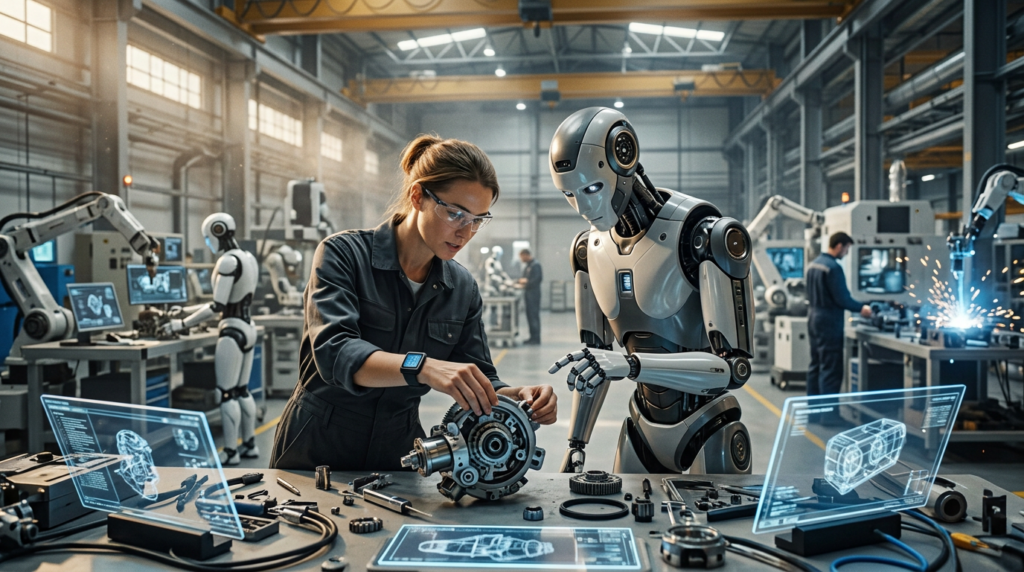
NVIDIA’s GR00T 2 announcement offers a glimpse of where advanced robotics could be heading.
Instead of treating every physical task as a separate programming challenge, researchers are developing systems capable of transferring knowledge across demonstrations and robotic bodies.
GR00T 2 combines visual prediction with physical action planning.
Isaac Lab 3.0 provides tools for simulated practice.
Newton improves the modeling of complicated physical interactions.
Meanwhile, new benchmarks help researchers evaluate whether those capabilities translate into dependable performance.
Together, these technologies address several long-standing obstacles in robotics development.
Of course, significant challenges remain.
Robots still need safer physical control, more reliable manipulation, and better performance in unfamiliar environments.
NVIDIA’s most impressive results also require broader independent verification.
Nevertheless, the direction is encouraging.
Machines that learn from human demonstrations could eventually become useful assistants across manufacturing, research, logistics, and other industries.
The most important breakthrough might not involve building robots that look more human.
Instead, it could involve giving machines the ability to learn useful skills without starting from zero.
And if that happens, teaching a robot could gradually become less like programming a machine and more like training a capable apprentice.
Sources
- NVIDIA Blog — GR00T 2, Isaac Lab 3.0, and robotics simulation advances at CoRL
- NVIDIA Research — GR00T 2 architecture, training data, experiments, and performance results
- NVIDIA Developer — Isaac Lab-Arena and robotics evaluation tools
- NVIDIA Developer Forums — GR00T 2, Newton, and open robotics technologies
- Crypto Briefing — NVIDIA introduces GR00T 2 and Isaac Lab 3.0 at CoRL
- CellCog — NVIDIA GR00T 2 benchmark results and availability analysis
- Tech Times — GR00T 2 performance claims and independent verification limitations