
The open-source AI agent taking GitHub by storm — and it’s not just hype.

The AI That Refuses to Forget You
You know that frustrating moment when you open a new chat with your AI assistant, and it has absolutely no idea who you are; you explain your project, again. you re-state your preferences, again You start from zero, again.
Most AI tools suffer from a kind of digital amnesia. Every session is a blank slate. Every conversation is a first date.
Hermes Agent is here to fix that. Built by Nous Research, this open-source AI agent doesn’t just help you get things done, it remembers how you like things done. It learns from its mistakes. It gets better every single day.
And the developer community? They’ve noticed. Big time.
From Zero to 65,000 Stars — Fast
Let’s talk numbers, because they’re wild.
Hermes Agent crossed 22,000 GitHub stars within its first month after open-sourcing in late February 2026. Then the v0.8.0 release dropped on April 8th. In a single day, it added 6,400 more stars. By mid-April, it had blown past 65,000 total stars and sat at the top of GitHub’s global trending charts.
That’s not a slow burn. That’s a rocket.
According to Evan Dong on DEV.to, that kind of growth usually signals one of two things: a project has hit a real developer nerve, or it’s become a vehicle for a narrative bigger than the product itself. With Hermes, it might honestly be both.
So what’s actually going on here? Let’s break it down.
What Is Hermes Agent, Exactly?
Think of Hermes as a personal assistant who lives on your computer or a cheap cloud server. Once it’s running, you can talk to it from Telegram, Slack, Discord, WhatsApp, Signal, or straight from your terminal. It supports 14 messaging platforms in total.
But here’s the key difference from every other AI tool you’ve used: Hermes doesn’t forget you.
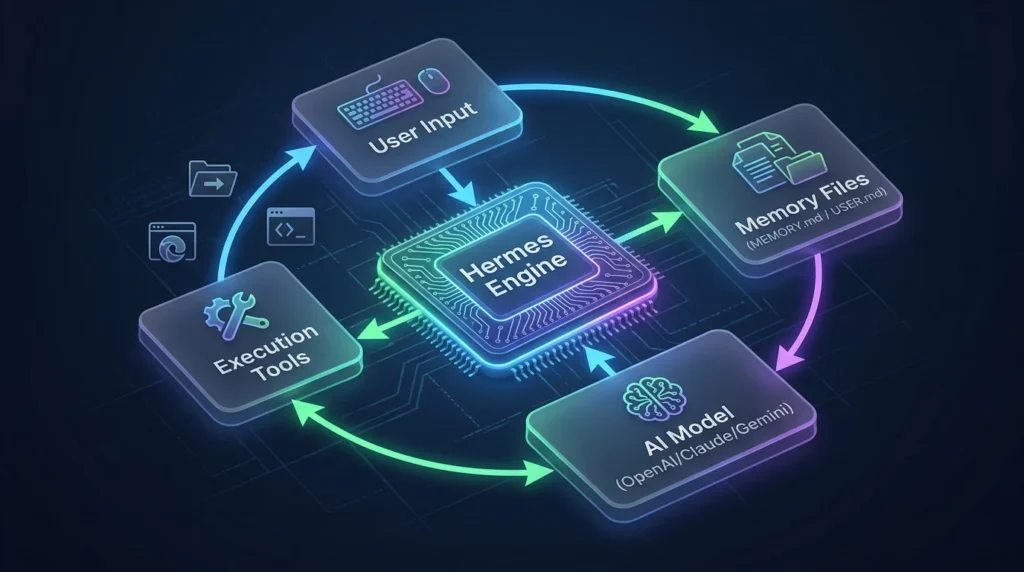
As Mehul Gupta explains on Medium, Hermes keeps two tiny but powerful text files:
- MEMORY.md — a notebook of facts about your environment, your projects, your tech stack
- USER.md — a profile of you: your preferences, your communication style, your skill level
These files travel with every conversation. So when you start a new chat, Hermes already knows you prefer raw code over verbose explanations. It already knows your server runs Ubuntu. It already knows you hate being talked down to.
That’s not magic. That’s just good memory management, and it changes everything.
The Brain Behind the Magic: How Hermes Actually Works
Let’s peek under the hood for a second.
When you send Hermes a message say, “Check my server’s disk space and delete temp files older than a week” here’s what happens. Hermes builds a system prompt that includes your memory files, your preferences, and a list of tools it can use. It sends that to whatever AI model you’ve connected (OpenAI, Claude, Gemini, or even a local model). The AI responds with instructions. Hermes executes them. It loops back. It keeps going until the job is done.
You just ask. It handles the rest.
The framework ships with 47 built-in tools covering browser automation, code execution, file management, image generation, text-to-speech, and more. It can open a headless browser, click buttons take screenshots, and analyze what it sees. It can spawn sub-agents to work on tasks in parallel It can run shell commands, safely, with a seven-layer security model that asks for your approval before doing anything dangerous.
It’s not just a chatbot. It’s a doer.
The Skills System: Teaching Hermes New Tricks
Here’s where things get genuinely exciting.
Every time Hermes completes a complex task, it can automatically write a reusable Skill file, a Markdown document that captures the steps, decision points, common pitfalls, and validation logic for that workflow. Next time a similar task comes up, Hermes loads that skill and executes it faster and more accurately.
As the deep-dive on DEV.to explains, this is fundamentally different from agents that start fresh every session. Hermes gets better the more you use it.
The skills system is smart about loading, too. It doesn’t dump every skill into memory at once. It keeps a lightweight index, skill names and one-sentence descriptions, and only loads the full playbook when it’s relevant. Skills can even be OS-aware, hiding themselves on platforms where they don’t apply.
And yes, Hermes can create, update, and delete its own skills during a live session. You’re not just using an AI. You’re training one.
GEPA: The Self-Improvement Engine
The self-improvement story goes even deeper with GEPA, the companion self-evolution system that earned an ICLR 2026 Oral acceptance (that’s a big deal in AI research circles).
GEPA doesn’t just notice when something fails. It reads execution traces to understand why things fail. If a task took 47 tool calls when it could have been done in 12, GEPA identifies that gap and updates the skill accordingly. It uses DSPy to propose targeted improvements to prompts and procedures.
Max Quimby on DEV.to puts it well: this is meaningfully different from a simple retry loop. The GEPA architecture has gone through peer review. This isn’t a framework built on vibes.
That said, there’s a fair caveat. The self-improvement loop works best on clearly-defined tasks, file operations, code execution, API calls. For ambiguous tasks like summarization or creative writing, the feedback signal is fuzzier. Set your expectations accordingly.
Hermes vs. OpenClaw: The Debate Taking Over Reddit
The moment Hermes started trending, comparisons with OpenClaw became inevitable. The debate has taken over r/openclaw (103,000 members) and split the AI tinkering community.
Here’s the honest breakdown, per Ariel Frischer’s comprehensive comparison on DEV.to:
OpenClaw is a TypeScript gateway built for operational control. It manages multiple agents, routes messages across 14 platforms, and gives you precise control over what each agent can do. Its skills marketplace, ClawHub, has 5,700+ community skills. It has 352,000 GitHub stars and a massive ecosystem, Xiaomi, Minimax, and Nvidia all have OpenClaw-based products.
Hermes is a Python agent runtime built for depth and adaptability. It has 47 built-in tools, self-improving skills, and a persistent memory system that compounds over time. It’s faster on tool calls, more flexible on model providers, and genuinely learns from experience.
The core tension? OpenClaw optimizes for multi-agent control. Hermes optimizes for single-agent growth.
Decrypt puts it simply: “OpenClaw is a good orchestrator, handing out tasks to different agents, whereas Hermes is a great solo executor.”
The real answer for power users? Run both. Use OpenClaw to orchestrate. Use Hermes to execute. They’re not competitors, they’re complements.
Getting Started: Easier Than You Think
Here’s the beautiful part. Setting up Hermes takes under five minutes.
One command handles everything, Python, Node.js, dependencies, the repo clone, and the global hermes command:
curl -fsSL https://raw.githubusercontent.com/NousResearch/hermes-agent/main/scripts/install.sh | bash
Works on Linux, macOS, WSL2, and even Android via Termux. After that, run hermes setup to configure your model and platforms, and hermes chat to start talking.
One hard requirement: your chosen model needs at least 64,000 tokens of context. Most major models in 2026 meet this bar. Local 7B models often don’t, you’ll want at least Mistral 7B with extended context, or a 13B+ model for best results.
Want Hermes in your pocket? Connect it to Telegram in about two minutes. Create a bot via @BotFather, paste your token into hermes setup, and you’re done. Send voice memos. Get scheduled briefings. Ask questions from anywhere. Your agent is always on.
The Controversy Worth Knowing About
Let’s be real, not everything is sunshine and GitHub stars.
A few things deserve honest attention. First, the self-improvement loop has a known weakness: the agent “almost always thinks it performed well even when it didn’t.” The same system that auto-generates skills can also overwrite manual customizations. GEPA addresses this architecturally, but it’s not a solved problem in production.
Second, several experienced Reddit users have flagged suspected coordinated promotion in Hermes threads. The star growth is real, but some of the community buzz may not be entirely organic.
Third — and this is important — Nous Research has roots in Web3 and has raised roughly $70M with backing from crypto-native investors. Unofficial “NOUS” token speculation has already started on-chain without direct project endorsement. If you’re a developer, judge Hermes on its technical merit. If you’re anyone else, be cautious about anything tied to unofficial token narratives.
The technology is genuinely impressive. The hype machine around it deserves a healthy dose of skepticism.
Who Should Actually Use Hermes?
Here’s the practical breakdown:
Use Hermes if you want a persistent personal assistant that learns your workflows, runs on cheap infrastructure, and supports open models. It’s especially powerful for repetitive tasks — research pipelines, morning briefings, server monitoring, automated workflows that improve daily.
Use OpenClaw if you need the most polished experience, the broadest IDE integrations, and the largest community ecosystem.
Use both if you’re serious about AI productivity and want a multi-agent setup where one orchestrates and the other executes.
Content creators, journalists, developers, data scientists, sysadmins — Hermes has a compelling story for all of them. And for anyone running on a budget, you can run it entirely on a local model with LMStudio. Zero API costs. Zero subscription fees.
The Bigger Picture

Hermes matters because it’s trying to answer a question the current AI stack hasn’t solved: What does an agent become after months of shared work?
Most agents are evaluated on what they can do on day one. Hermes bets on a different metric — what they become over time. Memory that compounds. Skills that accumulate. Behavior that adapts.
As Evan Dong writes: “Agents that become more valuable because they exist continuously in time, not because they win a benchmark on day one.”
That’s a genuinely different vision for what AI assistance can look like. And if Hermes delivers on even half of it, the 65,000 stars are just the beginning.
Sources
- hermes-agent: Is Self-Improving AI a Real Category? — Max Quimby, DEV.to
- What is Hermes Agent? Not Another OpenClaw — Mehul Gupta, Medium
- Hermes Agent: The Self-Improving Open-Source AI Agent Framework (v0.7.0 Deep Dive) — DEV.to
- OpenClaw vs Hermes Agent: A Comprehensive Comparison — Ariel Frischer, DEV.to
- Hermes Agent Crossed 47K GitHub Stars in Two Months — Evan Dong, DEV.to
- What Is Hermes? The Self-Improving AI Agent Coming for OpenClaw — Decrypt
- Hermes Agent Official Site — NousResearch
- Hermes Agent GitHub Repository — NousResearch
The Kingy Brief
Get The Kingy Brief.
AI changes, original tests and one practical thing to try. Fridays at 09:00 Vancouver time.
Free · Double opt-in · Unsubscribe anytime
Signup help and newsletter schedule
Signup form provided by Beehiiv. After submitting, check your inbox for "Confirm your subscription to The Kingy Brief" and open its confirmation link. Check Spam or Promotions if you cannot find it.
Fridays at 09:00 Vancouver time: source-checked AI changes, original tests and one practical thing to try. The weekly restart begins October 9, 2026. We skip a week when there is not enough verified material. Free. Unsubscribe anytime.