AI Launch Radar: Pancake Is a New AI Agent Tool for Making Small Teams More Autonomous
Pancake is a new AI agent product positioning itself as an “OpenClaw cofounder” that lives in Slack and helps small teams run more of the company through autonomous agents. The pitch is bold: instead of giving you another chatbot, Pancake wants to give you a working AI org chart for growth, engineering, operations, support, outbound, scheduling, and other recurring company work. The company’s Product Hunt page describes it as “OpenClaw in Slack that makes your company autonomous,” and the official site says Pancake “stacks autonomous agents to help your company run itself.”
The big question is not whether Pancake has a compelling pitch. It does. The real question is whether founders, marketers, and operators can trust a Slack-native agent system to do meaningful work without creating chaos, security issues, or messy approval problems. That is where Pancake gets interesting.

Quick Summary
- Product: Pancake
- Category: AI agents / autonomous company platform / Slack-native AI cofounder
- Main use case: Building a small AI agent “org chart” that can handle company workflows across growth, engineering, and operations
- Best for: Founders, startups, operators, technical teams, and small teams that already run work through Slack
- Pricing: Public pricing lists a $49/month base plan, token packs from $50 to $1,000, and a 3-day free trial with $100 in free credits.
- Official website: Pancake’s official site describes the product as an OpenClaw cofounder that makes your company autonomous.
- Launch source: Product Hunt; at the time checked, Pancake was listed as launched this week, with a #1 day rank and 545 points.
- Kingy AI early take: Worth testing if you want AI agents inside real company workflows, but only with tight human approval, limited permissions, and clear success metrics.
What Launched?
Pancake launched publicly on Product Hunt as an AI agent product for teams that want to run more of their company through autonomous agents. Product Hunt lists it under AI Agents and OpenClaw, with launch tags including Slack, Artificial Intelligence, and Maker Tools.
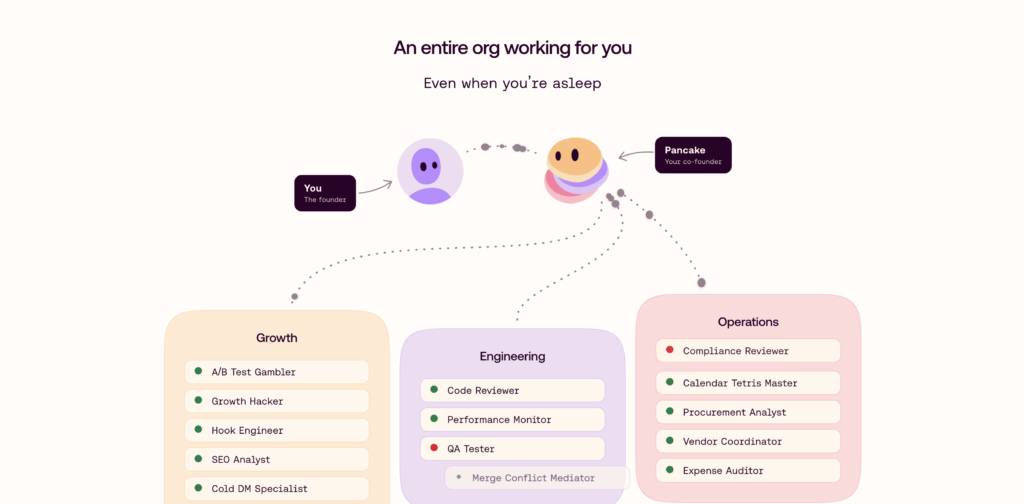
The official Pancake site frames the product as a Slack-native AI cofounder. The core idea is that you connect your company stack, define agents and workflows, and then let those agents work through the tools your team already uses. Pancake’s homepage shows example agent roles across growth, engineering, and operations, including copywriter, ad manager, social media manager, email marketer, full-stack engineer, DevOps, QA tester, scheduling, recruiting screening, invoicing, and customer support.
This appears to be a public product launch rather than just a concept post. Pancake has an official website, Product Hunt page, pricing page, blog, creator program, and app signup flow. The public positioning is not simply “chat with an assistant.” It is closer to: create a company brain, stack agents, let them work in Slack, and approve higher-risk actions before they ship.
Why It Matters
Pancake matters because it is aiming at one of the most important shifts in AI work: moving from prompting one assistant to managing a swarm of agents.
Most AI tools still ask the user to start the work. You open the tool, describe the task, wait for an answer, copy the output, edit it, and then move it somewhere else. Pancake’s pitch is different. The product is trying to sit inside the operating layer of a company, watch for recurring work, and push updates back into Slack.
That matters for founders and small teams because the painful work is often not one big task. It is the constant operational drag: qualify inbound leads, prepare sales notes, draft follow-ups, review customer feedback, summarize overnight changes, create social posts, check product issues, schedule things, and decide what needs human approval.
Pancake’s homepage specifically emphasizes Slack-native workflows, context from Notion, docs, and meeting notes, markdown-configured agents, 24/7 operation, approvals before risky actions, audit logs, and scoped agent sandboxes.
That is the right product direction for AI-native work. But it is also the hard direction. The more useful an agent becomes, the more permissions it needs. The more permissions it has, the more trust, observability, and rollback controls matter.
Who Should Care?
Creators
Creators should care because Pancake is visually demonstrable. A Slack-native agent that posts morning briefings, drafts content, qualifies leads, or creates work artifacts is easier to show on YouTube than a backend API tool.
Pancake also has a public creator program that rewards people for sharing real Pancake output on X or LinkedIn. The creator program requires a screenshot or screen recording of actual output from a real workspace, and the company says posts should not be staged, mocked, boosted, or fabricated.
That is a strong signal that Pancake understands creator-led distribution. It gives creators a clear before/after demo: “Here is the messy company workflow. Here is Pancake doing part of it inside Slack.”

Marketers
Marketers should care if they already use Slack, Notion, docs, meeting notes, email, and scheduling tools to coordinate campaigns. Pancake’s examples include writing social content, qualifying demo requests, drafting prep docs, and running outbound-style workflows.
The marketing use case is not “replace the marketer.” The better framing is: use Pancake to handle repeatable campaign operations that waste time but still need review.
Good first tests could include:
- Drafting X and LinkedIn posts from existing founder content.
- Summarizing campaign performance into Slack.
- Preparing sales enablement notes from calls.
- Turning customer feedback into content ideas.
- Qualifying inbound demo requests before a human follows up.
Founders and Startups
Founders are the most obvious target audience. Pancake’s own copy is heavily founder-focused. The homepage frames the user as “the founder” and Pancake as “your co-founder.”
The strongest founder use case is not handing the company to an agent. It is delaying or reducing the need for early operational hires by delegating narrow, repeatable workflows. For example: daily briefings, customer support triage, outbound prep, product feedback summaries, QA checks, and internal task routing.
That said, founders should be careful with financial, legal, hiring, customer-facing, and production-shipping actions. Pancake says users can set spend, scope, and trust thresholds, with human approval for higher-risk actions. That approval layer is not a nice-to-have. It is the product’s credibility layer.
Developers and Technical Teams
Developers should care if they are already interested in OpenClaw-style agents but want a more packaged, company-oriented layer. OpenClaw’s own docs describe it as a self-hosted gateway that connects chat apps such as Slack, Telegram, WhatsApp, Discord, Signal, Microsoft Teams, and others to AI coding agents.
Pancake seems to be taking the OpenClaw idea and packaging it around company operations, Slack workflows, hosted infrastructure, memory, approvals, and team-like agent structures. A Product Hunt maker comment says Pancake adds a task management system, a virtual computer with 50GB of storage, mail, phone number, browser integrations, a vault system for API keys, and a company brain memory system on top of OpenClaw.
The Demo That Matters
The most important demo is not one polished screenshot. It is the pattern Pancake is trying to show: agents that work in Slack, create useful artifacts, and then ask for human input when needed.
On the official pricing page, Pancake shows example workflows such as drafting and scheduling an X thread, qualifying 27 demo requests, drafting polite rejections, booking qualified prospects through Cal.com, and running an outbound project toward a demo-booking goal.
On Product Hunt, hunter Chris Messina said Pancake performed a deep research crawl on him and his business during onboarding, then created an onboarding deck explaining his current focus and how Pancake could help.
The demo proves that Pancake has a strong product story: AI agents are more compelling when they sit in the workflow, use company context, and return actionable updates. What it does not yet prove is long-term reliability. We still need more public evidence around error rates, permission safety, customer outcomes, integration depth, and how well Pancake handles ambiguous business decisions.
Pricing
Pancake’s public pricing page lists an Always-on plan at $49/month. The plan includes a private cloud computer, 50GB storage, encrypted secrets, access to “any LLM” with examples including Claude, GPT, and Gemini, Slack-native operation, a phone number for SMS and voice, an email inbox, authenticated browsing, live web access, deep web search, and unlimited sub-agents.
The pricing page also shows token packs labeled Syrup, with pack sizes from $50 to $1,000. Pancake says users can pick token packs at labs’ public price, and the page gives an example of $99/month total when combining the $49 base plan with a $50 token pack.
The site lists a 3-day free trial with $100 in free credits. It also says iMessage access and a credit card for agents are “Soon,” not currently presented as fully available.
Before adopting it seriously, buyers should verify:
- Which integrations are available today versus “coming soon.”
- Which model providers are supported.
- How token usage is metered.
- Whether token credits roll over.
- What security controls are included.
- How approvals, logs, and rollbacks work in real customer environments.
- Whether the SOC 2 claim is backed by documentation they can review.
Alternatives
Pancake sits in a fast-moving category that overlaps with AI agents, OpenClaw infrastructure, personal AI assistants, autonomous company tools, and workflow automation.
| Tool | Best known for | Where Pancake may be stronger | Where the alternative may be stronger |
|---|---|---|---|
| OpenClaw | Open-source, self-hosted AI agent gateway across chat apps | More packaged Slack-native company workflow experience | More control, self-hosting, open-source flexibility |
| Clawdi | Environment layer for AI agents, designed to preserve tools, memory, credentials, and setup across frameworks | More founder/operator “AI org chart” positioning | Better fit for teams focused on portable agent infrastructure |
| ZeroHuman | AI cofounder-style product for running business tasks, validating ideas, building products, and growth | Stronger Slack/OpenClaw-specific workflow pitch | Broader “start or grow your business” positioning |
| Lindy | AI work assistant for personal productivity and business workflows | More autonomous-company framing | More established assistant-style workflow polish |
| n8n / Zapier-style automation | Deterministic workflow automation | More agentic and flexible for messy work | More predictable for structured automations |
OpenClaw is the most important comparison because Pancake directly uses the OpenClaw category language. OpenClaw is self-hosted and developer-oriented; Pancake is trying to make that kind of agentic infrastructure feel like a company operating system inside Slack.
What Feels Promising
The strongest part of Pancake is the packaging.
“AI agents in Slack” is easy to understand. “An AI org chart” is even easier. Pancake does not need to convince users to learn an entirely new workspace first. The product meets teams where a lot of startup work already happens: Slack.
The second promising piece is the approval model. Pancake’s homepage says users can set spend, scope, and trust thresholds, and anything above those thresholds requires human approval.
The third promising piece is creator-friendliness. The creator program is unusually direct: show real Pancake output, tag the company, and get rewarded based on reach.
That suggests Pancake understands that this category needs proof. People will not trust “autonomous company” claims from a landing page alone. They need to see messy, real workflows.
What Feels Unproven
The biggest unproven area is reliability.
Pancake is making a strong claim: agents can work while you sleep, across GTM, product, and ops. That is exciting, but it raises obvious questions. How often does it make mistakes? How does it know when to stop? How does it classify reversible versus irreversible actions? How does it handle sensitive customer data? How does it recover from a bad instruction?
A Product Hunt commenter asked a useful question about how Pancake classifies actions that are irreversible versus merely costly, and a maker replied that Pancake is being built to adapt approval boundaries based on each team’s workflow and risk tolerance. That is the right answer direction, but it also shows the category is still early.
Other open questions:
- How many integrations are truly production-ready today?
- How much setup is required before agents are useful?
- How well does it work outside demo-friendly startup workflows?
- Can non-technical founders configure agents safely?
- How expensive does it become with heavy token usage?
- What happens when agents disagree, duplicate work, or create conflicting outputs?
Kingy AI Verdict
Kingy AI Verdict: Worth Testing
Pancake is worth testing because it is aiming at a real problem: small teams do not just need better chatbots. They need help operating the company. The product’s Slack-native approach, OpenClaw positioning, approval model, and agent-org-chart metaphor all make sense for where AI work is heading.
But Pancake should be tested with guardrails. Do not start by giving it access to everything. Start with one narrow workflow where mistakes are low-cost and outputs are easy to review. Examples: draft content, summarize meetings, qualify inbound leads, prepare sales notes, or create a daily company briefing.
The product becomes much more compelling if Pancake can prove that users keep agents running for weeks, not just hours. The evidence to watch: retention, real customer case studies, public workflow demos, security documentation, integration depth, and examples where agents completed meaningful work without constant babysitting.
For now, Pancake is not a “hand over the company” product. It is a “test agentic operations inside Slack” product. That is still a big deal.
Should Marketers Test It?
Yes, marketers should test Pancake if they work in a startup or small team where marketing is tied closely to sales, product, and founder-led content.
The best first marketing test is not a giant campaign. Start with one repeatable workflow:
- Turn founder notes into social drafts.
- Summarize customer calls into content angles.
- Qualify inbound demo requests.
- Create a daily growth briefing.
- Draft campaign follow-ups.
- Prepare sales enablement docs from recent product updates.
The tool is worth paying for if it saves real operator time, produces drafts that need light editing instead of total rewriting, and reduces the number of small tasks that fall through the cracks.
The result that would prove Pancake is useful: one agent workflow runs for two weeks, produces usable work every day, stays within permission boundaries, and gives the team more leverage without creating cleanup work.
That is the real bar. Not “does the demo look cool?” But: does Pancake help a small team do better work with less operational drag?
If it does, this is exactly the kind of AI product marketers, founders, and creators should be watching.
Related Guides
Compare
Recent Launches
- Claude Tag: Anthropic’s New Slack AI Coworker Could Be Bigger Than It Looks
- The Bot That Broke the Internet — And Now Nobody Wants It on Their Laptop
Latest News
Continue Reading
The Kingy Brief
Get The Kingy Brief.
AI changes, original tests and one practical thing to try. Fridays at 09:00 Vancouver time.
Free · Double opt-in · Unsubscribe anytime
Signup help and newsletter schedule
Signup form provided by Beehiiv. After submitting, check your inbox for "Confirm your subscription to The Kingy Brief" and open its confirmation link. Check Spam or Promotions if you cannot find it.
Fridays at 09:00 Vancouver time: source-checked AI changes, original tests and one practical thing to try. The weekly restart begins October 9, 2026. We skip a week when there is not enough verified material. Free. Unsubscribe anytime.