A complete, downloadable editorial workflow using a fictional community repair interview. Inspect the input, the actual assistant-authored outputs, and the checks that connect them.
Execution boundary: The assistant read this synthetic interview and wrote the sample article and excerpts in the active Codex task. No separately paid API was invoked. Model subscription or usage allocation was not measured. This is not independent reporting or a model performance benchmark.
Run the workflow
- Start with a permissioned interview. Preserve its source turns and record whether it is real or synthetic.
- Attach the input and use the downloadable prompt. Have the assistant write the article and excerpts with source references.
- Save the output and provenance using this kit’s JSON structure. Run
python3 validate.py --self-testbeside the two JSON files. - Read every claim against the cited turn, including qualifications and ambiguous wording. The validator cannot establish semantic support.
- Review the rendered page. Publish or distribute only with the appropriate separate authorization.
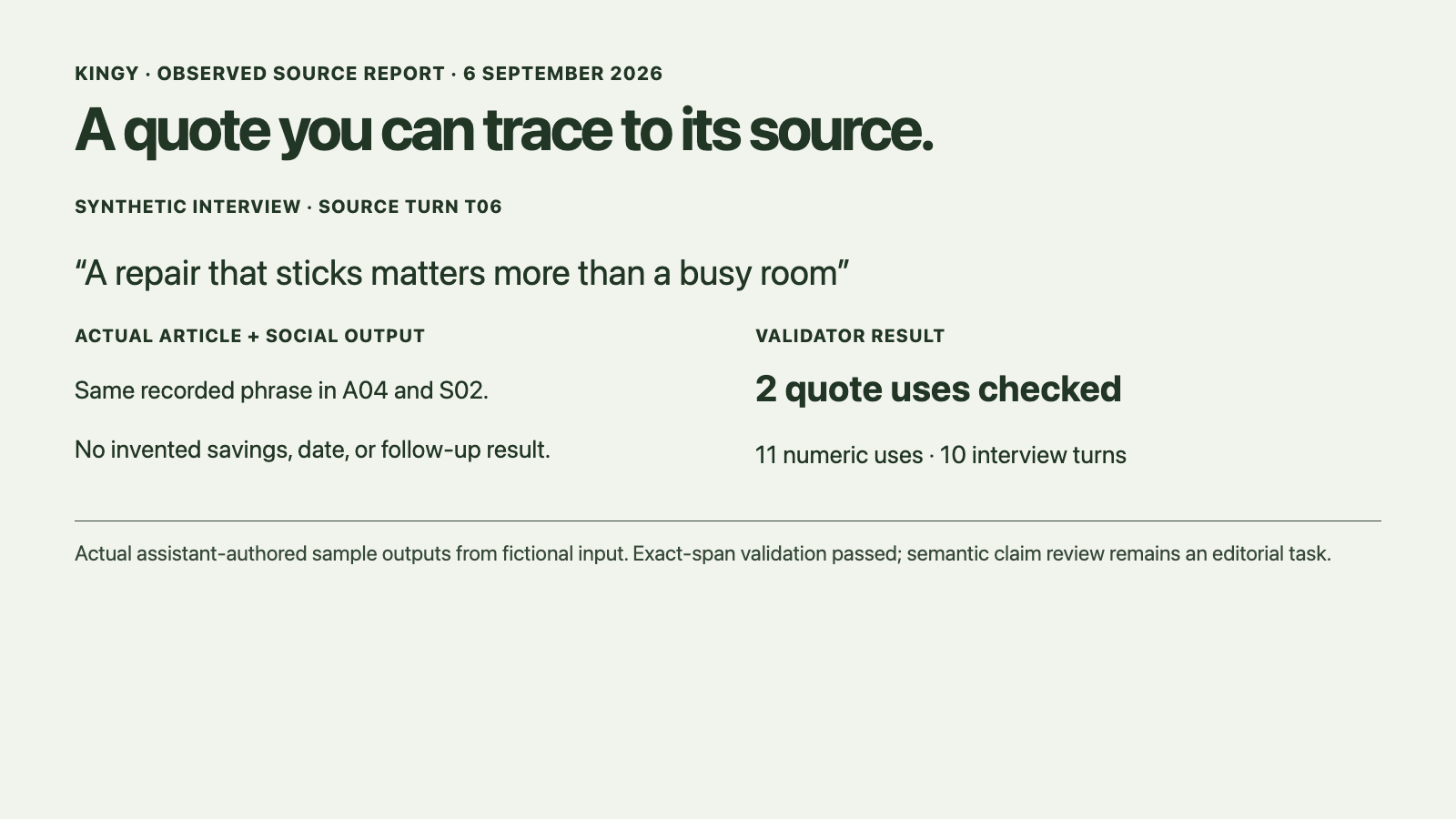
Completed here: 10 interview turns; one article; three excerpts; two registered quote uses; eleven numeric uses. The checks passed and rejected intentional number, quote, and source-ID defects.
Lantern Room team records 19 repairs, with durability still unverified
Source: T04
Fictional editorial example: all people, events and statistics below were invented for this workflow. This is not a report about a real community event.
The Lantern Room’s first repair event ended with 19 items recorded as repaired, according to fictional coordinator Mara. That result describes the team’s assessment before the items left; there has been no follow-up to establish how well the repairs lasted.
During the 3-hour event, volunteers helped 24 households bring in 31 items, including jackets, lamps and small wooden stools. The household count should not be read as a visitor count: the team did not report how many individual people attended.
Source: T02
Beyond the completed repairs, 7 items received a diagnosis and needed parts or another specialist. The team did not work on the remaining 5 because the problems were outside its skills or could not be assessed safely.
Source: T04
Visitors could sit with volunteers and watch if they wished. Mara described a jacket owner practicing stitches on spare fabric before working on the garment, while noting that learning was not measured. “A repair that sticks matters more than a busy room,” Mara said.
Source: T06
There was no entry fee. Visitors could leave voluntary donations, but the total had not been counted. The team did not weigh the items or collect replacement prices, so the interview supports no claim about money saved, waste avoided or emissions reduced.
Source: T08
For another event, Mara would like a booking option and a clearer list of what volunteers can assess. Those changes remain intentions: neither a date nor a venue booking has been confirmed.
Source: T10
Three ready-to-review excerpts
Results excerpt
Fictional example: Lantern Room volunteers recorded 19 repairs from 31 items. Another 7 needed parts or a specialist; 5 were not worked on. These are end-of-event records, with no follow-up yet on how the repairs lasted.
Learning excerpt
Fictional example: a jacket owner practiced stitches on spare fabric at Lantern Room. “A repair that sticks matters more than a busy room,” coordinator Mara said. Participation was optional, and the team did not measure learning.
Source: T06
What comes next excerpt
Fictional example: Lantern Room’s coordinator wants booking options and clearer repair limits next time. Another event is only a hope: no date or venue booking is confirmed. The team also has no measured savings or waste figure.
The original synthetic interview
Every person, event, location and statistic in this interview is invented for a reusable editorial workflow example. No real business or customer data is used.
T01 · Interviewer
What happened at the first Lantern Room repair event?
T02 · Mara, fictional event coordinator
We opened the Lantern Room for 3 hours. Six volunteers helped 24 households bring in 31 items. Those are household and item counts, not a count of individual visitors. The items included jackets, lamps and small wooden stools.
T03 · Interviewer
How many of those items were repaired?
T04 · Mara, fictional event coordinator
We recorded 19 items as repaired before they left the room. Another 7 received a diagnosis but needed parts or a different specialist. We did not work on the remaining 5 because they were outside our team’s skills or we could not assess them safely. The 19 repairs are the team’s end-of-event record; we have not checked whether they all held up afterward.
T05 · Interviewer
What did participants do while their items were being assessed?
T06 · Mara, fictional event coordinator
We invited people to sit with the volunteers and watch, but participation was optional. One jacket owner practiced stitching on spare fabric before working on the jacket. We did not measure how much anyone learned. A repair that sticks matters more than a busy room.
T07 · Interviewer
Did you measure financial savings or waste avoided?
T08 · Mara, fictional event coordinator
No. We did not weigh the items, ask for replacement prices or calculate emissions. We asked for no entry fee. Some visitors left voluntary donations, but the total has not been counted. We cannot claim a savings or waste figure from this event.
T09 · Interviewer
What would you change, and is another event confirmed?
T10 · Mara, fictional event coordinator
We would like a booking option and a clearer list of items the team can assess. A few people arrived with problems outside our skills, and we should have made those limits clearer. We hope to run another event, but no date or venue booking has been confirmed.
Recover from common failures
- Quote does not match: restore the exact words from the cited turn, or use a clearly attributed paraphrase. Never edit the source to match invented wording.
- Number has no support: remove it or correct the value, units and supporting turn. A matching number alone does not prove the same meaning.
- Missing source turn: select the actual supporting turn. If none supports the statement, remove or qualify it.
- Validator passes but the claim is wrong: human or assistant editorial review must still check entailment, omitted uncertainty, and misleading combinations of facts.
- No interview attachment: finish the reusable structure, but do not invent real reporting. Use a prominently labeled synthetic example only when that is appropriate for the task.
- Changed JSON breaks the check: retain the documented keys and IDs, then rerun the focused check. The sample validator is a starting point for this exact schema, not a universal newsroom validation system.
Reuse and measurement
Kingy can package this as a downloadable recipe for visitors trying to turn interviews into grounded content. Useful signals are recipe visits, kit downloads, and repeat visits from readers using the source-checking workflow. No collector, tracking service or external subscription was installed.
This kit uses synthetic input. Real-interview consent, editorial approval and any publication of your own outputs require a separate review. Prices, productivity savings and model quality were not measured.
Read the complete reusable prompt
Turn the attached interview into a short, source-grounded article and three social excerpts. Complete the work without asking about routine style choices. Use only the interview for event claims.

First read every turn. Keep each turn's ID. Write the article yourself; do not substitute a script that fills a prose template. Aim for 200–300 words and a clear factual headline. Each social excerpt must stand on its own and preserve the key qualification behind its claim.

If the input is synthetic, visibly label the article and each social excerpt fictional. Never present the sample as real reporting. For a real interview, preserve its actual provenance and do not invent permission or independent verification.

Attach source-turn IDs to every article paragraph, headline and social excerpt. Record each direct quote's verbatim span and source turn. Record every numeric claim with its value, meaning, source turn and exact supporting span. Do not confuse items with households or people. Preserve missing measurements, uncertainty and unconfirmed plans. Do not invent quotes, savings, emissions reductions, dates, success percentages or follow-up results.

Deliver interview.json unchanged, outputs.json with structured provenance, article.md, social-excerpts.md, and a readable local HTML preview with source references. Use a local standard-library validator to check turn IDs, all quoted spans and numeric-claim coverage; retain its result. Review every paraphrase yourself because mechanical checks cannot establish that the prose follows from its source.

If validation fails, correct the unsupported output or source mapping, then rerun only the relevant check. Never alter the source to make a claim pass. If the interview does not support a claim, remove or qualify it. Preserve the best supported output when a detail is unavailable.

Do not publish, send messages, access external accounts, or call a paid API. State actual execution and cost boundaries: assistant-authored output in the current session; no separately paid API invoked; subscription or usage allocation unmeasured. Do not call this an independent model benchmark or promise a free end-to-end workflow.
Plan the rest of the workflow
Use Kingy’s Workflow Planner to map research, creation and review. Keep the interview and claim checks alongside the finished output.