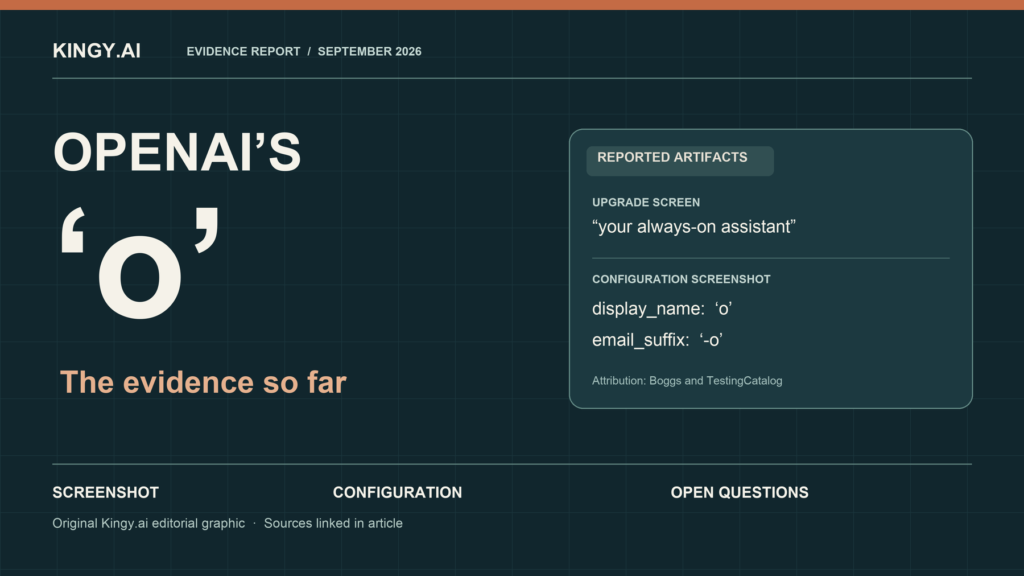
A Pro upgrade screenshot and configuration fields point toward an always-on assistant. Its capabilities, launch date, and commercial terms remain unconfirmed.
Prepared September 26, 2026 · Last checked September 26, 2026, 9:21 p.m. PDT · Living report
A line in a ChatGPT Pro upgrade screenshot offers a strikingly compact product pitch: “o, your always-on assistant.” Jake Boggs posted the image on September 25. The next day, TestingCatalog published a configuration screenshot containing an o display name and a -o email suffix. Together, the two artifacts suggest OpenAI is preparing an assistant with a recognizable identity and an ongoing role in a user’s work. Boggs’s original post, TestingCatalog’s original report.
That interpretation is plausible. The launch story remains incomplete. At this report’s cutoff, the official release notes, pricing page, and DevDay material checked for this article did not announce a product called “o.” The evidence supports reporting a possible upcoming assistant; it does not support promising readers a release date or a feature list. ChatGPT release notes, official pricing, DevDay 2026.
The most consequential possibility is a personal assistant that keeps track of work between visits to ChatGPT. Whether OpenAI intends anything that broad, and how much of it would be new, are still open questions.
What we know at a glance
“Observed” below means visible in a public source artifact. It does not mean we authenticated the artifact against OpenAI’s production systems.
| Claim | Evidence status | What readers can safely conclude |
|---|---|---|
| The name “o” appears in a Pro upgrade image. | Observed in a user-posted screenshot. | The image associates the name with an always-on assistant. Final branding is unconfirmed. |
| ChatGPT configuration contains related fields. | Reported by TestingCatalog; its screenshot inspected. | The displayed values support the report, but the originating response has not been independently reproduced here. |
| The assistant will handle email. | Inference. | An email-related identifier is a clue, not a specification of inbox access or sending powers. |
| It is included in a $100 Pro subscription. | Suggested by the leaked screen. | Final eligibility, usage allowances, and charges need official confirmation. |
| It will launch at DevDay on September 29. | Rumored timing. | The event is confirmed; an “o” announcement or same-day release is not. |
| “Aeon” is the model powering it. | Unverified claim. | Public accounts give different descriptions of the name. The architecture is unresolved. |
The underlying sources are Boggs’s screenshot, TestingCatalog’s post, Leo’s separate claim, and OpenAI’s event page. Articles repeating those posts should not be counted as additional independent discoveries.
The two artifacts behind the story
The upgrade screenshot is the clearest evidence of intended positioning. It shows a “Get ChatGPT Pro” screen with a $100.00 Standard option and a monthly renewal notice. The assistant appears among subscription benefits, alongside more Work and Codex usage. That placement suggests a product experience people might recognize and use, although it cannot tell us whether the wording was a test, a placeholder, or finished launch copy. View the source screenshot.
It also does not establish that “o” costs $100 separately. The displayed price belongs to the plan. Treating that number as an assistant-specific fee would misread the image. Conversely, an entry on one upgrade screen cannot establish that access will be exclusive to that tier.
The technical clue is narrower. These are the two relevant fields transcribed from TestingCatalog’s annotated configuration screenshot:
{
  "email_suffix": "-o",
  "display_name": "o"
}
This excerpt is a transcription of a published image, not code retrieved independently from ChatGPT. The image places the fields inside a dynamic_configs object. It does not identify a reproducible endpoint or a versioned application build. Configuration screenshot and attribution.
That distinction matters when the story is described as something “found in ChatGPT’s code.” Configuration can supply names and settings to an application without documenting how a feature works. Statsig’s own documentation explains that client initialization retrieves user-specific values for gates, experiments, and configurations, and may use cached or default values. Those mechanics help explain why a configuration artifact can be informative without demonstrating a public rollout. Statsig initialization documentation.
The email suffix could be associated with an assistant address or alias. It cannot establish whether the assistant reads an existing inbox, receives forwarded messages, drafts replies, or sends mail. Those are distinct capabilities with different permissions. None follows automatically from two field names.
September 29 is the date to watch
OpenAI’s DevDay takes place on Tuesday, September 29, 2026, in San Francisco. Its official schedule lists an opening keynote featuring Sam Altman at 10 a.m. Pacific, with a free livestream. That makes the event an obvious checkpoint for this story. The schedule does not name “o.” Official DevDay schedule.
OpenAI Developers also posted a countdown on September 26. The text promotes the event without identifying this assistant. Separately, Thibault Sottiaux used the wording “o yes” in a post about recovering from a service disruption. Readers have treated the phrasing as a possible hint; it supplies no product specification. OpenAI Developers’ post, Sottiaux’s post.
The editorial distinction will remain important even if “o” appears onstage. An announcement, an invitation-only preview, access for some subscribers, and general availability are different events. This article will record which one occurs rather than compressing them into a single “launch” claim.
“Aeon” remains an unresolved part of the rumor
Leo, posting as @synthwavedd, says “o” will be a DevDay launch powered by an Astra variant called “aeon,” designed for extended tasks. The post does not provide a model card, benchmark, or technical document establishing that relationship. Original claim.
TestingCatalog gives a different account: it associates Aeon with the existing custom-agent implementation for ChatGPT Workspace accounts and proposes that a consumer assistant could build on it. These descriptions might eventually prove compatible, but the published material does not show how. TestingCatalog’s account.
For now, neither description belongs in a specifications table as settled fact. Nor does the single-letter name establish a new reasoning-model generation, an upgrade to GPT-4o, or a return of the older o-series branding. Product names and model identities need separate evidence.
What an always-on assistant would need to add
OpenAI already offers several forms of work that continue beyond an ordinary chat exchange. Any assessment of “o” needs to start with that existing functionality.
| Existing product or feature | What OpenAI currently documents | What would still need explaining about “o” |
|---|---|---|
| Scheduled tasks | Recurring work, monitoring, and supported event-triggered tasks. | Whether the assistant changes how users set ongoing responsibilities and manage them. |
| ChatGPT Work | An agent for longer tasks and finished deliverables, including cloud work. | Whether “o” adds a distinct personal identity, continuity, or interface. |
| Workspace agents | Shared agents that operate across tools and team workflows, with organizational controls. | How a personal assistant would differ in ownership, access, and scope. |
There is also a trap in older comparisons. OpenAI’s June 17 release notes announced that Pulse would be sunset as proactive updates moved into scheduled tasks. The current ChatGPT agent help page opens with a retirement notice directing users to Work, although older instructions remain farther down that page. Comparisons that present Pulse and the former agent mode as unchanged current products miss those updates. June release notes, agent retirement notice.
Our assessment is that the potential advance lies in how these capabilities fit together for an individual. A recurring prompt can run on a timetable. A more persistent assistant might maintain responsibility for an evolving task, recognize when circumstances change, preserve unfinished work, and return with a useful result. The leak does not establish that “o” does all of this.
Consider an illustrative assignment: follow a product launch for ten days, maintain one accurate article, and alert the editor when a rumor becomes an official feature. Success requires remembering the evidence already checked, correcting the same document, detecting contradictions, and knowing when there is no worthwhile update. A daily summary alone would leave much of that work to the editor.
That is the kind of practical difference worth testing if the assistant becomes available. “Always-on” by itself tells us little about continuity, reliability, or the amount of supervision required.
The questions a launch needs to answer
The central unknown is what OpenAI means by always-on. It might describe work running in the cloud, an assistant that wakes on a schedule or event, or a persistent identity that users can return to. The phrase does not establish uninterrupted computation, unlimited usage, or continuous microphone access.
Four details would make the product assessable:
- Continuity. Does work resume after an interruption? Can the assistant retain the state of an assignment across days? Does it run while the user’s devices are offline?
- Authority. Which accounts and files can it access, and which actions require approval? If it has an email identity, who controls it and what can it send?
- Accountability. Can users inspect its actions, correct an instruction, revoke access, or stop every active task? How does it report a failure or an unresolved question?
- Cost and limits. Which plans qualify, how is unattended work counted, and can users cap consumption? A subscription benefit can still carry a usage allowance.
These questions build on controls OpenAI already documents. For connected-app tasks, existing permissions and approval requirements continue to apply; an action requiring approval can pause the task. That provides a useful baseline for evaluating a future assistant, but it does not prove that “o” will use exactly the same controls. OpenAI’s connected-app documentation.
A useful early test would compare a completed assignment with a human-maintained record: missed events, false alerts, unsupported conclusions, interventions required, and total usage. We have no “o” results to report. Claims about productivity gains or superior reliability would be premature.
What readers should do now
There is enough evidence to follow this story closely. There is too little to buy a subscription specifically for “o,” assume access is imminent, or treat a leaked benefit as a contractual promise.
The next decisive evidence would be an OpenAI product announcement, help documentation explaining access and permissions, or a reproducible rollout with an identifiable plan and region. A demonstration could establish some behavior; sustained independent testing would still be needed to judge reliability.
If OpenAI announces the assistant, this report will replace unresolved entries with sourced details and preserve the earlier claims in its update history. If DevDay passes without an announcement, the September 29 prediction will be recorded as unfulfilled. A missing announcement will not, by itself, establish that the project was canceled.
Reporting method and daily updates
This is a report on public evidence, not a hands-on review. We read the original posts by Boggs, TestingCatalog, Leo, OpenAI Developers, and Sottiaux; inspected the upgrade and configuration images; and checked the linked official product documentation. We have not independently reproduced the leaked upgrade screen or retrieved its originating configuration response. Reading a screenshot verifies what it depicts, not its authenticity or deployment status.
The research separates official statements, visible artifacts, attributed claims, and our analysis. Multiple stories tracing back to the same post count as one source of the underlying claim. A source that changes or contradicts this report will be recorded, with a correction where needed.
Daily reviews are scheduled for September 27 through October 6, 2026. Each completed review will update the check date and log. The main article will change when the evidence changes; a quiet day will be recorded without manufacturing a development.
Update log
- September 26, 2026, 9:21 p.m. PDT — Initial report. Inspected the original leak artifacts, distinguished the email and Aeon interpretations from confirmed facts, verified DevDay’s schedule, and checked the current Work, tasks, and workspace-agent context. No official “o” announcement was found in the sources reviewed.