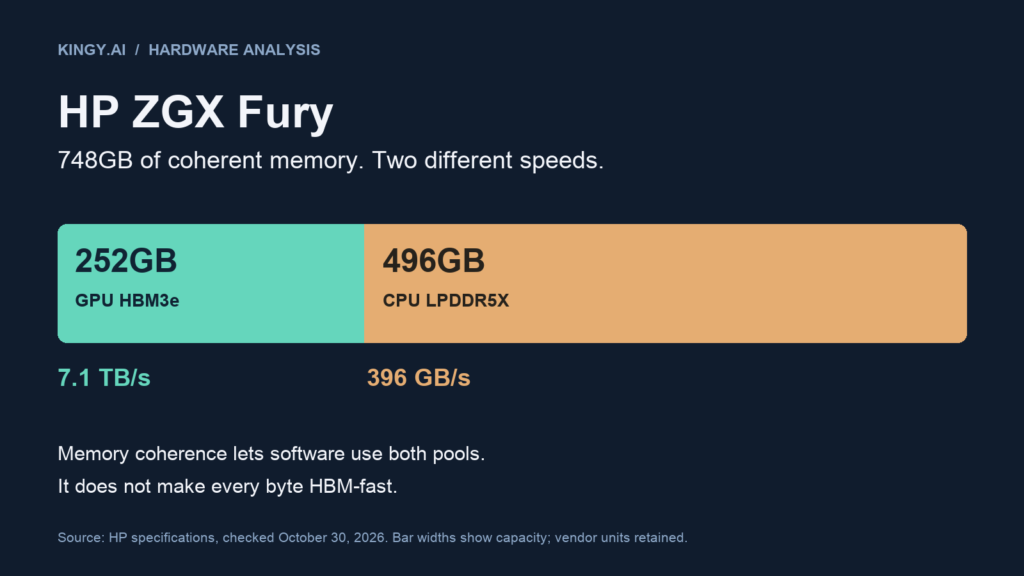
The HP ZGX Fury G1n puts NVIDIA’s GB300 Grace Blackwell Ultra platform in a liquid-cooled workstation for teams that want to run large AI models on their own infrastructure. Its headline is 748GB of coherent memory. The more useful detail is how that memory is divided: 252GB of fast HBM3e beside the GPU and 496GB of slower CPU memory accessible across the CPU–GPU link.
That split lets a model use more memory than the GPU’s HBM alone provides. It does not make every byte run at HBM speed. For a buyer, the difference can decide whether a model serves many people comfortably, produces tokens slowly, or needs a second system.
There is promising evidence, including a sponsored demonstration, vendor evaluations and an independent two-system cluster test. There is still no complete, independently reproducible standalone Fury benchmark against a current Mac Studio or DGX Spark in the sources reviewed. The strongest purchase decision starts with your own models, context lengths, concurrency and latency targets, followed by a written system quote and an acceptance test.
This article is based on documents and published tests available on October 30, 2026. Kingy.ai has not received or tested a Fury. Reported numbers below belong to the named testers and configurations.
Which HP Fury is this?
HP sells several similarly named machines. The ZGX Fury G1n is the GB300 system covered here. It combines an Arm-based NVIDIA Grace CPU and Blackwell Ultra GPU in a single platform. The smaller ZGX Nano uses NVIDIA’s GB10 platform. The Z8 Fury is a separate, expandable Intel Xeon workstation that can use multiple discrete RTX GPUs.
The ZGX Fury is aimed at local model serving, development and shared team use. It is also a tower or 5U rack system with data-center-derived networking and power requirements. It is a different proposition from a quiet personal desktop bought mainly for coding, design or occasional local model experiments.
The specification that matters: 252GB plus 496GB
HP lists 748GB of coherent memory in its October 19 QuickSpecs. The two pools have different jobs and different peak bandwidths.
| Memory tier | Capacity | Published peak bandwidth | Practical role |
|---|---|---|---|
| GPU HBM3e | 252GB | 7.1TB/s | Fast memory for GPU-heavy work and frequently accessed data |
| Grace CPU LPDDR5X ECC | 496GB | 396GB/s | Larger capacity available to the CPU and accessible to the GPU |
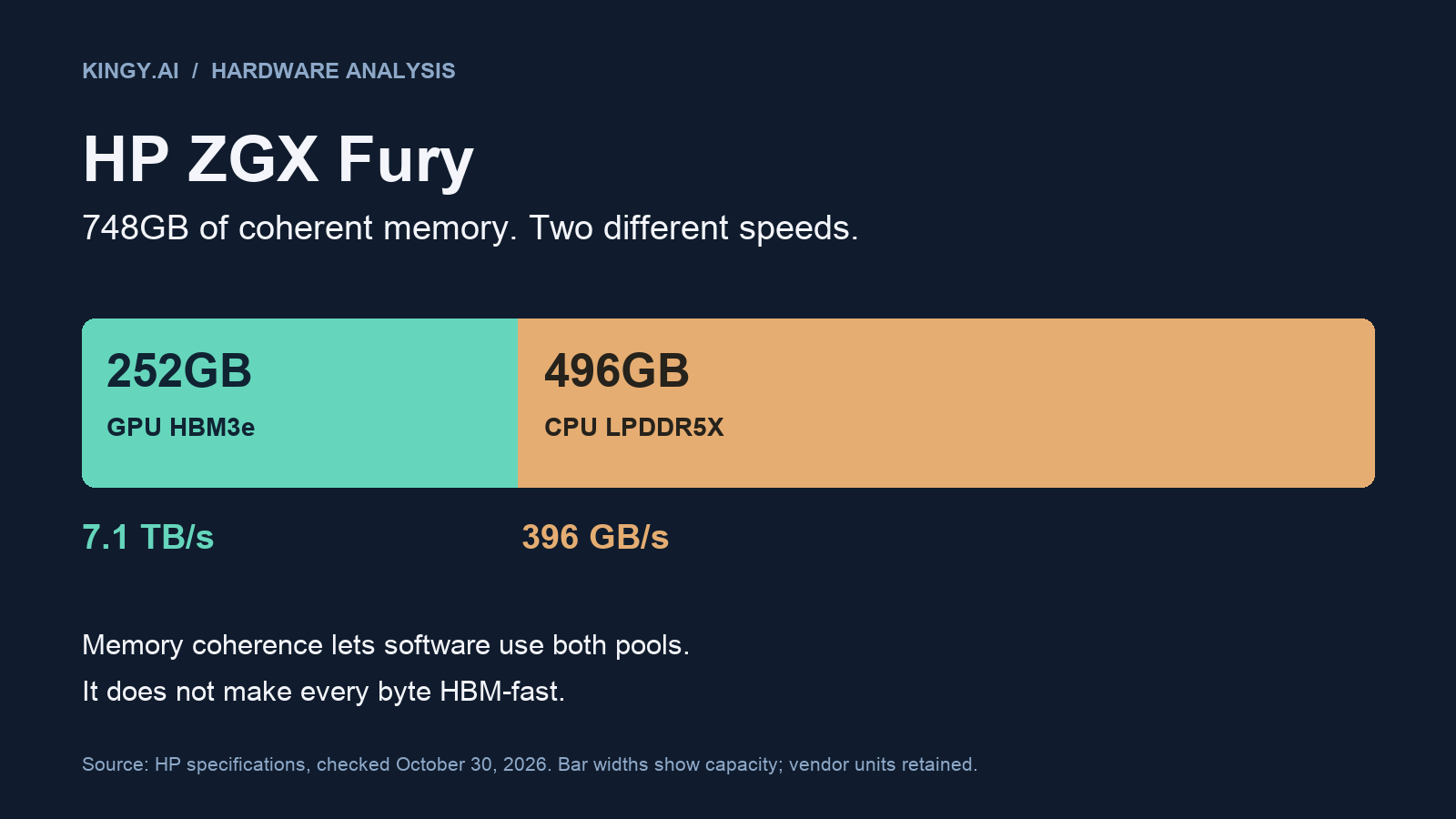
NVIDIA specifies a 900GB/s NVLink-C2C connection for its GB300 workstation platform. That link connects the processors; it does not convert the CPU memory into 7.1TB/s HBM. The listed memory bandwidths are theoretical peaks, and the real rate for a model depends on where data resides and how the software accesses it.
NVIDIA’s coherency guide makes the distinction explicit. Under its documented default mode, ordinary system allocations reside in CPU memory and cudaMalloc allocations use HBM. GPU access to CPU memory is not cached in that mode. The same coherency guide describes memory oversubscription as a tradeoff. The optimization guide recommends HBM allocations for performance-critical data.
For an LLM, model weights that do not fit in HBM can still be accessible from CPU memory. The capacity can make a larger model possible, but repeated access to those weights can constrain generation speed. The size and access pattern of the working set matter more than the headline total alone.
A rough weight calculation helps explain why:
| Model and weight format | Arithmetic weight size | What the estimate leaves out |
|---|---|---|
| 70 billion parameters at 16 bits | About 140GB | Runtime memory, cache and other overhead |
| 1 trillion parameters at 4 bits | About 500GB | Quantization metadata, higher-precision components and runtime memory |
| 1 trillion parameters at 16 bits | About 2TB | The same overhead, before training state |
These are decimal estimates, not measurements of a particular checkpoint or proof that it will fit. A mixture-of-experts model may activate only some of its parameters for each token, reducing the computation needed per token. Its full set of experts still has to be stored somewhere, and routing can make the memory-access pattern important.
Context has its own cost. The key-value cache holds information from previous tokens so the model can generate subsequent tokens without recomputing everything. Longer prompts, longer conversations and more concurrent users increase cache demand. Model architecture, cache precision and serving software affect the amount. A system that loads a model with a short prompt may run out of useful headroom at the context length your application needs.
HP ZGX Fury specifications
| Component | HP’s documented configuration |
|---|---|
| CPU | NVIDIA Grace, 72 Arm Neoverse V2 cores |
| Main GPU | NVIDIA Blackwell Ultra in the GB300 Desktop Superchip |
| Coherent memory | 252GB HBM3e plus 496GB LPDDR5X ECC |
| OS | Ubuntu 24.04 LTS with NVIDIA AI developer tools |
| Networking | Two 400Gb/s ConnectX-8 ports, 10GbE host port and separate 1GbE management port |
| Storage options | Four 2TB SSDs, or two 2TB plus two 4TB SSDs; an SED option is also listed |
| Form factor | Liquid-cooled tower or 5U rack configuration |
| Dimensions | 446 × 221.5 × 667mm, height × width × depth |
| Power supply | One 1,600W 80 Plus Titanium supply |
| Graphics options | Factory RTX PRO 2000 or RTX PRO 4000 SFF; selected RTX PRO 6000 cards available aftermarket |
Source: HP QuickSpecs, revision 3. Confirm the precise configuration and regional service terms on a quote.
The front panel has two USB-A ports rated at 5Gb/s, two USB-C ports rated at 10Gb/s and audio. At the rear, HP lists four 10Gb/s USB-A ports, audio, a micro-USB management connection and a mini DisplayPort for the baseboard management controller (BMC), alongside the network connections. The BMC display connection is for management rather than a substitute for an accelerated desktop GPU. Redfish management, TPM 2.0 and UEFI Secure Boot are listed, but their presence does not establish that a particular deployment meets a security standard. HP QuickSpecs.
The CPU is Arm-based. Linux and the NVIDIA software stack support substantial AI work, but an x86-only binary, proprietary driver, Python wheel, container image or custom CUDA extension may need an Arm build or an alternative. Check the whole pipeline, including security agents and storage clients, before assuming a workload will migrate unchanged.
The two 400Gb/s ports add up to 800Gb/s of nominal link rate, or 100GB/s before overhead when expressed in bytes. That is a networking figure, not 800GB/s of storage or memory bandwidth. A two-node design also needs compatible networking, cables and software that can use the links effectively.
The platform exposes two PCIe Gen 6-capable M.2 connections and two Gen 5 connections, but the SSD configurations listed in HP’s QuickSpecs use Gen 5 drives. Raw installed capacity also differs from usable capacity after RAID. Ask the seller for the actual layout: a mirrored operating-system pair protects against a drive failure, while a striped data volume can improve performance but does not provide the same redundancy. Neither replaces a separate backup. For example, HP’s datasheet describes RAID 1 for the OS and RAID 0 for data. On a four-by-2TB configuration, a two-drive OS mirror and two-drive data stripe would turn 8TB of raw capacity into roughly 2TB for the mirrored boot volume plus 4TB for the striped data volume, before formatting and other overhead. Confirm the actual configuration with the seller; a RAID 0 drive failure can take the striped volume offline.
HP lists a one-year limited onsite warranty in its worldwide QuickSpecs, with options and regional terms varying. Get the service response, replacement parts, support duration and exclusions in writing. HP says the liquid-cooling solution is not field repairable or replaceable, so ask how a cooling failure is handled and how long a repair or replacement would take.
Software and Windows availability
The documented shipping environment is Ubuntu 24.04 LTS with NVIDIA drivers, CUDA and container tools. HP’s October 19 QuickSpecs still list Windows as unsupported. HP demonstrated Windows on the Fury on October 7; HP Japan’s October 26 announcement says Windows support is planned for December 2026 onward. That is a regional plan, and the demonstration does not establish an orderable, supported Windows configuration today.
HP’s software adds two workflow tools. Z Runtime is a command-line application for pulling, serving and managing local models and inference engines. Z Toolkit is a VS Code extension for discovering machines, pairing environments and managing SSH connections. Those functions can reduce setup work; they do not establish that every checkpoint, quantization or custom extension is supported.
Read the client requirements before planning a Mac workflow. Although HP’s page uses broad “any device” language, its free Z Toolkit footnote specifies an x86 client running Windows 11 or Ubuntu 24.04 or later, with Visual Studio Code and a ZGX Fury host. It does not establish supported macOS use. Confirm the client and host versions, model access and licenses, update policy and support entitlement with the supplier. Red Hat certification and a software demonstration answer narrower questions than production availability or included support.
What do 20 petaflops mean?
NVIDIA lists up to 20 petaflops of FP4 tensor performance with sparsity for the GB300 workstation platform. It also lists 15 petaflops of dense FP4 tensor performance. Its 10-petaflop FP8/FP6 and 5-petaflop BF16/FP16 tensor figures also assume sparsity, according to NVIDIA’s specification footnote. These are theoretical tensor peaks, not measured LLM throughput.
Precision is part of the claim. Four-bit numbers can reduce weight storage and sometimes accelerate inference, but a model must be quantized appropriately and supported by the serving stack. Different formats, scales, kernels and sparsity assumptions make a single petaflop number a poor cross-platform speed comparison. Quantization can change output quality, so test the converted model on your own tasks alongside speed.
The same distinction applies to training. A large memory pool helps experimentation and fine-tuning, but the memory needed for full training includes more than weights: gradients, optimizer state, activations and temporary allocations can multiply the footprint. QLoRA uses quantized base weights and trains smaller adapters, making some fine-tuning jobs more practical than updating every weight. Whether a specific model and sequence length fit still depends on the implementation and memory budget. HP also advertises fine-tuning 100-billion-class models, with a footnote specifying an FP4-quantized model harness. That does not establish full-parameter training at an arbitrary sequence length or batch size. Neither a one-trillion-parameter inference claim nor a 748GB capacity figure establishes that full training of that model fits.
What the demonstrations and benchmarks show
| Evidence | System and test | Reported result | Main limitation |
|---|---|---|---|
| Sam Witteveen, sponsored | Loaned Fury; Qwen3.8 Flash Next RAG, 16 users | Over 1,300 output tokens/s aggregate | Incomplete reproducible configuration and latency data |
| HP and Infinity | GB300; Nemotron 3 Super 120.6B; 82-user baseline | 2× throughput and concurrency claimed | Joint vendor result; exact threshold and full settings undisclosed |
| StorageReview cluster | ASUS GB300 alone versus ASUS + Fury; GLM-5.2 NVFP4, 32 streams | 139 versus 1,525 output tokens/s | Two-system result includes a change in weight placement |
| StorageReview MSI comparison | MSI GB300, RTX PRO 6000 and Acer GB10; GPT-OSS 20B, 1 stream | 530, 244 and 50 output tokens/s, respectively | Separate systems and software; not a Fury result |
| HP and Quantum Sky | Larger-memory evaluation system; 744B model | 198 verified tasks across 83 projects | CPU-memory capacity differs from retail Fury |
| HP and Red Hat | Pre-GA evaluation system and multiple operating points | 11,681 output tokens/s at 500 chats reported | Model for headline not identified; no matched rival |
The cited reports and their specific conditions follow.
A sponsored multi-user demonstration
On October 30, Sam Witteveen published a demonstration of a loaned Fury and disclosed HP sponsorship. He reported more than 3,000 tokens per second in aggregate across multiple streams. In a separate retrieval-augmented generation test, he reported more than 1,300 tokens per second with 16 concurrent users and identified Qwen3.8 Flash Next.
That is useful evidence that a Fury can serve multiple users locally in a demonstrated setup. It is not a general speed guarantee. The narration does not give a complete reproducible configuration for each result, including exact model revision and quantization, engine versions, request lengths, latency percentiles, repeated runs and power draw. Aggregate output also does not tell you how long each user waited for the first token or how consistent the response felt.
HP and Infinity’s software optimization
Infinity and HP report that their work with Nemotron 3 Super 120.6B doubled concurrent capacity and token throughput on the same GB300 hardware relative to HP’s existing vLLM benchmark. Their footnote identifies an 82-concurrent-user baseline and validation using SPEED-Bench, MMLU and WikiText.
The finding is about a particular model and software optimization, not a twofold hardware upgrade. The announcement does not disclose enough detail to reproduce every result, including the numeric responsiveness threshold, full prompt and output lengths, exact software versions and quality-score changes. Buyers should ask which optimization is included in their quote and whether it supports their model, license and deployment environment.
An independent cluster test, with an important caveat
StorageReview tested an ASUS GB300 station alone and then an ASUS plus HP Fury pair connected with two 400G direct-attach cables. For GLM-5.2 NVFP4 at 32 concurrent streams, the reported output increased from 139 to 1,525 tokens per second on the short prompt/output profile. That roughly elevenfold increase includes a major change in placement: weights offloaded on the single system fit in HBM across the pair.
This is evidence for that mixed-vendor cluster and its tested stack. It is not a standalone Fury speed result or a promise that every model gets an elevenfold gain from a second system. The publication describes single-pass measurements, so repeated runs and latency distributions would strengthen the comparison. Its larger headline figure for a different model also compares different concurrency levels; it should not be read as a matched-user hardware comparison.
A separate StorageReview MSI GB300 test compared GPT-OSS 20B at native MXFP4 on a remotely hosted MSI system, a 600W RTX PRO 6000 and an Acer GB10 system. With 512 input and 512 output tokens, it reported 530, 244 and 50 output tokens per second respectively at one stream. At 128 streams, the reported aggregate rates were 22,161, 9,000 and 1,469. The figures illustrate how batching changes throughput; they are not HP Fury measurements, and the systems and software environments differ.
HP’s case studies need their configuration labels
In an HP and Quantum Sky case study, an evaluation from July 23 through August 7, 2026, used a 744-billion-parameter open-weights model and reported 198 verified tasks across 83 projects. The report describes 324 piloted targets and up to six agents concurrently. The tested node had approximately 250.7GiB of HBM and 743GiB of CPU memory. That CPU-memory figure does not match the 496GB retail specification in the current Fury QuickSpecs. Treat the study as evidence of a particular evaluated configuration, not proof that a standard retail Fury has that capacity or will reproduce its results.
An HP and Red Hat study reports 11,681 output tokens per second at 500 concurrent chat sessions in a pre-general-availability evaluation. It also describes multiple models, runtimes and operating points. The headline rate should not be assigned to a particular model unless the relevant test configuration is disclosed. Both studies are collaborative vendor evidence, and neither supplies a matched independent Mac-versus-Fury comparison.
Latency, throughput and the model your team will use
A team serving many requests may care about total tokens per second. An individual developer also cares about time to first token, the delay between subsequent tokens and whether the answer remains useful. Increasing batch size can improve aggregate throughput while increasing waiting time. A result at 128 simultaneous streams tells you little about the experience of one person unless both measurements are supplied.
Prefill and decode should be separated. Prefill processes the input prompt; decode generates the answer one token at a time. Long-document retrieval, short chat and an agent issuing many small tool calls produce different mixes. Speculative decoding, caching and model quantization can change the result, as can request arrival patterns and software versions.
For a purchase test, record the exact model revision, weight and cache precision, context length, input and output distributions, serving engine, kernels, batch settings and hardware configuration. Report aggregate output tokens per second alongside per-user latency, p50 and p95 time to first token, errors and measured power. Run enough repetitions to expose variance, and document whether the weights and cache fit in HBM or use CPU memory.
Then test answer quality. A smaller quantized model that meets a task’s quality threshold at low latency can be more useful than a larger model that fits on paper but misses the service target. For agents, include task completion and verification criteria, not only token generation.
How it compares with Mac Studio
Apple’s 2026 Mac Studio uses a different architecture and software ecosystem. Apple lists the M5 Max model with up to 128GB of unified memory and up to 614GB/s bandwidth on its 40-core-GPU configuration, and the M5 Ultra with up to 512GB and 1.2TB/s. Its specification page gives the detailed configurations.
| Decision point | HP ZGX Fury | Mac Studio M5 Ultra |
|---|---|---|
| Memory | 252GB HBM plus 496GB coherent CPU memory | Up to 512GB unified memory |
| Published bandwidth | 7.1TB/s HBM; 396GB/s CPU memory | Up to 1.2TB/s unified memory |
| Primary software environment | Arm Linux, CUDA and NVIDIA AI stack | macOS, Metal and Apple-compatible tools including MLX |
| Best starting question | Does the model and serving stack benefit from GB300, HBM and team networking? | Does the workload fit the memory and run well in the Mac software stack? |
These bandwidth figures describe different memory systems. They are not a benchmark of the same application, and they should not be added together or converted into a blanket speed ratio. A Mac’s shared memory can support a large model without a discrete GPU’s usual VRAM boundary, but model support, kernels, quantization and concurrency still determine performance.
Apple’s M5 Max Mac Studio starts at $2,499 in the US. Apple’s US Mac Studio configurator showed the following prices on October 30, before tax. The 512GB selection was available to order, with an estimated 13–15-week shipping window; delivery estimates depend on location and can change. An orderable configuration is not evidence of immediate stock.
| M5 Ultra configuration | Memory | Storage | US price |
|---|---|---|---|
| 30-core CPU, 64-core GPU | 96GB | 1TB | $5,499 |
| 30-core CPU, 64-core GPU | 256GB | 1TB | $9,499 |
| 36-core CPU, 80-core GPU | 512GB | 1TB | $22,299 |
Apple announced the Mac Studio family was shipping from September 22. The prices above are different configurations, so the memory and GPU changes both affect the comparison. Check the current configurator and delivery estimate before budgeting. Apple availability announcement.
For a Mac-native developer or a small team using supported MLX workloads, Mac Studio deserves a real evaluation. For an existing CUDA deployment or a team that needs NVIDIA’s GB300 software and high-speed cluster networking, porting and operational compatibility may favor the Fury. We found no matched, independently published Fury-versus-M5 Ultra test that settles the choice for a shared model and latency target.
Future Macs are a separate question. No next-generation Mac Studio specification was established in the sources reviewed. Buy against a current configuration and workload, or wait with the understanding that an unannounced machine has no confirmed price, delivery date or benchmark.
DGX Spark, RTX workstations and other alternatives
DGX Spark and HP ZGX Nano
NVIDIA’s DGX Spark and HP’s ZGX Nano use GB10 rather than GB300. The reference Spark has 128GB of coherent LPDDR5X memory, 273GB/s memory bandwidth and a 20-core Arm CPU; NVIDIA notes that some OEM options differ. Its published 1-petaflop sparse FP4 peak and the Fury platform’s 20-petaflop peak are architectural reference figures, not a promise that the Fury is twenty times faster on every job.
Spark is a more approachable personal development system and can be sufficient for smaller models or prototypes. Fury offers much more capacity, a fast HBM tier and higher-end networking for a team or a larger serving workload. NVIDIA’s February 2026 price announcement raised the Founders Edition MSRP to $4,699. NVIDIA’s marketplace displayed a 128GB, 4TB Spark at $6,950 on October 30; that is an observed listing, and price and availability can change. Check the seller before ordering.
RTX PRO 6000 and conventional workstations
An RTX PRO 6000 Blackwell has 96GB of GDDR7 ECC memory and a listed 1,792GB/s bandwidth for the 600W workstation card. If a model and its cache fit in that memory, an x86 workstation with this card can be a compelling CUDA and graphics machine. It can also offer a familiar software environment and expansion options.
Multiple discrete GPUs can add compute and memory capacity, but their memory does not automatically become one uniform pool. Model parallelism, interconnects, PCIe topology and software support matter. The HP Z8 Fury is an example of a separate x86 multi-GPU approach. Compare a complete, supported configuration and the actual model placement rather than counting GPU memory as though it were one HBM allocation.
The Fury itself can use an optional display GPU. HP’s QuickSpecs warn that certain aftermarket RTX PRO 6000 configurations may cause a GB300 power limit at boot. Its separate graphics memory is not part of the GB300 hardware-coherent HBM/CPU pool. Ask for the power policy, card, thermal configuration and effect on your intended AI workload before adding one.
AMD options
AMD’s Ryzen AI Max+ 395 is a much smaller class of machine, with a 16-core CPU and integrated Radeon graphics. AMD lists 256GB/s memory bandwidth and a 120W processor TDP. That processor figure is not the complete system’s wall power. A suitable 128GB system can be useful for local development, provided the model and software stack are supported. Check the actual ROCm or other runtime compatibility for the application, not merely the processor specification.
AMD has also announced a Threadripper Halo Station prototype for 2027. AMD lists up to 96 CPU cores and 192 threads, up to 576GB of HBM plus 2TB of RDIMM memory, and up to 16TB/s aggregate GPU memory bandwidth alongside 410GB/s CPU memory bandwidth. These are vendor prototype specifications; the bandwidth figures describe different memory paths. It is a future alternative, not an available purchase with a verified price or matched benchmark. Teams with a procurement deadline should compare shipping configurations first.
Price, power and the full cost of ownership
HP said the Fury was available to order in September. We did not verify a universal US list price. HP Japan announced a starting price of ¥28,490,000 including consumption tax, with sales beginning October 27, 2026. That is a Japanese regional price, not a US MSRP; configuration, tax, support and currency differ.
On Intelligence’s US-dollar storefront displayed a $94,000 listing on October 30. This is one seller’s observed listing, not HP’s universal MSRP or a confirmed delivered total. Confirm its precise configuration, tax, support and lead time directly before relying on it.
A useful quote should itemize the system, storage, optional display card, software and model licenses, onsite support, networking and cables, electrical installation, delivery date and taxes. Ask whether the proposed software environment is supported on delivery. Hardware certification or a planned software offering does not by itself establish that every software component is included at no extra cost.
HP’s US product information calls for dedicated 200–240V power. Confirm the outlet, circuit, facility load, rack clearances and cooling with the installer and local documentation before ordering. The single 1,600W power supply is a capacity rating, not proof that every workload draws 1,600W. It is also a single supply, so a team should plan maintenance and recovery around one machine as a failure domain.
HP’s QuickSpecs report 308W idle and 1,618W maximum under its stated Linux stress-test conditions at 230V/50Hz. Those are not measured LLM serving averages. At a hypothetical $0.15 per kWh, continuous operation at the published idle figure would use about 2,698kWh and cost about $405 a year; continuous operation at the reported stress maximum would use about 14,174kWh and cost about $2,126. Both calculations exclude cooling and use an illustrative electricity tariff. Measure the actual workload before estimating its energy cost per useful token.
HP lists 52.52dB(A) of sound power in its QuickSpecs. Sound power is not the same measurement as sound pressure at a person’s desk, so it cannot tell you how loud the system will sound in a particular room. HP’s documents also conflict on mass: the datasheet lists a starting system mass of 41kg, while the QuickSpecs list 27.61kg shipping weight. Obtain a written shipping and installed-weight confirmation for the actual SKU before planning a rack or move.
A standalone retail Fury test with repeated runs, power, latency distributions, noise at a specified position and an exact shipping configuration would answer questions the current evidence leaves open. The mixed-vendor cluster and larger-memory case study remain informative within their boundaries; neither establishes standalone performance for every retail unit.
Local inference can remove a per-token API bill for the work you move onto the machine. It still has hardware, support, electricity, cooling, storage, network, operator time and downtime costs. A fair cloud comparison needs the same quality target, request volume and latency service level. A cheaper local answer is not equivalent if it fails the task that a cloud model completes.
Who should buy it?
The strongest case is a team with a demonstrable need for large local models, CUDA-compatible software and enough sustained work to use the capacity. Sensitive or regulated workloads may benefit from keeping data under the organization’s control, but local placement alone does not provide security or compliance. Access controls, patching, network policy, logging, backup and model licensing still need attention.
The case is weaker for a single user whose models fit comfortably on a smaller system, or for a team without an operator and a clear plan for upgrades and recovery. A cloud service can also be the better economic choice for intermittent work, particularly when demand spikes are unpredictable. Compare the complete service and its quality rather than the nominal cost of one token.
Before signing, ask the supplier to run a representative workload or agree to an acceptance test on the delivered configuration. Replay real prompt and output lengths, include peak concurrency and long-context cases, measure latency and quality, then test a restart, backup restoration and access controls. Specify the model, software versions and success thresholds in writing. The resulting measurements will answer more about this purchase than the 748GB headline can.
The Kingy Brief
Get The Kingy Brief.
AI changes, original tests and one practical thing to try. Fridays at 09:00 Vancouver time.
Free · Double opt-in · Unsubscribe anytime
Sign up for The Kingy Brief on Beehiiv.
Signup help and newsletter schedule
Signup form provided by Beehiiv. After submitting, check your inbox for "Confirm your subscription to The Kingy Brief" and open its confirmation link. Check Spam or Promotions if you cannot find it.
Fridays at 09:00 Vancouver time: source-checked AI changes, original tests and one practical thing to try. We skip a week when there is not enough verified material. Free. Unsubscribe anytime.