
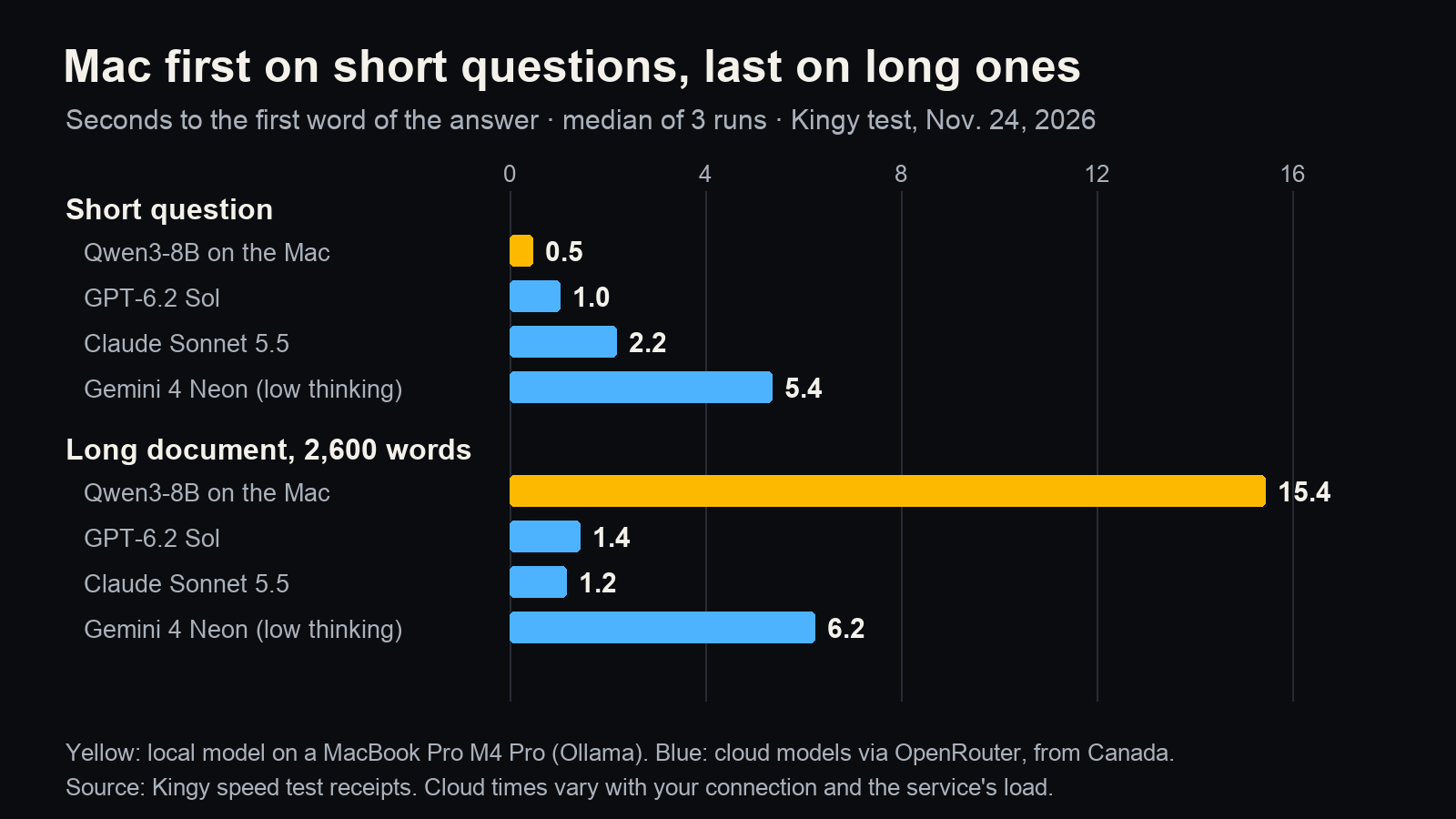
For a short question, local AI on a Mac starts answering faster than ChatGPT, Claude or Gemini. In Kingy’s test, Qwen3-8B on our MacBook Pro began its answer in a median 0.5 seconds. GPT-6.2 Sol took 1.0 seconds, Claude Sonnet 5.5 took 2.2 and Gemini 4 Neon took 5.4.
With a long document the order flips. Asked to summarise an article of about 2,600 words, the Mac took 15.4 seconds to start writing because it had to read the whole document first. Claude started in 1.2 seconds and GPT-6.2 Sol in 1.4. Claude and GPT-6.2 Sol also finished the whole summary in under 3.3 seconds and Gemini in 7.1, against 25.2 on the Mac.
So the Mac feels instant for quick questions and slow with long documents. The cloud models were quick at both in our test, as long as the connection held up.
The results
Each model got the same two prompts three times, and we report the median. “First word” is the time from sending the prompt to the first word of the answer arriving.
| Model | Where it ran | First word, short question | First word, long document | Finished, long document |
|---|---|---|---|---|
| Qwen3-8B | MacBook Pro (Ollama) | 0.5 s | 15.4 s | 25.2 s |
| GPT-6.2 Sol | Cloud (OpenAI) | 1.0 s | 1.4 s | 3.2 s |
| Claude Sonnet 5.5 | Cloud (Anthropic, via AWS) | 2.2 s | 1.2 s | 2.7 s |
| Gemini 4 Neon, thinking set to low | Cloud (Google) | 5.4 s | 6.2 s | 7.1 s |
Total times depend on how long each answer was, and the models wrote different lengths. For the long summary, Qwen3-8B wrote a median 92 tokens, GPT-6.2 Sol 141, Claude 247 and Gemini 563. A token can be a word, a piece of a word or a punctuation mark.
Why the Mac wins short and loses long
A cloud model’s answer has to travel over the internet both ways, and the request may wait in a queue. A local model skips all of that. On the one-line question, GPT-6.2 Sol’s whole wait, network included, was 1.0 second against the Mac’s 0.5. We didn’t measure the network part separately. Claude’s 2.2-second median was mostly thinking time: on the one run where it didn’t think first, it started in 0.8 seconds.
Before writing, every model has to read the prompt. GPT-6.2 Sol took only about 0.4 seconds longer to start on the long document than on the short question, so by our estimate its servers read the document in well under a second. A laptop takes far longer: the 2,600-word article took the Mac about 15 seconds. In our earlier 20-task test on the same Mac, we estimated that a 27B model needs over a minute to read an 8,000-token prompt. The longer the document and the bigger the model, the longer the wait.
Once writing starts, speed depends on the machine. Our local AI vs cloud AI comparison lists generation speeds from about 10 to over 90 tokens per second on different computers.
What this means for you
- Quick questions, rewrites, short replies: a small local model feels as fast as the cloud or faster, and works offline.
- Long documents, transcripts, codebases: the cloud is far faster to start. On a laptop, expect a wait of many seconds before a local model writes anything.
- Bigger local models make the wait longer. On this Mac we estimated that a 27B model needs over a minute to read an 8,000-token prompt. Check what your machine can run with What AI can my computer run?
- Cloud speed depends on the model’s settings. Gemini 4 Neon was the slowest cloud model here, even with its thinking turned down.
Kingy tested
Kingy tested on November 24, 2026, on our MacBook Pro with an M4 Pro chip and 24 GB of memory, running macOS 26.3, over a residential Wi-Fi connection in Canada. Qwen3-8B (Q4_K_M) ran in Ollama 0.40.17 with thinking off and an 8,192-token context window; it answered directly, with no visible reasoning. The cloud models were called through OpenRouter, which picked the provider: OpenAI, Claude on AWS and Google. OpenRouter sits between us and each company; we did not measure how much time that adds.
Each answer was capped at 300 tokens, and 1,200 for Gemini. Every prompt began with a unique run label so that no model could reuse a cached copy of an earlier prompt. The long prompt was the text of our own local AI vs cloud AI comparison, about 2,600 words (3,796 tokens by the Mac model’s count), ending with “Summarise the article above in three sentences.”
The 18 cloud calls cost US$0.14, plus US$0.08 for the Gemini re-run described below: US$0.22 in all, at OpenRouter’s November 24 prices.
Limits of this test
- Three runs per prompt in one late afternoon, from one residential connection. Cloud times change with your distance from the data centre, your connection and how busy the service is.
- The cloud models are far larger than an 8B model running on a laptop. This compares the experience of using each, not the models’ quality.
- Claude Sonnet 5.5 ran with its default settings and thought briefly before two of its three short answers. GPT-6.2 Sol used no reasoning tokens.
- Gemini 4 Neon, at its default setting, spent all 300 allowed tokens thinking and wrote no answer in any of its first six calls. We re-ran it with thinking set to low and room for 1,200 tokens; the table uses the re-run.
- The first Qwen3-8B run of the short question took 20.8 seconds, most likely because the model was reloading with a larger context window. The other two runs took 0.3 and 0.5 seconds, so the median of the three is 0.5.
- We also ran Qwen3-4B, but the installed version is a thinking model that ignored the setting to turn thinking off. It started writing within a second for short prompts and in about 5.7 seconds for the long one, but every reply began with its reasoning and used the full 300 tokens, so we could not time its answers and it is not in the table.
Frequently asked questions
Is local AI faster than ChatGPT?
For short questions, it can be. Qwen3-8B on Kingy’s MacBook Pro started answering in 0.5 seconds against 1.0 for GPT-6.2 Sol. With a long document, GPT-6.2 Sol and Claude were 10 to 13 times faster to start, and Gemini about 2.5 times.
Why is local AI slow with long documents?
The model has to read the whole prompt before it writes anything. A laptop reads far more slowly than a data centre: our Mac took about 15 seconds for a 2,600-word article.
How fast is ChatGPT’s model?
GPT-6.2 Sol, through OpenRouter, started answering in a median 1.0 to 1.4 seconds in our test and finished a three-sentence summary in about 3.2 seconds.
Which cloud AI is fastest?
In this small test, Claude Sonnet 5.5 and GPT-6.2 Sol both started within about 2 seconds. Gemini 4 Neon was slowest, at about 5 to 6 seconds, even with thinking set to low.
Sources
- Kingy’s speed test, November 24, 2026 (this article)
- OpenRouter, model access and per-call cost, November 24, 2026
- Kingy: Local AI on a 24GB MacBook Pro vs ChatGPT and Local AI vs cloud AI
Revision log
- November 24, 2026: first version.