What you actually get today
Gemini Decision: Available now.
Is it free? Yes, within a free tier or free limits. On the Gemini API free tier, with lower rate limits. Google says free-tier data is used to improve its products.
Where to try it free:
- Gemini API free tier (model gemini-decision-1 on the Decisions API): 200 requests a minute, 50,000 tokens a minute, 10,000 requests a day (source)
| Where | Who | Status | Notes |
|---|---|---|---|
| Gemini API: Decisions API, model gemini-decision-1 | Gemini API developers on the free tier or a paid tier | Available now | Google does not say every account in this group has it. Released in the November 11, 2026 release notes. Calls go to the v1beta endpoint and need Google's SDK 3.2 or later. (source) |
| Google AI Studio sample apps (Decisions Playground and two demos) | Google AI Studio users | Available now | Google does not say every account in this group has it. Linked from the model page as apps to try it on your own text and media; no separate limits stated. (source) |
Not included:
- Any generated text: it returns only probabilities, choices and scores (source)
- Batch API and context caching (source)
- Function calling, structured JSON output, thinking, search grounding and the Live API (source)
- Regions: Not stated in the Google pages we checked.
- Price: Paid tier: $0.10 per million input tokens for text, images, video, audio and PDFs; no output charge because it makes 0 output tokens. Free tier: no charge (source)
- Limits: Up to 262,144 input tokens and 1 to 1,000 questions per request. Rate limits by tier are in the table below (source)
- Tested by Kingy: Not tested by Kingy yet.
Checked against Google’s own pages on Nov 11, 2026, 18:40 UTC. Rollouts change in the first days; this box is re-checked for 72 hours.
Google released Gemini Decision on November 11, 2026. It is not a chatbot model. It reads text, images, video, audio or a PDF and answers questions you give it with numbers instead of words: the chance that something is true, which option from your list fits best, or a score on your own rubric. Google’s release notes list it as gemini-decision-1, used through a new Decisions API, and it makes zero output tokens. That last part is what changes the bill: you pay only for what you send in.
What one decision costs
Google’s pricing page lists one price on the paid tier: $0.10 per million input tokens, the same for text, images, video, audio and PDFs. There is no output price, because there is no output text. On the free tier, input is free of charge.
The useful detail is how questions are billed. Google says the shared input is billed once per request, no matter how many questions you ask about it. Each question adds only the tokens of its own wording and answer options.
In plain numbers (Kingy’s arithmetic, not a Google figure): a support message plus order details of about 2,000 tokens, checked with ten questions of about 50 tokens each, is about 2,500 input tokens. At $0.10 per million, that is $0.00025 per request, or about $0.25 for 1,000 checked messages. Images and video count as tokens too, so a long video costs more than a short message.
For a sense of scale on the same page, Google’s Gemini Embedding 2 lists text input at $0.20 per million tokens. The two do different jobs, so this is a price reference, not a like-for-like swap.
Rate limits by tier
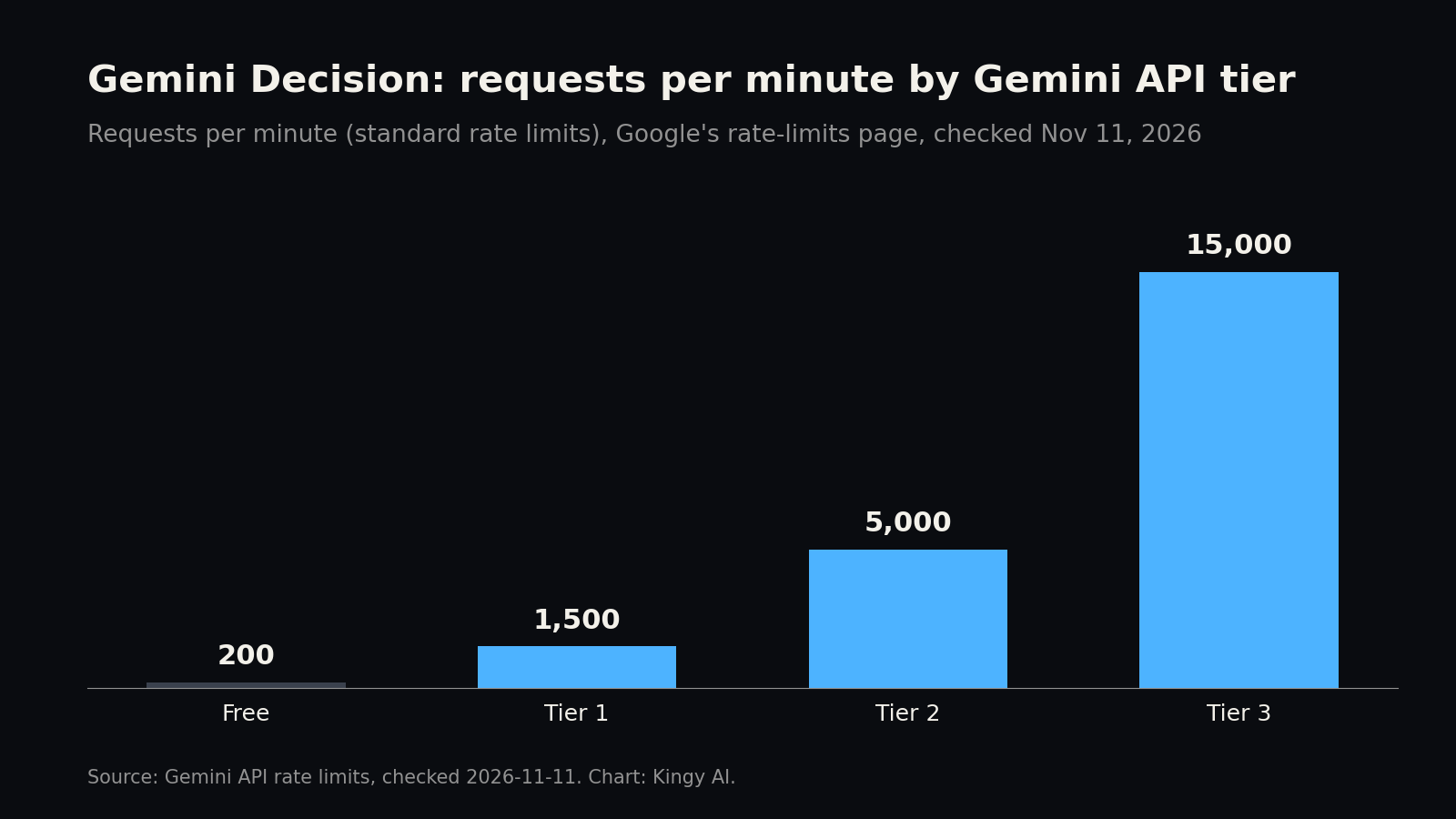
Gemini Decision has its own rate limits on Google’s rate-limits page. Requests per minute rise from 200 on the free tier to 1,500 on Tier 1, 5,000 on Tier 2 and 15,000 on Tier 3.
| Gemini API tier | Requests per minute | Tokens per minute | Requests per day |
|---|---|---|---|
| Free | 200 | 50,000 | 10,000 |
| Tier 1 | 1,500 | 1,000,000 | 50,000 |
| Tier 2 | 5,000 | 4,000,000 | Unlimited |
| Tier 3 | 15,000 | 10,000,000 | Unlimited |
The free tier’s 50,000 tokens a minute is the tighter limit for anything bigger than short text: at the 262,144-token maximum input, a single request would not fit in a free-tier minute.
What it does, in practice
The Decisions API guide describes three kinds of question:
- Yes or no. Returns the probability that the answer is yes, always between 0.01 and 0.99, plus a confidence score.
- Pick one. Scores 2 to 255 options you define and returns the top one with a probability for each.
- Rate on a scale. Scores 2 to 255 ordered rubric levels and returns a weighted score that can fall between levels.
One request can carry 1 to 1,000 questions over the same input, up to 262,144 tokens, according to the model page. Google says the questions run in one pass and cannot see each other, so adding or removing one does not change the other answers. Google’s suggested uses are routing requests to the right queue or model, checking content against many policy rules at once, scoring candidate answers against a rubric, picking tools for an agent, and reacting to live video or audio.
A few limits from the guide matter before you build on it. A pick-one question always spreads probability across your options, even when none of them fits, so Google suggests a separate yes/no scope check or an “other” option. Option names are sorted alphabetically before scoring. Requests blocked by safety filters return an error instead of answers. And Google itself says to treat user text as untrusted and keep a human or a second check on high-stakes actions such as payouts.
Gemini Decision versus a regular Gemini call
There is no earlier Gemini Decision model to compare with. The closer question is when to use it instead of asking a normal Gemini model and reading its answer. This table uses only what Google’s pages state.
| Item | Gemini Decision (Decisions API) | Regular Gemini model (Interactions API) | Source |
|---|---|---|---|
| What comes back | Probabilities, a chosen option or a score, with confidence | Generated text, JSON that follows your schema, or tool calls | Decisions API guide (Vendor-reported) |
| Output tokens billed | 0 | Yes, per output token | Gemini API pricing (Vendor-reported) |
| Many checks on one input | Up to 1,000 questions; shared input billed once | Not what Google lists it for; Google points many-checks jobs to the Decisions API | Decisions API guide (Vendor-reported) |
| Reasoning, tool calls, text answers | Not supported | Supported | Model page (Vendor-reported) |
| Batch API and caching | Not supported | Depends on the model | Gemini API pricing (Vendor-reported) |
What is still unknown
- Accuracy. Google calls the probabilities “calibrated” but the pages Kingy checked publish no accuracy or calibration scores for
gemini-decision-1. - Speed. Google says latency stays nearly flat as you add questions, but gives no millisecond figures.
- Whether it is offered on Vertex AI or in any Gemini app. The pages Kingy checked mention only the Gemini API and AI Studio sample apps.
- Country availability specific to this model. The model, pricing and rate-limit pages do not list regions.
- Whether it stays on the
v1betaendpoint. Google’s code examples use v1beta and do not label the model as a preview.
What Kingy tested
Not tested by Kingy yet. The prices, limits and features above come from Google’s own Gemini API pages, fetched on November 11, 2026.
Sources
- Google: Gemini API release notes (November 11, 2026 entry), fetched November 11, 2026
- Google: Gemini Decision model page, fetched November 11, 2026
- Google: Decisions API guide, fetched November 11, 2026
- Google: Gemini API pricing, fetched November 11, 2026
- Google: Gemini API rate limits, fetched November 11, 2026
- Google: Gemini API models list, fetched November 11, 2026
Revision log
- November 11, 2026: First published, from Google’s release notes, model page, Decisions API guide, pricing and rate-limit pages.