

Google released Gemini 4 Neon on November 18, 2026, at $3 per million input tokens and $15 per million output tokens. It landed close to Gemini 4 Carbon in Arena’s early chat and web development results. It also costs 50% more per token than Carbon through November 30. That reverses on December 1, when Google’s introductory rates for Carbon and Argon end. Google announcement · Gemini API pricing
The strongest benchmark story is how much the surrounding software matters. In DeepMind’s SWE-sweep table, Neon scored 39.0% inside Google Antigravity and 12.8% in a shared mini-SWE setup. Its lead over GPT-6.2 Sol narrowed from 30.7 percentage points to 1.2. If you’re choosing a coding agent, the model and the tool you run it in are both part of the purchase. DeepMind evaluation, pp. 2 and 5
Benchmarks · Independent Arena results · Specs and access · Pricing and worked costs · Open-weight alternatives
Gemini 4 Neon benchmark results
DeepMind’s November evaluation compares Neon with Claude Opus 5.5 and GPT-6.2 Sol. It combines results from evaluator leaderboards, published competitor results and DeepMind’s own runs. Neon generally uses its highest thinking level and one attempt per problem, with exceptions noted below. The rows use different metrics. Read each one across before comparing models. DeepMind evaluation and methods
| Benchmark | Neon | Opus 5.5 | GPT-6.2 Sol |
|---|---|---|---|
| AA Intelligence Index v5.0.1 | 61 | 59 | 57 |
| Vals Index v2.2 | 70.9% | 70.1% | 66.1% |
| CursorBench 4.1 | 65.4% | 58.1% | — |
| Terminal-Bench 4.1, adjusted | 65.2% | 65.8% | 61.5% |
| FrontierCode 2.0, main score | 46.2% | 47.3% | 43.8% |
| AutomationBench | 56.3% | 42.5% | 41.3% |
| Agents’ Last Exam v1.1 | 75.8% | 71.6% | 73.0% |
| RiemannBench | 84.0% | 80.0% | 80.0% |
| Terminal-Bench Science 0.1 | 70.5% | 63.3% | 68.0% |
| HLE-Diamond | 71.3% | 67.9% | 64.0% |
| Chartography | 73.5% | 66.3% | 75.1% |
| LVBench, vision only | 89.0% | 83.7% | 87.6% |
| GraphWalks, BFS F1 at 256K–1M | 95.2% | 66.8% | 80.1% |
Missing values were unreported in the source table. Terminal-Bench 4.1 uses cheating-adjusted accuracy. Neon’s FrontierCode result uses high. On the AA composite, Neon is xhigh, Opus 5.5 is Max with default fallback and Sol is Max. Score table and source by benchmark · AA model leaderboard · Google announcement
Repository coding depends on the agent harness
On Terminal-Bench 4.1, Neon trails Opus by 0.6 percentage points and leads Sol by 3.7 in DeepMind’s table. On FrontierCode 2.0, it trails Opus by 1.1 points and leads Sol by 2.4. Those margins are much smaller than the differences in the SWE-sweep provider setup below. Terminal-Bench and FrontierCode test different work, and a score averaged across one suite gives you no task-level guarantee. DeepMind evaluation
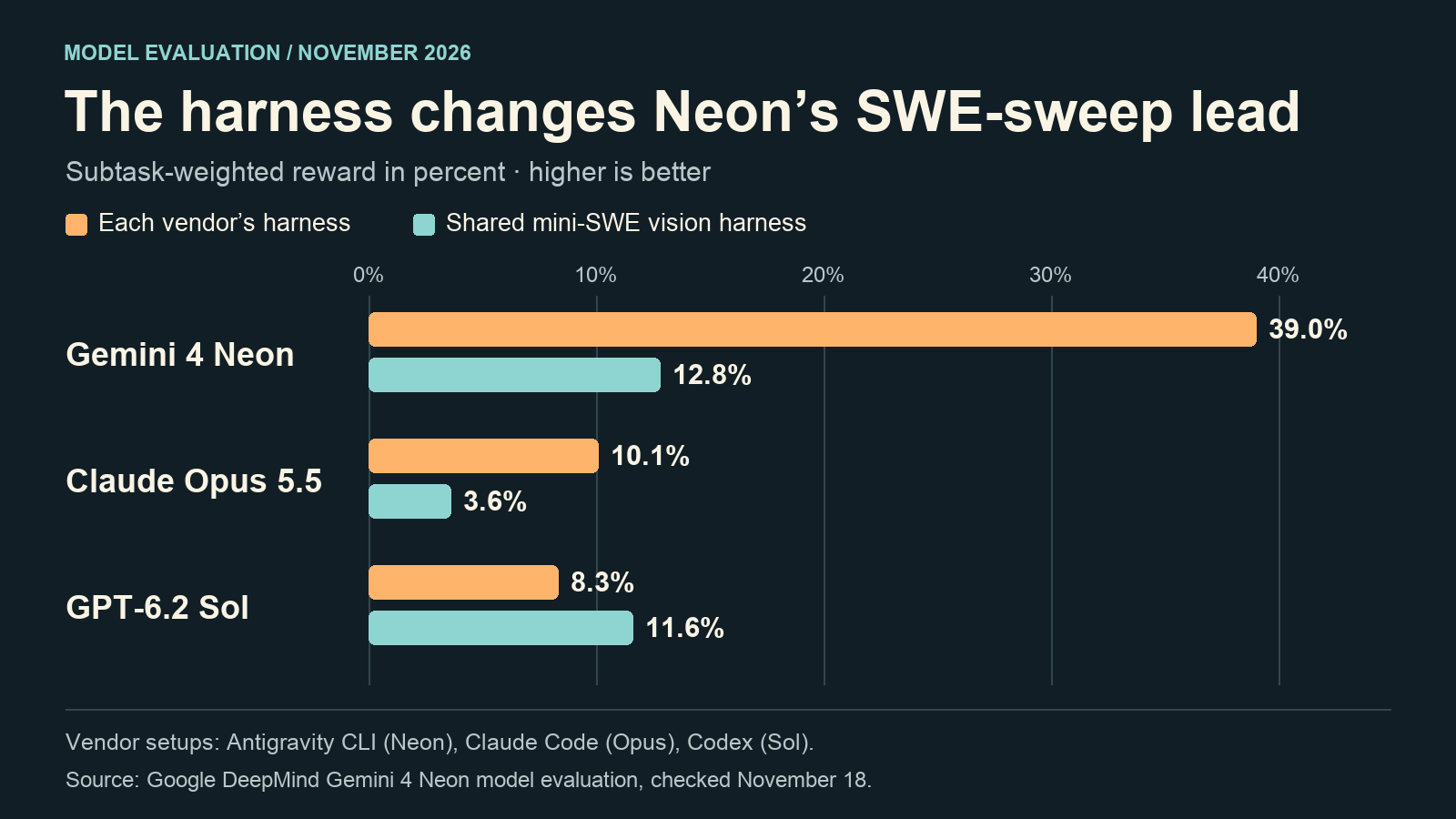
DeepMind used Antigravity CLI 1.5.9 for Neon, Claude Code for Opus and Codex for Sol in the provider-harness run. Their subtask-weighted rewards were 39.0%, 10.1% and 8.3%, respectively. With the shared mini-SWE vision harness the same models scored 12.8%, 3.6% and 11.6%. Google says Antigravity’s default ability to send subagents across a repository suits this test. The setups also differ in other ways, so the table cannot isolate how much of the 26.2-point change for Neon came from subagents. DeepMind’s SWE-sweep methodology
Cursor provides an independent check on effort and cost. CursorBench 4.1 reports 45.5% at $1.26 per test for Neon Low, 57.7% at $3.07 for Medium, 63.7% at $6.54 for High and 65.4% at $10.67 for Extra High. The last step bought 1.7 percentage points at 63% more cost in this suite. Carbon High scored 61.5% at $8.52. Neon High posted the better score and the lower cost per test in this setup. CursorBench 4.1 results and changelog
Knowledge work, science and multimodal results
Work across tools. Zapier’s AutomationBench independently lists Neon XHigh at 56.32% and $1.69 per run, and Neon High at 54.34% and $0.88. Carbon High got 53.88% at $2.12, while GPT-6.2 Astra Max got 52.36% at $0.83. On Agents’ Last Exam v1.1, Neon’s 75.8% was a DeepMind run on 122 tasks with Antigravity CLI 1.4.8 and a five-hour window. The report uses a rubric average there. That setup matters if you plan to run an agent inside a short request timeout. Zapier AutomationBench · DeepMind methods
Science and reasoning. The report’s 70.5% for Neon on Terminal-Bench Science 0.1 is average reward across five attempts per task using a mini-SWE vision setup. The competitor figures come from the public leaderboard. The report sources the 71.3% HLE-Diamond result from Artificial Analysis and the 84.0% RiemannBench result from that benchmark’s leaderboard. Each measures a different skill and uses its own scoring. Evaluation methods
Charts, video and long context. Sol leads Neon by 1.6 points on Chartography in DeepMind’s runs without tools. The Opus result comes from its system card. Neon leads on LVBench, where Google used one low-resolution frame per second for Gemini, 500 frames for Sol and 600 for Opus because of API limits. The 95.2% GraphWalks F1 result covers 200 graph problems in the 256K-to-1M range. A document workflow still needs its own test of whether the model locates the right page, reads the numbers and grounds its answer. Multimodal and long-context methods
How to read the composite scores
Google reports 61 at xhigh on Artificial Analysis Intelligence Index v5.0.1, a composite of nine evaluations. At our launch-day check the evaluator’s public results listed Fable 5.2 Max with default fallback at 65, Astra Max at 62, Carbon High at 60 and Hydrogen XHigh at 54. Google credits Artificial Analysis for Neon’s result, and the public snapshot we could inspect had yet to add the Neon row. Google also cites 58.6 on AA’s Coding Agent Index, which measures a different suite. The Intelligence Index includes Terminal-Bench 4.0, while the Coding Agent Index uses Terminal-Bench 4.1. AA model results · AA v5.0.1 methodology · AA coding-agent methodology · Google announcement
Google likewise reports 70.9% on Vals Index v2.2. Vals weights finance, coding, legal and tax by their share of U.S. GDP. Its public November 16 snapshot, which predates Neon’s release, lists Fable 5.2 at 71.31%, Sonnet 5.5 at 70.85% and Carbon at 70.45%. The reported Neon figure sits in that group. The precision and timing of the snapshots make a fraction of a point a poor reason to switch models. Vals Index v2.2 · Google announcement
What Arena shows independently
Arena tested Neon at High. Its Text and WebDev boards use model preference ratings. Agent Arena combines task completion, praise versus complaints, how agents respond to corrections, and Bash-command reliability in user sessions. Each rating belongs to its own leaderboard and setup. Text Arena · WebDev Arena · Agent Arena methodology
| Arena test | Neon rating | Displayed rank | Closest context |
|---|---|---|---|
| Text, Nov. 18 | 1,518 ±10 | 3rd | Carbon High 1,526 and Argon High 1,521 |
| WebDev, Nov. 18 | 1,764 ±14 | 7th | Sol Max 1,771, Carbon High 1,769 and Hydrogen High 1,703 |
| Agent, Nov. 17 | 1,336 ±33 | 2nd | Fable 5.2 Max 1,453, Opus 5.5 Max 1,335 and Carbon High 1,303 (preliminary) |
Neon’s Text rating comes from 3,885 votes, and Arena gives it a rank range of 1–5. WebDev uses 2,308 votes with a rank range of 3–10. Agent Arena counted 4,234 sessions for Neon with a rank range of 2–6. The one-point difference between Neon and Opus on Agent Arena is smaller than either model’s displayed uncertainty. Arena’s breakdown put Neon second on steerability, third on task completion and 49th on Bash-command reliability. On WebDev, Fable 5.2 XHigh scored 1,824, Opus 5.5 Max 1,818 and GPT-6.2 Astra Max 1,797. The different effort settings are part of the comparison. Text results · WebDev results · Agent results and model breakdowns
Arena’s Agent cost chart gives Neon a median of $2.66 per task and Carbon $1.34 in its snapshot. Google separately says Neon High cost 32% less per task than Carbon in Artificial Analysis’s benchmark. The workloads differ, and pricing assumptions may differ as well. To estimate your own bill, count reasoning tokens, repeated requests and tool calls through to a usable result. Agent Arena cost chart · Google’s cost claim
Specifications and availability
The model card says Neon is adapted from Gemini 4 Carbon and gives a March 2026 knowledge cutoff. Google positions it between Hydrogen and Carbon for frequent, complex work. An exact Neon parameter count and training compute figure are undisclosed in the card. DeepMind model card · Google’s model guide
| Specification | Gemini 4 Neon |
|---|---|
| Stable model ID | gemini-4-neon |
| Context budget | 1,048,576 tokens shared across input, thinking and output |
| Output | Text. Up to 65,536 combined thinking and output tokens per synchronous segment. Long Decode can continue up to the remaining shared budget. |
| Inputs | Text, image, audio, video and PDF. Google also documents supported Office and OpenDocument formats and file slicing. |
| Thinking levels | low, medium, high (default), xhigh |
| Tools | Function calling, structured output, code execution, file search, computer use, URL context and Search or Maps grounding on the Developer API |
| Caching | Implicit prompt caching at launch, with a 4,096-token minimum. A cache hit depends on prompt reuse. |
| Media generation | Text output only. Image generation, audio generation and Gemini Live use other models. |
Developer API model reference · Long Decode · Google Cloud specifications
A 900,000-token input leaves at most 148,576 tokens for reasoning and output combined. The one-million-token output ceiling assumes nearly the entire window is available. Clients that need more than a synchronous segment can use background execution in the Interactions API or continuation on a supported API route, with an explicit output budget. A low max_output_tokens can cut off the final answer because it counts thinking too. Neon migration guide · Long Decode
When moving from an older Gemini, set thinking_level explicitly. Legacy thinking_budget and the minimal level trigger validation errors on Neon. Temperature, top-p and top-k use fixed settings. For large inputs, slicing is a more useful knob. The document API can read only the relevant worksheet ranges or pages, and the media options support time intervals. Migration guide · November 18 release notes
What you actually get today
Gemini 4 Neon: Available now.
Is it free? No, paid access only. The Gemini Developer API lists Neon on its paid tier. (pricing)
| Where | Who | Status | Notes |
|---|---|---|---|
| Gemini Developer API | Paid-tier projects | Available now | Google does not say every account in this group has it. Stable model ID gemini-4-neon on generateContent and the Interactions API. (source) |
| Gemini app and Google Antigravity | Google AI Pro and Ultra subscribers | Rolling out, not every account yet | Google does not say every account in this group has it. November 18 rollout per Google. (source) |
| Google AI Studio | Google AI Pro and Ultra subscribers | Available now | Google names both plans for AI Studio access. (source) |
| Gemini for business | Enterprise users | Rolling out, not every account yet | Google does not say every account in this group has it. Google announced an API and a model dropdown. (source) |
| Gemini Enterprise Agent Platform (Vertex AI) | Verified enterprise customers in listed regions | Available now | Google does not say every account in this group has it. Standard and Priority PayGo and Provisioned Throughput are documented. (source) |
Not included:
- Explicit caching at launch, media generation or the Gemini Live API (source)
- Regions: Google Cloud lists global, US and EU endpoints for eligible projects. (source)
- Price: Standard $3.00 in and $15.00 out per million tokens, including thinking in the output rate. (source)
- Limits: 1,048,576 shared tokens. Synchronous segments of up to 65,536 combined thinking and output tokens. (source)
- Tested by Kingy: Not tested by Kingy yet.
Checked against Google’s own pages on Nov 18, 2026, 21:37 UTC. Rollouts change in the first days; this box is re-checked for 72 hours.
OpenRouter also lists google/gemini-4-neon. Its endpoint registry shows different completion limits and prices by route. The Google AI Studio Standard route showed 65,536 completion tokens at $3.00/$15.00 per million, while its Flex route showed $1.50/$7.50 and a different limit. Confirm the route if you need long output. OpenRouter model listing · Endpoint registry
Pricing against Gemini, GPT and Claude
These are U.S. dollars per million tokens on the Gemini Developer API. Google bills thinking tokens as output and charges Neon the same unit rate across its context window. Search grounding, where available, has a shared allowance of 5,000 free searches per month across Gemini 3 and newer models, followed by $14 per 1,000 searches. The default cap is 1,500 searches per project per day. One model request can trigger several billable searches. Gemini API pricing · Neon guide
| Tier | Input | Output incl. thinking | Cached input |
|---|---|---|---|
| Standard | $3.00 | $15.00 | $0.15 |
| Batch | $1.50 | $7.50 | $0.075 |
| Flex | $1.50 | $7.50 | $0.075 |
| Priority | $5.40 | $27.00 | $0.27 |
Batch and Flex halve the per-token rate. Choose them when the workflow can accommodate deferred processing or lower service priority. A Standard cache hit cuts the input rate by 95%. For example, if 80,000 of 100,000 input tokens are billed as cached, and the model consumes 10,000 output tokens including thinking, the price falls from $0.45 to $0.222 before any tools or retries. Rate card and tier details
| Model | Input / output per 1M | Illustrative job cost |
|---|---|---|
| Gemini 4 Hydrogen | $1.50 / $7.50 | $0.225 |
| Gemini 4 Carbon / Argon through Nov. 30 | $2.00 / $10.00 | $0.30 |
| Gemini 4 Neon | $3.00 / $15.00 | $0.45 |
| Gemini 4 Carbon / Argon from Dec. 1 | $4.00 / $20.00 | $0.60 |
| GPT-6.2 Sol / Claude Sonnet 5.5 | $2.00 / $10.00 | $0.30 |
| Claude Opus 5.5 | $4.00 / $20.00 | $0.60 |
| GPT-6.2 Astra / Claude Fable 5.2 | $8.00 / $40.00 | $1.20 |
Kingy calculated these illustrative totals at the listed uncached rates, with no tools, retries or extra fees. The OpenAI rows use Standard rates at up to 272K input tokens. Above that, input and cache rates double and the output rate rises by 50% for the whole request. OpenAI lists a 1,050,000-token context and 128,000 maximum output tokens for Astra and Sol. Anthropic lists 1M context and 128K maximum output for the Claude models above. Google · OpenAI Astra · OpenAI Sol · Anthropic
For a concrete crossover, consider a 300,000-input-token job with 10,000 output tokens and no cache hits. With the same token counts, Neon costs $1.05 and Sol costs $1.35 after Sol’s long-context surcharge. Sol was cheaper in the 100,000-token example. Tokenizers and reasoning depth can change the counts, so compare invoice usage per completed task when you test this on your documents. Sol’s Standard context surcharge · Neon’s flat token pricing
How Neon compares with open-weight models
Downloadable weights give teams the option to operate their own inference stack and choose an inference provider. Hardware, throughput, quantization and the license decide what that option is worth. Kimi K3.1 Pro and DeepSeek V4.1 Flash are serious hosted alternatives to compare on technical work. Gemma 4 31B is a smaller deployment option from Google itself.
| Model | WebDev rating | Context and license |
|---|---|---|
| Gemini 4 Neon High | 1,764 | 1,048,576 tokens, hosted proprietary model |
| Kimi K3.1 Pro Max | 1,684 | 1,048,576 tokens, custom Kimi K3.1 Pro License |
| DeepSeek V4.1 Flash 1017 Max | 1,659 | 1M context on DeepSeek’s API, MIT weights |
| Gemma 4 31B | 1,370 | 256K context, Apache 2.0 weights |
Ratings are from the same November 18 leaderboard with the displayed effort settings. They are evidence about Arena’s web development tasks. WebDev Arena · Moonshot model card · DeepSeek model card · Gemma model card
Moonshot lists 2.8 trillion total parameters and 104 billion activated for Kimi K3.1 Pro, a text-and-image mixture-of-experts model. Activated parameters describe how much of the network is used per token. They do not describe how much of the full model needs to be available to the serving system. DeepSeek lists uncached Flash 1017 input at $0.15–$0.30 and output at $0.60–$1.20 per million on its hosted API, depending on time of day. A 100,000-input, 10,000-output job at the peak rates costs $0.042 before tools, versus $0.45 for Neon Standard. The cost of extra retries and review is what determines whether the savings survive on a real task. Moonshot specifications · DeepSeek API rates
There is an independent baseline beyond web development. On the public Vals v2.2 snapshot, Kimi K3.1 Pro scores 62.52%, DeepSeek V4.1 Flash 1017 scores 61.26% and GLM-5.3 scores 59.85%. GLM-5.3 also publishes weights under its own license. Google’s 70.9% Neon result is attributed to Vals and was still awaiting a visible row in the public snapshot we checked. That timing matters more than extra decimal places. Vals v2.2 results · GLM-5.3 model card · Google’s Vals result
Limits of the launch evidence
This launch review draws on public results and documentation. For writing and professional research, chat preferences and Google’s demos leave open questions about source accuracy, editorial revisions and how much human review the final output needs.
DeepMind says Neon stayed below its Material Capability Change threshold relative to Gemini 4 Argon, so it carried forward Argon’s critical-capability findings, including unresolved risk thresholds in biosecurity and cybersecurity. Compared with Hydrogen, Neon showed broadly comparable automated content-safety results and a three-percentage-point drop in unjustified refusals in Google’s internal tests. The model card said the full Neon Safety & Security Report would follow. The technical evaluation presents cybersecurity scores with safety filters off, and Google announced a separate Fairwind rollout for eligible defenders. DeepMind model card · Evaluation conditions · Fairwind rollout
On the defensive code-patching benchmark CWE-Bench v2, DeepMind’s table reports 70.7% for Neon, 67.1% for Opus 5.5 and 66.0% for GPT-6.2 Sol. The report credits the independently evaluated leaderboard for those results. Treat the scores as measurements of patching in that benchmark under its evaluation conditions. DeepMind evaluation, pp. 4–5
To choose a default, run the same representative tasks on Hydrogen High, Neon High and the incumbent in the agent or API you will actually ship. Grade the deliverable against a fixed rubric and record total billed tokens, retries and elapsed time. Include Carbon at November’s discounted rate if you’re deciding this month, then rerun the arithmetic using December’s prices. For document work, include a case where the right answer depends on a chart or a specific spreadsheet range. For repository work, count a task as finished only after the relevant tests pass.
Sources
- Google’s November 18 launch announcement, DeepMind model card and DeepMind technical evaluation.
- Gemini API release notes, Developer API pricing and Google Cloud model documentation.
- Arena Text, Arena WebDev, Agent Arena, CursorBench, AutomationBench, AA Intelligence Index and Vals Index. The leaderboard figures above are from snapshots available on November 18, 2026.