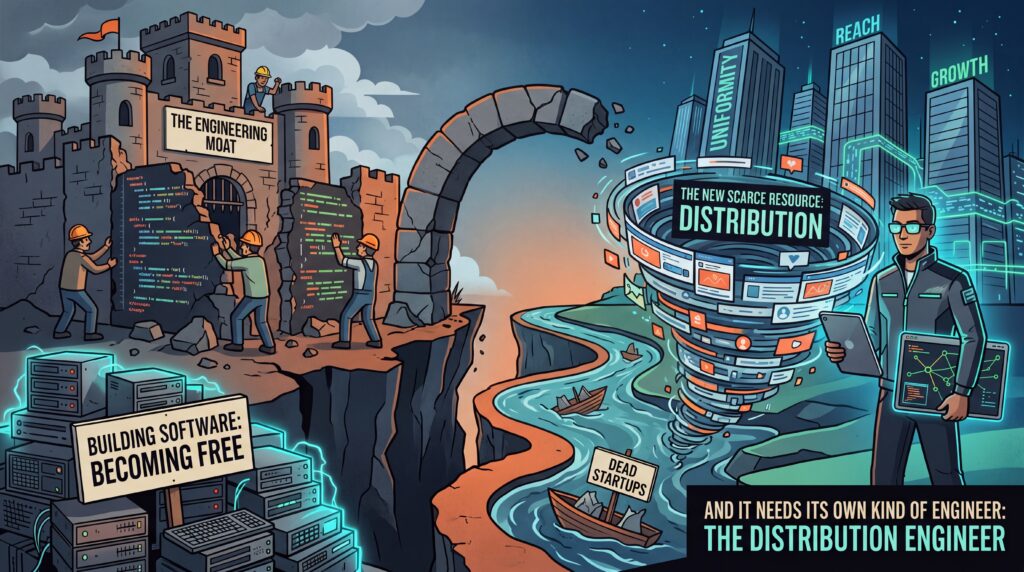
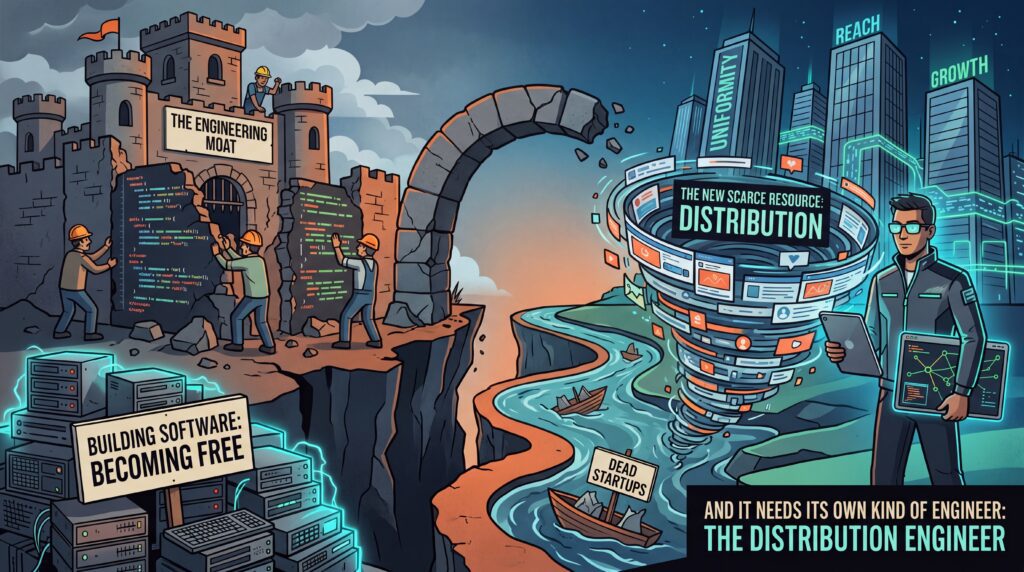
The engineering moat is collapsing. Building software is becoming free. The new scarce resource — the one that separates billion-dollar companies from dead startups — is distribution. And it needs its own kind of engineer.
There is a person at Anthropic — a company valued at north of $60 billion — who, with no prior coding experience, reduced the time it takes to create an ad from 30 minutes to 30 seconds. Not by hiring a team. Not by spending millions on an agency. By building a Figma plugin with Claude that automates the creation of ad creative variations.
Read that again. A growth marketer, not a software engineer, built a custom tool that gave them a 60x speed advantage. And they did it at the company that makes the AI.
This is not a story about marketing. This is not a story about AI replacing jobs. This is a story about a role that doesn’t have a proper name yet — a role that sits at the intersection of engineering, psychology, and distribution — and why it is quietly becoming the most valuable position in the entire technology industry.
I’m calling it the Distribution Engineer.
And if you’re a founder, an operator, or anyone who builds things for a living, understanding this role is no longer optional. It’s existential.
I. The Power Shift: When Building Becomes Free
Let’s start with the uncomfortable truth that most of the tech industry is still pretending isn’t real: building software is no longer a competitive advantage.
AI coding tools — Claude, Cursor, GPT, Codex, and a growing army of competitors — have fundamentally altered the economics of software development. We’ve moved from autocomplete to autonomous execution. What once required a team of engineers and months of work can now be accomplished by a single person in an afternoon. The trajectory is clear: the cost of building software is approaching zero.
This isn’t hyperbole. It’s math. When the marginal cost of creation collapses, creation itself ceases to be a moat. The world doesn’t need another to-do app. It doesn’t need another CRM. It doesn’t need another beautifully designed SaaS product that nobody uses. What it needs — what it has always needed, but never this urgently — is a way to get the right product to the right person at the right time.
The bottleneck has shifted. And as Max Mitcham wrote in his Substack analysis of this trend, the real moat is no longer shipping software, but “owning the trigger layer” — the infrastructure that captures actionable signals and converts them into distribution.
Think about what this means for every startup pitch you’ve ever heard. “We have a great team of engineers” used to be the killer line. Now? Everyone has a great team of engineers — or more precisely, everyone has access to AI that makes them equivalent to a great team of engineers. The differentiator has migrated from the supply side (building) to the demand side (distributing).
As J Suhas put it in a widely shared analysis: “A great product without distribution is invisible.” And more pointedly: “The best products often succeed not because they were the most technically complex, but because they reached the right users at the right time.”
This is the new reality. And it demands a new kind of professional.
II. Why “Marketing” Is a Dead Word
Before we go further, we need to have an honest conversation about why the word “marketing” is failing us.
Marketing, as a discipline and a job title, is anchored in manual action. It conjures images of people writing blog posts, managing ad accounts, scheduling social media content, A/B testing email subject lines, and arguing about brand colors in meetings that should have been emails. The word is saturated with connotations of doing things by hand — of campaigns, calendars, and creative briefs.
Here’s the problem: AI agents can do all of that now.
Not in some speculative future. Right now. Today. AI agent swarms — coordinated groups of specialized AI agents working together — can handle the entire marketing workflow, from research and content creation to lead generation and campaign management. An orchestrator controls their collaboration, each agent optimized for a specific task: one collects data, another analyzes it, a third creates content, a fourth distributes it, and a fifth monitors performance and feeds the results back into the loop.
These aren’t theoretical. In B2B contexts, AI agent swarms have been shown to boost lead generation by an average of 40%. They can automate the entire content research and creation process. They can monitor KPIs, analyze performance, and optimize campaigns in real-time — continuously learning through feedback loops.
So if AI can do marketing, what’s left for the human?
The answer is: architecture. The human’s job is no longer to execute campaigns. It’s to design the systems that execute campaigns. It’s to build the infrastructure, select the tools, define the logic, and engineer the feedback loops. It’s to create the machine — not to be the machine.
And that’s not marketing. That’s engineering. Specifically, that’s distribution engineering.
The distinction matters because it changes who you hire, how you structure teams, what skills you value, and ultimately, whether your company survives. If you put a job posting up for a “Head of Marketing” in 2025 and hire someone whose primary skill is manually executing campaigns, you’ve already lost. You’ve hired a human to do a machine’s job.
What you need is someone who can build the machine.
III. Introducing the Distribution Engineer
So what exactly is a Distribution Engineer?
A Distribution Engineer is a hybrid professional who combines skills in software development, data analysis, sales operations, and strategic thinking to build and automate scalable systems for getting products to market. They are, in essence, the person who engineers the infrastructure of growth.
This is not a rebranding of growth hacking. It’s not a fancy title for a demand gen manager. And it is emphatically not a marketer who learned to use ChatGPT.
Here’s what a Distribution Engineer does:
They build systems, not campaigns. A campaign is a one-time event. A system is a machine that runs continuously. The Distribution Engineer designs automated workflows for lead generation, outreach, inbound engagement, and retention. They build the infrastructure behind revenue — the plumbing that most companies never invest in until it’s too late.
They orchestrate tools, not tasks. The modern Distribution Engineer is proficient in a diverse and growing tech stack: CRM systems like HubSpot and Attio, sales engagement platforms like Apollo and Smartlead, automation tools like Clay, n8n, and Make, data enrichment tools like Clearbit and Crunchbase, and of course, AI agents like Claude, GPT, and Gemini. They don’t use these tools one at a time. They integrate them into a coherent “GTM operating system” — an integrated stack for capturing signals, orchestrating workflows, and measuring interventions.
They leverage data and AI as force multipliers. Distribution Engineers use AI for lead scoring, enrichment, prioritization, and targeted outreach based on buyer signals. They turn raw data into actionable insights and then build automated systems that act on those insights without human intervention.
They optimize through experimentation. Like any good engineer, they don’t guess. They build, measure, learn, and iterate. Distribution is treated as a systems engineering problem — with the same rigor and architectural thinking that goes into building software.
The core philosophy can be stated simply: Infrastructure, not campaigns. Systems, not sprints. Machines, not manual labor.
As Brendan Short put it while hiring for this exact role at Bravado: the GTM Engineer’s focus is on “blending strategy, automation, and AI to transform growth teams.” And Robert Bradley of The Playbook Agency was even more direct: “The future isn’t about adding more headcount — it’s about building scalable revenue systems.”
This is the Distribution Engineer’s creed: don’t hire more people. Build better systems.
IV. The Anthropic Case Study: One Person, $60B Company
If you want to see what a Distribution Engineer looks like in practice, look no further than Anthropic’s growth marketing operation.
Anthropic’s growth team is famously lean. At times, it has consisted of a single person. And yet, this tiny team — operating inside a company competing with Google, OpenAI, and Meta — has been able to achieve the output of a much larger traditional marketing department. They’ve done it by using their own AI, Claude, to automate and scale their marketing operations.
Let’s get specific, because the details here are instructive.
The Ad Creation Pipeline. Growth marketer Austin Lau, who had no prior coding experience, used Claude to build a custom Figma plugin. This plugin automates the creation of ad creative variations — different sizes, formats, copy combinations, and visual treatments. The result? The time to create a single ad dropped from 30 minutes to 30 seconds. That’s a 60x improvement in speed. For a single person. With no engineering background.
Think about what this means in competitive terms. A traditional company might assign three to five people to an ad creative team, each producing maybe 10-15 polished ads per day. Austin Lau, alone, can produce hundreds. The output asymmetry is staggering — and it’s getting wider every month as the tools improve.
The Copywriting Workflow. Lau also built a custom workflow in Claude for generating ad copy for Google Ads. The system incorporates brand guidelines and historical performance data, producing copy that’s on-brand and data-informed. A process that used to take hours — researching competitors, drafting variations, checking brand voice, reviewing performance data — now takes minutes.
The Broader Impact. It’s not just the growth team. Other marketing functions at Anthropic use Claude for writing influencer scripts, drafting case studies, and building web development workflows. The influencer team alone reports saving over 100 hours per month through AI-powered automation.
Now, here’s the thing that should keep every marketing director awake at night: Anthropic isn’t doing anything that other companies can’t do. The tools Austin Lau used — Claude, Figma, standard marketing platforms — are available to everyone. The difference isn’t access to technology. The difference is mindset. Lau didn’t think of himself as a marketer who uses tools. He thought of himself as a builder who constructs systems. He saw a manual process, and instead of optimizing it, he automated it. Instead of hiring someone to do the work, he built something to do the work.
That’s the Distribution Engineer mindset. And it’s what makes this role fundamentally different from anything that has existed before.

V. The Four Levels of AI-Powered Distribution
Not all AI-powered distribution is created equal. Based on what’s emerging across the industry, there’s a clear maturity framework — four levels that separate the amateurs from the architects.
Level 1: Automate Existing Work
This is where most companies are today. They take their existing manual processes and use AI to speed them up. Write emails faster. Generate social posts quicker. Summarize reports automatically. It’s valuable, but it’s table stakes. You’re using AI as a faster pair of hands.
The solo operators profiled in recent analyses of AI-powered agencies are a good example of Level 1 done well. AI tools can automate 70-80% of recurring tasks like lead generation, content drafting, social media scheduling, and reporting. This alone is transformative — a solo operator can now handle a client load that would typically require a small team. But it’s still fundamentally the same work, done faster.
Level 2: AI as Thinking Partner
At Level 2, AI isn’t just executing tasks — it’s contributing to strategy. You use AI to analyze data, identify patterns, generate hypotheses, and explore options that you wouldn’t have considered on your own. The AI becomes a collaborator in the decision-making process.
This is where Anthropic’s copywriting workflow lives. Claude isn’t just generating ad copy — it’s incorporating performance data and brand guidelines to inform what it generates. The human and the AI are thinking together, each bringing capabilities the other lacks.
Level 3: Do Previously Below-ROI-Threshold Work
This is where things get genuinely interesting. Level 3 is about using AI to do things that were theoretically valuable but never worth the human time. Things like: personalizing outreach for every single lead in your pipeline. Creating hundreds of ad variations to test. Monitoring every competitor’s pricing page daily. Responding to every comment on every social media post with a thoughtful, on-brand reply.
Before AI, these activities had clear value but terrible ROI because the labor cost was too high. AI changes the economics entirely. Suddenly, the long tail of distribution activities becomes viable. And companies operating at Level 3 discover opportunities that were always there but invisible — because no one could afford to look.
B2B AI agent swarms that boost lead generation by 40% are operating at Level 3. They’re not just doing what humans did, faster. They’re doing things humans never did at all — monitoring thousands of signals simultaneously, personalizing at a scale that was previously unthinkable, and finding micro-opportunities that no human team could justify pursuing.
Level 4: Build Custom Tools Unique to Your Business
Level 4 is the Distribution Engineer’s masterpiece. This is where you build proprietary tools and systems that are specific to your business, your market, and your unique competitive position. These tools become a moat in themselves — because they’re built on top of proprietary data and insights that no competitor can replicate.
Austin Lau’s Figma plugin at Anthropic is a Level 4 play. It’s not a generic AI tool — it’s a custom-built system designed for Anthropic’s specific ad creation workflow, incorporating their brand guidelines, their performance data, and their creative process. No competitor can buy this off the shelf. No agency can replicate it. It’s a proprietary distribution advantage built by a single person.
The Model Context Protocol (MCP) — an open-source standard that allows AI models to securely connect to live data from external systems — is accelerating Level 4 adoption. MCP acts as a universal interface, a kind of “USB-C port for AI,” allowing any compliant AI model to connect to various marketing platforms — ad networks, CRMs, analytics tools — without custom integrations. This means Distribution Engineers can build context-aware automation that accesses real-time campaign data, business rules, and performance metrics to make informed decisions: reallocating budgets, pausing underperforming ads, or generating performance reports autonomously.
Major AI providers like Anthropic, Microsoft, and Google, along with workflow platforms like Zapier, are adopting MCP, signaling its importance as a foundational protocol for AI-powered distribution. The protocol also supports human-in-the-loop workflows, where marketers shift from manual execution to supervising and coaching AI agents. This is the architecture the Distribution Engineer builds on.
The companies that win in the next decade will be the ones that reach Level 4 fastest. Not because they have the best product — everyone will have good products. But because they’ve built distribution machines that are uniquely theirs.
VI. The Most Dangerous Profile in Tech
Here’s where the argument gets provocative.
The most dangerous person in tech right now isn’t a 10x engineer. It isn’t a visionary founder. It isn’t a veteran CMO with a Rolodex of media contacts.
The most dangerous person in tech is someone who can build things, understands psychology, and has an audience.
This is the overlap that creates outsized outcomes. And it’s the overlap that defines the best Distribution Engineers.
Building + Psychology
A Distribution Engineer who can code (or who can get AI to code for them) AND who understands human behavior — what makes people click, share, buy, and evangelize — has a superpower that no purely technical or purely creative person possesses. They can identify a psychological lever and then build a system to pull it at scale.
Building + Audience
A Distribution Engineer who has personal distribution — a following, a newsletter, a community — has a testing ground and a launchpad built into their identity. They can ship something at 9 AM and have feedback by noon. They can announce a product and have customers by dinner.
The Cluely Example
Perhaps no company illustrates the power (and danger) of distribution engineering better than Cluely. The AI startup has pursued an aggressively distribution-first marketing strategy that is equal parts brilliant and controversial.
Cluely built a system — not a team, a system — to produce hundreds of videos per day, using a combination of interns and a network of paid UGC (user-generated content) creators. The content strategy is deliberately provocative: controversial, polarizing, designed to generate engagement through emotional reaction. Their operating philosophy? “If half the audience doesn’t hate it, it’s not viral enough.”
The company treats social media accounts as disposable distribution channels, not long-term brand assets. If an account gets banned, another one is created. The goal isn’t to build a beloved brand — it’s to generate maximum attention at minimum cost.
You don’t have to approve of Cluely’s tactics to learn from them. The lesson is structural: Cluely treated virality as an engineering problem. They didn’t hire a bunch of marketers and hope for the best. They built a content production system with clear inputs, processes, and outputs. They used the attention to secure funding and gather user data before the product was even fully developed. They engineered their distribution from day one.
In its early stages, Cluely focused on making virality its core product — using attention as a wedge to solve every other business problem. That’s distribution engineering in its most aggressive form.
The Skills Convergence
This brings us to an uncomfortable truth for specialists on both sides of the aisle: engineers need to learn distribution, and marketers need to learn to build.
The best Distribution Engineers are T-shaped professionals with depth in building and breadth across psychology, data, and go-to-market strategy. They’re the people who read both Hacker News and marketing Twitter. They understand conversion rate optimization AND database design. They can write a compelling headline AND a Python script.
The era of “I’m a technical person, I don’t do marketing” is over. And the era of “I’m a creative, I don’t do technology” is equally dead. The convergence is happening whether you participate or not. The only question is whether you’ll be on the right side of it.
VII. The One-Person Army
Let’s talk about what a single Distribution Engineer can actually accomplish today. Because the capabilities are frankly hard to believe unless you’ve seen them in action.
Consider Barbara Jovanovic, who runs a six-figure agency without a single employee by using AI to generate weeks of content from a single hour of client input. Or Alex Rivera, a solo agency owner who manages 12 client retainers using an AI-powered workflow that costs less than $500 per month.
These aren’t anomalies. They’re the leading edge of a structural shift. When AI can automate 70-80% of recurring marketing tasks, a single competent operator can produce the output of a small team. The math is simple and devastating for anyone still operating with traditional staffing models.
Here’s a partial list of what a single Distribution Engineer, armed with modern AI tools, can operate simultaneously:
- Automated lead generation pipelines that identify, enrich, score, and prioritize prospects without human intervention
- Multi-channel outreach systems that personalize messages based on buyer signals and adapt based on response data
- Content production engines that generate, format, and distribute content across platforms — blogs, social media, email, video — at a volume no human team could match
- Real-time campaign optimization through AI agents that monitor KPIs, reallocate budgets, pause underperforming assets, and scale winners — around the clock
- Custom internal tools built with AI coding assistants — dashboards, plugins, integrations — that give them proprietary capabilities
This is why the language is shifting. You’re seeing terms like “GTM Engineer,” “Growth Systems Architect,” and “Revenue Engineer” appear in job postings and LinkedIn profiles. The nomenclature is catching up to the reality.
Brendan Short, who has been hiring for these exact roles at Bravado, calls it “The Hottest Job in 2025: The GTM Engineer.” And he’s not wrong. The role’s focus on blending strategy, automation, and AI to transform growth teams is precisely what companies need — and what very few professionals can deliver.
The successful solo operators share a common pattern: they use a small, curated set of AI tools to cover their core needs, avoiding unnecessary complexity. They build lean systems rather than sprawling tech stacks. They invest their time in architecture and strategy, delegating execution to AI. And they achieve 10x output not by working 10x harder, but by building systems that work while they sleep.
The work itself has changed. It’s not about being busy anymore. It’s about being architectural. The Distribution Engineer’s most productive hours aren’t spent writing copy or tweaking ad settings. They’re spent designing systems, building workflows, and creating the automated infrastructure that does the writing and tweaking and optimizing autonomously.
The a16z Blueprint
For a high-profile example of distribution engineering at the organizational level, look at Andreessen Horowitz.
a16z has built what can only be described as a media and content empire — an in-house media operation designed to control its own narrative, provide distribution as a service to its portfolio companies, and establish itself as the dominant voice in the tech industry.
Their strategy is based on what they call the “New Media” thesis: the idea that venture capital firms should provide narrative and distribution services, not just capital. They aim to be “CAA for the tech industry.” To execute this, they’ve hired a team of storytellers and content creators — “online legends” — to produce daily podcasts, newsletters, videos, and essays. They prioritize their own channels over traditional media, breaking news and shaping conversations on their own terms.
The a16z media operation is distribution engineering writ large. It’s infrastructure, not campaigns. It’s a system designed to produce compounding returns over time — attracting top founders, improving deal flow, and amplifying portfolio companies. It’s a flywheel, not a funnel.
What a16z did at the organizational level with a team, a single Distribution Engineer can now approximate with AI tools. The same strategic architecture — owned channels, high-volume content, ecosystem building, narrative control — is available to anyone with the right mindset and the right tools. The playing field hasn’t just leveled. It’s been inverted.
VIII. The Prescription
So what do you do with all of this? Here are specific recommendations for the two audiences that matter most.
For Founders: Hire a Distribution Engineer, Not a Head of Marketing
If you’re building a startup in 2025 or beyond, your first go-to-market hire should not be a traditional Head of Marketing. It should be a Distribution Engineer.
Here’s why:
A traditional marketing leader will build a team. They’ll hire content writers, demand gen specialists, social media managers, and event coordinators. They’ll establish processes, create brand guidelines, and build a marketing calendar. All of which takes time, money, and headcount.
A Distribution Engineer will build a system. They’ll integrate your CRM with your data enrichment tools, connect your analytics to your outreach automation, build AI-powered content workflows, and create a GTM operating system that runs 24/7 with minimal human oversight. They’ll do in weeks what a traditional team does in quarters — and the system they build will scale without adding headcount.
Robert Bradley was right: the future isn’t about adding more people. It’s about building scalable revenue systems. And a Distribution Engineer is the person who builds those systems.
When you’re evaluating candidates, look for this profile:
- Can they build? Not necessarily traditional software engineering, but can they construct workflows, integrate tools, write scripts (or get AI to write scripts), and create functional systems? Austin Lau had no coding experience and built a Figma plugin that transformed Anthropic’s ad production. The bar isn’t “can they code in C++.” It’s “can they make things that work.”
- Do they think in systems? Ask them to describe how they’d approach a distribution challenge. If they start talking about campaigns, that’s a red flag. If they start talking about infrastructure, feedback loops, and automation — that’s your person.
- Are they data-driven? Distribution Engineers optimize through experimentation. They don’t believe in “gut feelings” about what works. They believe in data, A/B tests, and continuous iteration.
- Do they have personal distribution? The best Distribution Engineers practice what they preach. They have a blog, a newsletter, a social following, a podcast — some form of owned distribution that demonstrates they understand the game at a personal level.
For Individuals: Treat Building and Distribution as the Same Skill
If you’re a marketer, learn to build. If you’re an engineer, learn distribution. If you’re neither, start now — because the tools have never been more accessible.
The convergence is happening. The Model Context Protocol is making it possible for AI to connect directly to marketing platforms, ad networks, and analytics tools. AI coding assistants are making it possible for non-engineers to build functional tools and workflows. The barriers between “building” and “distributing” are dissolving.
Here’s a practical starting path:
- Pick one tool and go deep. Choose an automation platform — Clay, n8n, or Make — and learn to build workflows. Start with a simple one: automatically enrich new leads with company data and score them based on fit criteria.
- Build something with AI. Use Claude, GPT, or Cursor to build a small tool that solves a real distribution problem. It could be a script that monitors competitor pricing pages, a bot that generates social media content from your blog posts, or a dashboard that tracks your key distribution metrics. The point isn’t what you build — it’s that you build.
- Start distributing. If you don’t have a personal channel, start one. Write on Substack. Post on LinkedIn. Create short-form video content. The medium doesn’t matter. What matters is that you develop an intuition for what resonates, what spreads, and what converts. Distribution is a skill learned through practice, not theory.
- Think in systems, not tasks. Every time you do something manually, ask yourself: “Could this be automated? Could an AI agent do this? Could I build a system that does this continuously?” Train yourself to see every manual process as a prototype for an automated system.
- Study the best. Look at how Anthropic’s growth team operates with AI. Look at how a16z built distribution infrastructure. Look at how solo operators run six-figure businesses with AI-powered workflows. These aren’t just case studies — they’re blueprints.
The Tools Are Already Here
I want to end on a point that is both empowering and terrifying: everything I’ve described in this article is possible today. Not in some imagined future. Not with tools that are “coming soon.” Right now, with tools that are available, affordable, and increasingly easy to use.
The MCP protocol is already being adopted by major AI providers and workflow platforms. AI agent swarms can already automate end-to-end marketing workflows. AI coding assistants can already enable non-engineers to build custom tools. Solo operators are already running multi-client businesses with AI-powered stacks that cost less than $500 per month.
The question is not whether this transformation is coming. It’s whether you’ll be the one building the distribution machine — or the one being replaced by it.
The Bottom Line
The Distribution Engineer is not a trend. It’s not a buzzword. It’s the inevitable result of two converging forces: the commoditization of software development and the maturation of AI-powered automation. When building becomes free, distribution becomes everything. And when distribution becomes everything, it needs its own kind of engineer.
The companies that understand this — the Anthropics, the a16zs, the lean startups that hire a builder instead of a team — will have a compounding advantage that grows wider every quarter. The companies that don’t will hire bigger marketing teams, run more campaigns, and wonder why they’re falling further behind.
The future belongs to those who can build the machines that distribute. Everything else is noise.
Related Guides
- The Importance of Distribution for Generative AI Startups – Detailed Guide
- The Importance of Distribution for AI Software, Tools, and Applications
- AI Distribution: Why Market Reach Matters as Much as Development
Compare
Latest News
- Marketers Are the New Engineers in the AI Economy
- Distribution Channels for Generative-AI Apps: From APIs to Influencers
Continue Reading
The Kingy Brief
Get The Kingy Brief.
AI changes, original tests and one practical thing to try. Fridays at 09:00 Vancouver time.
Free · Double opt-in · Unsubscribe anytime
Signup help and newsletter schedule
Signup form provided by Beehiiv. After submitting, check your inbox for "Confirm your subscription to The Kingy Brief" and open its confirmation link. Check Spam or Promotions if you cannot find it.
Fridays at 09:00 Vancouver time: source-checked AI changes, original tests and one practical thing to try. The weekly restart begins October 9, 2026. We skip a week when there is not enough verified material. Free. Unsubscribe anytime.