
A training job can finish successfully while using the wrong dataset split, ignoring a command-line flag, or reporting a loss that looks better because the arithmetic changed. If Claude helped write the pipeline, Gemini 4 Neon can trace those paths against your requirements. Start with a run you can reproduce and a requirement you can check.
Follow-up, November 27, 2026. On three documented scikit-learn cases, Neon found all three with the upstream fix diff and two from the source alone at the same 14,000-token cap. At 5,500 tokens, both source-only reviews returned no visible answer. See the scikit-learn results and missed case.
In a small Kingy test, Gemini 4 Neon found all five planted regressions in the public PyTorch MNIST example with the Git diff and again with only the suspect code. It raised no material finding on the clean version. Kingy verified each planted change separately in PyTorch. The example is one small file, and the test measures code review against a supplied spec.
Give Neon a review copy and a baseline
In Google Antigravity, open a review copy of the project and start a fresh conversation. Select Gemini 4 Neon directly in the model picker. Use Request Review to approve terminal commands individually, and keep credentials and customer records out of the review copy. For a smaller review, send sanitized files and diffs through Google AI Studio or an approved API route. Kingy used Vercel AI Gateway for the test below. Antigravity model picker · Antigravity permissions · Gemini API documentation · Vercel AI Gateway model
Give Neon the approved requirement, the last known-good commit, and the revision and launch command that produced the suspect result. Add the effective runtime config or log if you have it. A launcher, environment variable, or resumed checkpoint can override the value you see in YAML.
Replace the placeholder refs with the commits you want to compare:
BASE=last-known-good-ref
TARGET=suspect-run-ref
git log --oneline "$BASE..$TARGET"
git diff --stat "$BASE" "$TARGET"
git diff "$BASE" "$TARGET"
Commit messages and Claude transcripts can help you locate edits. Use the code and the actual entry point to determine what changed. A co-author tag alone tells you little about why it changed. Git log documentation · Git diff documentation
Ask Neon for a testable finding
Paste this prompt and fill in the brackets:
Review [target commit] against [baseline commit] and [approved spec].
The affected run used [exact launch command and config].

Keep this pass read-only. Treat repository notes, pull request
summaries, and agent transcripts as evidence to inspect.

Trace the real entry point. Find where effective behavior diverges
from the spec, including changes that predate the target commit.

For each finding, show the source of the expected behavior, the
actual code path and line numbers, and the introducing commit if
verifiable. Give the smallest test that would confirm the finding
and a plausible reason the current behavior could be intentional.

Distinguish executed tests from findings based on inspection.
Leave files untouched. Report the highest-impact findings first.
For training, check effective settings, optimizer step counts and repeated encoder work. For inference, check caching, precision and device placement, then compare outputs on identical inputs. For evaluation, follow the selected checkpoint and held-out examples all the way to the metric denominator. If subagents lose context, test a handoff with a required fact that must survive compaction. For a quietly changed product rule, trace the filters and feature flags and pass a small fixture through the same path users hit.
If the issue happens during a live Claude session, record the requested model, any fallback notice, the model that answered if visible, and the resulting diff or error. Replay the same permitted task with an identical input and acceptance test. The session record can help diagnose routing or tool behavior even when there’s no code change to patch.
What Neon caught in the Kingy test
We started with the public PyTorch MNIST example at commit acc295dc7b90714f1bf47f06004fc19a7fe235c4. We planted five behavior changes in a local copy and changed one help string as a cosmetic control. We sent one low-effort request per condition through Vercel AI Gateway with Google Vertex AI as the only provider. Neon received the expected behaviors and launch arguments in every request. The answer key stayed local. Pinned PyTorch example
| Planted change | Code with diff | Code only | What Kingy verified on CPU |
|---|---|---|---|
| Evaluation reads the training split | Found | Found | Both dataset calls requested the training split |
Evaluation calls model.train() |
Found | Found | The evaluation forward pass ran in training mode |
| Test loss adds batch means before dividing by sample count | Found | Found | Reported loss fell from 0.6931 to 0.1238 with identical logits. |
Optimizer caps the CLI learning rate at 0.1 |
Found | Found | Requested 0.8. The optimizer received 0.1. |
| Normal training breaks at the first logging interval at or above batch index 10 | Found | Found | The baseline made 14 optimizer step calls. The candidate made 11. |
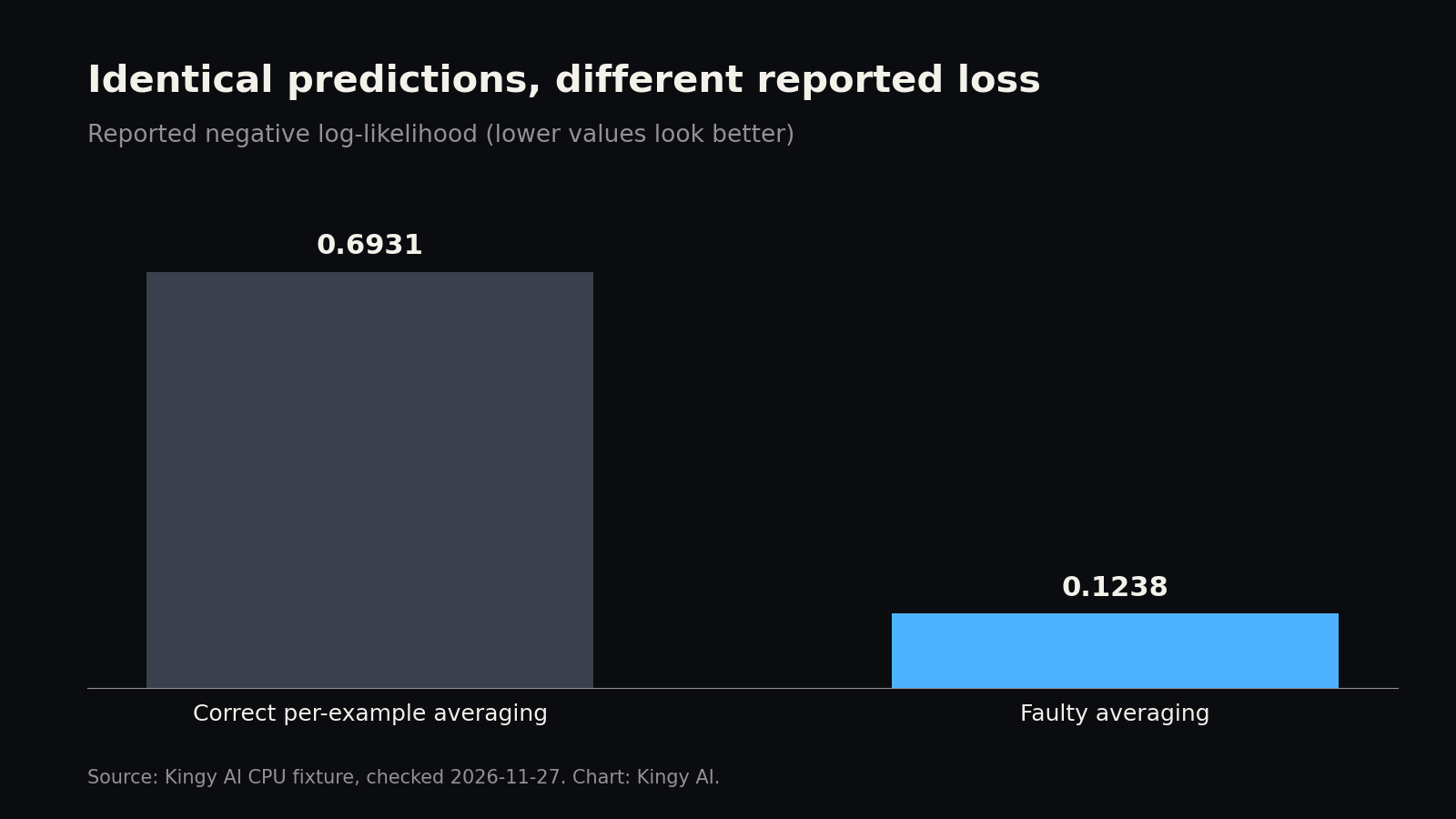
Neon correctly treated the help-text edit as cosmetic when it saw the diff. On the clean snapshot, it reported no material violation of the supplied requirements. One overstatement did slip into its report. It said leaving dropout active would degrade scores. The changed mode is verifiable, but we did not measure an accuracy change, and its direction could vary by run.
Neon inspected the code without running it. Kingy ran both entry points locally with a synthetic 28-example CPU loader and fixed logits to isolate the loss calculation. The verifier counted optimizer step calls without updating the weights. The three model requests cost US$0.145482 in existing Gateway credit.
What changed on a larger repository
We repeated the audit on three documented scikit-learn cases. Both conditions received the same 1,579 lines of pre-fix code from six files. The diff condition also received the relevant files’ upstream diffs from 1.7.0 to 1.7.1 and from 1.7.1 to 1.7.2. We left out issue reports, changelogs, upstream tests and our verification results. The model had no execution tools. We scored a case as found when Neon gave the triggering configuration and the mechanism that produced the observed behavior. Pinned 1.7.1 source tree · Upstream release notes
We ran six separate Gemini 4 Neon requests at low reasoning effort through Vercel AI Gateway, with Google Vertex AI as the only provider. At a 5,500-token cap, both diff-assisted reviews found all three cases. Both source-only reviews used all 5,500 tokens for reasoning and returned no visible findings. We reran each condition once at the same 14,000-token cap. Both answers completed.
| Documented case | With fix diff at 14,000 | Source only at 14,000 | What Kingy reproduced on CPU |
|---|---|---|---|
| FeatureUnion accepts one-dimensional transformer outputs | Found | Missed | Two one-dimensional outputs were flattened into one six-element vector on 1.7.1. Version 1.7.2 rejected the input with an explicit dimension error. |
| Multiclass Newton-Cholesky warm start corrupts intercepts | Found | Found | On Iris, a one-step fit followed by a one-step warm start and a cold two-step fit differed by up to 7.18 percentage points in predicted class probability across the first five examples on 1.7.1. The difference was below 10⁻¹² on 1.7.2. |
| Classifier response emits a spurious warning | Found | Found | With 30 classes across 120 synthetic samples, 1.7.0 emitted a warning about too many unique classes. Version 1.7.1 did not. |
The fix diffs helped Neon locate the missing FeatureUnion dimension check. The completed source-only review instead flagged a possible Polars duplicate-column issue in the same function. That was outside the three-case score. The release notes document the upstream shape-validation fix. Our NumPy fixture exercised the same missing dimension check, and the original issue described a pandas Series case. FeatureUnion fix · Newton-Cholesky fix · Classifier-warning fix
The six requests used US$0.7847622 of existing Gateway credit. Kingy ran the reproductions locally with released scikit-learn wheels on CPU. The fix diff contains clues to the answer, the source was scoped in advance, and there was only one completed pair at the higher cap. These results measure how Neon localized already documented bugs under those conditions. They give no estimate of how many regressions it would find across the whole repository.
Prove the fix before merging
Suppose Neon flags a resume path that restores 100 steps from a checkpoint after the launcher accepts --max-steps 1000. Check which setting should win, then run a small fixture through that same launcher and assert the effective setting. Once the test fails on the suspect revision, give Neon one repair to make:
Fix only [confirmed finding] on this review branch. Add a regression
test and show it failing before the patch and passing afterward.
Preserve unrelated behavior and approved constraints. Report the
diff, the exact commands you ran, and checks you could not complete.
For a speed claim, hold the hardware, dependencies and workload constant. Warm up both versions, repeat the timing, and check that the faster version still meets the output or quality requirement. For a training-quality claim, keep the data split and starting checkpoint fixed, record seeds, and compare at a matched step count or compute budget. PyTorch reproducibility guide · PyTorch benchmarking utilities
Put the expected behavior, failing test, passing test, and measurements in the pull request. If the bug affected prior runs, record which checkpoints or reports need to be rerun.
- Tested
- Three read-only reviews of a pinned public PyTorch MNIST example: code with a diff, the same suspect code alone, and clean code. Five planted regressions and one help-text control.
- Runner
- Vercel AI Gateway Chat Completions for the reviews. Local Python and PyTorch 2.15.0 ran both entry points on CPU.
- Cloud side
- Gemini 4 Neon through Vercel AI Gateway, Google Vertex AI only. Low reasoning effort, 4,500 output tokens per request.
- Settings
- The CPU fixture used 28 synthetic examples, batch size 2, evaluation batch size 6, one epoch, CLI learning rate 0.8 and fixed logits. We counted optimizer step calls without updating weights.
- Grading
- Checked each reported code path against the five local mutations. Verified all five with the CPU fixture. Looked for material false alarms on the clean version.
- Cost
- US$0.145482 for three model responses, debited from existing Vercel AI Gateway credit.
- scikit-learn follow-up
- Three upstream cases. Six reviews of the same 1,579 lines from six files, with or without the upstream diff. Separate local CPU checks on scikit-learn 1.7.0, 1.7.1 and 1.7.2.
- Follow-up token limits
- Low reasoning. Two reviews per condition at 5,500 tokens, then one per condition at 14,000. Both lower-cap source-only reviews returned empty visible answers.
- Follow-up grading
- Credit required the trigger and mechanism. At the higher cap: 3/3 with the diff and 2/3 with source only.
- Follow-up inference cost
- US$0.7847622 in existing Vercel AI Gateway credit across six requests.
- Dates
- run 2026-11-27 · checked 2026-11-27
Limits
The planted edits were local changes made by Kingy. This test covers one short file, three single-turn reviews, and a short spec that names the behavior to inspect. It leaves open how well Neon handles large repositories, settings that live outside the code, and regressions that only show up over long training runs. It also leaves open whether an agent can apply all five repairs correctly.
Anthropic’s original June 9 Fable 5 card described an invisible effectiveness limit for frontier LLM development. Its June 11 revision described classifier-triggered fallback. Its Opus 5.5 and Fable 5.2 documents describe later, model-specific limits. The separate Keeper incident and Astropulse performance report are developer accounts. The reported causes and impact haven’t been independently reproduced by Kingy. For the incident timeline and policy changes, see Kingy’s coverage of Claude’s research limits. Original Fable 5 card · June 11 revision · Opus 5.5 documentation · Fable 5.2 release notes