
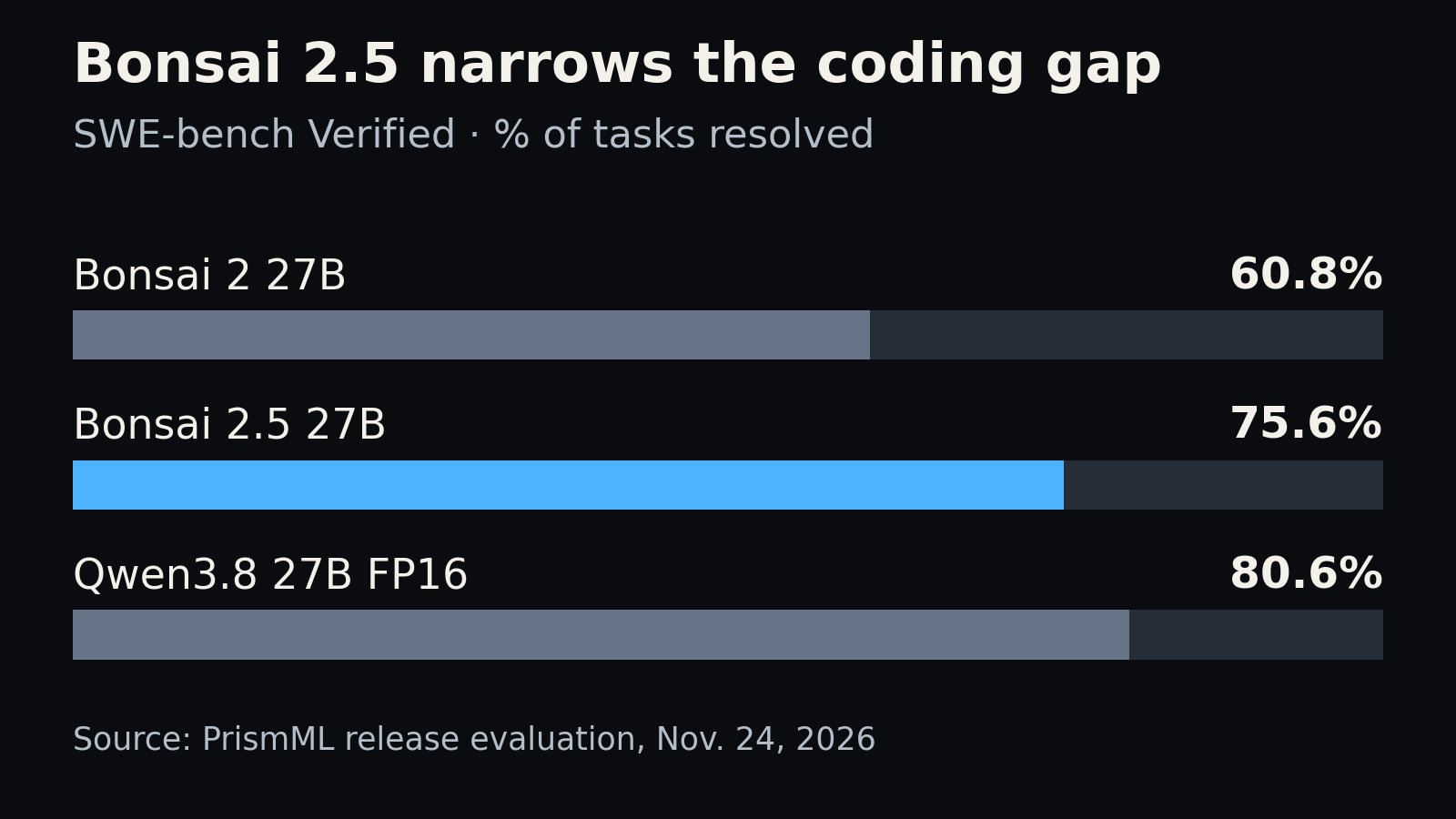
PrismML says its new Ternary Bonsai 2.5 27B solved 75.6% of SWE-bench Verified tasks in its tests, up from 60.8% for Bonsai 2. Both have a reported 5.93 GB weight footprint. The company released the model on November 24, 2026 for coding agents and other multi-step work on local hardware.
The full-precision Qwen3.8 27B base model takes 53.8 GB, about 9.1 times the weight storage. The smallest GGUF download is 5.99 GB, and the runtime needs additional memory. Not tested by Kingy.
What the benchmarks show
Bonsai 2.5 gains 14.8 percentage points on SWE-bench Verified, which tests whether a coding agent can resolve real GitHub issues. AppWorld, where an agent works through tasks using simulated app APIs, jumps 39.3 points. LiveCodeBench v6 falls 0.8 points. All scores below come from PrismML’s release evaluation.
| Benchmark | Qwen3.8 27B FP16 | Bonsai 2 27B | Bonsai 2.5 27B |
|---|---|---|---|
| SWE-bench Verified | 80.6 | 60.8 | 75.6 |
| DeepSWE v1.1 | 30.1 | 0.0 | 27.0 |
| Terminal-Bench 2.1 | 70.8 | 52.8 | 60.1 |
| AppWorld | 93.2 | 51.2 | 90.5 |
| τ³-Bench | 72.8 | 69.1 | 73.9 |
| BigCodeBench | 61.5 | 57.2 | 60.3 |
| LiveCodeBench v6 | 87.6 | 83.8 | 83.0 |
PrismML served the models on NVIDIA H100 GPUs with vLLM and xhigh reasoning. It used mini-SWE-agent for all 500 SWE-bench Verified tasks and for DeepSWE v1.1. On τ³-Bench, the agent handled simulated customer interactions across several turns. The paper gives the task counts, scaffolds and token budgets in Appendix A.
Bonsai 2.5 led the tested sub-10 GB Qwen3.8 27B builds on PrismML’s coding and tool-calling averages. That comparison covers selected quantizations of one base model. The same paper puts full-precision Qwen 10.7 points ahead on Terminal-Bench 2.1. PrismML says the upgrade completes work in fewer turns and uses fewer tokens, and its whitepaper leaves multi-hour tasks that span several context windows for future evaluation.
Files, memory and compatibility
Bonsai 2.5 uses ternary language weights, which encode three values (−1, 0 and +1) with a shared scale for each group of 128. PrismML reports 1.76 bits per weight for its densest packing. The Qwen3.8-based architecture has 27.36 billion parameters in total, including the vision tower, and supports up to 262,144 context tokens. Usable context depends on the memory available for the cache and other runtime allocations. The GGUF model card lists xhigh as the default reasoning effort and medium as an option.
The published GGUF files package the same ternary model in three layouts. The base downloads are 5.99 GB for PTQ1_0, 7.25 GB for PQ2_0 and 7.67 GB for Q2_0, in decimal GB. Optional multi-token prediction (MTP) builds add about 0.24 GB. Image input on GGUF requires a separate vision file, about 0.63 GB for Q8 or 0.93 GB for BF16.
For the simplest stock llama.cpp path, choose Q2_0 and check that the engine is at least release b11556. PrismML warns that older versions may load the file but produce unusable output. PTQ1_0 and PQ2_0 need PrismML’s llama.cpp fork. The card recommends PTQ1_0 for NVIDIA and reports Apple Metal results with PQ2_0. Check the Bonsai demo repository for current setup instructions, especially if a local app bundles its own engine.
The Apple silicon MLX release has an 8.60 GB main file. Its current card documents image input through the bundled loader, while the demo README still describes the 2.5 MLX pack as text-only. Follow the model card for that specific download. PrismML also names iPhone and iPad as MLX targets, with device-level fit for this 27B build still to verify.
How fast is it?
PrismML’s whitepaper separates ordinary generation from speculative decoding, which uses an extra draft head to propose tokens. In its current-runtime, single-GPU llama-bench test without that head, PTQ1_0 generated 186 tokens per second on an H100 and 112 on an RTX 4090. Its PQ2_0 test on an Apple M5 Pro reported 30.2 tokens per second. These figures use synthetic tokens and are not a guarantee of speed on another machine.
A separate server test used 36 real prompts. On the H100, it measured 184 tokens per second without the draft head and 282 with it. The 291 tokens per second highlighted in the launch announcement also includes kernels still in testing. On the RTX 4090, the paper reports 111 without the head and 204 with it. In the same RTX 4090 server test, the draft head slowed processing of the 2,048-token prompt from 2,808 to 2,166 tokens per second on the current build. Generation speed and time spent reading the prompt can move in different directions. The paper reports these server figures separately from its synthetic llama-bench results.
Price and availability
The weights are available to download under the Apache 2.0 license. Running them still costs the hardware, electricity and time needed for your setup. On November 25, the Hugging Face model card showed no Inference Provider deployment, and OpenRouter’s catalog listed the older Bonsai 2 models only. We found no public hosted per-token rate for Bonsai 2.5 27B. PrismML offers custom training and deployment work without a published price in the release announcement.
If you have a compatible computer and want to try a local coding agent, start with Q2_0 on a current llama.cpp build, leave room for context and runtime memory, and test it on a small repository task you can review. If you need the smaller PTQ1_0 file or speculative decoding, follow PrismML’s fork instructions and compare completed tasks on your own hardware.