OpenAI has published a preprint claiming that the exponent of square matrix multiplication is exactly 9/4, or 2.25, over every field. Its October paper put the exponent at 2.25 or below over the complex numbers. The November 24 paper claims to close the other side of the problem. Its argument says any fixed exponent below 2.25 would make a different computation, checking lists for duplicate entries, cheaper than a lower bound allows. Read the November preprint.
If the lower bound holds, it rules out the long-standing conjecture that general square matrix multiplication can run in nearly quadratic arithmetic time. OpenAI has released Lean formalizations covering the headline equality and specified related results. We found independent papers explaining or extending the October upper bound, and did not find an independent verification of the November lower bound at publication. OpenAI’s Lean scope · Independent upper-bound exposition.
What the matrix multiplication exponent measures
Multiply two square matrices of side length n and you get another square matrix with n2 entries. Each entry is a dot product. For example, if the first row of the left matrix is (2, 3) and the first column of the right matrix is (5, 7), the top-left entry of the product is 2 × 5 + 3 × 7 = 31. For the usual algorithm, each output uses n multiplications and n − 1 additions. Computing all the entries that way takes cubic work, proportional to n3.
In 1969, Volker Strassen showed that the four entries of a 2 × 2 product can be assembled from seven carefully chosen products of sums or differences, instead of the usual eight products. The same identity works on blocks. Repeating it recursively gives an exponent of log2 7, about 2.807. Later work drove upper bounds much closer to 2. An August 2026 paper by Emilien Dupont and colleagues, using AlphaEvolve in its search process, reported an upper bound below 2.371177. OpenAI’s October result came from a different construction. October paper’s historical and technical context · Dupont and colleagues’ paper.
A field is a number system with exact addition, subtraction, multiplication and division by nonzero values. The complex numbers are a field, as are integers modulo a prime. The Greek letter ω denotes the infimum of the achievable growth exponents for the number of exact scalar arithmetic operations. Formally, if ω = 9/4, then for every fixed ε > 0, there are algorithms with operation count O(n9/4+ε), with constants that can depend on ε and the field. Every fixed exponent smaller than 9/4 is impossible in this model. The equality alone leaves open whether an algorithm attains O(n9/4) with zero slack. The paper’s definition and theorem.
Evaluating the growth terms alone makes the quarter power easier to see. Doubling the side length multiplies the output size by 4, the n9/4 term by about 4.76, and the cubic term by 8. Those are mathematical growth factors. Actual timing depends on the algorithm, input size and hardware.
How October got the exponent down to 9/4
The October paper treats matrix multiplication as a tensor, an array of coefficients that records how entries of the two input matrices interact to make the outputs. An exact bilinear algorithm takes linear combinations of entries of the first input, multiplies them by linear combinations of entries of the second, and combines those products to form the answer. The fewest products in such a recipe is the tensor’s rank. The ranks of repeated tensor powers capture how those recipes scale. October tensor definitions and proof overview.
The proof uses ordinary polynomial multiplication as a source of useful building blocks. Some blocks are already independent on the two input sides but share variables on the output side, or share one of the other groups after relabeling. The construction puts labels on the shared side and uses a parameter to retain the terms with matching labels. That turns the pieces into independently usable blocks. A Fourier step helps assign the tentative labels. The rest of the proof tracks what the separation buys over many copies.
In Strassen’s asymptotic spectrum, the proof measures tensors with numerical invariants that add on independent sums, multiply on tensor products, and cannot increase under restrictions. Two bounds on the growth of the polynomial multiplication tensor force each relevant invariant to assign the square matrix multiplication tensor a value of at most n9/4. The spectral argument converts that into the arithmetic upper bound. The key exponent in the paper’s growth argument is 3t, with t at most 3/4. October proof, including the separation and growth arguments.
OpenAI’s October theorem was over the complex numbers. The November paper credits Alimzhan Amanov, Maxim van den Berg and Jeroen Zuiddam for the every-field upper bound, following Houxi Lü’s extension of the separation principle to arbitrary characteristic. Mahmut Levent Doğan and colleagues gave another exposition over every field, and Amir Shpilka supplied an explicit recursive algorithm with exponent below 9/4 + ε for any ε > 0. These follow-ups address the upper bound. Every-field upper bound · Lü’s separation principle · Doğan and colleagues’ exposition · Shpilka’s explicit construction.
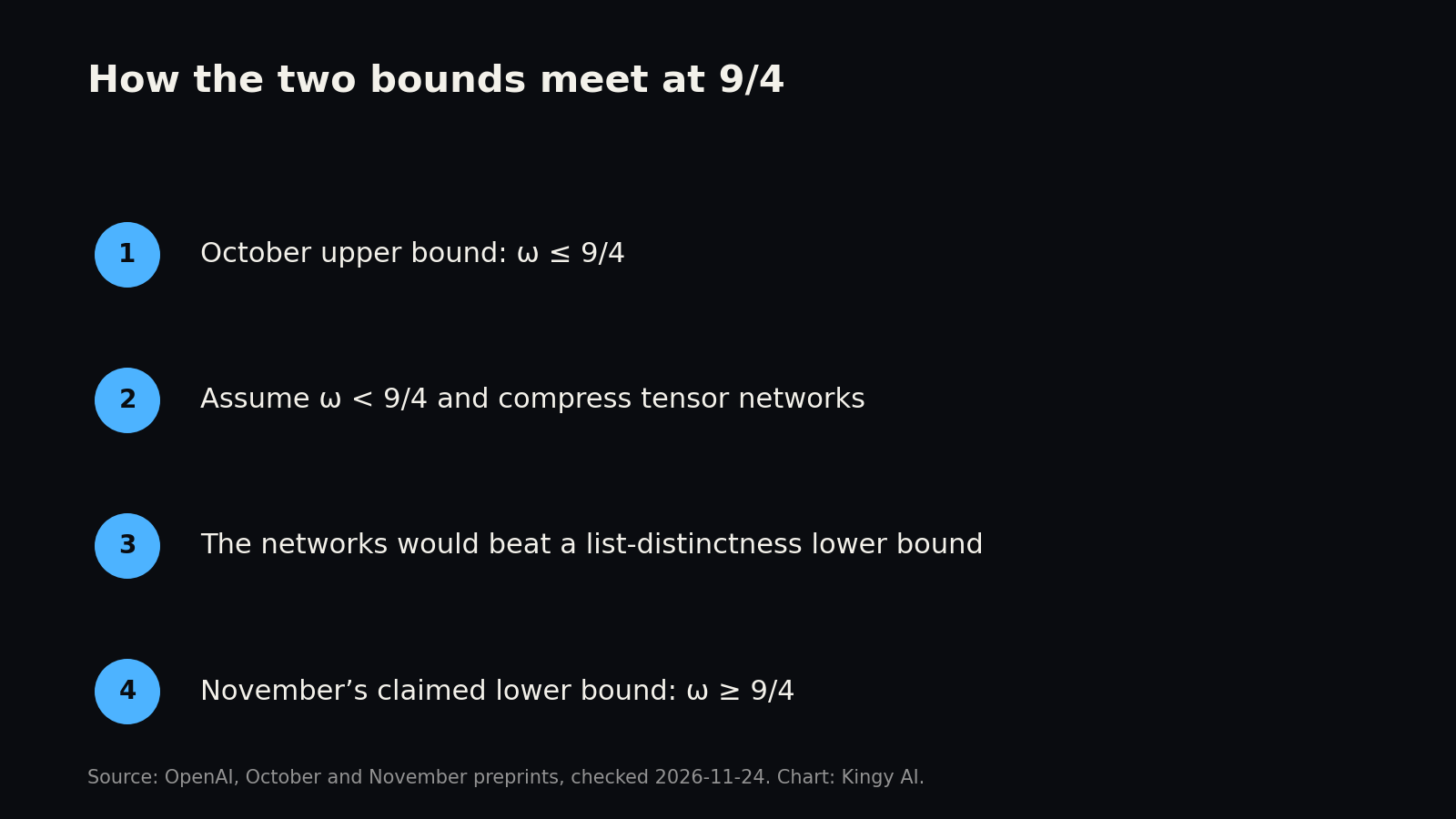
How a test for duplicates leads to the lower bound
The November proof starts with a counterfactual. Suppose a finite field admits square matrix multiplication with an exponent strictly below 9/4. OpenAI argues that this would give a way to compress a wide class of tensor networks. A network in this proof has tables at its vertices, bit-valued wires connecting them, and exposed wires carrying the input. Fix the exposed bits, multiply the table entries for each internal assignment, then sum over the assignments. That gives the network’s answer. The measure of work in this part of the proof is network volume, which counts vertices and wires. List-distinctness obstruction.
Take a list of 2w records, each 2w bits long. A sorting network can put the records in order and check whether any adjacent pair is equal. That gives an initial tensor network for list distinctness. OpenAI then proves a separate lower bound that applies even when one network checks a batch of independently supplied lists, with permission to share wiring and work across them. The argument encodes a problem about routing tagged records using two instances of the distinctness test. The lower bound says the required volume per input bit grows at least as a positive power of w for the batches considered. Tagged-record reduction and volume lower bound.
The hypothetical compression works on a batch of copies of the network. It saves a power of a logarithm on the old size per copy and adds a charge for each exposed bit. Each copy keeps its own exposed bits, which lets the construction run again on the resulting batch. After a fixed number of rounds, the remaining charge grows more slowly than the lower bound per bit, and the batch is still within the range covered by that bound. Both estimates then apply to the same network, giving the contradiction. Compression theorem and contradiction.
Where the number 9/4 enters the argument
The hard part is deriving compression from a faster square product. The paper assigns certain arrangements of shared tensor indices a numeric cost, which it calls a price. The price of a two-way wire is encoded as a distance between sites. For square matrix multiplication, the row, inner and column indices give three pairwise wires between the three factors. A rank decomposition gives another description of the same tensor, with one label shared across all three factors. Each value of that label selects one term in the decomposition.
The comparison produces a numerical threshold. At the tips of a tripod with three unit arms, each pair of tips is two units apart, so the three pairwise distances sum to six. At a three-way shared-label rate of 8/3, the ratio is 6 ÷ (8/3) = 9/4. The paper argues that a strict saving below 9/4 rules out the relevant tripod geometry. That exclusion constrains the prices of a family called sphere tensors. The resulting identities let the authors concentrate many small tables into fewer larger ones, then use batched sorting and lookup to keep the cost of the larger tables under control. Accounting for those costs is what makes the compression claim work. The tripod calculation and the compression roadmap.
To reach arbitrary fields, the paper argues that a strict saving anywhere would give one finite-size bilinear multiplication identity with fewer than n9/4 products. The finitely many coefficients generate a ring, and the proof shows that reducing those coefficients to a suitable finite field preserves the identity. Recursion would carry that saving to larger matrices in the finite field, where the distinctness argument forbids it. Over finite fields, the statement concerns formal polynomial or rational-function identities. This matters because distinct polynomials can agree on every point of a finite field. Modulo 2, for instance, x2 and x agree at both inputs, 0 and 1, but have different formal coefficients. Bilinearization and finite specialization.
What Lean covers and what the paper claims at fixed sizes
OpenAI’s Lean scope says the formalization proves exact equality for the square exponent in the division-free formal circuit model over every field. The broader scope also reports a theorem that allowing division preserves the square exponent, and a theorem that the total number of multiplication and division gates is at least half the tensor rank over the field’s algebraic closure. OpenAI explicitly lists the paper’s finite-size lower bound on nonscalar multiplication or division gates as outside the formalized scope. The formal statements and their definitions are public for inspection. Square and rectangular formalization scope · Companion formalization and exclusions.
That finite-size result says that at any side length n ≥ 2, a general formal arithmetic circuit needs at least ⌈n9/4/2⌉ nonscalar multiplication or division gates, even if additions and other linear operations are free. The paper claims at least ⌈n9/4⌉ products for an exact bilinear algorithm. The factor of two comes from extracting the part of the circuit that is linear in each matrix separately. A general multiplication or division gate can contribute up to two new products to that part. At side length 256, the paper’s formulas give at least 131,072 nonscalar gates in the general circuit model and at least 262,144 products in the exact bilinear model. A practical algorithm at that size can require many more operations. Fixed-size rank and circuit consequences.
The manuscript derives a second fixed-size claim in terms of geometric border rank. This measure allows the matrix multiplication tensor to arise as an algebraic limit of tensors with a given rank. At side length 256, OpenAI claims the border rank is at least 262,144. The first version of Zhi-Wei Sun’s separate preprint proposes an upper bound of 131,072 at that same size. The two inequalities cannot both hold. This gives reviewers a concrete place to compare the arguments. OpenAI’s rank consequences · Sun’s preprint.
What comes next for algorithms and AI
For complexity theory, the immediate work is to reproduce the formal checks independently, compare the formal statements with the manuscript’s claims and work through the compression argument in a form other researchers can reuse. The square paper also gives bounds for rectangular products. OpenAI’s Lean scope reports a separate exact formula for rectangular exponents and puts the dual exponent at 1/2. In the notation where an n × nβ matrix multiplies an nβ × n matrix, this is the stated threshold for a quadratic exponent as the inner dimension grows. It is a separate claim with its own formal statement. Exact rectangular and dual statements.
Matrix multiplication also sets the arithmetic cost of many algorithms that call it as a subroutine. Strassen’s 1969 paper already used faster multiplication to construct faster algorithms for solving linear systems, taking determinants and inverting matrices. The newer upper bound gives this type of algorithm a stronger arithmetic building block. Transferring a lower bound to another problem calls for a reduction in the other direction. Strassen’s 1969 paper.
For numerical computing, the question is where a concrete method becomes faster on matrices people actually use. The theorem counts exact scalar operations. GPU workloads use specific precisions and matrix shapes, and their runtime also depends on data movement, tiling and how much work can run in parallel. Even a recursive algorithm that approaches 9/4 can have a base case and overhead large enough to lose to a tuned library. Lower arithmetic exponents matter to algorithm design, but a GPU speed claim needs a kernel, finite input sizes, error measurements and a baseline. Explicit recursive upper-bound algorithm · NVIDIA’s matrix multiplication performance guide.
OpenAI attributes the repository’s manuscripts to an unnamed internal model. This release includes the mathematical argument and formal statements, which readers can examine regardless of the model attribution. The next evidence to watch for is an independent reconstruction of the November lower bound, including the part that turns a strict square-algorithm saving into a contradiction about independently specified lists. OpenAI’s repository and model attribution · Kingy’s mathematics and science breakthrough tracker.
Sources
- OpenAI’s November 24 release notes and the square exponent preprint
- OpenAI’s October upper-bound paper
- Amanov, van den Berg and Zuiddam’s upper-bound exposition, Doğan and colleagues’ tensor-value proof and Shpilka’s explicit algorithm
- Lean scope for matrix exponents and Lean scope for the November release family