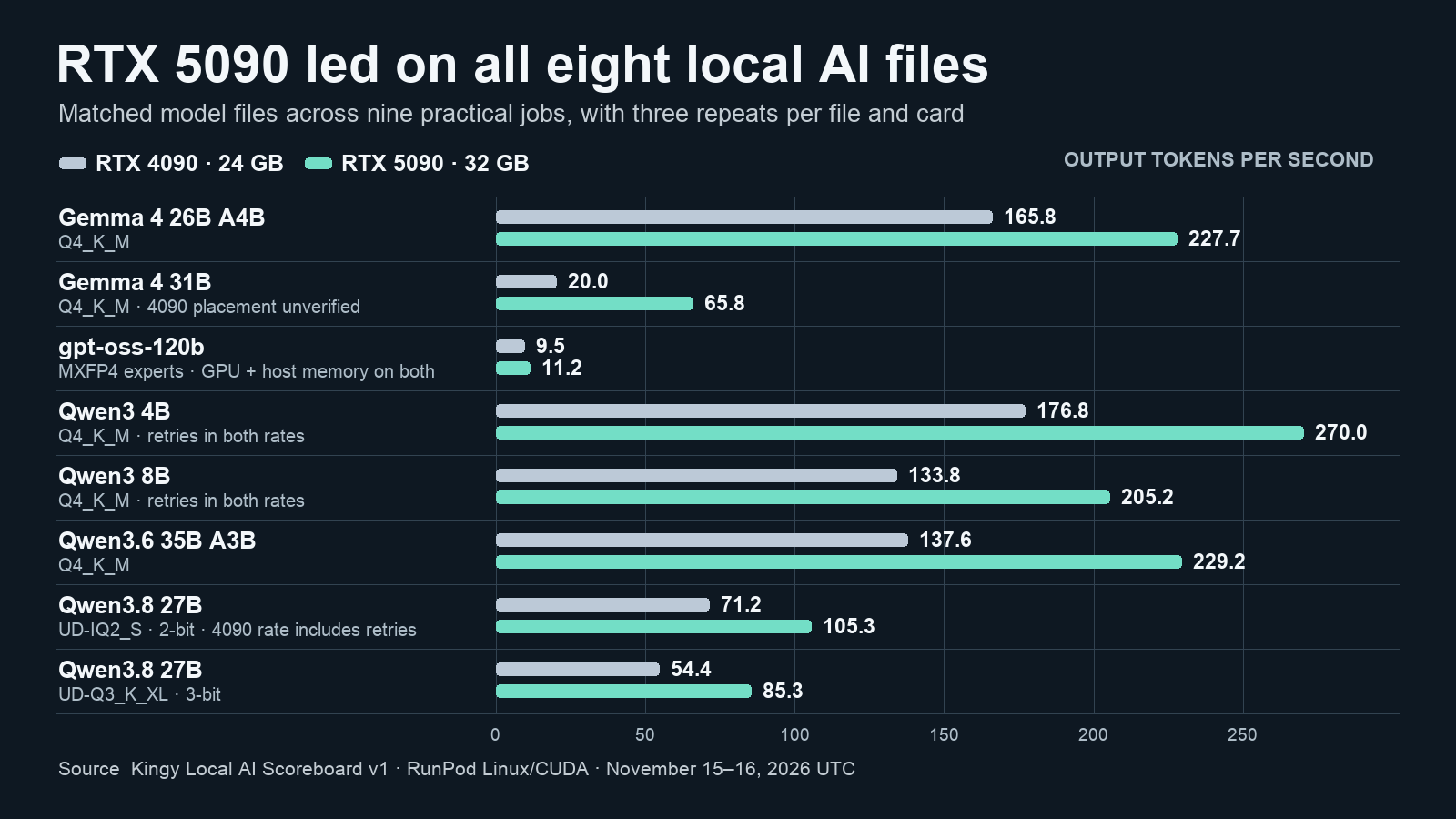
On the 2-bit Qwen3.8 27B file, the RTX 5090 generated 105.3 tokens per second. The RTX 4090 generated 71.2. The 5090 led on all eight matched files from the original Kingy Local AI Scoreboard. Six ran 1.37 to 1.67 times as fast. Kingy Local AI Scoreboard
For a 4090 owner, the decision comes down to how long you wait for output and how close you already run to 24 GB of VRAM. At the measured Qwen rates, generating 1,000 tokens would take about 14.0 seconds on the 4090 or 9.5 seconds on the 5090, before prompt processing and other overhead. With a 65.37 GB gpt-oss-120b file, both systems used host memory and the gap shrank to 9.5 versus 11.2 tokens per second. Kingy Local AI Scoreboard
The results
These are aggregate output-generation rates in tokens per second. A token can be a word, a fragment of a word or a punctuation mark. The rate divides generated tokens by generation time across the recorded calls. It excludes prompt processing, network delays and other overhead. Source: Kingy Local AI Scoreboard
| Model and file | RTX 4090 tokens/s | RTX 5090 tokens/s | 5090 / 4090 |
|---|---|---|---|
| Gemma 4 26B A4B, Q4_K_M | 165.8 | 227.7 | 1.37× |
| Gemma 4 31B, Q4_K_M | 20.0 | 65.8 | 3.29×* |
| gpt-oss-120b, MXFP4 experts | 9.5 | 11.2 | 1.18׆ |
| Qwen3 4B, Q4_K_M | 176.8 | 270.0 | 1.53ׇ |
| Qwen3 8B, Q4_K_M | 133.8 | 205.2 | 1.53ׇ |
| Qwen3.6 35B A3B, Q4_K_M | 137.6 | 229.2 | 1.67× |
| Qwen3.8 27B, UD-IQ2_S | 71.2 | 105.3 | 1.48ׇ |
| Qwen3.8 27B, UD-Q3_K_XL | 54.4 | 85.3 | 1.57× |
* The 4090’s Gemma 4 31B logs leave GPU memory placement unresolved.
† Both hosts ran the 65.37 GB gpt-oss-120b file across GPU and system memory.
‡ Timing includes output from disconnected attempts that Kingy retried and excluded from scoring. This applies to Qwen3 4B and 8B on both cards and the 2-bit Qwen3.8 27B file on the 4090. Sources: Kingy Local AI Scoreboard, published dataset
Qwen3.6 35B A3B went from 137.6 to 229.2 tokens per second. The 3-bit Qwen3.8 27B file went from 54.4 to 85.3. Those are meaningful differences if you generate long responses regularly, though they should not be applied as a universal multiplier to other models or software. The six-result range above includes the rows with retry caveats. Source: Kingy Local AI Scoreboard
What Kingy tested
Kingy rented and paid for two RunPod Linux CUDA hosts, one with an RTX 4090 and one with an RTX 5090. We ran the eight GGUF files from Scoreboard job set 0.2 on both machines on November 15–16, 2026 UTC, using llama.cpp build 11538. We verified full SHA-256 fingerprints and used the same settings for each matched file. Each configuration received nine practical jobs three times, for 216 scored job runs per card and 432 across the pair. The jobs included building a web app, fixing a bug, reading a long document and producing a video cut. The test harness and grading ran on Lucy AI Studio. Sources: Kingy Local AI Scoreboard, published dataset
The scoreboard uses fixed code checks to grade work. Its headline score draws on seven jobs. It reports the landing-page and animated-title jobs separately. Results can move between runs, especially with only three attempts per job. Kingy publishes the data and methodology so readers can inspect the individual jobs as well as the headline number. Sources: Kingy Local AI Scoreboard, published dataset
Did the 5090 produce better answers?
We did not find a reliable quality win for either card in this test. For each matched model, the difference between its two seven-job scores was below the scoreboard’s 14.7-point heuristic for distinguishing results. The largest gap was 7.9 points, for Qwen3.6 35B A3B, which scored 96.5 on the 4090 and 88.6 on the 5090. Other gaps went in the opposite direction. Source: Kingy Local AI Scoreboard
The board sets that threshold using variation across repeated passes on the Lucy AI Studio. More runs or a different job set could produce a clearer quality result. For this buying decision, the measured speed and memory differences are more concrete than any claimed quality advantage from swapping the GPU. Source: Kingy Local AI Scoreboard
What 8 GB more memory buys
NVIDIA lists 24 GB of GDDR6X memory for the RTX 4090 and 32 GB of GDDR7 for the RTX 5090. Its Blackwell architecture whitepaper lists memory bandwidth of 1,008 GB/s and 1,792 GB/s respectively. Those specifications describe the cards, while the table above shows what happened in our particular runs. Sources: NVIDIA RTX 4090, NVIDIA RTX 5090, NVIDIA Blackwell whitepaper
Extra VRAM gives you more room for model weights and working memory. In a separate short test, both cards ran the same 16.56 GB Qwen3.8-27B UD-Q4_K_M file with all model layers on the GPU at 8,192 tokens of existing context. The 4090 generated 49.0 tokens/s and the 5090 reached 77.7. The 4090 could already handle that file at the tested depth. Check the exact file and context before paying for more capacity. Kingy’s separate Qwen hardware test
- Tested
- Eight matched files from Scoreboard job set 0.2. Nine jobs, three repeats per file and host. 216 scored job runs per host.
- Machine
- Rented RunPod desktops: RTX 4090 (24 GB) and RTX 5090 (32 GB). Jobs and grading ran on Lucy AI Studio.
- Runner
- Linux and llama.cpp build 11538 with CUDA on both hosts.
- Files
- Identical model files verified by SHA-256. gpt-oss-120b used a 65.37 GB GGUF.
- Settings
- Same per-model settings across machines. Rates use llama.cpp generated tokens divided by generation time and exclude prompt processing.
- Grading
- Fixed checks grade seven of nine jobs in the headline score. The landing page and animated title are excluded from that score.
- Cost
- Kingy paid to rent both RTX hosts.
- Measurement window
- November 15–16, 2026 UTC
- Dates
- run 2026-11-16 · checked 2026-11-22
Limits
We tested two complete rented machines. Host hardware and configuration can affect results, particularly for a model split across GPU and system memory. The test covers eight specific files, one runner build and one job set. Output-generation speed also leaves out prompt processing and network time. Your own context length, software, model file and workload may change the result. The Gemma 4 31B placement uncertainty and retry-affected rates deserve special attention before using those rows to predict performance. Sources: Kingy Local AI Scoreboard, published dataset
If your 4090 already fits the models and context you use, keep it unless the measured speed gain is valuable enough for your workload. If you regularly run close to its memory limit, check whether your chosen file and context fit within the 5090’s 32 GB before treating the extra headroom as the reason to upgrade.