

Five billion dollars and a first trial still ahead
Isomorphic Labs has raised $5 billion to expand its AI drug design platform and move its first drug candidates toward human testing. Greenoaks and Sequoia Capital co-led the oversubscribed Series C. The Alphabet-backed company’s press release appeared at 8:17 p.m. Philippine time on November 17. Reuters reported the financing at 9:43 p.m. that evening.
The funding announcement describes a company building both a technology platform and a pipeline of potential medicines. That second job gives the financing its stakes. Isomorphic says it has encouraging preclinical results in oncology and immunology. The next test is whether its programs can produce evidence in people, where the questions get harder and the answers matter more.
The investors behind the round
Andreessen Horowitz joined the round as a new investor. Alphabet made a significant additional investment, and Isomorphic said all its existing investors took part. They include Thrive Capital, MGX, GV, CapitalG, Temasek, and the UK Sovereign AI Fund. Reuters reported that the company declined to disclose its valuation.
An oversubscribed round means investors wanted to commit more than the company intended to raise. The term describes demand for a stake in the business. What stands out here is the combination of fresh money and returning backers. Earlier investors have already funded the company’s move from building AI models to applying them to drug discovery. Their continued participation backs the next, more expensive stretch, when the programs must move through development.
Six months after another multibillion-dollar round
In May, Isomorphic announced a $2.1 billion Series B led by Thrive Capital. The new raise is more than twice as large. Add the $600 million external round announced in 2025, and the three disclosed rounds total $7.7 billion.
Both of this year’s rounds named the drug design platform and the candidate pipeline as priorities. The November announcement also emphasized building the infrastructure to move programs into the clinic. Scale in this case has two meanings. The company wants its software to support more research projects, and it wants enough development capacity to carry promising candidates forward when that research gives them a reason to proceed.
How DeepMind’s research led here
Isomorphic Labs spun out of Google DeepMind in 2021. Founder and CEO Demis Hassabis shared half of the 2024 Nobel Prize in Chemistry with John Jumper for protein structure prediction. Their work on AlphaFold showed how AI could help researchers predict the three-dimensional shapes of proteins, information that can help scientists understand what those proteins do.
For Isomorphic, that history supplies a starting point. The team wants to take what computers can predict about molecules and put those predictions to work on drug development. A predicted shape can help frame a research question. Developing a medicine then calls for many other judgments about how a candidate behaves and whether its effects can be measured. Those judgments are where much of the new funding will be put to work.
What IsoDDE does for researchers
IsoDDE stands for Isomorphic Labs Drug Design Engine. The company describes it as a suite of AI simulation models that helps researchers evaluate potential medicines across several kinds of drugs and areas of disease. It gives teams a way to weigh ideas on a computer before deciding which ones deserve time in the lab.
Think about the research meeting where someone asks which of several ideas to pursue first. Each idea could sound plausible, and each experiment takes time. A useful prediction gives scientists additional evidence for that decision. It may also point out where the available evidence is thin. The value comes from improving decisions about what to test and learning from the results that come back.
What the early model results tell us
In its technical overview, Isomorphic reported that IsoDDE more than doubled AlphaFold 3’s accuracy on one benchmark for predicting the structure of a protein with a molecule bound to it. That was a specific test of how well the model handled unfamiliar examples. Fierce Biotech noted the benchmark when reporting the funding round.
Structure predictions can help researchers understand which proposals make sense to examine further. Other questions arise as a candidate advances, including whether the effect lasts and how the body responds. The benchmark gives readers a concrete example of progress on the platform. The evidence for any potential treatment will come from studies of that particular candidate, with outcomes that researchers and clinicians can assess.
Where Isomorphic says the candidates stand
The company reported positive preclinical results in its own oncology and immunology programs, as well as in work with partners. Oncology concerns cancer. Immunology looks at how the immune system works and can help guide research into diseases involving that system. Those labels give a sense of where the company is working, but they cover many different conditions and possible treatments.
The financing announcement did not name a lead candidate, identify a first trial, or supply detailed preclinical results. Without those details, readers have limited information about how advanced individual programs are or what a particular candidate might be used for. The milestone the company describes is preparation for clinical entry.
The work between a prediction and a trial
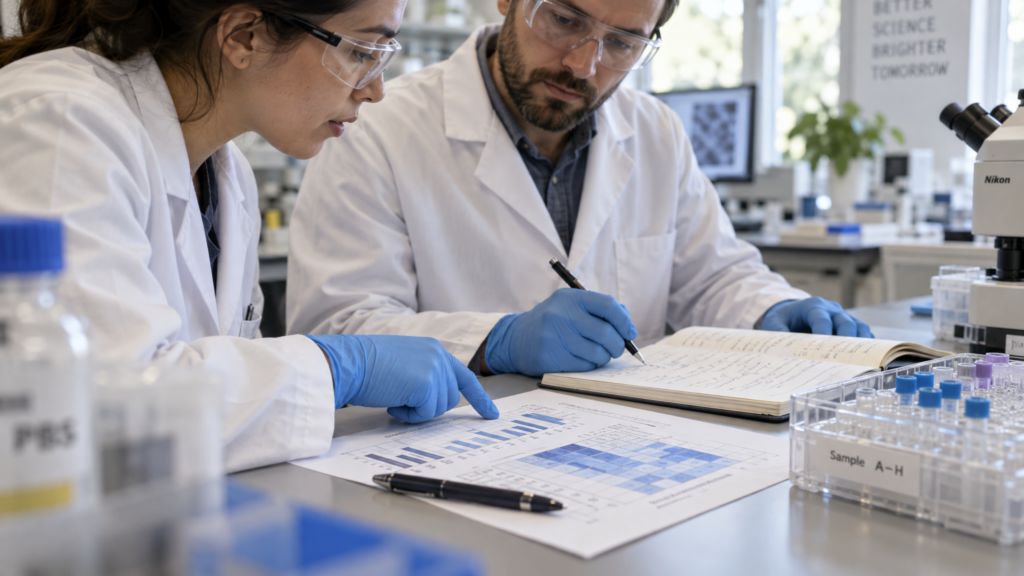
A candidate can look promising on a computer and still have a long journey to a clinical study. Researchers gather evidence in the lab and use preclinical studies to investigate basic safety questions. They also need to be able to produce a consistent supply for a study. Each step gives the people deciding whether to move forward something more concrete to consider.
The FDA’s drug development overview lays out those stages in the United States. Isomorphic’s latest announcement described funding for the work that links lab research to clinical development. That spending sits alongside the AI investment. It helps explain why a company known for its software also needs people and systems that can support a clinical program.
Why the first human study matters
Early human studies typically focus on basic questions about safety, tolerability, and dosage. They can also gather preliminary information about how a candidate behaves in the body. Later studies usually address effectiveness more directly. The exact questions depend on the candidate, the people who take part, and the study design.
For Isomorphic, a first clinical study would establish that one of its programs had reached the point where researchers could begin asking those questions in people. That would be a significant development in its own right. The clinical benefit of the candidate would still need evidence. For a field accustomed to hearing about model accuracy and the speed of discovery, the change in what researchers can measure is the news.
The first-trial timeline has moved before
In January, Reuters reported that Hassabis expected Isomorphic’s first clinical trials by the end of 2026. That followed an earlier expectation of reaching trials by the end of 2025. The November financing release describes programs heading toward clinical trials and gives no date for a first study.
The history makes the distinction between a target and a documented start worth keeping in view. A new study can be tracked through details such as the candidate name, who the study is intended to enroll, and the outcomes it plans to measure. Those details would give readers a much firmer basis for following the program than an estimate offered months before the work is ready.
The drugmakers already working with Isomorphic
Isomorphic has research collaborations with Eli Lilly, Novartis, and Johnson & Johnson. The Lilly and Novartis deals were announced in 2024, and Novartis expanded its collaboration the following year. The Johnson & Johnson agreement came in January 2026. The relationships give the company several places to apply its platform alongside teams with experience in pharmaceutical research and development.
The partnerships also tell a different financial story from the funding round. The original Lilly and Novartis announcements put their combined potential value at nearly $3 billion, excluding possible royalties. That figure included payments tied to future milestones. The $5 billion Series C is money the company says it raised. Keeping those figures straight helps show exactly what was achieved this week.
Why building an in-house pipeline matters
Isomorphic is developing its own candidates alongside programs with drugmakers. The in-house work gives the company responsibility for decisions like which projects to take forward and how much to spend on getting them ready for the next stage. The company named both kinds of programs in its financing plans.
Those two routes can reveal different things about a shared AI platform. A partner program shows how the technology fits into another research organization’s priorities. An internal program gives Isomorphic more room to shape the work from discovery onward. Both generate questions that future candidate disclosures could help answer. How long did it take to choose a candidate? Which parts of the process benefited from AI predictions? Which still took the most time?
What the money can buy beyond computing
Isomorphic says it will keep developing IsoDDE, invest in new models for biology, and build out global infrastructure and clinical development capability. The company is headquartered in London and has offices in Lausanne and Cambridge, Massachusetts. Its plans span software, research, and the work required to bring candidates closer to trials.
Computing capacity gets plenty of attention in an AI funding story. A medicine program also needs time from people who can compare results, catch discrepancies, and document the decisions behind each candidate. It may need a specialist whose work will matter for only one difficult stage. With several programs running, the ability to coordinate that work can matter as much as the ability to run more simulations.
Where AI could save time
One plausible benefit comes early, when researchers have a long list of ideas and limited time to weigh them. Predictions can help focus discussion on which questions are worth answering first. If the model helps a team rule out a weak idea sooner, that can be valuable even when the day ends without a promising result.
A bigger claim would be that the approach cuts the time needed to bring a medicine through development. That would take evidence from multiple programs, including ones that run into trouble. Isomorphic’s future disclosures could make the comparison easier by showing how long its candidates spend in each stage of development. Savings in one stage may help a project move faster even when later stages follow a familiar schedule.
What to look for in the next announcement
A named candidate would give the story a clear subject. A disclosed trial plan could explain which condition the company is targeting, how the study will be run, and what investigators hope to learn. When the first results come out, readers can look at how many people took part, how long researchers followed them, and what the findings actually showed.
Those details matter for the technology story as well as for the medicine. They offer a way to trace which predictions turned into a candidate that could be studied and which questions had to wait for clinical testing. Over time, public results from multiple programs would say more about the usefulness of IsoDDE than a single successful demonstration could.
The next headline needs a candidate

Isomorphic has secured the capital to keep developing its platform while preparing multiple projects for the work ahead. That lets the company proceed on two fronts at once. It can try to make better predictions and put resources behind the candidates that have already emerged. The financing says investors see enough potential in both to keep going.
The next milestone is easier to picture than the size of the check. Somewhere along the line, there should be a named candidate and a study that says exactly what researchers hope to learn about it. If Isomorphic gets there, the conversation can move from how much money AI drug discovery attracted to the first concrete questions its medicines raise in clinical research.
Sources
- Isomorphic Labs — Series C financing and plans for IsoDDE
- Isomorphic Labs via PR Newswire — Timestamped financing release and preclinical progress
- Reuters — Series C financing and undisclosed valuation
- Fierce Biotech — Pipeline status and clinical development infrastructure
- TechCrunch — Funding, drug candidates, and pharmaceutical partnerships
- The Frontier Wire — Disclosed fundraising totals and first-trial timing
- Isomorphic Labs — Series B financing
- Isomorphic Labs — First external funding round
- Nobel Prize — Hassabis and Jumper’s award for protein structure prediction
- Isomorphic Labs — IsoDDE technical overview and structure prediction benchmark
- Isomorphic Labs — How AI predictions inform laboratory research
- U.S. FDA — The drug development process
- U.S. FDA — Preclinical research
- U.S. FDA — Clinical research and trial phases
- U.S. FDA — Investigational drug applications and manufacturing information
- Reuters — Earlier expectations for Isomorphic’s first clinical trial
- Isomorphic Labs — Eli Lilly and Novartis collaborations
- Isomorphic Labs — Novartis collaboration expansion
- Isomorphic Labs — Johnson & Johnson research collaboration