When does it pay back? Divide the extra purchase price by the monthly cloud spending you can eliminate after local running costs. A US$1,200 upgrade saving US$34 a month crosses over in month 36.
How much computer can your bill justify? Multiply that monthly saving by your ownership horizon. Over three years, US$34 a month supports a US$1,224 purchase.
Already own a capable Mac? Count only the additional work the upgrade can take off your cloud bill. In our worked case, it needs to remove US$35.07 a month in extra API charges to finish ahead. At US$35, keeping the Mac wins by US$2.37.
Calculate your own payback. These figures assume equivalent completed work, constant monthly costs and no replacement or resale.
A US$1,200 upgrade can win or lose over US$1 a month
Suppose you keep a US$20 subscription and spend US$41 a month on API work after moving suitable tasks onto an existing computer. A proposed upgrade would reduce that API bill to US$6, but cost US$1,200 upfront and US$5 a month for local operation.
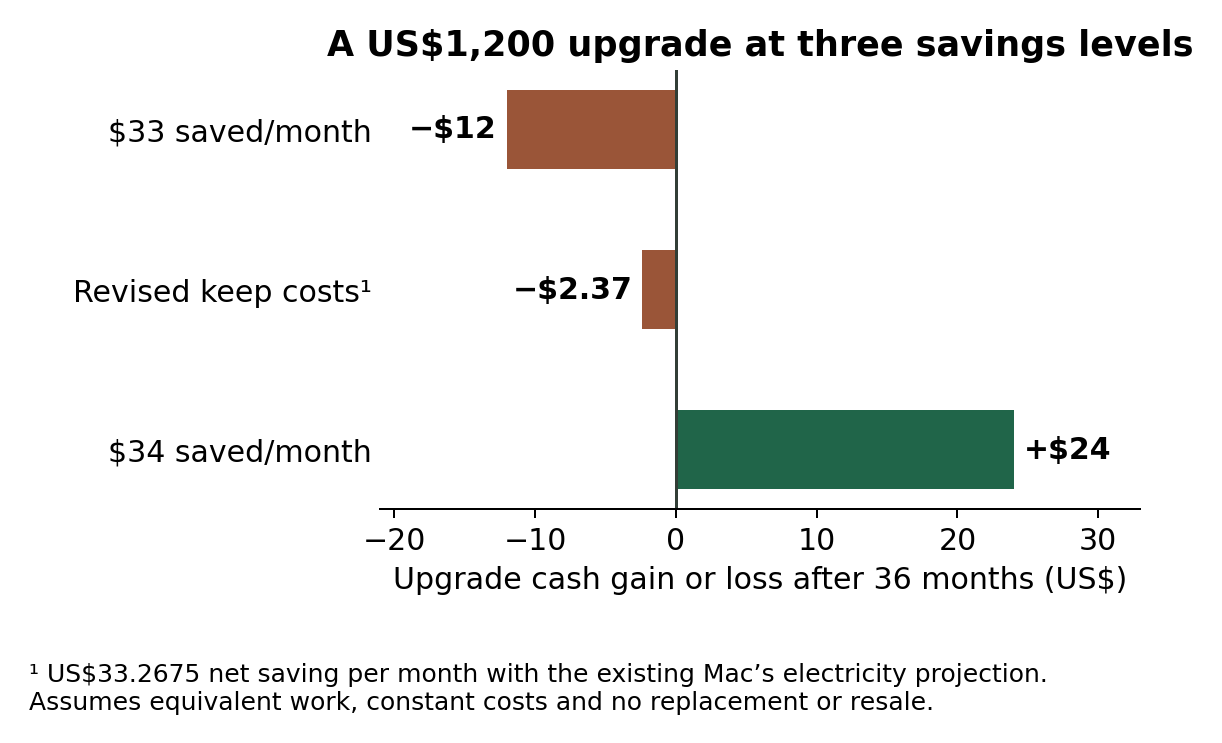
First, budget US$4 a month to run the existing computer. Keeping it costs US$65 a month; upgrading costs US$31 after purchase. The upgrade saves US$34 a month and finishes US$24 ahead after 36 months. Reduce the net saving to US$33 and it finishes US$12 behind.
| Net monthly saving after local costs | Saved over 36 months | Less US$1,200 purchase | Result |
|---|---|---|---|
| US$33.00 | US$1,188.00 | US$1,200.00 | US$12.00 behind |
| US$34.00 | US$1,224.00 | US$1,200.00 | US$24.00 ahead |
| US$33.2675, using the electricity projection below | US$1,197.63 | US$1,200.00 | US$2.37 behind |
At US$34 saved monthly, adding US$0.67 to monthly costs changes the US$24 gain to a US$0.12 loss. An extra US$24.01 on the purchase also reverses it. A result this close needs a margin for errors, price changes and extra work.
What the owner-reported batch changes
For a representative editorial batch on an existing M4 Pro MacBook Pro, the owner supplied these meter readings: 120.00 to 120.75 kWh during a 90-minute work window, then 120.75 to 120.85 kWh during a 90-minute idle window. Subtracting the matching idle window gives 0.65 additional kWh per batch.
The owner also reported 15 editor minutes with the local workflow versus 35 with the usual workflow, a saving of 20 minutes per editing task as reported. Those timings and meter readings have not been independently verified. They come from a subsequent representative-work report, separate from the synthetic pilot discussed below. We do not extrapolate those minutes into a monthly labor saving: repeated matched tasks and acceptance checks are still needed.
Use the reported workload of 20 comparable batches of 10 tasks each month. That is 200 tasks and 13 additional kWh monthly. At an assumed C$0.13/kWh, the projected energy cost is C$1.69 a month, C$20.28 a year or C$60.84 over three years.
For context, BC Hydro’s residential tiered energy rates, checked November 17, 2026, are C$0.1187/kWh below the threshold and C$0.1408 above it. At those rates, 13 additional kWh costs about C$1.54–C$1.83 monthly before applicable bill adjustments and tax. The C$0.13 figure is a working estimate, not a quoted tariff. Apply your actual plan, marginal tier, time-of-day terms, adjustments and tax. An unchanged household basic charge is not an additional AI cost.
Now use C$1 = US$0.75 as an explicit exchange-rate assumption and US$2 a month for non-power upkeep. Electricity becomes US$1.2675 a month, so the existing computer’s local running cost becomes US$3.2675. This replaces the US$4 allowance; it is not added on top.
| Cash over 36 months | Keep the existing computer | Buy the proposed upgrade |
|---|---|---|
| Extra purchase | US$0 | US$1,200 |
| Retained subscription | US$720 | US$720 |
| API spending | US$1,476 | US$216 |
| Local electricity and upkeep | US$117.63 | US$180 |
| Total | US$2,313.63 | US$2,316.00 |
The revised calculation favors keeping the computer by US$2.37. The upgrade’s US$5 local cost, US$6 remaining API bill and US$1,200 delivered price are hypothetical. Nothing in the existing-Mac observations proves that another machine can achieve them.
To break even, the upgrade must remove US$1,200 ÷ 36 = US$33.3333 of monthly spending after its extra local costs. Its local costs rise by US$5 − US$3.2675 = US$1.7325. Therefore, it needs US$35.0658 of additional avoided cloud spending per month to tie. At whole-cent monthly billing, US$35.07 finishes US$0.15 ahead. The assumed US$35 reduction is slightly too small.
Before treating the power projection as typical, repeat the matched windows and record meter resolution, what equipment the meter covers, battery charge and other activity. A dedicated machine left on all day needs its extra idle energy counted too. Subtract idle use only when that computer would otherwise have been on for the same period.
Buy against the bill you can remove
For a new purchase, subtract the cloud costs you will keep and all additional local running costs from today’s bill.
| Hypothetical monthly change | Net monthly cash saving | Purchase supported over 36 months |
|---|---|---|
| Keep a US$20 subscription; add US$5 local costs | −US$5 | No purchase pays back |
| Cancel a US$20 subscription; add US$5 local costs | US$15 | US$540 |
| Cut a US$100 cloud bill to US$20; add US$10 local costs | US$70 | US$2,520 |
At US$70 saved monthly, a US$2,500 purchase crosses over during month 36 and finishes that month US$20 ahead. One extra dollar of monthly running cost reduces the supported price to US$2,484 and leaves the purchase US$16 behind.
A subscription you keep contributes no fixed-fee saving, however many prompts you move locally. If you prepaid a year without a refund, count savings when you avoid the next renewal. A downgrade saves the difference between plans. The subscription fees in these examples are assumptions; use your own bill and terms.
If you would buy a computer anyway, compare the AI configuration with the computer you would otherwise buy. Count the additional purchase cost. If you are upgrading a PC, include every required component, such as a compatible power supply or cooling, plus tax and delivery. A graphics-card price alone is not the price of a working system.
Count accepted work, retries and editor time
Consider a hypothetical month with 100 summaries: 80 short release notices and 20 difficult reports. Keep a US$20 subscription. Assume the cloud charges US$0.25 per routine summary and US$2 per difficult report.
Suppose 72 routine summaries pass local review immediately. Eight need another local attempt; four then pass and four go to the API. The difficult reports still go directly to the API. This produces 76 accepted local summaries from 88 local attempts, with all 100 summaries ultimately completed to the same standard.
| Monthly item | Cloud-only workflow | Hybrid workflow |
|---|---|---|
| Retained subscription | US$20 | US$20 |
| Routine summaries in the API | US$20 | US$1 |
| Difficult reports in the API | US$40 | US$40 |
| Extra local running costs, including retries | US$0 | US$4 |
| Total | US$80 | US$65 |
Completing 76% of documents locally saves US$15 of the US$80 bill. Most cloud spending remains in the difficult reports. The success rates and task prices here are invented to explain the calculation; they do not come from our pilot.
Keep cash savings and labor value separate. At an assumed US$30 an hour, an extra minute of editor work costs US$0.50. Thirty additional minutes would use the entire US$15 cash saving in this example. Cloud answers also require review, so measure the difference between workflows. Background generation does not automatically consume an equivalent amount of human working time.
What our original local pilot established
The recorded pilot ran the installed qwen3:4b Q4_K_M model through Ollama 0.40.16 on an existing M4 Pro MacBook Pro with 24GB unified memory. The model file was hash-checked. Settings included an 8,192-token context, a 2,000-token output cap, temperature zero, seed seven and thinking disabled.
Thirty short synthetic development tasks covered summaries, text invoices and small Python function repairs. Each allowed up to two attempts. Six tasks reused matching records from a revised smoke test; 24 ran as new pilot tasks. The full pilot contains 47 attempt records: 37 new local requests and ten retained smoke-test requests. The smoke and pilot totals overlap and must not be added as independent samples.
| Workload | First-attempt automatic passes | Final automatic passes | Tasks |
|---|---|---|---|
| Summaries | 4 | 6 | 10 |
| Text invoices | 2 | 8 | 10 |
| Small function repairs | 7 | 9 | 10 |
| Total | 13 | 23 | 30 |
The final 23/30 count is an automatic-check result on development material, not a general accuracy rate or a forecast of bill reduction. Invoices arrived as text, so it says nothing about reading scanned invoices. The code tasks were small repairs rather than whole repositories.
Separate native AI editorial review judged 24 final outputs usable within these narrow tasks and six in need of correction. It found both automatic passes that changed meaning and automatic failures caused by limited matching rules. That review did not replace the original scores or complete the required human review of the 20 summary and code tasks.
Summed client-request duration was 142.102 seconds, including loading and retries and retaining the original durations of reused requests. This excludes setup, grading gaps and editor work. The synthetic pilot did not measure wall electricity or human correction minutes, and no cloud comparator was executed. Those values remain unmeasured, not zero. The later owner report does not retroactively fill them in.
Three assignments from this guide’s editorial desk
We gave the same installed local model three assignments drawn from this guide — turn a retailer listing into a price card, compare US and Canadian listings, and explain a cloud pricing threshold. We supplied short fact packets drawn from the public pages, set the acceptance criteria before sending any request, and allowed one attempt per assignment.
In the editor-agent assessment, all three drafts needed correction. The price card introduced a one-unit purchase limit absent from the supplied facts and omitted the requested hardware identifier. The comparison changed 512GB of storage to 5,112GB and gave conflicting accounts of Canadian tax and delivery. The pricing note used 272,010 tokens in place of the requested 272,001 boundary example and omitted that the long-context rate applies to the whole request.
The three requests took 11.6 seconds in total including model loading. That gives a generation time for this batch. Its human correction time and wall energy are unknown. The three drafts illustrate why billing estimates need an acceptance check before counting a cloud charge as displaced.
A cheap cloud model can change the purchase case
Comparing local AI only with an expensive cloud model can exaggerate savings. Check a lower-cost model that might satisfy your workload, then measure whether it does.
The following official rates were checked November 17, 2026. Each calculation assumes 2,000 uncached input tokens plus 500 total billable output tokens per task, one attempt, Standard processing, no tools and no cache writes. These are equal token recipes, not measured equal-quality results.
| Cloud model | Input / million tokens | Cached input / million | Output / million | Cost per assumed task | 1,000 assumed tasks |
|---|---|---|---|---|---|
| GPT-6 Luna | US$0.10 | US$0.01 | US$0.50 | US$0.00045 | US$0.45 |
| GPT-6.2 Sol | US$2 | US$0.10 | US$10 | US$0.009 | US$9 |
| GPT-6.2 Astra | US$8 | US$0.40 | US$40 | US$0.036 | US$36 |
OpenAI describes Luna as a model for focused, high-volume tasks. We have not tested whether it can do this editorial work to the required standard. At the assumed recipe, however, replacing every Luna call would avoid only US$0.45 per 1,000 tasks before local costs. Even replacing all 1,000 Astra calls would avoid US$36. Model choice and actual usage can matter more than the number of prompts.
For Sol and Astra requests above 272,000 input tokens, the model pages specify double input and cache rates and 1.5 times output rates for the full request. Batch, Fast and other processing options have different prices. Use the current pricing documentation for your selected mode. Include charged reasoning tokens in billable output, retries and tool fees; do not add reasoning tokens twice if they are already included in usage totals. Actual tokenizers and accepted output lengths can differ between models.
What the hardware listings tell us
The lowest-cost purchase worth considering depends on the model and work it must complete. These public listings give price references, not tested AI recommendations. All were opened November 17, 2026; the PC page still came from an older crawl.
| System and exact configuration | Seller’s listed price | Listing conditions and limits |
|---|---|---|
| Mac mini M6, 12-core CPU/12-core GPU, 16GB, 256GB; MHQK4LL/A | US$799 at Best Buy US | Lower-cost new configuration, sold by Best Buy. The page showed local US pickup/shipping; destination availability and tax remain to be checked. |
| Mac mini M6, 12-core CPU/12-core GPU, 24GB, 512GB; MHQM4LL/A | US$1,199 at Best Buy US | New-product listing with Add to Cart. No destination-specific total established. |
| Same 24GB/512GB Mac mini configuration, Canadian MHQM4VC/A | C$1,849.99 at Best Buy Canada | Sold and shipped by Best Buy; available to ship. Tax and destination delivery unverified. |
| Mac Studio M5 Max, 18-core CPU/40-core GPU, 64GB, 1TB; Z1U4000JJ | US$3,799 at B&H | New-product listing, in stock. Displayed free delivery was to a default US destination, not Vancouver. |
| ArsenalPC Hyte X50 White, Ryzen 7 9700X, RTX 5070 Ti 16GB, 64GB DDR5, 2TB NVMe, 850W PSU, Windows 11 Home | US$3,839 on Newegg | Sold/shipped by Arsenal PC. The source is marked crawled last month, so price and stock need a fresh seller confirmation. Component brands can vary. |
The US$799 mini is a cheaper entry point than the 24GB target, with less memory and storage. We have not established its capacity or acceptance rate for this workload. None of these machines is the M4 Pro MacBook Pro used in the pilot. Its results and electricity figures cannot be transferred to these systems.
US listings stay in US dollars and the Canadian listing stays in Canadian dollars. The illustrative exchange rate used for electricity does not turn a US sticker price into a Vancouver delivered quote. Add required accessories, tax, delivery and import costs before comparing a quote with your purchase ceiling. Optional memberships, financing and protection plans are not included here.
Privacy and useful capacity can justify a different choice
Keeping sensitive documents on hardware you control may be worth paying more for. Check the entire application: local generation can coexist with web search, cloud fallback or synchronized files. Ollama documents disabling its cloud features in its FAQ; that does not verify every other application on the computer.
If a task must remain local, a failed answer needs a local retry or human completion. Include that work in the comparison. Also check whether the computer can finish your actual volume while you use it for other jobs. A short successful request does not establish unattended monthly capacity.
For an existing machine, start with a representative batch before buying anything. Record accepted outputs, all attempts, extra electricity, retained cloud charges and editor minutes for both workflows. Kingy’s Local AI Lab can help explore model fit; the purchase decision still needs your own completed-work measurements.
Use your bill in the calculator
Enter today’s cloud bill, the subscription and API charges you will retain, the full additional hardware price, and extra electricity and upkeep. Keep every figure in one currency. Enter future costs on the dates they occur, including subscription renewals, replacement purchases and any assumed resale proceeds.
Run a second case with a cheaper adequate cloud model, more correction time and a shorter useful life. Future unannounced discounts belong in a sensitivity case. If an upgrade only wins by a few dollars after three years, confirm the specific additional tasks and cloud charges it can remove before buying.
Open the local-versus-cloud calculator.
Evidence dates and changes
| Evidence | Date | Scope |
|---|---|---|
| Official API prices and seller listings | Checked November 17, 2026 | Listed prices and conditions above; PC crawl remains older. No cloud execution or hardware purchase. |
| Local synthetic pilot | November 17, 2026 | One installed model on an existing M4 Pro MacBook Pro; automatic scores preserved. |
| Guide-writing check | November 17, 2026 | Three one-attempt local drafts from public source packets. Each needed edits against the predeclared criteria. |
| Representative editorial batch | Owner-reported November 17, 2026 | Meter readings and editor minutes; not independently verified or part of the synthetic pilot. |
| Electricity tariff | Checked November 17, 2026 | BC Hydro residential tiered energy rates; the tariff lists the rate schedule effective April 1, 2026. |
November 17, 2026: Added the three-year purchase ceiling and keep-versus-upgrade comparison, showed the US$33/US$34 reversal, and replaced the existing-Mac running-cost allowance with an explicit owner-reported electricity projection plus US$2 monthly upkeep. Rechecked Sol and Astra prices, added Luna as a lower-cost cloud comparator and a US$799 hardware reference, and separated the representative batch from the original synthetic test.
- Tested
- 30 synthetic pilot tasks, including six reused smoke tasks. A separate three-assignment editorial check used one attempt each.
- Machine
- M4 Pro MacBook Pro, 24GB unified memory. Proposed purchase hardware was not tested.
- Runner
- Ollama 0.40.16 on loopback.
- Files
- Installed qwen3:4b Q4_K_M, model layer verified with SHA-256 before execution.
- Cloud side
- Sol, Astra and Luna appear as official price comparisons; none was executed.
- Settings
- 8,192-token local context, temperature 0, seed 7, thinking off. Up to two pilot attempts; one per new editorial assignment.
- Grading
- Pilot: 23/30 final automatic passes. Native editorial review: 24 usable within fixture scope. All three new editorial drafts required corrections on predeclared criteria.
- Cost
- No paid API calls or purchases. Owner-supplied meter and editor timings refer to a separate batch; new test energy and correction time were unmeasured.
- Dates
- run 2026-11-17 · checked 2026-11-17
Sources
- Sol Standard short-context input US$2, cached US$0.10, output US$10 per million
- Astra Standard short-context input US$8, cached US$0.40, output US$40 per million
- Luna input US$0.10, cached US$0.01, output US$0.50 per million
- Processing modes/regions can change list cost
- Mac mini M6 24GB/512GB MHQM4LL/A, US$1,199
- Matching Canadian mini MHQM4VC/A, C$1,849.99
- Lower-price mini M6 16GB/256GB MHQK4LL/A, US$799
- Studio M5 Max 18 CPU/40 GPU, 64GB/1TB Z1U4000JJ, US$3,799
- ArsenalPC Hyte X50 Ryzen 9700X/5070 Ti 16GB/64GB/2TB/850W, US$3,839
- BC Hydro energy tier rates C$0.1187/C$0.1408 per kWh
- Tariff effective April 1, 2026
- Ollama documents cloud-feature disabling