

The confession that triggered a national review
South Korea ordered a review of every national qualification exam held in 2026 after the top scorer on its certified tax accountant exam admitted using generative AI and electronic devices to cheat. The presidential office convened an emergency meeting on November 15 at 3:30 p.m. in Seoul, or 2:30 p.m. Philippine time. Labor officials followed with a meeting of their own an hour later.
That put two kinds of work on the government’s desk. Investigators would have to look back at exams already graded. Officials preparing for the country’s college entrance test, just four days away, had to decide what they could change by Thursday. The same confession set both efforts in motion, but each ran on a very different clock.
What the top scorer admitted
The candidate, identified publicly by his surname Han, said he used electronic devices and generative AI in both rounds of the tax accountant exam. Reuters reported that he earned near-perfect marks across hundreds of questions in the April and July rounds. He made the admission in a video and said he had submitted a written confession to police.
A result that unusual can draw attention. It can also tempt people to read more into a score than the score can tell them. In this case, the candidate’s own account gave officials a specific incident to investigate. As they look through other exams, they’ll face a harder question. What evidence would justify taking a second look at any individual result?
Why a qualification exam carries so much weight
A professional qualification exam is one of the ways an institution decides who has met a standard for entry into a field. Candidates put time and money into reaching that standard. Employers and the public, in turn, rely on the credential to mean something about the work its holder can do.
That makes a cheating case costly even before anyone works out how widespread it is. A candidate who sat the exam honestly can start wondering what their result means alongside a tainted one. People who passed may find themselves defending an achievement they earned. By identifying compromised results and explaining the evidence behind any decisions, exam authorities can give everyone else a firmer basis for trusting their own results.
The penalty officials announced
The Ministry of Employment and Labor and the Human Resources Development Service of Korea said they would invalidate the candidate’s result, revoke his pass and bar him from taking national qualification exams for five years. They also announced plans to file a criminal complaint and cooperate with police. The agencies laid out those steps in the labor ministry’s account of its emergency meeting, and Seoul Economic Daily reported the details of the planned sanctions.
The exam sanctions address the status of the candidate’s result and his eligibility to sit future tests. A criminal complaint goes to investigators, who determine how to proceed. The five-year figure refers to the announced restriction on sitting exams.
How far the review reaches
Labor officials said the review would cover all national qualification exams conducted in 2026. They intend to use patterns from the tax accountant case to check for similar incidents. That gives investigators a place to start, even when they’re looking across qualifications with different subject matter, formats and venues.
The scope is worth reading carefully. Every exam describes the reach of the review. The government has yet to establish how many results, if any beyond the known case, were affected. A useful public update would explain which records exam authorities could examine, what evidence they looked for and how they handled ambiguous findings. Those details would help candidates understand what officials mean when they announce the results of an audit this broad.
Why Thursday mattered
The confession came on the Sunday before the College Scholastic Ability Test, known as the CSAT or Suneung. That exam is a separate event from the professional licensing test at the center of the case. It presented a more immediate problem. Officials reviewing earlier exams could spend time examining records. CSAT administrators had students arriving on November 19.
According to the presidential office’s meeting notice, officials reviewed how exam sites would check for AI-capable devices and supervise the test. The practical question was what they could put in place with the people, equipment and time available. For a student walking in on Thursday morning, the immediate concern was simpler. What should I expect at the door?
Who the AI inspectors actually are
The title AI inspector sounds like something you’d plug in. The government used it to describe a person. The labor ministry outlined plans to expand the use of dedicated staff who would look for prohibited AI-capable devices alongside regular proctors. It also called for more training on how to identify devices and respond to suspected violations. The presidential office separately reviewed assigning dedicated personnel at college entrance test sites.
A dedicated staff member gives the room proctor someone to call when a device raises a question. That division of work could matter in a busy venue. One person can assess the concern while the proctor keeps the rest of the room on schedule.
What a device check looks like for candidates
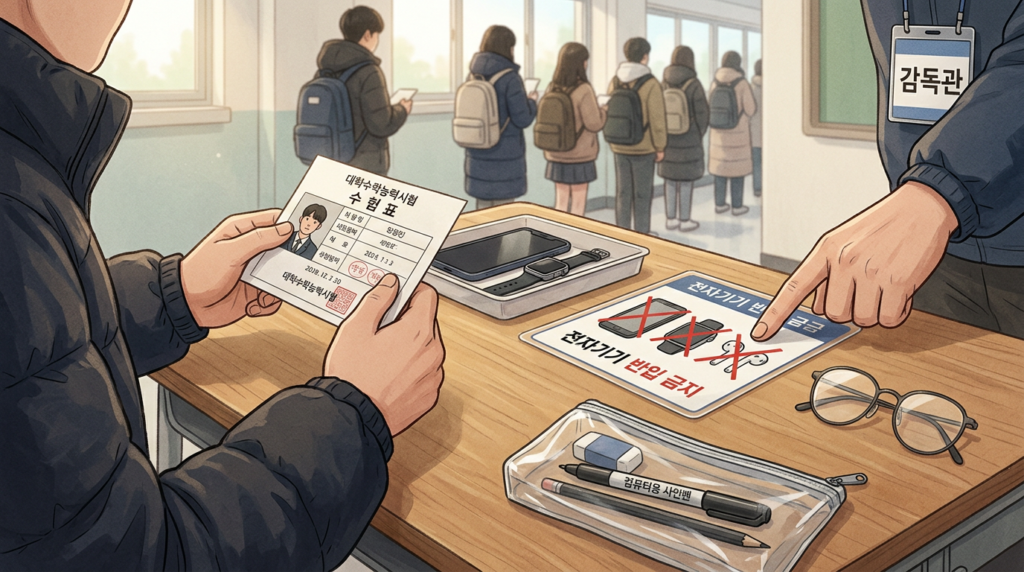
A well-written rule can save time at the door. Candidates need to know which items they can bring, whether they must hand anything over and whom to contact if they need an accommodation. The labor ministry said it would make the rules and penalties clearer, including restrictions on smart devices such as smart glasses, while expanding proctor training.
Wearables make that job trickier. An ordinary pair of glasses and a device with electronic features can occupy the same patch of someone’s face. A clear procedure gives staff a consistent way to resolve doubt. It also gives candidates a chance to check the rules before exam morning, when they already have enough to think about.
Where radio-frequency detectors fit
The labor ministry’s plans included radio-frequency detectors that the Korea Communications Agency was developing, according to Seoul Economic Daily. The proposal concerned national qualification exams. Officials described a tool they intended to bring into exam monitoring as part of a wider response that also included staffing and training.
Think of a signal alert as a reason to ask a better question. Staff would still need to establish where the signal came from, which exam rule applied and what evidence they could document. Decisions about where to test the equipment and how staff should respond to an alert will shape its value. A detector can give a supervisor something to investigate. The supervisor still has to investigate it.
Why thermal imaging came up
Thermal imaging entered the conversation through the college entrance exam preparations. The Kyunghyang Shinmun reported that presidential policy chief Ha Jun-kyung asked agencies to consider available measures, including thermal cameras. He also told officials to take care that people wearing ordinary glasses or using medical devices could sit the exam without being discouraged or harmed.
A thermal image shows differences in surface temperature. The challenge for staff would be deciding what, if anything, a reading warrants in a room full of people. If an exam site uses the equipment, the procedure for following up matters as much as the reading. Candidates have only a short time to get settled before the clock starts.
How a tip becomes something investigators can use
The Human Resources Development Service of Korea plans to set up online and offline channels for reports of cheating in national qualification exams. The reporting channels would cover suspected use of AI-capable devices as well as other forms of misconduct. They give candidates and staff a route to share concerns after an exam, when a supervisor may have more time to look into them.
A report that says when and where something happened gives reviewers a starting point. From there, the people handling it can check what records exist and ask whether independent evidence supports the account. That step matters to the person who flagged a concern and to any candidate whose conduct comes under review.
What an unusual score can tell you
Han’s marks helped make his case newsworthy. But if officials are reviewing other exams, high scores are a poor shortcut for deciding where misconduct occurred. An exam with enough candidates will produce some exceptional results. A small difference between first and second place says very little about how either person answered the questions.
Scores can still help reviewers decide where to look if they have something else to go on. A specific report, a documented incident at a venue or other records can give them context. The distinction matters when the consequences include losing a professional qualification. A review can follow leads without turning an impressive result into a liability for someone who earned it.
Keeping accommodations workable
Ha’s instruction about glasses and medical equipment points to a concrete problem for test sites. Candidates who need an aid may have to communicate that need to staff enforcing a tighter device policy. If those staff have a way to check an approved accommodation discreetly, the candidate can get on with the exam without explaining a medical issue in front of a room of strangers.
Consistency matters here. Two candidates with the same approved accommodation should be able to walk into different exam sites and expect the same treatment. That takes instructions people can use at the door, staff who know whom to call and enough time in the schedule to handle questions calmly.
The line between studying and sitting the test
Generative AI can help someone get ready for an exam. A candidate studying tax law might ask a chatbot for a practice question, then check the answer against a textbook or an official source. During a closed assessment, using outside assistance changes what the result measures. The exam is supposed to establish what the candidate can do under the stated conditions.
That distinction is useful when explaining device rules. Candidates generally need a straightforward answer about the tools they may use in a particular room for a particular test. As more everyday devices gain AI features, written rules and practical examples can help people work out what to leave at home before they reach the door.
What happens after the emergency meetings
The labor ministry and the Human Resources Development Service of Korea said they would form a joint task force to review national qualification testing and prepare broader countermeasures by the end of the year. That work gives officials time to examine procedures that go beyond any single exam date, including how venues train staff and how agencies handle reports.
The next details to watch are concrete. Which exams have officials reviewed? Where will dedicated inspectors be deployed? How will sites handle alerts, device disputes and accommodations? The announcement tells candidates what agencies intend to do. Their answers to those questions will tell candidates how the changes could affect their own exam day.
What candidates need to see next

For a candidate who spent months studying, the most reassuring outcome may look unremarkable. They arrive with the allowed items, staff explain the same rules to everyone, and the exam starts on time. If a question comes up at the door, someone with the authority and training to resolve it is available. Afterward, a candidate who saw something suspicious knows where to report it.
The national review serves the people who have already done all that and are waiting to learn whether their results will stand. A clear account of what officials checked, what they found and what they still need to establish would let those candidates follow the response without having to guess what it means for them.
Sources
- South Korean Presidential Office — Emergency meeting on AI-assisted exam cheating
- South Korean Ministry of Employment and Labor — Tax accountant exam response and national qualification review
- Reuters — Tax accountant exam confession and the upcoming college entrance test
- Seoul Economic Daily — Planned sanctions, reporting channels and device safeguards
- The Kyunghyang Shinmun — College entrance exam safeguards, thermal imaging and accessibility