ChatGPT Wallet lets an eligible user approve a card purchase made by their ChatGPT dot on a merchant’s website. Its initial rollout is for US ChatGPT Pro subscribers aged 18 or older. Each purchase requires review and a security check. OpenAI announced Wallet on November 13, 2026.
The difficult question is whether your account, card and intended checkout qualify. Amazon support has not been verified. A Shopify store needs to be assessed individually. An ordinary card-network logo does not settle either question.
Our reporting: This guide is based on published documentation, not a Kingy hands-on test. We did not enroll a card, place an order, or test a refund. The rules below were checked on November 13, 2026; rollout and merchant behavior can change.
Who can use ChatGPT Wallet?
| Requirement | Launch position |
|---|---|
| Where you use Wallet | In the United States. |
| Residence and billing | US resident with a US billing address. |
| Card | Eligible US-issued American Express, Chase, Mastercard or Visa credit card. |
| Excluded cards | Debit and virtual cards unsupported at launch. |
| Chase | Primary cardholder required; authorized users ineligible. |
| Interface | A dot conversation; unavailable in Chat, Work and standalone Codex. |
| Approval | Supported device with biometrics; link or QR continuation can use another device on the same account. |
Source: Wallet enrollment and approval instructions. A virtual card you try to enroll is different from the substitute number Wallet generates for checkout.
The terms require lawful card authority; business cards need organizational permission. Providers can reject cards.
OpenAI lists three monthly Pro tiers: $100, $200 and $500. Wallet documentation says Pro, without assigning the feature to just one tier. Paying for a plan does not establish access for your account or acceptance of your card. Source: Pro tiers.
 Music, footage and AI tools for video
How a Wallet purchase works
A dot is an agent with its own cloud computer and sign-in sessions. Your personal computer’s store login does not automatically sign the dot in; it may ask you to complete a secure sign-in or take over. Source: dot setup guide.
OpenAI says a payment-network token substitutes for card details after biometric purchase approval. Launch partners are American Express, Mastercard and Visa; existing card rewards and eligible-dispute protections remain. Source: launch announcement.
Material changes require renewed approval under the Wallet terms.
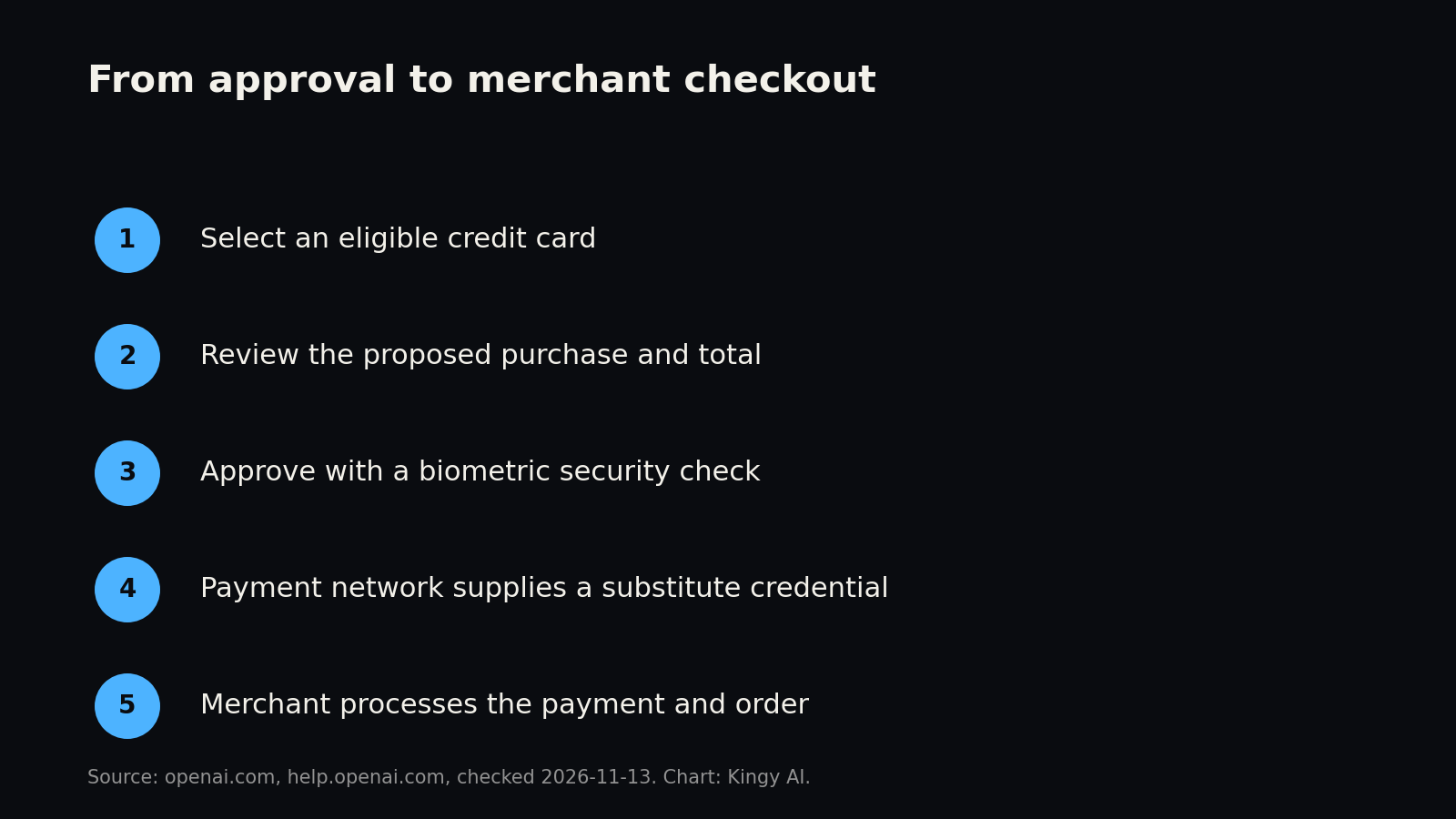
Approval is not an order confirmation. Check the merchant’s receipt or account before repeating an uncertain checkout. A conversation error does not tell you whether an order succeeded. Keep the order reference and the final amount so you can compare them with your card statement.
OpenAI describes spending-, category- and time-bounded advance delegation as a future direction. Do not assume those Wallet settings exist at launch. Source: launch announcement.
A separate route lets dots purchase with cards already saved on merchant websites, with purchase-specific approval that can be given in advance. That route has its own rules; it does not remove Wallet’s current approval flow. Source: dots safety FAQ.
Set up a card and request a purchase
- Create or open a dot in the latest iOS or Android app, the desktop app or desktop web. Mobile web is unsupported. General dot access does not establish Wallet access. Dot setup.
- Ask the dot to add a card, or use Settings → Wallet → Add Card on mobile. Complete the secure form and any bank verification. Chase uses its mobile app and biometrics. Wait for confirmation. Card setup.
- Specify the seller, exact item, variant, quantity and all-in maximum. Include any delivery deadline and whether subscriptions are acceptable.
- Compare the request with those instructions. Check the shipping address, taxes, delivery charges, total and recurring terms before approving. Save the merchant’s confirmation.
Supported secure login forms keep entered credentials from the model; text pasted separately into a conversation does not get that protection. Use the designated secure forms for card details and bank verification. Source: dots safety FAQ.
Example request, written by Kingy: “Find the blue 20-ounce bottle from the manufacturer’s store for no more than $35 including shipping and tax. Show me the exact item, delivery estimate, total and return conditions. Do not choose a subscription. Bring me the purchase request for review.” This is suggested instruction design, not a tested prompt or a guarantee of compliance.
Ask the dot to list, default or remove cards by their last four digits. Verify the removal confirmation. Source: saved-card management.
Which websites support ChatGPT Wallet?
OpenAI’s merchant payment guide says existing checkout forms need no Wallet-specific integration. That is a technical route, not a retailer guarantee. An agent must reach checkout, the payment must be authorized and the merchant must accept the order.
| Site or platform | What is established | Practical interpretation |
|---|---|---|
| Amazon | No Wallet-specific support announcement or successful checkout verified for this guide. | Do not assume support from ordinary credit-card acceptance. |
| United Airlines | United announced agent-access restrictions covering its platforms and indirect booking and distribution. Reuters, November 11. | An announced restriction; no Wallet checkout tested. Other airlines need their own assessment. |
| Shopify stores | Several AI-shopping routes exist, with different store and channel requirements. | Check the individual store, product and checkout route. |
| Other websites | Existing checkout can be technically compatible. | Access controls, payment authorization and merchant acceptance still matter. |
Amazon has challenged outside shopping agents. Its November 2025 statement about Perplexity asks third-party purchasing applications to respect merchants’ participation decisions. Its published robots file includes broad exclusions for named AI agents and crawlers. A robots declaration does not prove what happens in a specific authenticated Wallet checkout.
For Shopify, separate discovery from payment. Its ChatGPT channel refers customers to the merchant’s own checkout in an in-app browser or web tab. Eligible products and stores must meet its requirements. Shopify’s broader channel guide also describes direct checkout in selected other AI channels and personal-agent purchases through Shop Pay. None establishes universal Wallet acceptance across Shopify.
OpenAI says no product feed or plugin is inherently required for cloud-browser access. Merchants can configure their security systems to recognize signed, user-directed browser requests, separately from crawlers. Store policies and page-level controls still apply. A shopper should not treat access troubleshooting as permission to bypass a deliberate restriction. Source: agent access guide.
For merchants, the payment guide describes a gradual rollout of forwarded user signals: IP/network information, estimated country, locale, time zone and browser or app identity. Risk systems can otherwise flag the cloud browser and stop a legitimate purchase. These measures do not prove any named store has enabled Wallet. Source: merchant payment guide.
What can Wallet buy, and what is restricted?
Wallet terms prohibit fraud, laundering, cash-equivalent transactions, unlawful goods/services, sanctions evasion and restriction bypass. OpenAI can block transactions or impose merchant, category, card, account, device and geographic limits.
Its separate commerce policy governs product listings and merchant participation in OpenAI shopping experiences. Restricted categories include:
- Explicit adult content, sexual products and gambling services.
- Controlled drugs and paraphernalia, prescription-only products and supplements.
- Alcohol, tobacco, nicotine and relevant consumption accessories.
- Weapons, explosives, hazardous materials and recalled or unsafe goods.
- Counterfeits, stolen goods, piracy products, malware and covert-surveillance tools.
- Fake IDs, personal-data lists and artificial social-engagement services.
- Certain financial, crypto, identity-protection, legal and high-chargeback travel businesses.
The policy also excludes high-risk account-linked digital goods and certain post-purchase account services, while excepting conventional software, software licenses and complete games from the digital-entitlement category. These listing rules are not an exhaustive Wallet-only browser blacklist. The Usage Policies effective on launch day separately prohibit illicit transactions, real-money gambling and weapons procurement. The main policy page already displays a November 20, 2026 effective date; this guide uses its previous version for November 13.
Recurring subscriptions need explicit consent
OpenAI’s merchant documentation permits subscriptions when checkout supports recurring billing, the customer consents and the processor’s merchant-initiated-payment practices are followed. A credential approved for one transaction cannot be saved or reused for a separate purchase. Source: merchant payment guide.
Before accepting a trial or subscription, check the renewal price, interval, minimum commitment and cancellation route. Write the renewal date down. To end recurring charges, cancel with the merchant and retain its confirmation. Removing a Wallet card does not cancel those obligations. Source: Wallet terms.
Costs, card fees and limits
Budget for Pro, the goods, delivery and taxes. Your card’s interest, fees, currency-conversion and dispute rules continue. Source: Wallet terms. CNBC reported that OpenAI said it was not taking a transaction cut at launch. That is a launch-economics statement, not a complete fee schedule or permanent promise. Source: CNBC’s launch interview.
We found no published universal per-order, daily or monthly spending cap, card-count maximum or exhaustive issuer list. Unspecified does not mean unlimited. The terms reserve limits and transaction blocks.
Wallet is distinct from the ChatGPT account balance for eligible ChatGPT website purchases. That balance can contain gift-card funds or account credits; it is not evidence of a way to fund a merchant order. Wallet itself creates no bank account or stored balance. Source: Wallet terms.
Security, data and privacy controls
The secure-form provider receives full card data. OpenAI says it receives a token and limited card metadata rather than the full credit-card number or security code. Source: Wallet privacy notice. Local biometric checks do not send the underlying face or fingerprint scan to OpenAI. Source: Wallet terms.
The privacy notice still describes collection of contact/delivery details, items and amounts, order/refund/dispute status, approval and authentication records, plus device, location and fraud signals. Relevant merchants, payment/security providers, networks and issuers receive data for their roles and have their own notices. OpenAI says it does not sell Wallet information or share it for targeted or cross-context behavioral advertising.
Removing a card does not immediately erase all records. Limited retention supports credential deactivation, pending transactions, fraud prevention and legal obligations. Other retention depends on purpose; the notice specifies no universal deletion deadline. Source: Wallet privacy notice.
For personal plans, Improve the model for everyone controls whether eligible dot conversations/work can improve models, including action-related and connected-app information used in conversations. Turning it off does not prevent limited safety-related human review. Dot context, shared memory and separately stored files/conversations have distinct controls. Source: dots privacy FAQ.
A website can contain malicious instructions and agents can make mistakes despite safeguards. Content on a page does not grant the agent your permission. Source: dots safety FAQ. Inspect the seller’s domain, exact item, return conditions and total yourself; tokenization cannot tell you whether the product is the one you wanted.
Who handles orders, cancellations and refunds?
Contact the merchant for orders, returns, cancellations and refunds; contact your issuer promptly for billing errors or unauthorized charges. OpenAI can assist with records but generally does not fund refunds or chargebacks. Non-waivable rights remain. Source: Wallet terms.
For Wallet errors, suspected account access or a purchase different from the approval, contact OpenAI Support. Source: Wallet help. Keep the time, error, merchant, amount and order reference; redact card numbers and security credentials.
Verification can create a temporary authorization, reversed after card verification. No universal amount or release deadline is specified. Source: Wallet terms. For an uncertain checkout, compare the merchant’s order history and receipt before trying again; ask the issuer about a pending charge.
ChatGPT Wallet vs. Claude Duet, Meta Muse and other options
Compare the whole purchase path, not only the name of the wallet. The agent finds or selects the item; the payment service supplies a credential under an approval or budget; the merchant decides whether to accept the order and fulfills it. A one-time card can limit exposure of the underlying payment details, but it cannot establish that the agent chose the correct size or a seller with acceptable return terms.
| Option | Purchasing and approval | Access and limits |
|---|---|---|
| Claude Duet + Link | Confirm the item and approve a maximum in Link; Link supplies a one-time card scoped to merchant and amount. | US research preview, waitlist and eligible Claude paid plan; a merchant can still refuse the order. Recurring payments through this Link integration are unsupported. |
| Meta Muse + Link | Approve the total in chat; Link uses a saved payment method where accepted or a scoped virtual card elsewhere. | US consumers for the Link integration; store and agent availability are separate questions. |
| Shop Pay for personal agents | Default per-order approval; optional budgets may allow delegated payments where available. | Support differs by agent, store and transaction. Muse’s Shop Pay route is limited to Shopify stores; Duet, Instinct and Grok Bot can use it beyond Shopify. |
| Perplexity Instant Buy | Choose a supported product and complete checkout using saved details. | US, compatible merchants; separate from the Comet browser. |
| Google Pay agentic checkout | Uses an eligible Google Pay method for supported agent purchases; a price increase blocks the purchase. | Select merchants and supported markets; availability can change. |
| Amazon Alexa for Shopping | Amazon’s own assistant supports shopping and target-price auto-buy; eligible external Buy for Me orders have a confirmation flow. | Amazon’s native route does not establish access for ChatGPT Wallet or other outside agents. |
Claude Duet: a separate Link approval
Anthropic’s Duet is an agent research preview available by waitlist to US Pro, Max and Ultra subscribers. The underlying Claude plans are listed at $20, $100 and $200 per month respectively, with an annual option for Pro; access to a plan does not guarantee an immediate waitlist invitation. Duet announcement; Claude pricing.
With Duet’s Link integration, the user approves a maximum amount in Link and a one-time credential is limited to the merchant and amount. An approved transaction can still fail at checkout. The merchant handles fulfillment and product returns; Link handles payment issues, while Anthropic directs incorrect agent-selection issues to its own support. This description is specific to Link: Duet’s Shop Pay route has different controls. Source: Anthropic’s Link guide.
Meta Muse: Link and Shop Pay are different routes
Meta’s Muse is a personal agent with a free tier and optional paid subscriptions. Meta lists Power at $20 a month and Maximum at $100 a month; availability and benefits vary. Meta’s introduction; Muse subscription details.
For Muse’s Link integration, Stripe describes approval of the transaction total in chat. Link can use a saved method at participating businesses or issue a single-use virtual card for an approved purchase elsewhere. That payment capability does not guarantee that a particular merchant permits the agent to shop. Source: Stripe.
Shop’s personal-agent documentation describes another path. The default is to prepare an order for approval; an optional weekly, monthly or total budget can authorize purchases without a fresh approval for each one where the feature is offered. Check the permission carefully: controls and reach vary by agent, and the merchant remains responsible for fulfillment and returns.
Other ways to shop
Perplexity Instant Buy offers checkout for compatible merchants in the US. It is an integrated product-card purchase path, distinct from using Perplexity’s Comet browser to visit a site. Its current help page says it is available to US users except Enterprise Pro and Enterprise Max accounts; a consumer Pro subscription is not required.
Google Pay’s agentic checkout works with selected merchants and an eligible saved method. Google says a price increase stops the purchase; out-of-stock items or a declined card can also interrupt it. On November 13, its opening eligibility note lists the US and Australia, while troubleshooting still says US-only. We cannot resolve that inconsistency from this page; check your account’s availability.
Alexa for Shopping is Amazon’s own shopping assistant. Amazon describes target-price auto-buy and an eligible external Buy for Me route, as well as ordinary referrals to merchant websites. Those are Amazon’s product flows, not evidence that another company’s Wallet can complete an Amazon order.
Finally, a familiar wallet such as Apple Pay also protects card details at supported checkout, using a device account number and transaction-specific security code. It is a payment method, not by itself a shopping agent that searches and chooses items. Source: Apple Pay security overview.
Sources
- OpenAI: Introducing ChatGPT Wallet
- OpenAI: Making purchases with ChatGPT Wallet
- OpenAI: ChatGPT Wallet terms and privacy notice
- OpenAI: Accept payments and agent access
- Anthropic: Link with Claude Duet
- Stripe: Muse and Link
- Shop: Using Shop with AI agents and Shopify: Selling on ChatGPT
- CNBC: Wallet launch interview and Reuters via CNBC: United agent restrictions