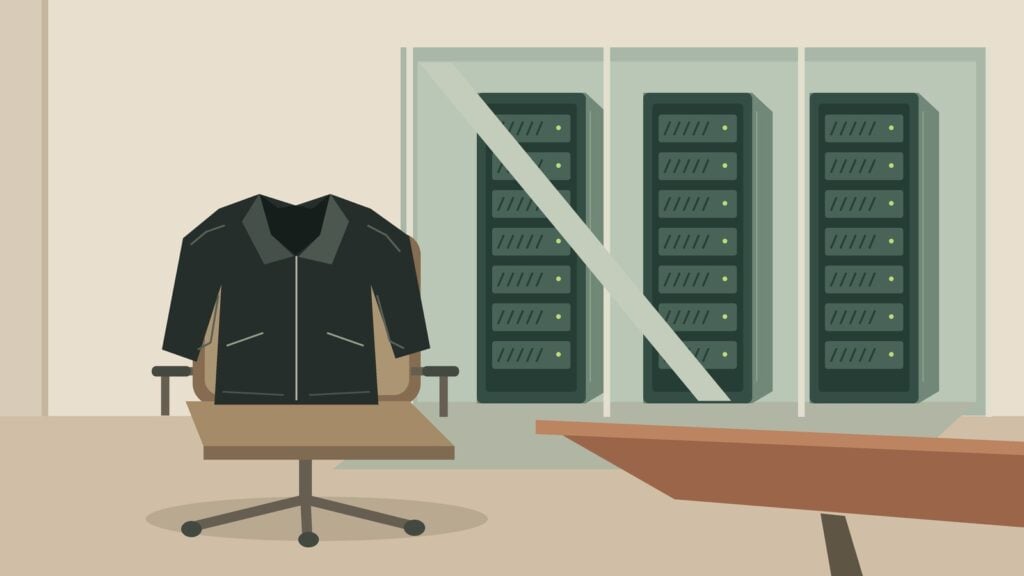
Jensen Huang has resigned as NVIDIA’s president, CEO and director, effective immediately. CFO Colette Kress is interim CEO while remaining CFO, and the board has begun a search for a permanent successor. Elon Musk has publicly welcomed the idea of hiring Huang, but there is no confirmed job, company, role or formal offer.
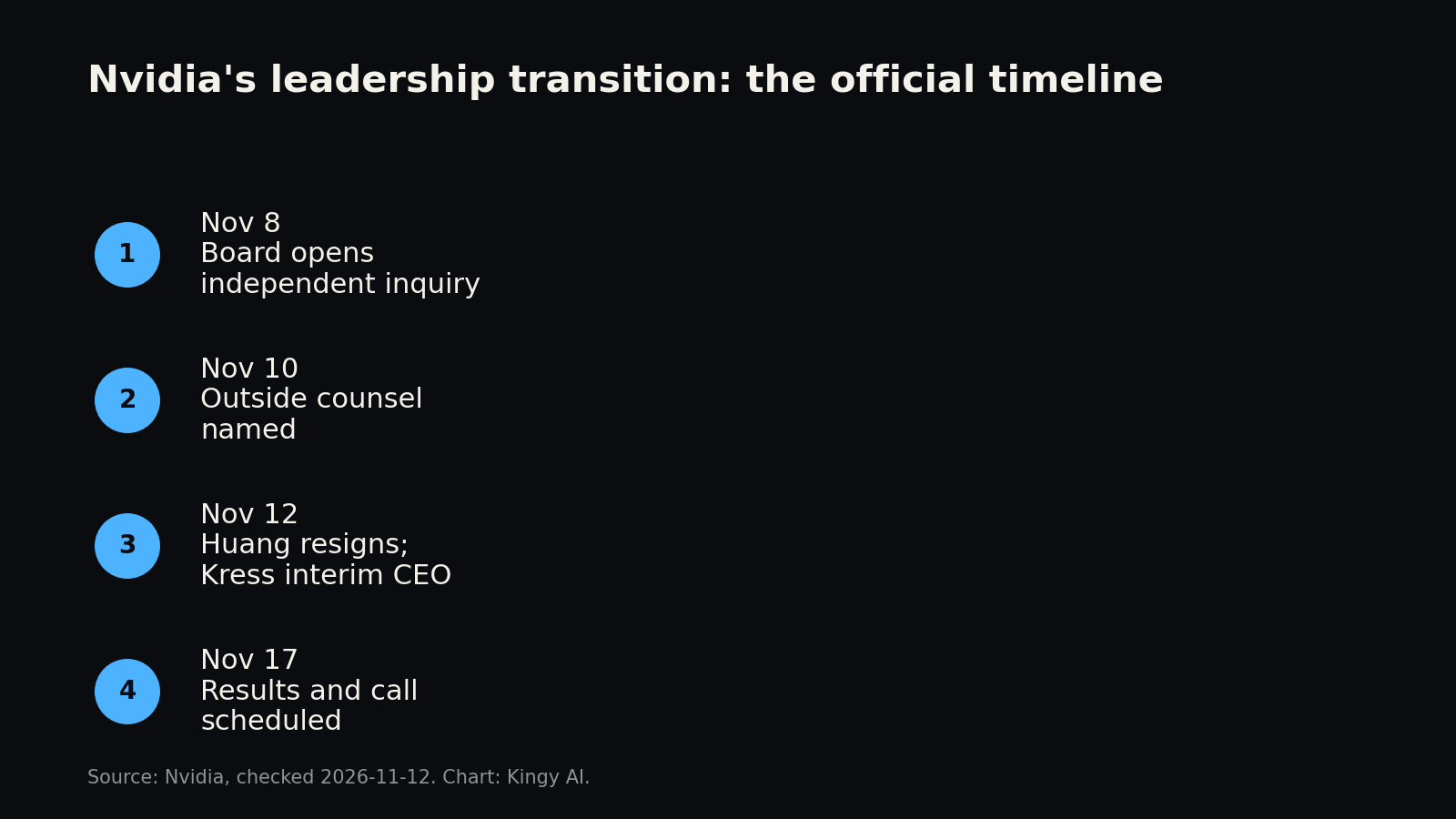
NVIDIA named director Harvey C. Jones its first board chair. The company says it expects operations, customer commitments and its product roadmap to continue without interruption. That is management’s expectation; the next several months will show how the transition affects delivery and decisions. NVIDIA announced the changes on November 12, 2026.
Huang’s departure exposes a distinction that matters across AI: owning an installed platform, coordinating its next delivery, and funding its future are different kinds of strength. The consequences will arrive on different clocks. Installed systems and software remain in place. Coordinating the next wave of chips, networking and support is an organizational job that must continue through the transition. Longer-term decisions about open models, developer tools and partnerships will depend on leaders who have yet to be chosen.
What NVIDIA has said about the departure
On November 8, Huang told employees he had been unfaithful in his marriage and would cooperate with an investigation. That admission should not be expanded into an admission of espionage or sharing company secrets.
The same day, NVIDIA’s board said it had initiated an independent inquiry and, at that time, had no reason to believe national security or NVIDIA secrets had been compromised. That was the board’s November 8 assessment, not a published outcome of the inquiry. On November 10, its independent directors named Joon H. Kim and Wachtell, Lipton, Rosen & Katz to lead the outside investigation.
The Associated Press reported that Huang’s departure followed an affair with a Chinese businesswoman suspected of acting for Beijing. That allegation is not an established finding of espionage. AP also said it could not independently confirm a separate report about a second relationship. NVIDIA’s transition announcement does not publish investigative findings. The available statements do not establish why each director acted or whether any secrets were compromised.
The board’s earlier public confidence in Huang preceded his resignation. The chronology is clear; the private deliberations are not. NVIDIA has announced neither a permanent successor nor an investigation result.
The infrastructure already installed will remain in place
For developers, the immediate concern is whether an application still runs, a cluster stays available and a supplier honors its commitments. A change of CEO does not technically erase GPUs in a data center, compiled applications, downloaded model weights or source code already distributed under a license. That is an engineering inference from the assets themselves, not a live test of customer systems.
NVIDIA’s platform is also more than a single chip design. Its October announcement with Oracle described Vera Rubin NVL72 systems and Vera CPUs as generally available on Oracle Cloud Infrastructure, alongside existing GB200 and GB300 systems. It described CUDA as a shared software foundation across generations. The planned expansion to multi-gigawatt scale is a future commitment, not evidence that every planned system has already been installed.
That example shows why continuity has several layers. A cloud customer may have working equipment today, a contract for additional capacity, and an application that relies on NVIDIA-specific software. Those are three different exposures. A functioning cluster does not by itself prove that next year’s delivery schedule or support response will be unchanged.
We have not independently audited NVIDIA’s customers or deliveries. The research for this article established no transition-related supply interruption, and NVIDIA expects continuity. Customers should still judge that expectation against their own delivery dates, support agreements and communications.
The next few quarters will test coordination
Large AI systems require GPUs, memory, networking, power, cooling, software and the people who integrate them. A CEO does not personally perform each job. Leadership does influence priorities when customers compete for scarce components, a product encounters a delay, or different teams must choose which problem to solve first.
For an interim period, Kress holds both the CEO and CFO jobs. She brings experience inside NVIDIA to the transition; the two titles also make her span of responsibility unusually visible. Her finance background alone tells us nothing about her ability to lead technical teams. The useful question is who has authority over product decisions and whether that team can make them quickly.
Customers can watch for named executives taking responsibility for hardware, software and major accounts; changes to delivery commitments; and explanations of any revised product schedules. An unchanged roadmap statement is a starting point. A customer confirming that a complex system arrived, was integrated and received support is stronger evidence of execution.
The distinction matters for smaller builders too. A startup renting cloud GPUs may never buy hardware directly from NVIDIA, but its provider’s capacity and pricing can be affected by installation schedules and system availability. A research team maintaining a model might care more about software compatibility and support for the next accelerator generation than about a particular shipment.
NVIDIA has scheduled financial results for November 17, with a call afterward. Management can use that event to explain decision ownership, customer commitments and any changes to its expectations. Results and guidance would still be company statements, not an independent audit of every deployment.
Open software gives users options, with limits
NVIDIA’s software portfolio contains genuinely open-source projects alongside software governed by proprietary or other commercial terms. Its licensing overview identifies projects including Dynamo, Triton, NeMo and RAPIDS under licenses such as Apache, BSD and MIT. The exact project and component determine the terms.
For example, Dynamo is a distributed inference framework whose public code is available under Apache 2.0, subject to third-party notices. A published version can be inspected, modified and reused under its applicable terms. If a vendor changes direction, that code does not disappear from every existing copy. A community or another company could maintain a fork in principle; there is no evidence in the reviewed material that this transition has caused one.
That availability is useful insurance, but it is not a maintenance contract. Efficient inference depends on changing hardware, drivers, libraries and model architectures. Keeping an old version available is different from paying engineers to add support for the next generation, investigate bugs and review outside contributions. A new NVIDIA leadership team could continue that work or alter its priorities. The transition announcement does not announce a change to these projects.
Models need their own license review. NVIDIA’s Nemotron open model license grants commercial use, modification and redistribution rights subject to its terms, including notice obligations and a litigation-related termination provision. It applies to works distributed under that license, not automatically to every NVIDIA model. The rights attached to a release already received are a separate question from whether NVIDIA funds another release.
Nor should “open weights” be read as a promise that all training data, code, distribution rights and services are open on identical terms. NVIDIA has described Nemotron releases and customization work involving weights, data and recipes. Check the actual artifacts and license for the specific model before building a commercial deployment around it.
Other parts of the stack have different restrictions. The CUDA SDK license includes proprietary terms, while separate provisions apply to samples and open-source components. NVIDIA’s licensing overview says the NIM runtime falls under AI Enterprise terms and that a model’s license is separate. Calling all NVIDIA AI software open, or all of it closed, would hide the decisions developers actually have to make.
Openness can serve users and NVIDIA at the same time
There is a commercial explanation for a chip supplier investing in accessible models and tools. A capable downloadable model gives a company a reason to build an application; a good serving framework can make that application easier to run efficiently on the supplier’s hardware. More useful applications can create demand for computing capacity.
Users can benefit from the same arrangement. A team with the relevant rights and skills can run a model itself, adapt it for a domain, inspect available code, or reduce its dependence on a single hosted endpoint. That may matter for data handling, customization or continuity if a hosted service changes. Self-hosting also transfers costs and operational responsibilities to the user.
This is Kingy’s interpretation of the commercial incentives visible in NVIDIA’s mixed portfolio, not a claim to know the company’s internal motives. A vendor can support open projects for several reasons at once. The practical measure is whether users retain usable artifacts and rights, whether the project accepts outside work, and whether independent maintainers can keep pace.
Open weights do not automatically make a deployment portable across hardware. A model file may be downloadable while its serving code, optimized kernels, quantization format or operational tooling depends heavily on one accelerator stack. Moving can require new kernels, accuracy checks, performance tuning and procurement work. Portability is a property of the whole workload, not a label on the model alone.
What Musk’s interest does and does not establish
After a social-media suggestion that Musk hire Huang, Musk replied, “That would be an honor,” according to Anadolu Agency. Teslarati embedded the response. We could not directly retrieve the original X post. Neither report establishes a specified role, employer, signed agreement or formal offer. Huang has not been confirmed as joining Tesla, xAI, SpaceX or another Musk company in the sources reviewed.
If Huang eventually joined a major NVIDIA customer or a business competing across the AI supply chain, the move would raise a legitimate platform question. NVIDIA sells to organizations with competing interests. They may care whether a former leader’s relationships and knowledge of the market affect perceptions of neutrality or access, even if NVIDIA continues to treat customers consistently.
That is a conditional issue to watch, not evidence of favoritism or confidential information changing hands. Huang’s experience, judgment and relationships would travel with him; NVIDIA’s engineers, intellectual property, supplier contracts and manufacturing capacity would not automatically follow. Any actual role and its responsibilities would matter more than a social-media exchange.
The same distinction applies to any prospective employer, not only Musk’s companies. A leader moving from a supplier to one customer can change how other customers assess their own dependence. The effect would depend on the new job, the employer’s position and NVIDIA’s subsequent behavior, none of which can be inferred from the reply.
Alternatives exist, but migration takes work
AI buyers already have reasons to consider more than one computing stack. AMD said in its November 3 prepared earnings remarks that its Helios production ramp was underway and ROCm 10 had launched. Its Helios reference design combines Instinct accelerators, EPYC CPUs, networking and ROCm software. Google lists cloud TPU generations and locations for customers evaluating another path.
Those are real alternatives, not proof that a particular customer can immediately obtain enough capacity or move an existing workload cheaply. Published hardware specifications do not settle the cost or speed of a particular training or inference job. Software dependencies, model support, data movement, staff experience, available regions and contractual commitments all affect a migration.
A sensible resilience exercise starts with one important workload. Record its model and license, dependencies, hardware-specific code, data requirements, acceptable accuracy and latency, and recovery procedure. Then test a representative version on an alternative where access and budget permit. The result will not eliminate supplier dependence, but it can show which parts of the application are expensive to move before a deadline makes that question urgent.
What to watch on November 17
NVIDIA has scheduled its results release for about 1:20 p.m. Pacific on November 17 and its call for 2 p.m. Pacific. Listen for specific answers on who owns roadmap decisions during the search, whether delivery commitments or guidance have changed, and how management plans to handle customer priorities. Compare those statements with subsequent customer confirmations.
Beyond the call, watch for the permanent CEO appointment, any published inquiry findings, and the actual cadence of open-project releases and maintenance. A new announcement or a paused release should be assessed on its own evidence; a single missing update will not establish a company-wide strategic shift.
For a team relying on NVIDIA today, the immediate action is to identify its next delivery or renewal date, the support contact responsible for it, and the software components that would make a change of provider difficult. Those details will make management’s next commitments easier to evaluate.
Sources
- NVIDIA: CEO transition; November 17 results schedule
- NVIDIA: Huang’s message to employees
- NVIDIA board: November 8 statement; independent directors: November 10 statement
- Associated Press: live coverage of the transition
- Anadolu Agency: Musk’s response; Teslarati: embedded response
- NVIDIA and Oracle: infrastructure announcement
- NVIDIA software licensing overview; CUDA EULA; Nemotron open model license; Dynamo source
- NVIDIA: Nemotron customization examples
- AMD: earnings prepared remarks; AMD: Helios; Google Cloud: TPU regions and zones