Google Just Gave the AI Chip Race Another Major Shake-Up
The artificial intelligence revolution has a rather inconvenient problem.
Everyone wants smarter AI. Businesses want faster responses. Researchers want machines capable of solving increasingly complicated problems.
Unfortunately, all that intelligence requires extraordinary computing power.
Google believes it has an answer.
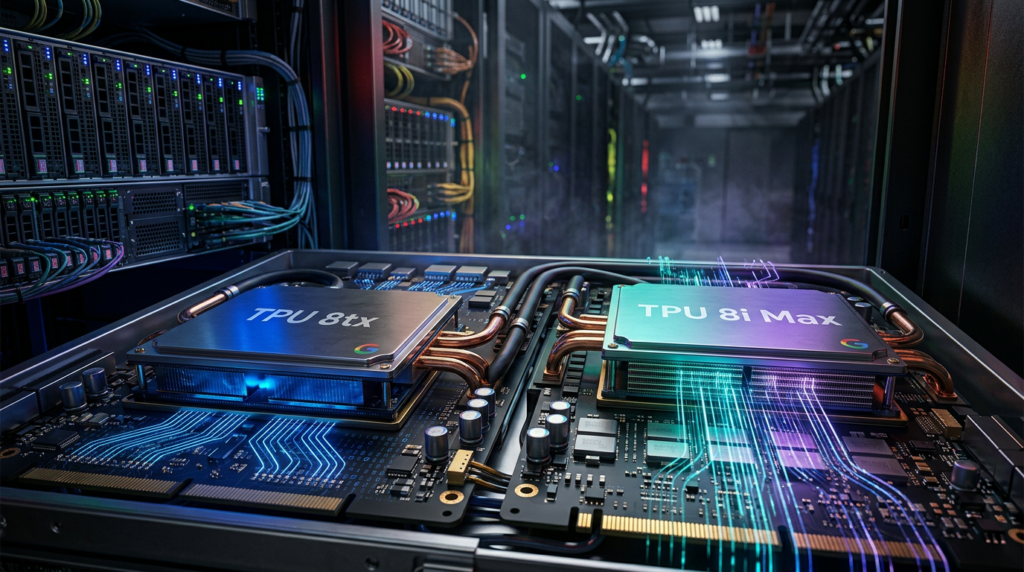
On November 9, 2026, the technology giant announced two additions to its eighth-generation Tensor Processing Unit lineup: TPU 8tx and TPU 8i Max.
These specialized computing systems address two increasingly important challenges facing modern AI infrastructure.
One tackles security. The other tackles memory and computing capacity.
According to Google’s official announcement, the TPU 8tx protects sensitive information while AI models actively process it. Meanwhile, TPU 8i Max combines two processors to handle workloads involving enormous amounts of information.
The implications stretch well beyond faster chatbots.
Financial institutions could process confidential information with stronger hardware-level protections. Researchers could analyze larger datasets. Software developers could operate sophisticated AI agents across substantial programming projects.
Google is also challenging Nvidia’s influential position in the AI accelerator market.
As Reuters reported, the announcement strengthens Google’s efforts to attract businesses looking for alternatives to traditional GPU-based infrastructure.
The message is becoming increasingly clear.
The next AI breakthrough might not come from a smarter model.
It could come from the hardware making that intelligence possible.
Meet the Four Members of Google’s TPU Family
Before exploring the newcomers, understanding Google’s broader hardware strategy helps.
A Tensor Processing Unit, or TPU, is a specialized processor designed to accelerate machine-learning computations.
Unlike general-purpose CPUs, TPUs concentrate on mathematical operations commonly used by AI systems.
Google originally developed these processors for internal applications, including language translation and voice recognition.
Today, they support increasingly demanding workloads involving Gemini models, cloud computing, and autonomous AI agents.
Google introduced two eighth-generation systems earlier in 2026.
TPU 8t targets large-scale AI training, while TPU 8i focuses on responsive inference and reasoning.
Now, two additional systems complete the family.
TPU 8tx specializes in confidential computing, allowing organizations to process sensitive information with stronger protections.
TPU 8i Max addresses demanding workloads that require substantial memory capacity and bandwidth.
Importantly, these additions aren’t entirely new processor architectures.
Google describes them as specialized systems built by combining existing silicon with different configurations of memory, networking, security, and packaging.
That distinction matters.
Designing a completely new processor can require years. Reconfiguring an established architecture allows Google to respond more quickly to changing customer requirements.
Instead of building one processor for everything, Google is developing specialized infrastructure for different AI challenges.
TPU 8tx Makes Confidential AI Computing a Priority
Picture a hospital using AI to analyze confidential medical records.
Or imagine a financial institution processing sensitive customer information through an advanced reasoning model.
Both applications could benefit enormously from artificial intelligence.
However, they also introduce difficult security questions.
Traditional encryption protects information while it travels across networks or remains stored on disks.
Processing introduces another challenge.
Computers generally need access to usable information while performing calculations, potentially exposing sensitive material within the computing environment.
Google designed TPU 8tx to address this problem.
The system introduces hardware-level confidential computing that helps protect sensitive data and AI model weights during active processing.
Model weights are especially important because they contain information learned during training and may represent valuable intellectual property.
Protecting them helps organizations safeguard proprietary AI systems.
TPU 8tx combines Google’s TPU technology with fifth-generation AMD EPYC host processors.
The resulting architecture supports isolated, protected execution environments intended for demanding enterprise applications.
Nevertheless, confidential computing doesn’t eliminate every cybersecurity risk.
Organizations still need proper access controls, secure software, identity management, and independent security assessments.
Google’s innovation strengthens an important part of the infrastructure.
It doesn’t magically make every application invulnerable.
Why Governments and Regulated Industries Should Pay Attention
For many organizations, adopting advanced AI involves more than choosing the most capable model.
They must also satisfy strict requirements concerning privacy, confidentiality, and information security.
Banks handle financial records.
Healthcare providers manage sensitive patient information.
Government agencies process material that may require particularly careful protection.
These organizations cannot simply upload everything into an unfamiliar computing environment and hope for the best.
TPU 8tx offers another potential option.
Google designed the system for enterprises and government organizations that need stronger protection when using proprietary AI models and confidential datasets.
Its hardware-level security could help organizations operate advanced AI workloads while reducing certain exposure risks.
Consider a financial company developing an internal fraud-detection model.
The organization might want to customize that model using private transaction data without repeatedly moving sensitive information between separate computing clusters.
Google says TPU 8tx can support such workflows.
However, the distinction between technical security and regulatory compliance remains essential.
Using confidential-computing hardware doesn’t automatically satisfy privacy laws, data-residency requirements, or industry-specific regulations.
Those obligations depend on the entire system, including storage locations, operational procedures, and governance.
Still, stronger hardware protections could remove an important obstacle preventing some organizations from expanding AI adoption.
And that makes TPU 8tx commercially interesting.
Security Without Sacrificing Too Much Speed
Security improvements often create performance challenges.
Additional protections can consume computing resources, introduce processing delays, or complicate system design.
Google wants TPU 8tx to avoid those compromises wherever possible.
According to the company’s technical announcement, TPU 8tx delivers up to twice the latency performance of TPU 8t, meaning certain workloads can experience approximately half the delay.
Google attributes this improvement partly to its low-latency Boardfly networking technology.
The company also claims that confidential-computing protections introduce almost no additional performance penalty.
That’s particularly relevant for AI agents.
Unlike traditional applications that perform one straightforward operation, advanced agents may repeatedly analyze information, call external tools, and adjust their actions.
Each additional delay can accumulate across a complicated workflow.
Reducing latency helps maintain responsiveness during these multi-step operations.
Google also says organizations can fine-tune models, perform model distillation, and conduct reinforcement learning within the same protected infrastructure.
That could simplify workflows involving sensitive information.
However, these performance figures come from Google’s own testing.
Independent production benchmarks will be necessary to establish how consistently the improvements translate across different workloads.
The promising development isn’t merely that Google added stronger security.
It’s that the company is attempting to make confidential AI computing practical without imposing substantial speed penalties.
TPU 8i Max Takes Aim at the Memory Wall
While TPU 8tx focuses on security, TPU 8i Max addresses another increasingly frustrating problem.
AI systems need enormous amounts of memory.
And sometimes, processing power isn’t the biggest obstacle.
Imagine a team of AI agents analyzing an entire software repository.
They must repeatedly access programming files, documentation, dependencies, and previous decisions.
Even powerful processors can struggle when the necessary information cannot move quickly enough.
Engineers call this limitation the memory wall.
Essentially, computational capabilities have advanced faster than some memory systems can supply data.
Google designed TPU 8i Max to reduce this bottleneck.
The system combines two TPU 8i processors within a single package.
According to Google, this configuration doubles computational capacity, on-chip SRAM, and high-bandwidth memory throughput compared with a standard TPU 8i.
That combination matters because faster processors accomplish little when they constantly wait for information.
By increasing computing and memory resources together, Google aims to keep demanding AI workloads moving efficiently.
The result could prove particularly valuable for systems processing extended conversations, large datasets, complicated software projects, and lengthy video sequences.
Two Chips Working Together Change the Equation
Here’s where Google’s hardware engineering becomes particularly interesting.
Rather than simply making one processor bigger, the company combined two existing TPU 8i chips into a unified package.
This configuration increases available computational resources while maintaining the system’s emphasis on low-latency processing.
According to independent reporting from TechTarget, TPU 8i Max provides approximately 768 megabytes of on-chip SRAM and 17.2 terabytes per second of high-bandwidth memory throughput.
Those figures describe substantial resources designed to keep data moving rapidly.
But what do they actually mean?
Consider an AI application working with thousands of interconnected pieces of information.
The processor must repeatedly retrieve relevant material while performing calculations.
Slow memory access can force computational units to remain idle.
Increasing memory bandwidth helps reduce that waiting.
Google also says TPU 8i Max delivers twice the silicon within the existing rack footprint.
That gives data centers an opportunity to increase computing density without requiring twice as much physical space.
Of course, doubling hardware resources doesn’t guarantee every application runs twice as fast.
Actual performance depends on software efficiency, workload characteristics, networking, and resource utilization.
Nevertheless, the architecture addresses a genuine infrastructure challenge.
And for businesses operating large AI systems, that could be more valuable than another impressive theoretical benchmark.
Massive Context Windows Could Transform AI Agents
Artificial intelligence is gradually moving beyond answering isolated questions.
Increasingly, organizations want AI systems that can complete complicated projects involving numerous steps.
These systems are commonly called AI agents.
Unlike a conventional chatbot, an AI agent might investigate a problem, inspect relevant files, execute tools, and continue working toward a defined objective.
Now imagine several agents collaborating on the same project.
One examines software architecture.
Another searches for programming errors.
A third reviews documentation.
Others test possible solutions.
Coordinating these activities can require access to enormous amounts of information.
That creates demand for larger context windows.
A context window determines how much information an AI model can consider during a particular interaction.
Google designed TPU 8i Max to support workloads involving million-token-scale contexts.
Its additional compute and memory bandwidth help address the infrastructure demands associated with those workloads.
However, context capacity also depends on model architecture, software configuration, and available memory across the system.
The hardware alone doesn’t determine how much information a model can reliably understand.
Nevertheless, efficient long-context infrastructure could make sophisticated multi-agent applications more practical.
And that opens interesting possibilities for research, programming, and enterprise automation.
Software Developers Could Be Major Beneficiaries
Software engineering is becoming one of the most promising applications for advanced AI agents.
Modern development projects can contain millions of lines of code spread across numerous repositories.
Understanding their relationships requires substantial computational resources.
An AI coding assistant might need to analyze dependencies, inspect previous changes, identify vulnerabilities, and recommend architectural improvements.
Simple code generation is only part of the job.
TPU 8i Max could help support these demanding workflows by improving access to substantial amounts of working information.
For example, developers might eventually operate groups of specialized agents that collaborate on software maintenance.
One agent could investigate a reported defect.
Another might examine relevant documentation.
A third could generate potential corrections.
Additional agents could test those proposed changes.
Such workflows create considerable demand for memory, processor availability, and communication efficiency.
Google’s expanded TPU portfolio addresses several of these infrastructure requirements.
However, more powerful hardware doesn’t guarantee that AI-generated code will be correct.
Developers still need reliable testing, secure deployment procedures, and human review.
The real opportunity involves reducing infrastructure constraints that prevent useful AI workflows from operating efficiently.
When those constraints shrink, engineering teams gain more room to experiment with automation.
Drug Discovery and Scientific Research Enter the Picture
Software development isn’t the only field that could benefit from Google’s latest hardware.
Scientific research increasingly relies on computationally demanding AI systems.
Drug discovery provides an especially interesting example.
Researchers must investigate molecular structures, biological interactions, and enormous collections of experimental information.
Machine-learning models can help identify patterns and prioritize promising candidates for further investigation.
However, analyzing complicated scientific data can require considerable memory and processing capacity.
Google identifies drug discovery as one potential application for TPU 8i Max.
The system’s additional resources could support workloads involving large datasets and sophisticated model architectures.
Mathematical reasoning represents another relevant use case.
Some advanced AI systems explore complicated problems through multiple reasoning steps, generating substantial intermediate computational demands.
Better infrastructure can help support those processes.
Still, faster hardware shouldn’t be confused with proven scientific breakthroughs.
TPU 8i Max hasn’t independently demonstrated that it can discover approved medicines or solve previously impossible mathematical problems.
Its potential contribution is more fundamental.
It may provide researchers with additional computational capacity to investigate difficult questions efficiently.
Scientific progress still requires careful experiments, validation, and expert interpretation.
Google Is Building an Entire AI Computing Ecosystem
Powerful chips matter.
But hardware becomes much more useful when developers can access it through familiar software.
Google understands this challenge.
Alongside its TPU expansion, the company highlighted improvements intended to make its infrastructure more accessible.
One major initiative involves PyTorch, a popular machine-learning framework.
Google has open-sourced TorchTPU to support PyTorch applications on TPU hardware.
The company also highlighted compatibility with Hugging Face models and inference frameworks such as vLLM and SGLang.
Why does that matter?
Developers generally prefer tools they already understand.
Requiring extensive code modifications can discourage organizations from adopting unfamiliar hardware.
Google wants to reduce those barriers.
The company also introduced a TPU agent suite that can assist with onboarding, troubleshooting, and performance optimization through natural-language instructions.
That approach could make specialized infrastructure easier for smaller development teams to explore.
However, compatibility doesn’t guarantee effortless migration for every application.
Complex production systems may still require engineering adjustments and performance testing.
Nevertheless, improved software support strengthens Google’s position.
A chip becomes much more attractive when developers don’t need to reinvent their workflow just to use it.
Smarter Software Could Reduce Wasted Computing Power
Here’s an expensive little secret about AI agents.
They don’t spend every second performing calculations.
Sometimes, they wait.
An agent might pause while requesting information from a database, executing an external tool, or waiting for human approval.
During these pauses, valuable computing resources can remain underutilized.
Google wants to improve that situation.
Its new Agent Compute Engine software can suspend idle agent sessions and move their working state away from accelerator memory.
When the agent needs to continue, the system can restore its state.
This approach could help organizations allocate expensive computing resources more efficiently.
Google also introduced TPU Sync, a software layer designed to coordinate different levels of memory and storage.
The system connects chip memory, host memory, shared storage, and networking resources into a more integrated hierarchy.
According to Google, TPU Sync can reduce certain memory-transfer delays and improve response-start times substantially under specified conditions.
These improvements matter because infrastructure efficiency depends on more than processor speed.
Better resource management could lower the cost of operating large collections of AI agents.
And as agent deployments grow, managing idle time may become increasingly important.
Nvidia Faces a More Specialized Challenger
No discussion of AI processors is complete without mentioning Nvidia.
The company has built a formidable position through powerful GPUs, networking products, and its established CUDA software ecosystem.
Google’s growing TPU portfolio introduces another competitive option.
Unlike general-purpose GPUs used across numerous computing applications, Google’s TPUs focus specifically on machine-learning workloads.
That specialization can offer advantages for certain tasks.
However, Nvidia benefits from widespread developer familiarity, extensive software support, and broad hardware availability.
Google must therefore compete on more than raw processing performance.
It needs attractive pricing, dependable cloud access, software compatibility, and measurable efficiency improvements.
Reuters described the new TPU systems as part of Google’s expanding challenge to Nvidia’s dominance in AI computing.
The competition could become particularly interesting as businesses demand increasingly specialized infrastructure.
Some organizations may prioritize training performance.
Others might emphasize long-context inference or confidential computing.
Different requirements could favor different processors.
There’s no guarantee that one architecture will dominate every workload.
For customers, however, additional credible hardware options could encourage innovation and potentially improve purchasing flexibility.
And competition rarely hurts when the alternative is paying premium prices forever.
What the Announcement Means for Businesses
For enterprise customers, Google’s announcement offers two distinct possibilities.
TPU 8tx could help organizations address security requirements that complicate AI adoption.
TPU 8i Max could support larger and more demanding computational workloads.
Together, they strengthen Google’s ability to serve customers with different technical priorities.
That matters because enterprise AI adoption rarely follows a single pattern.
A bank might prioritize confidential processing.
A software company could focus on multi-agent coding.
A research institution might require substantial memory bandwidth.
Google’s specialized approach recognizes those differences.
However, purchasing decisions should involve more than impressive specifications.
Businesses need to assess total operating costs, software compatibility, reliability, deployment options, and regulatory requirements.
They should also distinguish announcement-stage capabilities from production-proven results.
Google had not disclosed specific pricing or general availability dates for TPU 8tx and TPU 8i Max in its initial announcement.
Consequently, customers cannot yet make complete cost comparisons using publicly available information.
Still, the direction is encouraging.
Rather than asking organizations to adapt every workload to identical hardware, Google is creating systems designed around increasingly specialized requirements.
What Happens When AI Infrastructure Becomes More Accessible?
One of the most interesting aspects of Google’s strategy involves accessibility.
Historically, advanced AI infrastructure has been expensive and technically demanding.
Operating powerful models often requires specialized knowledge, substantial capital, and sophisticated engineering teams.
Google is attempting to reduce some of those obstacles.
Its expanded TPU portfolio offers specialized hardware for different applications.
Meanwhile, improvements to PyTorch support and automated optimization tools aim to simplify development.
That combination could make advanced AI infrastructure more practical for a broader range of organizations.
Smaller research teams might gain access to computing capabilities previously associated with major laboratories.
Businesses could experiment with sophisticated AI agents without designing every infrastructure component themselves.
Universities might explore more ambitious machine-learning projects.
Naturally, affordability remains an important question.
Access to specialized cloud infrastructure still carries costs, and Google’s newest systems need transparent pricing before their financial advantages can be assessed.
Nevertheless, easier development and more efficient infrastructure represent meaningful steps.
The value of powerful AI hardware increases when more people can use it productively.
After all, an extraordinary processor isn’t particularly useful if only a handful of specialists know how to operate it.
The Next AI Revolution Might Be Happening Inside Data Centers
Google’s TPU 8tx and TPU 8i Max announcement reflects an important change in artificial intelligence.
The industry increasingly needs infrastructure designed for specific challenges rather than simply more raw computing power.
Security matters.
Memory bandwidth matters.
Latency matters.
Software compatibility matters.
And for businesses operating AI agents continuously, every inefficiency can become expensive.
Google’s newest systems address several of those concerns directly.
TPU 8tx introduces additional protections for confidential AI processing, potentially helping regulated organizations adopt advanced models.
TPU 8i Max combines greater computational resources with increased memory bandwidth, supporting demanding long-context applications.
Neither system guarantees revolutionary results overnight.
Independent benchmarks, real-world deployments, pricing, and availability will determine their ultimate commercial impact.
But the technological direction is significant.
Artificial intelligence is becoming more sophisticated, and its supporting infrastructure must evolve alongside it.
The next generation of AI applications may depend just as much on memory systems, networking, and security architecture as on improvements to the models themselves.
Google clearly wants to help build that foundation.
And if its latest TPU systems deliver on their promises, the benefits could extend from data centers to laboratories, software companies, and organizations developing tomorrow’s intelligent tools.
The AI revolution isn’t only about building smarter brains anymore.
It’s also about building better machines to support them.
Sources
- Google — Official announcement of TPU 8tx, TPU 8i Max, and eighth-generation AI infrastructure
- Google Cloud — Technical specifications, confidential computing, memory architecture, and developer tools
- Reuters — Google’s new TPU systems and competition with Nvidia
- TechCrunch — Google’s expansion into specialized AI hardware
- TechTarget — TPU memory bandwidth, agentic computing, and enterprise security
- Data Center Dynamics — TPU system architecture and data center infrastructure