The full Yang–Mills Millennium Prize problem remains unsolved. OpenAI’s newly public existence construction has received a favorable initial assessment from an external group of mathematical physicists. The positive mass gap required by the Clay Mathematics Institute’s problem remains open.
The submitted archive describes a relativistic quantum field theory arising from a four-dimensional Wilson lattice limit, with selected-phase reconstruction and short-distance tests. It excludes a positive mass gap from its scope and permits refinement in the large-volume limit. Those are consequential limits on what this release establishes.
Summary and key points
- What is claimed: A mathematically defined, nontrivial relativistic quantum field theory arising from Wilson’s lattice formulation, with specified field and short-distance properties.
- What remains open: The released construction gives no proof of a positive mass gap and does not prove the infinite-volume limit is unique.
- What was checked: The published records report successful checks of the submitted target and a stronger review target. Kingy did not rerun them.
- Why this matters: A rigorous four-dimensional construction has long been difficult in its own right. If it withstands further scrutiny, it gives mathematicians a concrete formal object and a large body of arguments to inspect and extend.
- What it does not establish: A Millennium Prize solution, confinement, or a complete solution of QCD.
Why Yang–Mills is so hard
Yang–Mills theory supplies the mathematical language for fundamental interactions. Quantum chromodynamics, the theory of the strong interaction, is a related gauge theory with quarks; the Clay problem concerns pure quantum Yang–Mills theory, without those matter fields. Physicists have powerful calculational and computational methods for studying these theories. The mathematical challenge is to construct the relevant four-dimensional quantum theory with the required precision and prove a specific property of its spectrum.
In their official problem description, Arthur Jaffe and Edward Witten ask for a nontrivial quantum Yang–Mills theory on four-dimensional space-time for every compact simple gauge group, and for proof that it has a mass gap. A gauge group specifies the symmetry structure used to define the theory. “Simple” here is a mathematical condition on that structure, not a claim that the resulting physics is easy.
The mass gap is a statement about possible energies above the vacuum. Set the vacuum energy to zero. A positive gap means there is some positive number Δ such that the Hamiltonian has no spectrum between zero and Δ. It does not require this release to calculate a particular particle’s mass; it requires proving a separation exists.
Positive energy alone is weaker. A theory can have no negative energies and still have allowed energies arbitrarily close to zero. Likewise, a unique vacuum in a chosen representation does not by itself rule out excitations with energies approaching zero. Those distinctions explain why a construction with a positive-energy spectrum and a selected vacuum can still leave the prize’s gap requirement unanswered.
What the public assessment says
OpenAI said in its October 26 announcement that its models produced an existence proof on September 9 and that a Lean formalization was completed on October 16. OpenAI described pure Yang–Mills existence as part of the larger Millennium problem. Its announcement also discussed other scientific claims, which should be evaluated separately.
On November 9, the Yang–Mills group identified the public repositories and said the submitted code had been received on October 28. The group is chaired by physicist David Gross and includes Michael Douglas, Arthur Jaffe, Igor Klebanov and Nikita Nekrasov. OpenAI initially approached Gross, who selected the other members; the group’s published procedures describe its review and conflicts rules.
The 35-page November 10 assessment judges the construction to be Yang–Mills under an existence criterion that does not require precise characterization of the vacuum. This is the group’s judgment, subject to wider scrutiny.
On the mass gap, its conclusion is explicit: the construction supplies no evidence for or against one.
From a lattice to a quantum field theory
The construction’s starting point is a grid. At finite size and spacing, Wilson lattice gauge theory assigns group-valued variables to links between neighboring grid points. A probability law weights configurations according to quantities built around the grid’s smallest squares, called plaquettes. The public Wilson definitions encode this finite lattice law.
A grid is a regulator: it gives the construction a controlled starting point, while the intended theory lives in continuous space-time. The difficult work is to define observables, adjust the relevant parameters and prove that their correlations have meaningful limits as the spacing shrinks and the physical volume grows. A numerical lattice calculation can be valuable physics, but evidence from a finite grid is not by itself the continuum existence theorem.
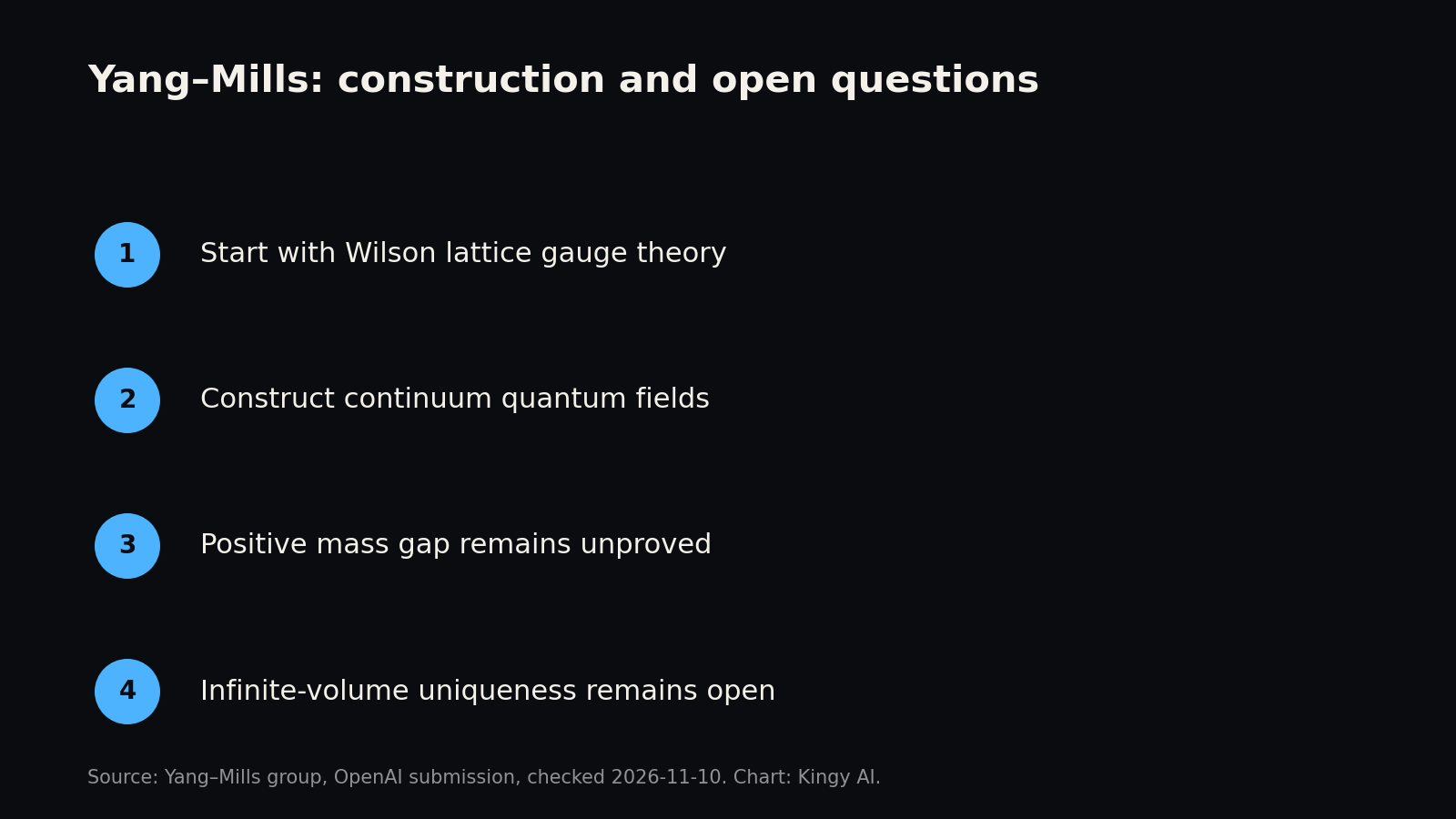
Reading guide: the diagram describes the stated construction and its limits. It is not a percentage of the problem completed or a prediction of a route to the mass gap.
The distinction between the two limiting steps matters. At suitable fixed physical volumes, the formal definition requires the full mesh limit along the construction’s chosen spacing sequence. As volumes increase, the submitted target permits extraction of a subsequence. Informally, given a sequence of larger volumes, it asserts that one can select a refined sequence along which the required object is obtained. That is different from proving every possible limiting route produces the same theory.
The resulting Euclidean correlations are then used to reconstruct a relativistic quantum field theory. The stated structure includes a Hilbert space of states, fields, a vacuum, space-time symmetry, a positive-energy condition and locality conditions governing suitably separated observables. These are mathematical requirements on the object, not a score for how closely a simulation resembles experiment. The public definitions make the relevant axioms explicit.
The specification also includes a short-distance test intended to distinguish the constructed correlations from specified free-theory alternatives. This is important because the problem asks for a nontrivial theory. The test should not be inflated into a claim that every conceivable generalized-free alternative has been ruled out.
One object, several demanding checks
There is a trap in a complex proof: an author might establish several desirable properties separately without proving that they belong to the same constructed object. The review group paid particular attention to how the lattice family, the limiting correlations and the reconstructed theory are connected.
The assessment says the original jointExistence target omitted lattice-construction links established elsewhere in the proof; its judgment instead rests on the stronger combined_acceptance target. The review specification binds the family, table and reconstructed witness together. It also specifies the selected scalar stress-trace OS interface, operator content, normalization and leading short-distance law. That scalar interface is not a separately specified check of every field and every axiom.
The operator product expansion, or OPE, is another part of the submission. When field insertions approach one another, an OPE describes their product in terms of local fields with coefficients and a controlled remainder, while other insertions stay separated. This makes short-distance structure precise. In the submitted OPE statement, a bound for truncations at every field degree does not mean that every perturbative loop coefficient has been calculated or matched. Degree describes the field labels used in the expansion; loop order describes a different perturbative bookkeeping scheme.
The committee’s separate OPE check has its own witness; its documentation does not automatically identify that witness with the one in the combined acceptance target. This detail matters because the strength of a theorem depends on exactly which properties are proved together.
What Lean checking can and cannot tell us
Lean is a proof assistant. A formal proof is written in a language whose rules allow a kernel to check whether the proof establishes a precisely encoded proposition from the accepted assumptions. The submitted verification log reports a successful replay of project declarations and lists the axioms used. A declaration count describes formal software artifacts, including generated declarations; it is not a count of independent discoveries.
Formal checking answers a narrower question than the one a physicist asks first. Does this proof term establish that proposition under those assumptions? A separate question is whether the proposition captures the intended Yang–Mills construction. A proof assistant cannot decide that merely because a definition or theorem has a familiar name. Reviewers must inspect the definitions, their connections and what the theorem leaves out.
The original archive says its standalone Comparator was not run. The later review did run Comparator checks: the committee’s dated records report passes for the submitted endpoint, the combined endpoint and a separate OPE endpoint. Those records describe the environment and qualifications, including use of a cached submitted build. Kingy reviewed the published descriptions and did not independently run the code or audit the entire proof.
Human interpretation remains unfinished. The assessment discloses use of OpenAI Astra to help digest the Lean code and says the reviewers do not yet fully understand the proof. It did not use the separate informal manuscript. The group reports no current Clay connection. External review here includes AI assistance.
What this could mean for mathematics
A sound existence construction would give researchers something concrete to study: a specified hierarchy of fields and correlations, linked to a lattice construction, with formal statements that others can test and attempt to extend. Its value would not depend on immediately solving the mass gap. Constructive quantum field theory has a long history, and the group’s earlier statement places the work in the context of Kenneth Wilson’s lattice formulation and earlier constructive renormalization work.
There is also a large interpretive job ahead. Researchers can ask whether the precise assumptions and field identifications are the right ones, whether the results can be explained in conventional mathematical language, which earlier techniques carry the argument and whether different limiting choices agree. Reproduction by other teams and scrutiny of the formal specification would strengthen confidence. Disagreement over a definition or an inference would have to be resolved on its merits, not by counting declarations.
The mass gap may require additional ideas about long-distance behavior. The construction’s short-distance checks are informative, but a short-distance signature does not itself establish a spectral gap. Nor does this assessment establish an area law for Wilson loops or confinement. Those are related research questions with their own precise statements.
What it could mean for AI and mathematicians
The reported workflow is notable because AI appears both in the origin of the result, according to OpenAI, and in the reviewers’ effort to understand the code. That creates an opportunity and a verification challenge. Formal proofs can expose assumptions and make checks repeatable, while long machine-generated or machine-assisted arguments can be difficult for people to navigate. External targets and readable explanations help make the result usable beyond its authors.
For working mathematicians, a practical possibility is more time spent designing precise problems, inspecting specifications, testing proof dependencies and translating formal results into explanations that others can use. Another is that difficult review work becomes a bottleneck when generated arguments grow faster than people can understand them. Neither outcome follows automatically from one result, and this release does not establish a general rate at which AI can replace mathematical researchers.
There are institutional questions too. The Advisory Group on Mathematics and AI criticized restricted access before the public release and called for the formal and natural-language outputs to be made public. That was a process objection, not a technical refutation of the later released proof. Public code gives a wider group a chance to inspect the claim; meaningful access also depends on documentation, reproducible checks and the resources needed to understand it.
Kingy’s earlier coverage of OpenAI’s scientific announcements discussed the claims before this code and assessment became public. The November release makes a much more specific discussion possible, while leaving the hardest verification and interpretation to the research community.
Limits and what happens next
This article reports the public source code, verification records and committee assessment. Kingy has not replayed the Lean checks, independently verified the mathematical proof or tested a model. OpenAI’s public announcement does not identify a specific discovery-model version or cost for this result, so we do not assign either.
A complete prize claim would need the missing positive mass-gap proof as well as a construction meeting the problem’s requirements. Under Clay’s published rules, consideration also requires a qualifying publication, at least two years and general acceptance by the global mathematics community. Waiting alone cannot supply the missing theorem.
Sources and revision log
Primary sources include the review group’s assessment, the submitted archive, its formal target, the review checks, and the official problem statement. Other sources are linked at the relevant claims above.
November 10, 2026: Initial publication, based on the public submission and the review group’s assessment.