Anthropic reports a cryo-electron microscopy structure of L05, a phage-encoded vault protein assembled in laboratory E. coli. A bacteriophage is a virus that infects bacteria. Claude assisted the human-directed research. The authors present it as the first experimental 3D vault structure from these non-eukaryotic MVP relatives.
The result gives researchers a physical specimen to investigate. It leaves the biological question open: what does this hollow shell do? Anthropic says native-host assembly remains untested. Producing a protein in laboratory bacteria and observing what it builds is a different experiment from finding the particle in a naturally infected host.
The technical report was available as an Anthropic-hosted document when we reviewed it. The company says it submitted the manuscript to bioRxiv. Treat the findings as preliminary.
Not tested by Kingy. This article examines the researchers’ report and related published work. Kingy did not run Claude, reconstruct the structure or perform the laboratory experiments.
A particle with a long history
In 1986, Nancy Kedersha and Leonard Rome described an unusual particle isolated from rat liver. Under an electron microscope, its repeated arches suggested a cathedral vault. The name stuck. The particle is a large, hollow assembly built around copies of a major vault protein, or MVP.
Its shape makes the obvious questions tempting: What goes inside? How does it get there? What does the container do for a cell? Decades of research have produced clues without a single settled answer that explains vault biology across organisms.
A 2025 study of human vaults, for example, resolved how PARP4 associates with the cage and identified binding sites for NAD+ and related nucleotides. NAD+ is a molecule used in cellular chemistry. The researchers also compared protein interactions in cells with and without normal PARP4 levels. Their results supported hypotheses about cargo selection and localization; they did not establish a universal vault function.
That distinction helps make sense of the new work. Knowing that a container exists, mapping its surfaces and identifying a binding partner are useful advances. Explaining why an organism needs the container requires a link between those observations and a biological outcome. A shell could be structurally similar across organisms while participating in different processes. That possibility should guide experiments rather than become a conclusion drawn from appearance.
What counts as new here
A 2013 computational study examined distant MVP relatives, including plausible bacterial examples, and predicted folding and assembly features. A 2023 preprint identified putative MVP genes in phage sequences and used protein-structure predictions to study them. Those were already substantial steps toward recognizing a broader protein family.
In March 2026, researchers also reported an archaeal vault model. Their computational assembly suggested a cup made from ten MVP molecules. They explicitly warned that estimating the number of subunits without experimental data is difficult. A predicted assembly therefore belongs in the history of the field without being treated as an experimentally observed particle.
The useful distinction is between a predicted shape and a reconstruction supported by images of a physical sample. Predictions can nominate candidates, suggest contacts and help interpret density. Experiments ask whether the proposed assembly actually appears under defined conditions. Neither stage alone explains native function. Calling every stage a “discovery” hides the specific contribution readers need to assess.
For that reason, a broad “first 3D model” description would erase relevant prior work. The current claim should be assessed at the level of experimental assembly and structural reconstruction. Priority also needs a defined scope: a new protein relative, a new assembly and a new biological mechanism are different achievements.
From a protein to a specimen
Sequence searches and laboratory screening answer different questions. A database match is a lead about relatedness; it does not show that a protein is expressed, soluble or capable of building a closed shell. Moving from that lead to an interpretable microscopy sample requires decisions about which proteins to produce, how to isolate material and what evidence distinguishes a complete particle from an aggregate.
Size-exclusion chromatography helps separate components according to how they move through a porous column. Large assemblies can emerge separately from many smaller proteins. That separation does not by itself identify the material. An early fraction can still contain unwanted large material, so microscopy and other checks remain necessary.
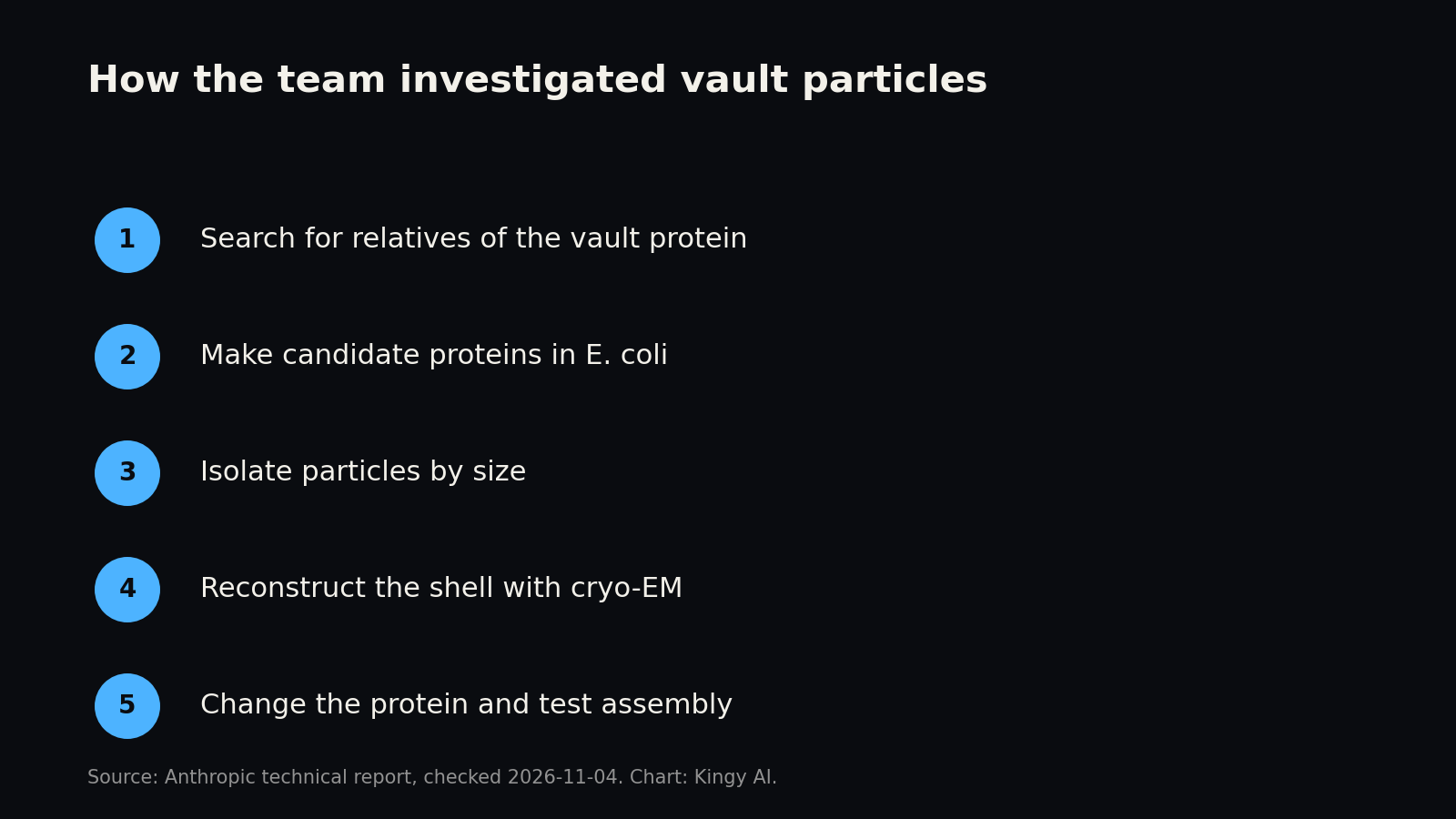
Kingy’s simplified workflow schematic is not a microscopy image.
Earlier vault research had already used size-exclusion chromatography. That history matters when evaluating an AI-assisted protocol: selecting, adapting and troubleshooting an existing technique can be valuable without inventing the technique.
Cryo-electron microscopy adds another kind of evidence. Researchers freeze a sample, collect images of particles in different orientations and use software to reconstruct a three-dimensional density map. A structural model interprets that map. The strength of the interpretation depends on the underlying images, processing choices and validation, as well as the apparent detail of the final picture.
What the L05 structure shows
The report describes 96 chains in L05, two halves of 48, versus 78 in a human vault. L05 has seven wall repeats per chain; human MVP has nine. Its estimated cavity is about 25% larger. Nominal resolution is 3.2 angstroms, averaging five local reconstructions; the whole-vault consensus map is 3.50 angstroms. An unidentified pocket density may represent coenzyme A or a derivative.
These numbers answer separate questions. Chain count describes how many protein copies build the shell. Repeat count describes sections within each copy. Neither can be substituted for the other. Resolution describes how much structural detail the reconstruction supports; a local average should not be read as uniform detail throughout the particle.
Likewise, an estimated internal volume is a geometric comparison. It does not measure usable cargo capacity, delivery efficiency or the amount of a treatment that could reach a cell. A candidate molecule fitted to density also remains a hypothesis until its chemical identity is established. These are places where precise language preserves the value of the result.
Structure can point to where to look next: contacts between chains, cavities and sites for mutations. Functional experiments would then ask what changes when those contacts or sites are altered, and whether that change affects an organism under relevant conditions.
What Claude contributed
The authors report Claude-written code and computational analyses under their direction. Task-level model versions are unspecified.
Anthropic’s account reports a roughly 90-minute cells-to-grid workflow, versus a conventional three days; a first model in 34 hours; final maps in about a week; and under four months overall. Cryo-EM processing used an internal multi-agent harness and hundreds of parallel GPUs.
The clocks describe different scopes. Cells-to-grid excludes upstream preparation such as obtaining DNA and growing cultures. A first model and a final map are also different deliverables. Combining the shortest interval with the broadest description of the project would give readers a false impression of its duration.
The company’s estimates of time saved are counterfactuals. A team can reasonably judge that an assistant accelerated its work, but a measured speed multiplier would need a comparison with a defined alternative workflow. Useful measurements would include researcher time, compute, failed runs and validation effort. They would also need to state which existing scientific tools and facilities were available to both workflows.
Resource disclosure matters for the same reason. Access to an assistant is only one part of reproducing a structural biology project. A convincing replication claim would identify the hardware, software, samples, facilities and human expertise required, then separate those requirements from the assistant’s contribution.
The mistakes are part of the result
Anthropic reports a protocol additive caused a two-week setback and an omitted processing step produced a mirror-contaminated map.
These examples explain why plausible protocols and convincing pictures still need checks. Experimental recommendations must be compatible with the rest of a procedure. Reconstructions must be validated against known failure modes. Two reported mistakes cannot establish an overall error rate without a denominator covering the recommendations, accepted changes and failed attempts.
For readers evaluating scientific assistants, a useful question is where a mistake became detectable. Could a routine check catch it before an expensive experiment? Did the assistant flag uncertainty? How much specialist knowledge did correction require? Those are editorial criteria for judging a workflow, not outcomes measured by this article.
Making a larger shell
Adding two repeats produced a closed L05+2 shell with roughly 20% more internal volume than L05, about 50% more than the human reference.
The comparison is multiplicative: 1.25 × 1.20 = 1.50. Adding 25% and 20% would give the wrong result because the second increase uses the already larger L05 shell as its baseline. The figures are approximate, so the calculation does not justify extra precision.
Engineering vaults as containers is an established research idea. In 2005 experiments, researchers packaged functional luciferase and fluorescent protein inside engineered mammalian vaults and studied uptake in cultured cells. Those results supply useful context for proposals to develop other vault scaffolds.
A larger hollow shell still needs separate tests for loading, stability, targeting and release before a delivery claim becomes persuasive. Uptake in cultured cells would itself leave questions about performance in an organism. The new dimensions are a property researchers can investigate; they are not a shortcut through those experiments.
Limits and the next tests
The report discloses Anthropic employment, possible equity and a provisional patent application. Matthew Durrant also discloses an outside interest in Stylus Medicine. Anthropic identifies Leonard Rome as a paid consultant. It promises structures and additional data.
We found no public structure accession identifiers or supplementary-information files in the reviewed PDF. That bounded observation does not show that no supporting material exists elsewhere. Readers should check the linked report and announcement for subsequent releases.
For the biological claim, useful next experiments would seek the particle in its natural setting, identify the pocket molecule and test the consequences of disrupting the relevant protein. For the structural claim, independent groups could compare assembly results and reconstructions. Public maps, models and supporting methods would make that work easier to scrutinize.
For the AI claim, matched workflows with and without the assistant would help establish how much time it saves and where oversight remains costly. Those tests would connect a promising laboratory account to evidence other teams can use when deciding how to work.
Sources
- Anthropic research announcement and technical report.
- Kedersha and Rome, 1986; Daly and colleagues, 2013; Santos and colleagues, 2023 preprint.
- Lodwick and colleagues, 2025; Köstlbacher and colleagues, 2026; Galbiati and colleagues, 2018; Kickhoefer and colleagues, 2005.
Revision log
November 4, 2026: First published version.
The Kingy Brief
Get the free AI price sheet.
25 AI plans and models on one page, from official pricing pages, updated every month. Free when you join The Kingy Brief: AI changes, original tests and one practical thing to try, Fridays at 09:00 Vancouver time.
Free · Double opt-in · Unsubscribe anytime
Signup help and newsletter schedule
After submitting, check your inbox for "Confirm your subscription to The Kingy Brief" and open its confirmation link. Your price sheet download is on the page that opens. Check Spam or Promotions if you cannot find it.
Fridays at 09:00 Vancouver time: source-checked AI changes, original tests and one practical thing to try. We skip a week when there is not enough verified material. Free. Unsubscribe anytime.