OpenAI plans to acquire Pierre Computer Company, which builds Code Storage and the open-source Diffs and Trees libraries. The proposed deal connects coding agents with more infrastructure for storing and inspecting their work.
The transaction has not closed: regulatory approvals and other conditions remain, and the businesses are independent until then. OpenAI’s announcement gives no price or closing timetable. It says Codex already uses Trees and Diffs, pledges continued open-source contributions, and says customers can keep using Code Storage after closing while its capabilities are integrated into Codex.
The immediate significance is broader than a new place to put code. As coding agents generate more candidate changes, someone still has to preserve the versions, compare the alternatives and decide what belongs in a project. Pierre sells infrastructure and publishes interface components for parts of that work. Whether OpenAI can join them into a better product, and on what terms, remains to be seen.
More generated changes mean more to keep track of
Consider a hypothetical team asking an agent to try three approaches to the same bug. Each attempt may touch a different set of files. One might fix the visible problem while breaking a test; another might be promising but incomplete; the third might be acceptable after a small correction. The team needs to know which change came from which attempt, compare each with the original and retain the reasoning behind the eventual choice.
A model’s ability to write a patch does not settle those questions. Repositories and branches give the work a history. A file tree helps a person navigate that history. A diff shows what changed. Comments and tests add context for deciding whether a change should be accepted. These are different jobs, and a convenient interface cannot guarantee that the underlying code is safe or correct.
Our interpretation is that Pierre fits OpenAI’s interest in the whole path around a coding agent. Parallel attempts can increase the number of branches and changes a team must manage even when only one version will ship. Better storage and presentation could make that work easier to organize. They do not establish that a human can review an unlimited stream of generated code, or that this particular acquisition has reduced review time.
What Pierre actually builds
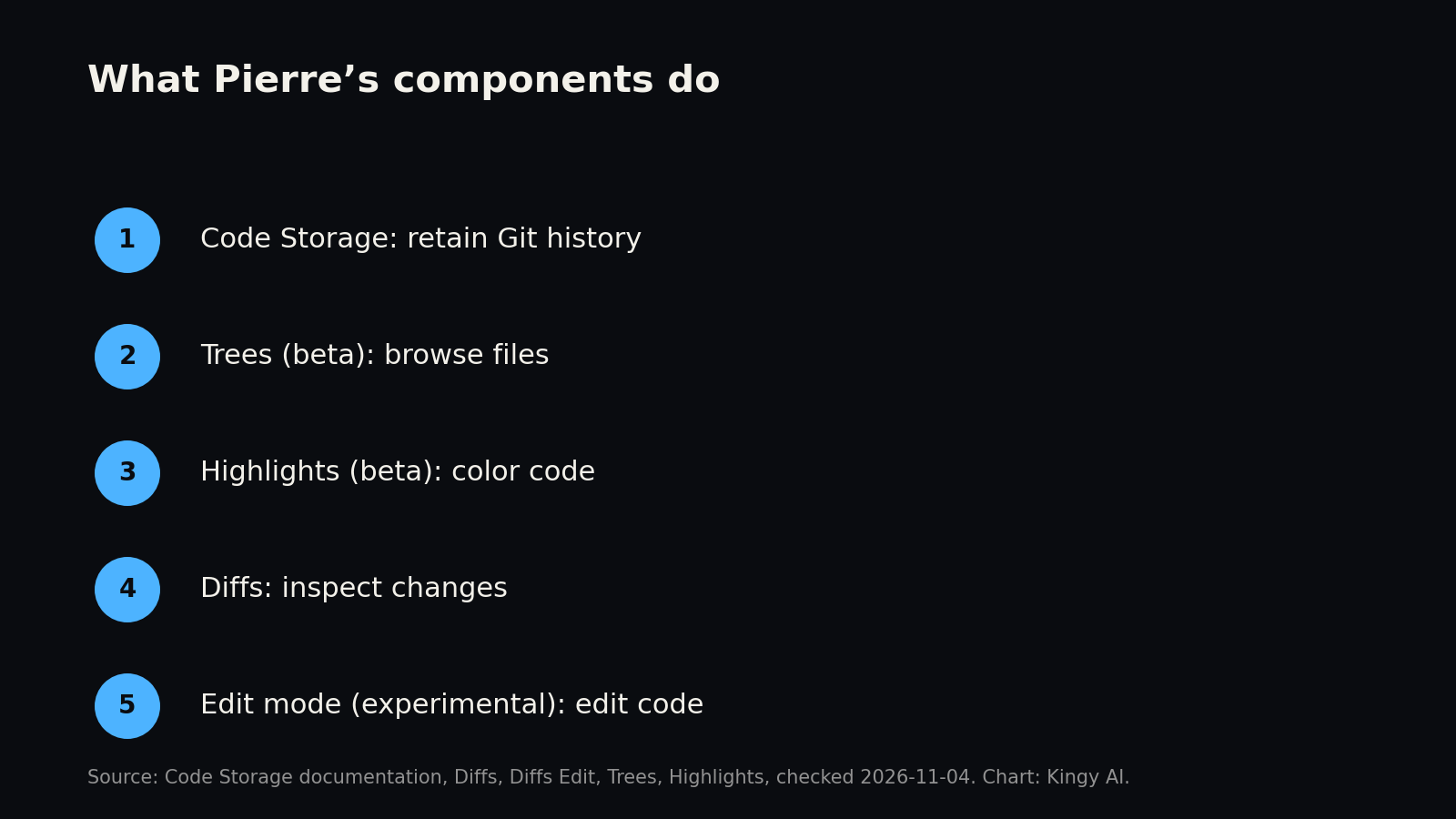
Pierre describes itself as a company building composable infrastructure for machine work. Its current products span a hosted Git storage service and reusable open-source interface libraries. They can be discussed together, but they are separate components; the following diagram describes their functions, not a promised integrated Codex workflow.
Code Storage: a programmable Git backend
Code Storage’s documentation describes distributed Git storage accessible through standard Git over HTTPS as well as an SDK, command-line interface and HTTP API. Applications can create repositories and commits, work with isolated references, merge, import existing repositories and sync from other hosts. Pierre also describes saving agent state and running parallel attempts using these interfaces.
That matters because an agent application needs somewhere to put work between the initial request and the final accepted change. A Git-compatible service gives developers a familiar vocabulary for versions and branches while giving software a programmable way to create and manipulate them. Pierre advertises TypeScript, Python and Go SDKs, webhooks and synchronization with GitHub, GitLab and Bitbucket on its product site.
Compatibility has limits. Being able to fetch a repository does not automatically move the review conversation around it. Comments, approvals, access rules, continuous-integration settings and commercial agreements may live outside the Git history. Anyone considering a migration should check each of those separately rather than assume that a working clone reproduces an entire development environment.
The documentation describes the intended interfaces and design; Kingy has not tested the service. Pierre’s advertised service-level agreement is a contractual commitment, not an independent measurement of observed uptime. The company’s product claims should be assessed against the terms and operational evidence relevant to a customer’s own use.
Diffs: making changes visible
Diffs is an open-source library for rendering code and changes. Its documented options include unified and side-by-side views, annotations, inline change styling and interface primitives for merge conflicts. It can also compare arbitrary pairs of files. These are building blocks that another application can use; the library itself is not a complete hosted code-review service.
The implementation details explain why a component like this matters. Pierre’s engineers describe the browser work involved in displaying large sets of changes in their account of rendering diffs. Rendering many lines at once can consume processing time and memory. Their approach limits what the browser renders around the visible area while trying to preserve normal scrolling. That is the builder’s engineering account, not an independent productivity test.
A legible, responsive diff helps a reviewer find evidence, but it cannot tell them whether a permission check is missing or a business rule has changed incorrectly. Those judgments still depend on context, tests and human attention. A smooth view and a correct change are separate outcomes.
Editing, trees and highlighting
Pierre also documents an experimental Edit mode for file and diff components, including undo, find-and-replace and selection features. Editing where a problem is spotted could reduce the mechanical effort of moving between views. The experimental label matters: the documentation does not establish that this mode has shipped in Codex or that its current behavior will remain unchanged.
Trees provides a file-tree renderer, with documented search, keyboard navigation, Git-status decoration and rendering of visible rows. Its page identifies the release as beta. Pierre documents accessibility features, but those descriptions are not an accessibility audit by Kingy. A file tree is useful because it lets a reviewer move through a project’s structure; it does not by itself explain why an agent changed a particular file.
Highlights is Pierre’s beta syntax highlighter, with streaming and incremental interfaces. The company’s engineering explanation also describes tradeoffs: its lexers require maintenance, unsupported languages fall back to plain text, and classifications can differ from other highlighters. Pierre publishes speed comparisons, but those are narrow vendor measurements, not evidence that a whole Codex session runs faster or produces better code.
From a collaboration idea to infrastructure
Pierre’s original pitch was closer to a developer collaboration platform. In a July 2023 team post, the company described work on collaborative branches, previews, real-time comments and programmable bots. The post said the work had begun about six months earlier and described a team whose members had worked together across several technology companies. It was a description of an early vision, not a reliable current feature list.
The company’s present site emphasizes a different product mix: Git storage and reusable components that other applications can embed. That evolution matters to understanding the transaction. OpenAI is not simply acquiring an old private-alpha pitch; it is buying a company whose current public portfolio includes infrastructure used by other developers.
Wayfinder Ventures’ portfolio profile identifies Ian Ownbey as a co-founder and Jacob Thornton as CEO, and says the firm invested in 2023. It describes experience at companies including Twitter and Coinbase. The profile does not establish the acquisition price or Pierre’s total funding.
Thornton is also one of Bootstrap’s creators. The Bootstrap history traces the project to Twitter, and its official repository names Thornton and Mark Otto as creators. That is a useful piece of interface-development history, but it does not establish who will hold which roles at OpenAI or the terms on which any individual will join.
How Pando fits—and where it does not
On November 2, OpenAI published an engineering account of Pando, the Git-compatible backend for its internal monorepo. It describes independent coordination of branch updates and shared packfiles to support many writers and readers.
Reading several branches need not produce one repository-wide snapshot from a single instant. That tradeoff matters for software depending on a consistent view across references. OpenAI reports lower median push latency and substantial daily data serving in production. These are vendor observations, not Kingy tests or measures of deployment speed.
Pando and Code Storage are distinct systems with different architecture descriptions. OpenAI’s internal backend and Pierre’s externally sold service address related needs, but the public record does not say they will merge, that one will replace the other or that Pierre’s customers will use Pando. Our interpretation is that both reflect interest in source-control infrastructure for agent-heavy development. OpenAI is exploring sharing Pando technology; it has not announced a general hosting launch.
Who uses Code Storage?
Pierre’s product site names Lovable, Poke, Anything, Bolt, Amp and Parahelp as customers. That is a company-provided list, not a complete census or independent verification of every customer’s current usage.
In a seller-hosted case study, Pierre describes Lovable using one or more Git repositories per project and says the application creates more than eight million repositories per week. The case study illustrates the scale at which an application that creates software projects may need to manage repository state. The figure comes from Pierre’s account and has not been independently verified by Kingy.
A separate Pierre case study about Poke describes Git-backed state for agent memory, recipes, integrations, workspaces and generated changes. That expands the potential use beyond an ordinary source-code repository. It does not prove Git is the best storage choice for every form of agent memory, and a seller’s description should not be treated as an independent performance audit.
Does this make Codex a GitHub replacement?
The evidence does not establish that OpenAI has shipped a GitHub replacement. Pierre’s products cover meaningful pieces of the development stack, but a complete platform also needs decisions about permissions, organizations, review records, automation, security, support and integrations. A set of libraries and a Git-compatible storage service do not answer all of those questions on their own.
There is nevertheless a clear strategic reason to pay attention. Git hosting has historically been a place where developers store projects and coordinate changes. Agents can create new demand around the same repository: multiple temporary branches, intermediate work and large volumes of changes that need to be inspected. A company supplying the agent may want to control more of the environment in which that work is saved and reviewed.
That is our analysis of the fit, not a product announcement. OpenAI has not published a detailed architecture showing how every Pierre component will connect to Codex. A library’s use in an application does not establish that every feature on its product page is enabled there. Nor does a possible future integration prove that existing GitHub, GitLab or Bitbucket workflows will disappear.
For teams, a connected environment could reduce the work of moving among tools. It could also increase dependence on one provider for both the model and the place where its output is stored or reviewed. The practical balance depends on export paths, access controls, contracts and future product choices. The available evidence does not establish a forced migration.
What existing customers should watch
Existing customers still face operational questions. Customers should look for a closing notice, subsequent service announcements and the terms that apply to their own accounts. They should also ask for clear API compatibility commitments, export procedures, support arrangements and any changes to pricing or data processing.
Another question is how future terms will handle stored code and model training. We have not audited the applicable contracts, and the announcement does not supply enough detail to make a general privacy assurance. Customers building products that compete with Codex may also want clarity on continued access. An unanswered question is not evidence that access will be restricted.
Open source helps with a different part of the picture. Pierre’s public repository currently makes code available under the Apache 2.0 license. That gives developers something tangible to inspect and use under its terms. It does not settle future release cadence, maintenance, governance or the commercial continuity of a hosted service. Those are separate commitments.
There is no reason to migrate solely because a deal was announced. Teams with an existing dependency can inventory the repositories, integrations and non-Git metadata they would need to recover, then compare that inventory with documented export and support terms as those become available. Teams evaluating a new deployment can test the actual workflow and contract rather than assume either continuity or disruption.
Limits
Not tested by Kingy. This article is based on company announcements, documentation, engineering posts and seller-hosted customer accounts. We did not run Code Storage, Diffs, Trees, Highlights or Codex for this story, audit their security or accessibility, independently reproduce vendor measurements, or review customer contracts.
Sources
- OpenAI: Pierre acquisition announcement, November 4, 2026.
- OpenAI: Scaling Git at OpenAI, November 2, 2026.
- Pierre Computer Company; Code Storage documentation; Code Storage product page.
- Diffs; Diffs Edit; Trees; Highlights; Pierre’s public repository.
- On Rendering Diffs; On Highlighting Code.
- Pierre’s 2023 team post; Wayfinder’s Pierre profile; Bootstrap history; Bootstrap repository.
- Pierre: Lovable case study; Pierre: Poke case study.
Revision log
November 4, 2026: Initial publication; sources checked.
The Kingy Brief
Get the free AI price sheet.
25 AI plans and models on one page, from official pricing pages, updated every month. Free when you join The Kingy Brief: AI changes, original tests and one practical thing to try, Fridays at 09:00 Vancouver time.
Free · Double opt-in · Unsubscribe anytime
Signup help and newsletter schedule
After submitting, check your inbox for "Confirm your subscription to The Kingy Brief" and open its confirmation link. Your price sheet download is on the page that opens. Check Spam or Promotions if you cannot find it.
Fridays at 09:00 Vancouver time: source-checked AI changes, original tests and one practical thing to try. We skip a week when there is not enough verified material. Free. Unsubscribe anytime.