The AI Classroom Is Getting Bigger
Artificial intelligence has become remarkably good at attracting attention. Teaching people how to build something useful with it? That takes a little more than a dazzling demo.
Google’s DevFest 2026 aims to help close that gap.
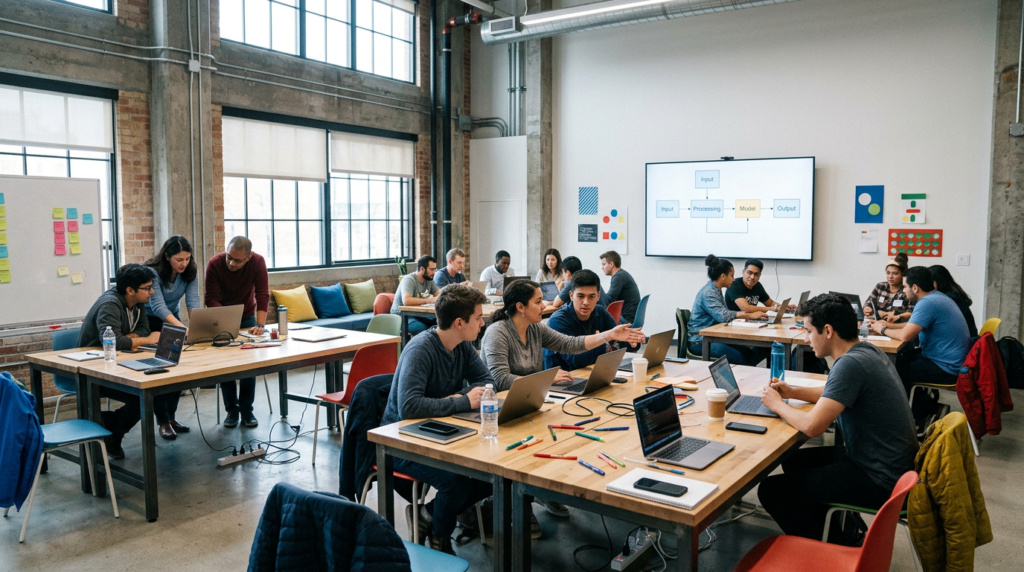
The company expects nearly one million participants across more than 800 events in 115 countries. Organized through local Google Developer Groups, the conference series combines technical learning with the kind of human interaction that documentation cannot deliver.
Someone can explain a confusing concept. Someone else can inspect a stubborn bug. Occasionally, both happen before the coffee disappears.
The opportunity extends beyond discovering another AI tool. Community events can help people connect ambitious ideas with practical skills.
For developers, students, and curious builders, that connection could prove more valuable than another afternoon spent collecting bookmarks they will absolutely, definitely read later.
First, Get the Timeline Right
DevFest deserves coverage, but the dates require care.
Google’s September 14 announcement already described the 2026 season and its projected global reach. The main series runs from October 1 through December 31.
An October 30 Google Developers Blog post revisited the initiative. Independent coverage followed on October 31.
Those later publications provide a reason to examine the program. They do not establish that Google launched it during the October 31–November 1 Philippine-time reporting window.
The accurate framing is therefore an ongoing education initiative receiving renewed attention.
That distinction also changes the headline. “Google launches a new global AI education program” would misrepresent the evidence.
The stronger story asks what this existing program offers, why community learning matters, and how participants might turn a conference visit into something useful afterward.
Big Numbers, Carefully Explained
The projected scale makes an eye-catching introduction. However, expected attendance and completed attendance measure different things.
Google’s nearly one million figure describes anticipated participation. It does not establish that one million people have already attended, completed training, or developed working applications.
There is also a discrepancy between official pages. Google’s announcements describe more than 800 events, while the DevFest landing page displays more than 700.
The reviewed sources do not explain that difference. It would be premature to label it either a confirmed expansion or a cancellation.
For now, the responsible description attributes the larger forecast to Google’s announcements.
The more useful questions come afterward: What do attendees learn? Can they apply it? Does a local community keep helping once the stage lights switch off?
A crowded room starts the story. It does not finish it.
Local Organizers Give Learning Context
DevFest’s structure gives local communities an important role.
Google says grassroots organizers tailor events to their regional technology ecosystems, including sessions in local languages.
That flexibility matters because useful software begins with specific problems. A developer serving local retailers may face different constraints from someone building software for a multinational company.
Language, connectivity, available devices, and customer habits can all influence a sensible design.
Consider a hypothetical community workshop exploring a multilingual customer-support assistant. Participants could discuss which languages customers actually use, when a human should intervene, and whether the service works on ordinary phones.
Those questions bring an abstract AI demonstration closer to daily life.
Local knowledge cannot guarantee a successful product. It can, however, help builders notice assumptions that a polished global presentation might glide past.
A Broader Invitation to Build
Google’s DevFest materials explicitly welcome people beyond professional software engineers, including designers, product managers, entrepreneurs, students, and technology enthusiasts.
That wider invitation reflects an important reality: understanding a problem and implementing a solution involve different skills.
A designer may spot a confusing interaction. A business owner may recognize a repetitive process. A developer may identify why the proposed automation will fail at lunchtime on Monday.
Put them together and the conversation improves.
For example, a hypothetical appointment assistant needs more than a working chat window. It needs understandable choices, accurate availability, sensible cancellation rules, and a clear route to human help.
People who manage appointments every day can contribute essential knowledge.
A workshop becomes more productive when everyone brings expertise—and remains willing to discover where that expertise ends.
Hands-On Learning Makes Ideas Concrete
Google’s September announcement describes codelabs, workshops, and agent-building activities across its technology stack.
These formats can turn vague understanding into questions people can actually investigate.
A presentation might make an AI assistant look effortless. Building a small version exposes the decisions underneath: what information it receives, what actions it can perform, and how the application handles failure.
That friction has educational value.
A useful exercise does not have to produce an impressive finished product. It might help someone understand why their first approach was unreliable.
Imagine an assistant that summarizes customer inquiries. Testing it against ambiguous messages could reveal missing context, inconsistent categories, or an overconfident answer.
Discovering those weaknesses during practice gives the builder something concrete to improve.
The best souvenir may be a better question.
What the Agentic Theme Means
Google frames this year’s program around building, securing, and scaling in the agentic era.
In practical terms, an AI agent combines model-driven decisions with tools or workflows that let it perform tasks.
Consider a hypothetical event assistant. It might interpret a question, search an approved schedule, identify a relevant session, and suggest a calendar entry.
Each step introduces a design decision.
Which schedule can it trust? What happens when two sessions overlap? Should it ask before changing a calendar?
These questions help explain why agent education involves more than writing an appealing prompt.
A convincing response is only one part of a useful system. The surrounding application must decide what the software can access and what requires approval.
That is where a friendly demonstration becomes an engineering project.
Security Belongs in the First Sketch
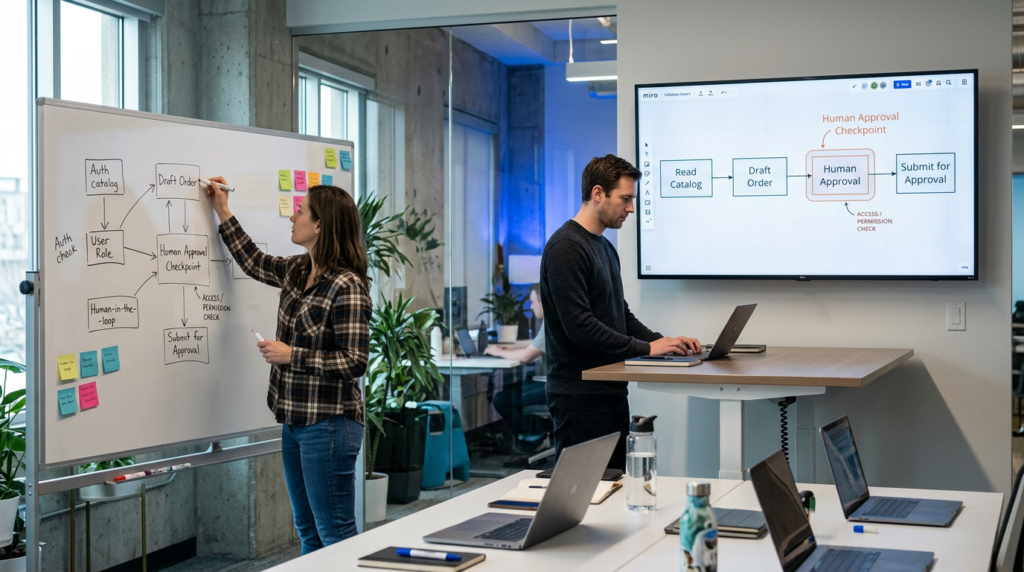
Security forms an explicit part of Google’s DevFest theme.
For participants, a useful way to approach it is to ask what an application should be allowed to do before connecting it to valuable information.
Consider a hypothetical assistant that drafts purchase orders. Reading a product catalog, preparing a draft, and submitting an order should involve different permissions.
Keeping those boundaries clear makes the system easier to inspect.
Builders can also ask how users will know what happened. A record of actions can help someone understand whether the application retrieved information, changed a document, or requested approval.
These are practical design questions for any workshop project that reaches beyond a sandbox.
The aim is to build something people can understand and control.
An assistant with unlimited enthusiasm still needs a sensible job description.
A Workshop Example Beyond the Slide Deck
Google Cloud’s account of a New York community workshop provides a more detailed example of its teaching approach.
The company reported bringing together 80 engineers and using a format called Workbench, emphasizing architectural understanding.
Its account describes exercises involving long-running agent workflows, human approvals, and integration with business data.
This is Google’s description of the event, rather than an independent assessment of learning outcomes. It nevertheless offers concrete detail about the intended subject matter.
For learners, the interesting question is whether they can explain the architecture afterward.
Why does a workflow pause? What information must survive that pause? What happens when approval never arrives?
Someone who can reason through those situations has gained something more durable than a copied code snippet.
Syntax changes. Understanding travels.
Accessibility Starts With Actual People
Google’s October post describes an accessibility example from Ireland.
According to the company, organizers responded to an interpreter shortage affecting two deaf attendees by building a real-time transcription tool within two weeks.
The post does not date the episode, so it should not be presented as a newly verified 2026 breakthrough.
Its relevance lies in how the problem emerged: people wanted to participate, and organizers looked for a practical response.
That offers a useful design lesson.
Accessibility planning should begin by asking participants what support they need. Builders can then assess whether a proposed tool helps, where it struggles, and what alternatives remain necessary.
A transcript might support participation while still requiring checks for accuracy and speaker identification.
Useful technology begins with listening—even when the eventual solution involves converting speech into text.
The Commercial Context Matters Too
DevFest teaches Google technologies. That gives the program a commercial context alongside its educational purpose.
Developers who become comfortable with an ecosystem may later choose it for professional projects.
Participants can benefit from the training while making deliberate choices about the tools they adopt.
A sensible approach is to separate transferable knowledge from product-specific instructions. Understanding permissions, evaluation, data handling, and deployment can help across projects.
Knowing which button to press in a particular console has a narrower shelf life.
Builders should also ask what happens after a workshop ends. Can they continue experimenting affordably? Can they retrieve their data? Which parts of a project depend on a particular service?
These questions help turn enthusiastic exploration into an informed technical decision.
Learning a platform works best when curiosity keeps its independence.
Access Includes Price and Preparation
Google’s DevFest FAQ says ticket prices vary by location. Some events are free, while others charge a fee to cover costs such as venue expenses and catering.
Readers should therefore check individual listings before making plans.
The ticket price is only part of accessibility. Travel, equipment, time away from work, and a session’s assumed knowledge can also affect participation.
For organizers, clear descriptions help people decide whether an event suits them. A beginner should be able to distinguish an introductory session from an advanced engineering workshop.
For attendees, preparation can prevent disappointment.
Check the agenda, registration conditions, and any published equipment requirements. Ask organizers when important details remain unclear.
A welcoming event starts before arrival, with information that helps people show up ready to learn.
What Philippine Builders Could Take Away
For Philippine readers, the practical opportunity is to explore the official directory and assess relevant community events.
The reviewed sources do not establish a specific Philippine schedule, so individual dates, venues, and registration details need separate confirmation.
The potential applications are easy to imagine, provided they remain examples rather than claims about announced projects.
A small retailer could explore better product-information retrieval. A student team could investigate an accessible campus information tool. A nonprofit could test ways to organize public resources.
Each project should begin with a manageable question.
Who needs help? What information can the application use? How will the team know whether it works?
A focused prototype can teach more than an ambitious collection of features.
Start with one useful job. Give it clear boundaries. Then see what reality has to say.
Measure Learning After the Event
Conference attendance offers a visible measure of reach. Lasting learning requires a closer look.
Participants can test their own progress with a simple exercise: explain the project to someone who did not attend.
Describe its purpose, inputs, permissions, and likely failure points. Then explain what remains unfinished.
If that explanation becomes difficult, the difficulty identifies the next learning task.
Organizers could also explore follow-up activities, such as project reviews or informal debugging sessions. These are suggestions, rather than verified commitments across DevFest events.
The underlying idea is straightforward. People often discover their hardest questions after trying to work independently.
A community that remains available can help turn initial enthusiasm into steady practice.
One productive conversation a week later may matter more than a photograph beside the conference banner.
Turn a Conference Visit Into a Small Experiment
Attendees can approach an event with one problem they already understand.
Choose something narrow enough to explore: organizing public documents, summarizing non-sensitive sample messages, or improving a simple interface.
Bring a few examples. Include an awkward case that might trip up the proposed solution.
During a session, ask how the demonstrated approach would handle those examples. Pay attention to the explanation as well as the result.
Afterward, rebuild a small part independently. Write down what worked, what failed, and which assumptions changed.
That process creates a useful record of learning.
It also keeps expectations realistic. An afternoon workshop may produce a starting point, a clearer design, or a reason to choose another approach.
All three can be worthwhile outcomes.
Progress sometimes arrives wearing a surprisingly ordinary name: “Now I understand.”
A Promising Opportunity, With Work Still Ahead

DevFest 2026 offers a positive story about making practical AI learning available through local communities.
Its projected reach is substantial. Its educational value will depend on what participants understand, build, and continue improving.
The initiative also highlights something easy to overlook during a fast-moving technology cycle: people need places to ask questions without pretending they already know the answers.
Workshops, local expertise, and collaborative problem-solving can provide those places.
The strongest outcome would be more builders who can judge an AI system thoughtfully—its usefulness, its limitations, and its responsibilities.
That may create fewer spectacular headlines than a dramatic model launch.
It could still make a meaningful difference.
A new capability becomes more valuable when someone learns how to put it to work, checks the result, and helps another person do the same.
Sources
- Google Developers Blog — DevFest is back! — Primary source for the renewed program overview, local organizing model, and community examples. (Google Developers Blog)
- Google — DevFest 2026: DevFest is back — Earlier primary announcement establishing the season, projected participation, and planned learning formats. (blog.google)
- Google for Developers — DevFest — Official directory, audience information, event counter, and ticket-price FAQ. (developers.google.com)
- Google Cloud — The DevFest Community Workshop Experience: Building Real Agents Together — Google’s account of the New York workshop and its architectural exercises. (Google Cloud Blog)
- PPC Land — Google’s DevFest 2026 expects almost 1 million attendees at 800+ events — Independent reporting providing additional context about the program’s scale and unanswered measurement questions. (ppc.land)
The Kingy Brief
Get the free AI price sheet.
26 AI plans and models on one page, from official pricing pages, updated every month. Free when you join The Kingy Brief: AI changes, original tests and one practical thing to try, Fridays at 09:00 Vancouver time.
Free · Double opt-in · Unsubscribe anytime
Sign up for The Kingy Brief on Beehiiv.
Signup help and newsletter schedule
Signup form provided by Beehiiv. After submitting, check your inbox for "Confirm your subscription to The Kingy Brief" and open its confirmation link. Your price sheet download is on the page that opens. Check Spam or Promotions if you cannot find it.
Fridays at 09:00 Vancouver time: source-checked AI changes, original tests and one practical thing to try. We skip a week when there is not enough verified material. Free. Unsubscribe anytime.