Andrej Karpathy’s HackerTube turns years of Hacker News conversations into a browsable catalog of YouTube videos. Instead of starting with YouTube’s home page, you can start with videos that people linked in discussion, see the surrounding recommendations, and explore related topics.
Karpathy says he built the project in roughly two hours using Claude Code. That makes for a good headline, but the more useful story is how the project separates a messy data problem into stages: find recurring links, classify what commenters said about them, and give readers a way to explore the result. The site also publishes its dataset, so those choices can be inspected.
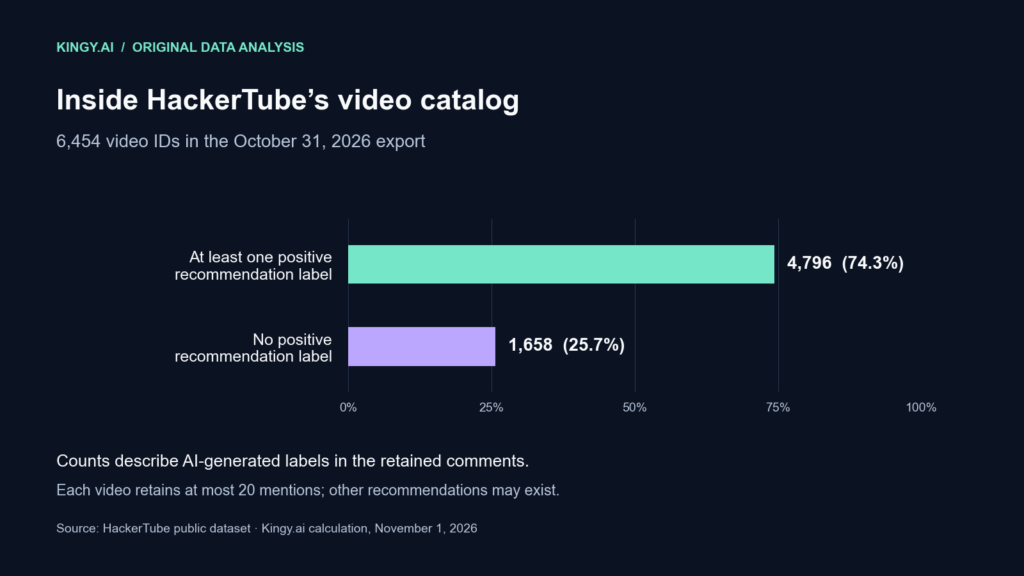
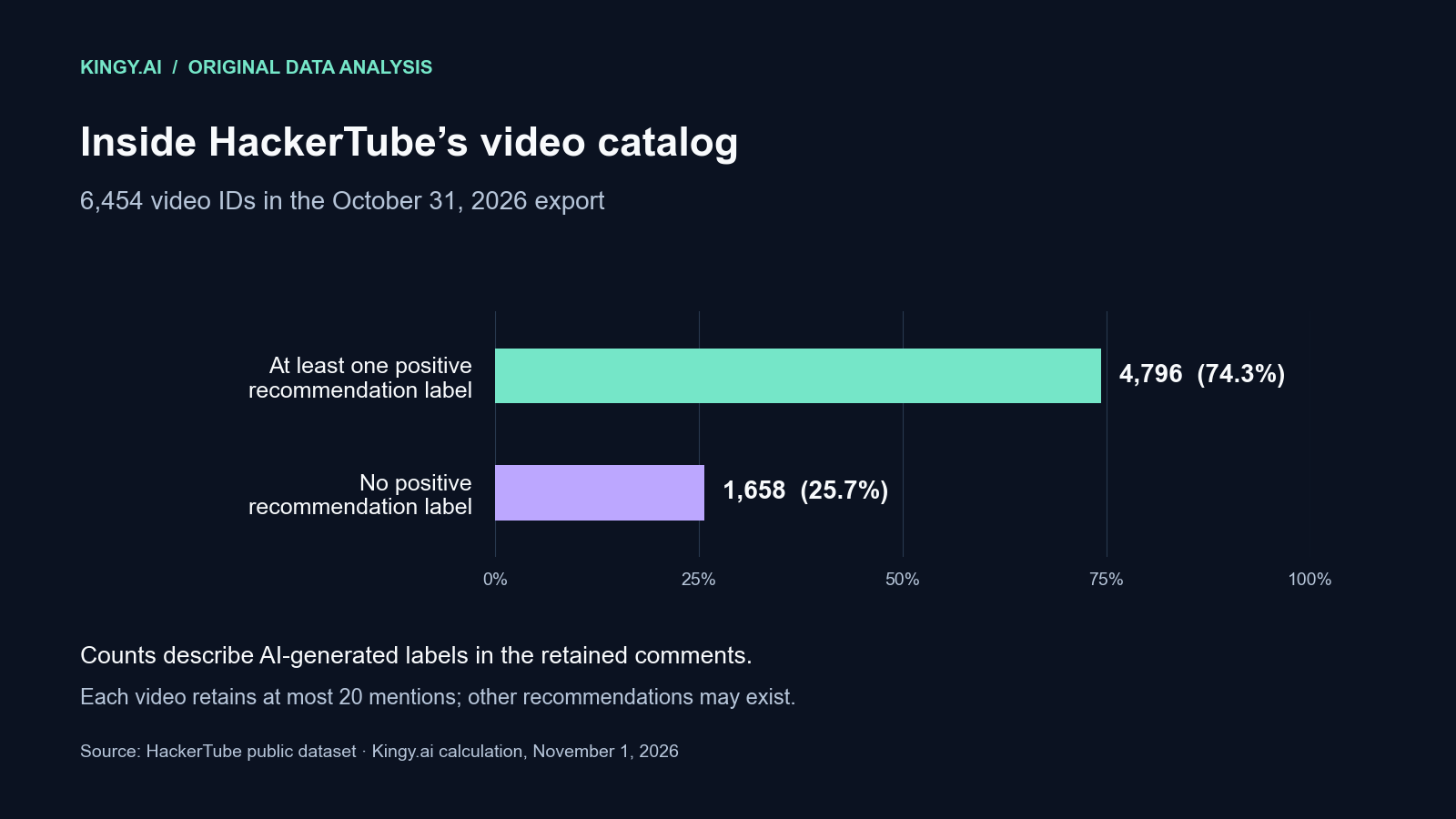
Kingy analyzed every record in the October 31 export. It contains 6,454 distinct YouTube video IDs and 39,834 comment–video mention pairs. One finding deserves attention when browsing: 1,658 videos, or 25.7%, have no positive recommendation label in their retained mentions. HackerTube’s own dataset documentation already discloses the roughly one-quarter figure. The result does not mean those videos were never recommended anywhere; the export keeps at most 20 mentions per video.
What is HackerTube?
HackerTube is a discovery interface for YouTube videos linked in Hacker News comments. Its About page describes a catalog built from recurring links in the community’s discussions. Video cards provide titles, topic information and summaries, with links back to the original discussions. The videos themselves remain on YouTube.
Hacker News readers discuss programming, startups and AI, but the taxonomy also covers mathematics, history, music and comedy. A video’s presence tells you it met the selection rules; it does not establish accuracy or universal endorsement.
The interface offers a different starting point from a personalized YouTube feed: a collection shaped by an identifiable community’s past conversations. That can be useful if you want a technical talk or an explanation that people have returned to over time. It also inherits the community’s interests and blind spots. A good video that Hacker News users did not link in qualifying comments will not appear through this process.
Karpathy’s two-hour build, in context
In his October 31 announcement, Karpathy said he used the Claude Code Mac desktop app with Claude Opus 5.5 at Medium effort and completed HackerTube in about two hours. He described handling the YouTube API key, virtual private server and domain himself; in a follow-up, he also mentioned DNS.
Those details come from the creator’s account. We have not seen a complete session log or an independent timed reproduction. The reported time is a useful example of one experienced developer’s workflow, not a promise that someone else can build, operate and maintain the same service in two hours.
The work also involved more than a single model writing a website. According to HackerTube’s data documentation and About page, Opus 5.5 coordinated the pipeline, while Claude Sonnet 5.5 labeled comments, wrote video cards from mentions and metadata, and helped build the topic taxonomy. Think of the split as orchestration and implementation on one side, with a large volume of repeated classification and summarization on the other. The documentation describes the roles; it does not provide a controlled comparison showing that this combination was the best or cheapest choice.
Karpathy said in a Hacker News reply that a Claude-assisted tally came to approximately 504 million input tokens, around 90% cached, and 7.6 million output tokens, with most usage going toward labeling. He said he used a subscription. Those figures describe reported usage, not an itemized API bill or the cost of the server and domain. There is no reliable dollar total in that account.
For readers comparing the models themselves, our Claude Sonnet 5.5 versus Opus 5.5 guide covers the broader choice. HackerTube is a case study in assigning different jobs to models, not a universal productivity benchmark. Karpathy announced joining Anthropic in May 2026, relevant context for his account of a Claude-built project. Reuters reported the announcement.
How a video gets into the catalog
The project starts with the open-index Hacker News archive. Its documentation says the pipeline scanned comments for YouTube links, considering mentions with at least 100 characters of the commenter’s own text. A video had to be mentioned by at least three different people across at least three different months to qualify. Up to 20 mentions per video were retained, favoring different commenters. Source.
That first filter finds repeated discussion. It does not distinguish an enthusiastic recommendation from a critical citation. A person can link a video to explain an argument they disagree with, share a joke, or supply background for a thread.
The next stage attempts to make that distinction. Sonnet labels retained mentions as a recommendation, strong recommendation, neutral reference, joke or criticism, using the Hacker News story title as context. It also produces short descriptions and categorization for video cards. These are model-generated interpretations, not votes collected directly from a survey of commenters. The project acknowledges that labels and summaries can be wrong; we did not conduct a human accuracy study of them.
The score then rewards recommendations that recur over time. The documented formula adds the number of distinct months with a recommendation to half the number of distinct months with a strong recommendation. For example, a video recommended in four different months, with at least one strong recommendation in two of those months, receives a score of five. Several recommendations in the same month do not each create a new month in the score. Source.
That design favors a video people return to across months over a single burst of discussion. It is still a measure of labeled Hacker News behavior, not a direct measurement of teaching quality or factual accuracy. A newer video also has had less time to accumulate recurring mentions. Ranking is a starting point for choosing what to inspect, not a substitute for reading the source comments or judging the video.
What Kingy found in the downloadable data
We downloaded the public October 31 export and counted every video and mention record. The export manifest and data documentation describe the files and fields. Our analysis concerns that snapshot and its existing labels; we did not independently relabel the comments or watch the videos.
Table scope: October 31, 2026 export. Video counts use distinct YouTube IDs; the comment and mention-pair rows use separate units.
| Measure | Kingy’s count | What it means |
|---|---|---|
| Distinct video IDs | 6,454 | Separate YouTube IDs; two uploads can still contain the same talk. |
| Comment–video pairs | 39,834 | A row links a comment to one video. |
| Distinct comment IDs | 38,411 | One comment can link more than one catalog video. |
| Videos with zero labeled recommenders | 1,658, or 25.7% | No positive label appears in their retained mentions; other mentions may exist outside the cap. |
| Distinct videos in AI/data categories | 576 | Videos can belong to multiple categories in that area. |
| Videos in the LLM/generative AI category | 108 | A model-generated category assignment, not a quality rating. |
The difference between mention pairs and comments matters if you build on the data. A single Hacker News comment containing links to two catalog videos can produce two rows. Treating 39,834 rows as 39,834 separate people or comments would overstate the number of distinct comments, and the export does not support a claim that each commenter is a unique person.
The zero-recommender count follows naturally from the pipeline. The initial filter accepts recurring mentions; it does not require those mentions to be positive. A video may therefore be in the catalog with retained comments classified as references, jokes or criticism rather than recommendations. The documentation tells builders about this and suggests deciding whether to show those videos. It is an important product choice, not a hidden discovery.
We also checked the documented score calculation against the exported data. All 6,454 scores matched the formula when recomputed from the supplied labels. That confirms arithmetic consistency in this snapshot. It does not tell us whether individual labels are right or whether the ranking serves a particular reader well.
The AI/data counts show another counting trap. HackerTube’s displayed area total of 718 corresponds to category memberships in the export, while our deduplicated count is 576 distinct video IDs. A video assigned to two categories within that area contributes twice to the membership total. Both numbers can be useful, provided they are labeled. The project’s browse endpoint exposes its category structure.
Finally, the earliest and latest months in retained comment records run from February 2007 through August 2026. That is the span of this export’s retained mentions. It does not establish the exact archive-ingestion cutoff or how often the live site refreshes.
Finding something useful to watch
Begin with a subject, open a promising card, and follow its Hacker News comments before deciding whether to watch. Check the date and context, especially for fast-moving AI topics: a clear older introduction can still be helpful, while its examples or product details may have aged.
The catalog includes, for example, Karpathy’s micrograd lecture, 3Blue1Brown’s transformer explainer, and David Silver’s introduction to reinforcement learning. These are examples of records in the AI/data subset, not a ranked Kingy curriculum or a claim that we watched and assessed each video for this article. Follow the creator’s link, check the date, and choose material that fits your background.
What developers can reuse
The data page offers a download with video records, labeled mentions, a taxonomy, related-video data and embeddings. A developer could build a small topic browser, a reading-list companion or a search tool from that snapshot. Each mention includes its Hacker News comment ID and URL, which makes it possible to link a recommendation back to its context.
The documentation describes embeddings created with BGE small and a Jina reranker for search. Those details give builders a route to reproduce a similar retrieval approach, but we have not benchmarked its relevance. The data license is presented as ODC-By 1.0, with attribution requested for HackerTube and the source archive. Comments and videos remain their authors’ work; a dataset license does not grant permission to redistribute the videos. Source.
The export also has gaps a new application must handle. It excludes fields including YouTube descriptions, view counts, durations and publication dates, and it does not establish whether a video is still available. The project describes using the YouTube Data API for additional metadata. Separate uploads can represent the same talk, so deduplicating only by YouTube ID will not catch every duplicate. Source.
Public data should not be confused with a published application codebase. On October 31, Karpathy said the server source had not been published at that time. Check the project’s current documentation if that distinction matters to your build. Source.
What remains unknown
HackerTube’s About page says preferences are stored in the browser. That claim alone does not establish that preference information never reaches a server, and we did not perform a live network, privacy or security audit. YouTube playback brings its own platform behavior; YouTube’s documentation says privacy-enhanced embeds can still show non-personalized ads.
For your own project, start with the exported labels and source links, decide how to handle videos without positive labels, and test a sample with real readers before treating the ranking as a measure of quality. If the broader workflow interests you, our guide to vibe coding and AI-native development explains how to frame and review work with coding agents.
The Kingy Brief
Get the free AI price sheet.
26 AI plans and models on one page, from official pricing pages, updated every month. Free when you join The Kingy Brief: AI changes, original tests and one practical thing to try, Fridays at 09:00 Vancouver time.
Free · Double opt-in · Unsubscribe anytime
Sign up for The Kingy Brief on Beehiiv.
Signup help and newsletter schedule
Signup form provided by Beehiiv. After submitting, check your inbox for "Confirm your subscription to The Kingy Brief" and open its confirmation link. Your price sheet download is on the page that opens. Check Spam or Promotions if you cannot find it.
Fridays at 09:00 Vancouver time: source-checked AI changes, original tests and one practical thing to try. We skip a week when there is not enough verified material. Free. Unsubscribe anytime.