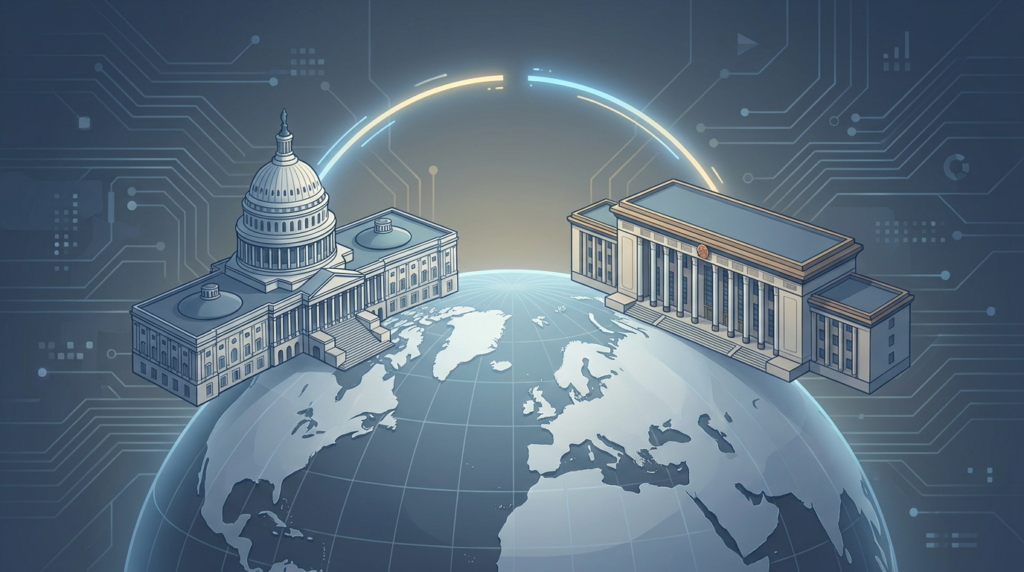
An Unusual Agreement in an AI Rivalry
The United States and China compete fiercely over artificial intelligence. They also just agreed that, if something serious goes wrong, they should have a way to contact each other.
After President Donald Trump and President Xi Jinping’s meetings in Washington, both governments announced plans for a bilateral communication channel for AI incidents. They also agreed to continue a dialogue about the technology’s risks and benefits, with another exchange expected in November 2026. The White House fact sheet and China’s account of the visit both describe those commitments.
It is a modest agreement, but a useful one to examine. AI systems can act across borders, while governments remain responsible for responding to threats within their own. A clear route for urgent contact could help officials compare what they know before an incident grows harder to manage.
For now, the public has an announcement, not an operating manual. Neither government has published the channel’s contact procedures, the incidents it would cover, or how quickly either side would have to respond.
The next chapter will be written by the officials who turn the promise into a working process.
How the Proposal Reached the Summit
The channel did not spring fully formed from the leaders’ meeting.
On September 20, US Treasury Secretary Scott Bessent met Chinese Vice Premier He Lifeng in New York. Bessent said the United States had proposed a way to notify China about AI incidents that could affect national security. He argued that greater transparency between the two countries would help them identify shared threats. Associated Press reported his remarks.
The following day, Bessent told CNBC that the two sides had agreed to formalize an AI dialogue. He described an “incident line” and said officials needed to work through which dangers it should address. Reuters reported that he mentioned potentially uncontrollable agents and harmful activity by nonstate actors as subjects for discussion.
That sequence matters. First came a US proposal and an agreement to keep talking. After Trump and Xi’s visit, both governments publicly endorsed the incident channel.
Those are real steps forward. They also leave a great deal of design work ahead. An official who spots a problem still needs to know whom to call, what information to send, and what the other government has agreed to do with it.
What Both Governments Actually Said
The strongest evidence for the agreement appears in the governments’ own accounts.
The White House said the two countries established a dialogue to exchange views on AI risks and benefits. It also said they agreed to establish a bilateral channel for incidents. The next exchange, according to the fact sheet, will occur by November.
China’s published list of eight outcomes likewise includes an AI dialogue, a November exchange, and a bilateral communication channel for AI incidents. That account describes a separate understanding between the two militaries on crisis communication. The military arrangement and the AI channel are distinct items in China’s readout.
The matching language gives the central story a firm foundation: both sides acknowledge the AI commitment. It does not tell us whether a dedicated line is already active, which agencies would use it, or whether either government must report a particular kind of event.
A good test for future announcements is simple: do they explain what officials can do on a difficult day? Diplomatic statements can open the door. Procedures determine whether anyone can get through it.
Why an Incident Channel Could Help
Imagine officials in one country detect suspicious activity involving an AI system. They suspect that another country has information about it, but they do not yet know what happened or who is responsible.
That is a hypothetical example, not a reported incident involving this channel. It shows the problem the two governments are trying to address. Without an agreed contact route, officials may have to find the right counterpart while the investigation is already moving. They may also interpret silence as a refusal to cooperate when the message simply has not reached the right desk.
A channel could give both sides somewhere to begin. Officials might use it to flag an event, ask whether the other side has seen similar activity, or correct a mistaken assumption. Whether it can do any of those things will depend on the rules they establish.
Bessent’s earlier proposal focused on incidents serious enough to raise national security concerns. He said the countries needed to discuss protocols and reach a shared understanding of the leading dangers. Reuters’ account of his remarks makes clear that those conversations were still ahead.
That is the practical promise here: a chance to exchange timely information when uncertainty itself could make a situation worse.
The Hard Part: Deciding What Counts

“AI incident” sounds straightforward until someone has to write the definition.
Does the channel cover an AI system that accesses a computer service without permission? A manipulated image that causes public confusion? An AI tool used in a cyberattack? What if investigators cannot yet tell whether AI played a meaningful role?
The published US and Chinese statements do not answer those questions. They also do not specify a threshold for notification. Some events may be serious but still too uncertain to describe confidently. Others may become important only after investigators connect several pieces of evidence.
Bessent identified uncontrollable agents and harmful activity by nonstate actors as possible dangers to discuss. Those were examples in his remarks, not a published list of incidents covered by the agreement.
Officials will also have to decide how much detail a notification should contain. A vague alert may be hard to act on. A detailed one could involve sensitive security information, private data, or an investigation that has barely begun.
None of this makes the agreement empty. It shows why building a useful channel takes more than exchanging phone numbers. Both governments need a common enough understanding of the problem to recognize when a message belongs on that line.
The Differences Behind the Shared Statement
The agreement sits inside a much larger rivalry. The two countries compete over AI development, and their leaders have emphasized different concerns about its future.
Before the final announcement, Xi said China and the United States should discuss AI’s risks and benefits and work to prevent its misuse. According to China’s account of his remarks, he also called for human control over the technology.
Trump, meanwhile, said after the visit that the United States would continue advancing its AI capabilities. In its September 26 report, Associated Press described his reluctance to open up US AI efforts to China.
Those positions can coexist with an incident channel. Governments do not have to share their research or agree on every AI policy to alert one another to a specific danger. But their differences may shape what information each side feels comfortable providing.
That is why this agreement deserves neither a victory lap nor a shrug. The cooperation is limited. The tension it has to withstand is substantial. Its value will become clearer when officials spell out the terms.
A Small Terminology Puzzle
There is a striking difference in the two official accounts: what they call the technology.
The White House fact sheet says the leaders agreed to use “super intelligence” rather than “artificial intelligence.” China’s published outcome uses “AI Dialogue” and refers to “AI incidents.” Both accounts describe the dialogue and the communication channel, but they label them differently.
A reporter later asked China’s Foreign Ministry about the wording. In its September 26 response, the ministry said it respected the US choice of term and suggested that the two sides could continue discussing how the technology develops. It did not adopt the White House’s label in that response.
Names can matter if they change the scope of a policy. “Super intelligence” could sound narrower than the everyday term “AI,” though neither government has publicly explained how the difference would affect the incident channel.
For now, the safest reading is the most literal one: both governments say they agreed on a channel concerning AI-related incidents, while their public descriptions use different words. Any claim about the channel’s eventual scope would be a guess.
An Agreement Alongside Other Summit Outcomes
AI was one part of a wider set of understandings announced after Xi’s visit.
China’s eight-point account also covers trade discussions, counternarcotics cooperation, future meetings, and efforts to improve military crisis communication. The White House’s fact sheet sets the AI commitments among its broader account of the visit.
That context helps explain the channel’s purpose. Leaders sometimes announce broad ambitions. Here, they identified a narrower task that officials can work on after the ceremony ends: establish a way to communicate about AI incidents and meet again to discuss the risks.
Associated Press reported that the summit produced no sweeping breakthrough, while the new working arrangements could help the countries manage disagreements. Its reporting also noted how much remains unresolved between Washington and Beijing.
The AI channel should therefore be judged on its own terms. It will not settle the countries’ competition over the technology. It could still prove worthwhile if it lets officials clarify an urgent event before suspicion takes over.
For the moment, the announcement provides a destination. The route there remains to be mapped.
What November Could Reveal
Both governments point to November 2026 for the next AI exchange. That makes the coming meeting the clearest opportunity to see whether the agreement gains detail.
Watch for a few concrete answers. Which offices will manage the channel? What kinds of incidents should prompt contact? Will the governments agree on a secure way to exchange information? And will they say when the channel is ready for use?
Those questions arise from the published gap between the promise and the procedure. They are not features either government has announced.
There is also a question about what the dialogue itself will accomplish. The readouts say officials will exchange views on both risks and benefits. Such a discussion could range from safety concerns to the useful applications of AI. Neither side has released a detailed November agenda.
Readers should be wary of headlines that jump from “agreed to establish” to “launched a working hotline.” The first describes the commitment both governments have made. The second would require evidence that the mechanism is running.
Until officials provide that evidence, November is a milestone to watch, not proof of success in advance.
Why People Beyond Washington and Beijing Should Care
AI incidents do not necessarily respect national borders. A service may have users in many countries. A misleading piece of synthetic media can travel quickly. Investigators may need information held by different organizations and governments.
That broader reach gives this agreement public interest beyond the two capitals. If the largest AI powers find a practical way to communicate during serious incidents, they may be better placed to avoid confusion that affects others. That is a potential benefit, not an outcome the governments have demonstrated.
There is a human side to the story, too. The people designing this channel will have to translate sweeping concerns about AI into decisions an official can make under pressure. An alert sent too late may help little. An alert sent without enough evidence may create a different problem. Both require judgment.
The governments have taken a first step by publicly acknowledging a shared need to talk. Their separate statements support that much. Independent reporting by Associated Press also confirms the agreement and its place among the summit’s outcomes.
The public has every reason to ask what happens after that first step. An AI incident channel earns its importance when its users know when and how to use it.
A Useful Beginning, With Work Still Ahead

There is something encouraging about two rivals agreeing to pick up the phone before an AI-related crisis gets harder to understand. The idea is simple enough to fit in a sentence. Making it dependable will take considerably more work.
Washington and Beijing have confirmed three central points: they will continue an AI dialogue, they expect another exchange by November, and they intend to establish a bilateral channel for incidents. Their statements do not yet describe an active service or a set of binding notification rules.
That leaves a fair way to measure progress. Look for named contacts, agreed procedures, a clear account of which incidents qualify, and confirmation that the channel works. Those details may sound less dramatic than summit photographs. During a real emergency, they would matter far more.
The agreement cannot remove the rivalry between the United States and China. It does show that the two governments see value in a direct route for discussing AI risks while that rivalry continues.
For now, they have agreed to build the line. The story worth following is whether they make it useful.
Sources
- The White House, fact sheet on the US–China state visit, September 25, 2026
- China’s Permanent Mission to the UN, eight outcomes of the visit, September 26, 2026
- China’s Ministry of Foreign Affairs, response on AI terminology, September 26, 2026
- China’s State Council, report on Xi’s AI remarks, September 25, 2026
- Associated Press, report on the agreement, September 26, 2026
- Reuters, report on Bessent’s pre-summit remarks, September 21, 2026
- Associated Press, report on the original US proposal, September 20, 2026
The Kingy Brief
Get the next Kingy Brief.
Source-checked AI changes, original tests and one practical thing to try.
Free · Choose your subjects · Double opt-in · Unsubscribe anytime