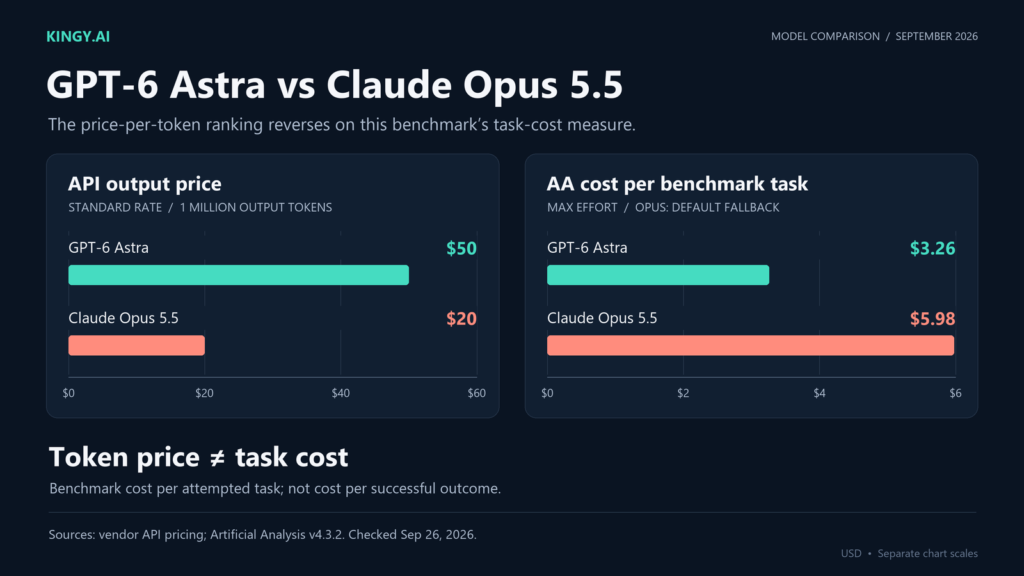
Claude Opus 5.5 is the stronger starting point for buyers seeking broad capability at a low token price. GPT-6 Astra remains a serious contender when the workload, reasoning setting and surrounding tools favor it—and can cost less per task despite its higher rates. The evidence supports a conditional recommendation, not a universal winner.
The most revealing comparison is between two bills. Opus charges $20 per million output tokens; Astra charges $50 at its standard short-context rate. Yet at maximum effort, Artificial Analysis reports weighted benchmark costs of $5.98 per task for Opus and $3.26 for Astra. Turn Opus down to high effort and the same evaluator reports $1.82 per task, with an aggregate score slightly above Astra at max. The setting is part of the product you are buying. OpenAI pricing; Anthropic pricing details; AA effort comparison.
Evidence checked September 27, 2026 (UTC). Prices are USD before taxes. This is a source-based comparison of published evaluations and documentation; Kingy.ai did not run a new head-to-head test. Recommendations below are our editorial interpretation. “Astra 6” refers to OpenAI’s official model name, GPT-6 Astra.
The quick verdict
| Your priority | Start with | What should decide the purchase |
|---|---|---|
| Professional analysis, documents and broad reasoning | Opus 5.5 | Its independent evaluation lead is a useful prior; verify the final files and evidence. |
| Coding in an established workspace | Both, in your actual coding tools | Passing patches, review time and integration friction; the independent terminal result is close. |
| Large, repeated document contexts | Opus 5.5 as the cost baseline | Cache behavior, retrieval quality and Astra’s long-context premium. |
| Business automation | Both, with production safeguards | Correct final state, unwanted actions and fallback behavior. |
| Difficult scientific or abstract reasoning | Include Astra in the trial | Task-specific verification; the relevant benchmark signals are mixed. |
| Lowest operational cost | An effort sweep before choosing | Cost per accepted outcome, including retries and human correction. |
These are starting points for evaluation, not claims that either model wins every task in a category. The tables below explain the evidence and its limits.
Jump to: specifications · benchmarks · API costs · subscriptions · ease of use · use cases · your own evaluation.
Specifications: similar capacity, different economics
| Specification | GPT-6 Astra | Claude Opus 5.5 |
|---|---|---|
| Direct API model ID | gpt-6-astra |
claude-opus-5-5 |
| Context window | 1,050,000 tokens | 1,000,000 tokens |
| Standard maximum output | 128,000 tokens | 128,000 tokens |
| Model input → output | Text and images → text | Text and images → text |
| Published knowledge cutoff | April 30, 2026 | June 2026 |
| Reasoning controls | low, medium, high, xhigh, max; no none setting | Adaptive thinking always on; low through max; medium default |
| Long-context price premium | Above 272,000 input tokens | Standard pricing across the 1M window |
Sources: Astra model specification, Opus 5.5 specification and Claude pricing. Opus also offers a separate 300K-output beta through the Message Batches API; that is not its standard synchronous output limit.
Astra’s extra 50,000 context tokens amount to a 5% larger advertised window. That is useful capacity, but it does not establish better recall or reasoning across a million-token document. Likewise, a later knowledge cutoff is not a guarantee that a particular fact is known or current. Retrieval and source checking still matter.
Keep model specifications separate from application features. Astra can call image-generation tools even though the underlying model’s listed output is text. A product’s voice or media interface may use additional models. A chatbot screenshot therefore cannot establish the native modalities of the model selected inside it.
Benchmarks: three views, three different questions
1. What the vendor launch comparison says
Anthropic’s September 22 launch table reports the following. These are published vendor comparisons, not one evaluator rerunning both models under identical conditions.
| Benchmark | Astra | Opus 5.5 |
|---|---|---|
| Terminal-Bench 4.0 | 57.9% | 66.4% |
| FrontierCode v1.1 Main | 53.3% | 54.4% |
| GDPval-AA v2.1 | 1542 Elo | 1846 Elo |
| AutomationBench | 41.4% | 40.0% |
| Humanity’s Last Exam, with tools | 57.2% | 67.7% |
| Terminal-Bench-Science 0.1 | 64.6% | 58.7% |
Opus generally uses max effort here; Terminal-Bench uses xhigh against Astra at high. Astra’s terminal and science scores are OpenAI-reported; other rows draw on their respective evaluators. For most benchmarks, safeguards were enabled and designated fallback models could complete restricted tasks; launch AutomationBench excludes fallbacks. Science standard errors are roughly 3.5–5 percentage points per model, so its 5.9-point gap does not establish a general scientific winner. Source and evaluation notes: Anthropic.
2. What independent testing changes
Artificial Analysis’s v4.3.2 comparison puts Opus at 58 and Astra at 53 on its Intelligence Index at max effort. Opus uses adaptive reasoning with default fallbacks. That is an aggregate index, not a percentage of all possible tasks solved. AA’s direct comparison.
The lead is not uniform: Astra leads AA’s GDP.pdf all-pass document-reasoning result, 31% to 26%. “All-pass” requires every grading criterion to be satisfied. That is a relevant counterexample for buyers whose document work is mostly extracting and reasoning over evidence. AA component results.
The terminal story is less decisive than the launch table suggests. AA measured Opus at 59.6% on Terminal-Bench 4.0, level with Astra at xhigh. Its launch analysis also identifies professional knowledge work as an Opus strength. This supports taking Opus seriously for substantial deliverables; it does not support claiming that it demolishes Astra on every coding task. AA’s independent launch analysis.
Several labels need translation. Elo expresses relative performance against the comparison pool; it is not a completion rate or a measure of economic value. AA’s terminal evaluation uses its own agent setup and repeated pass@1 trials. Its HLE implementation uses text-only questions, so a vendor’s “with tools” score belongs in a separate comparison. Its long-context reasoning test uses roughly 100K-token inputs, not an exhaustive test of a million-token window. AA methodology.
Do not average these numbers into a homemade “overall winner” score. A percentage, an Elo rating and a composite index have different meanings. Nor should a missing score be entered as zero.
3. Why the automation winner changes when fallbacks are included
Zapier’s current AutomationBench v1.0.6 board, checked September 26, lists Opus 5.5 with default fallbacks at 42.47% and $1.44 per task, versus Astra max at 41.4% and $1.73. Zapier says refused tasks were rerun with Anthropic’s default fallback routing; other results stayed unchanged. That explains why this ordering differs from the launch table. Zapier’s live leaderboard.
The 1.07-point advantage is small, and the page does not establish its statistical significance. The more useful lesson is that the deployed system includes routing and safeguards. A buyer needs to know which models can handle a request, how refusals are treated and whether a fallback’s cost is captured.
Zapier grades the state left inside simulated business applications. Scores around 40% on these difficult tasks are a reason to validate automation carefully. Also, AutomationBench-AA uses different scoring, including partial objective credit under guardrail conditions; its higher-looking numbers are not directly interchangeable with Zapier’s headline completion rate. Zapier scoring; AA scoring.
Abstract reasoning: Astra has a credible counterpoint
ARC Prize lists Astra’s best observed ARC-AGI-2 semi-private score at 95.0% with max effort, compared with Opus 5.5’s best 93.3% at high. Opus scores 91.7% at max, another reminder that more effort does not monotonically improve every measured result. Astra results; Opus results.
Astra’s ARC-AGI-3 result is about 62.7% at max effort with the standard harness and 99.9% at high effort with a provider adapter. These are different agent configurations and effort settings. There is no Opus 5.5 ARC-AGI-3 counterpart on its results page, so this is not a head-to-head victory. ARC Prize also cautions against interpreting benchmark saturation as proof of AGI. ARC Prize’s analysis.
API costs: the rate card is only the beginning
These are direct API prices per million tokens. Astra figures in the main column apply at or below 272K input tokens.
| Billing item | Astra | Opus 5.5 |
|---|---|---|
| Standard input | $10 | $4 |
| Standard output | $50 | $20 |
| Cached input / cache read | $1 | $0.20 |
| Cache write | $12.50 | $5 (5-minute); $8 (1-hour) |
| Batch input / output | $5 / $25 | $2 / $10 |
| Fast mode input / output | $20 / $100 | $8 / $40 |
Sources: OpenAI API pricing, Opus pricing details and Claude Fast mode. Cache products have different lifetime and eligibility rules; these prices are not a claim of identical caching behavior. Astra also offers half-price Flex processing. Opus Fast is a research preview on the Claude API, with platform restrictions.
Above 272K input tokens, Astra charges $20 input and $75 output, with doubled cache rates, for the whole request. Opus has no corresponding long-context surcharge across its 1M window. Both providers may charge separately for tools and apply other modifiers. Astra threshold; Claude full pricing.
Refusals can still cost money. Anthropic’s September 24 billing change covers refusals before any output in the bio, frontier_llm and reasoning_extraction categories; other pre-output categories remain unbilled. Mid-stream refusals bill input and output already generated. A fallback can add another billed attempt, with a credit for its prompt-cache miss. For accurate accounting, inspect usage.iterations: top-level usage describes only the attempt that returned the message. September 24 release notes; refusal and fallback billing.
Two transparent budget examples
Example A: a moderate research request. Assume exactly 100,000 uncached input tokens and 10,000 billable output tokens. Astra costs $1.50; Opus costs $0.60. Across 1,000 identical requests, that is $1,500 versus $600.
Example B: one very large document request. At 500,000 uncached input tokens and 20,000 billable output tokens, Astra costs $11.50 and Opus costs $2.40. Astra’s input threshold changes the rates for this entire request.
These are our calculations from the rates above, not observed task costs. They assume identical token counts, standard processing, no cache writes or reads, and no tools, retries, regional premiums or taxes. Different tokenizers and reasoning behavior mean the same assignment will not necessarily produce the same billable counts.
“Output” also does not mean just the text a user sees. OpenAI bills internal reasoning as output and includes it in output limits. Anthropic’s thinking-token accounting similarly means visible answers do not tell the whole cost story. Use the provider’s usage records. OpenAI reasoning accounting; Claude thinking-token accounting.
Measured task cost: effort can reverse the conclusion
| Configuration | AA Intelligence Index | Weighted cost per benchmark task |
|---|---|---|
| Opus 5.5 medium | 51 | $1.34 |
| Opus 5.5 high | 54 | $1.82 |
| Opus 5.5 max | 58 | $5.98 |
| Astra high | 51 | $1.73 |
| Astra max | 53 | $3.26 |
AA v4.3.2; Opus runs use default fallbacks. These are weighted inference costs per attempted benchmark task, not cost per successful outcome, and the aggregate scores are not success percentages. Named effort settings do not imply equal compute. Source: AA effort comparison.
At max, AA reports roughly 119K output tokens per task for Opus versus 27K for Astra. That helps explain the price reversal. At high, Opus’s result makes it an attractive configuration to test before paying for max on every request. Neither observation tells you what a different mix of customer tasks will cost. AA measured usage.
The business metric to track is total workflow cost divided by accepted outcomes. Include failed attempts, tools, execution infrastructure and reviewer time. A cheap draft that needs twenty minutes of repair can be worse value than an expensive draft that needs two. Define “accepted” before seeing which model produced it.
Subscriptions: buying access is different from buying tokens
| Plan family | OpenAI | Claude |
|---|---|---|
| Individual paid entry | ChatGPT Plus: $20/month | Claude Pro: $20/month or $200/year (about $16.67/month) |
| Higher individual usage | ChatGPT Pro: from $100/month | Claude Max: from $100/month |
| Team / business | Business: $20/user/month billed annually or $25 monthly; two-user minimum | Team standard: $20/seat/month billed annually or $25 monthly; premium: $100/seat/month billed annually or $125 monthly; 2–150 seats |
Sources: OpenAI plan pricing and Claude plans. Subscriptions are not unlimited API budgets. OpenAI’s Work and Codex share allowances; API-key usage is billed separately. Published local-message estimates vary with task complexity rather than guaranteeing a fixed number of Astra assignments.
Check the exact model picker and account limits before committing. Astra availability depends on the client, plan, rollout and workspace configuration. Product controls also differ from API controls: OpenAI’s Ultra setting orchestrates subagents, rather than adding an API reasoning-effort value beyond max. OpenAI model selection.
For an individual, the useful subscription test is straightforward: can this plan finish your typical week without disruptive limits, and does its workspace fit how you work? For a software product serving customers, start from API costs and production throughput. Mixing those two purchasing decisions produces misleading comparisons.
If you are choosing a personal plan, our ChatGPT Pro vs Claude Max buying guide compares the $100 and $200 tiers, usage limits and current purchase availability.
Ease of use: compare the whole working environment
A capable model can still be frustrating when files are awkward to move, permissions repeatedly interrupt a task or its output is hard to revise. Evaluate the model inside the product you will actually use.
On OpenAI’s side, Work supports research, file creation and authorized application workflows. Local Work can use resources made available on your computer; cloud Work runs in a separate environment and does not automatically inherit local files, applications or browser sessions. That distinction matters when a task depends on an already-open spreadsheet or a signed-in website. Work’s execution boundaries.
Claude Code provides the repository-focused environment. Cowork’s file and application capabilities are being integrated into ordinary Claude conversations, with the product page describing a Pro and Max rollout and more plans to follow. For many buyers, the practical comparison is Claude Code against Codex, or Claude’s delegated-work experience against Work. Claude Code overview; Claude Cowork and rollout.
For a writer or analyst, try a deliberately untidy assignment: supply conflicting notes, a style guide and a partly finished file. Ask the assistant to resolve what it can, identify what it cannot verify, and return something editable. Count factual corrections and revision rounds. A preference for the first paragraph is a weaker buying signal than the ability to preserve your instructions through three revisions.
OpenAI itself documents possible Astra friction: excessive clarification, verbose formatting and broader testing than a small coding change needs. Its guidance recommends explicit scope, style and completion criteria. These are useful tuning notes, not evidence that Opus never has similar problems. OpenAI model guidance.
Anthropic likewise documents cases where Opus ends a turn with a progress report before the assignment is finished. Its guidance recommends tracking completion and using bounded continuations; for cross-application work, it recommends explicitly finding relevant information before acting. Both assistants benefit from a clear definition of done. Anthropic’s prompting guidance.
Developers: migration can require more than a model-name swap
Astra supports Chat Completions, but its current guide requires the Responses API for tool calling. It does not support reasoning effort none; reasoning-enabled requests also have sampling-parameter restrictions. Audit these before migrating an existing agent. Astra integration guidance.
Opus 5.5 removes several familiar paths: thinking cannot be disabled, forced tool_choice values any and tool fail, and older computer-use tooling changes on the Claude API and Google Cloud. Thinking blocks are tied to the model and conversation. Its migration guide also explains why progress narration can disappear between tool calls unless display behavior is configured. Opus migration guide.
Test structured output, tool selection, interrupted runs, retries and conversation continuation independently. A model returning valid JSON once is not evidence that your complete workflow survives a timeout or a refused action.
Speed: measure time to a usable result
There is no defensible universal speed winner in the evidence reviewed here. Tokens per second measures generation throughput; it does not capture the amount of thinking, tool waiting, retries or human repair. A shorter answer can arrive later and still finish the assignment sooner.
Both ecosystems offer paid speed options. Keep their billing units straight: Astra API Fast doubles applicable token rates, while OpenAI’s app Fast mode consumes 2.5 times the credits where available. Claude’s Fast mode has its own premium pricing and availability. Astra API; OpenAI app credits; Claude Fast.
Which model should you try for your work?
Coding and software maintenance
Run both against real issues in a disposable copy of your repository. Include a localized bug, a change spanning several modules, and a task with ambiguous requirements. Grade whether the patch passes meaningful tests, preserves existing behavior and is understandable to a reviewer. Log unnecessary edits and attempts to weaken tests. The independent terminal result makes a categorical coding verdict difficult to justify.
If your team already has a mature workflow in either ecosystem, treat migration effort as a cost. Better benchmark performance has to produce enough practical value to cover prompt changes, tool compatibility work and retraining users.
Working code and secure code are different outcomes. Endor Labs’ September 24 evaluation reports Opus 5.5 in Claude Code 2.1.280 at 68.7% functional correctness and 33.5% functional-plus-security correctness. It ran each task once: 200 tasks were attempted, with 179 in the scored denominator after excluding unusually restrictive test cases. Confirmed recalled solutions did not earn credit. Endor reports no fallback or cyber-safeguard activation during this run; the article does not state the reasoning-effort setting. Endor’s evaluation and scoring rules.
The live Endor board, checked September 27, lists Codex with Astra at 82.1% functional and 34.1% secure, ahead of the Opus combination. Endor’s accompanying article instead quotes 34.6% for Astra’s secure score; that discrepancy remains unresolved. These compare different agent products and run dates, not models in an identical harness. Our takeaway is to test security separately from whether a patch works, rather than read a small leaderboard margin as a universal winner.
Research, writing and professional documents
Opus is a sensible first trial given the independent knowledge-work signal. Judge the deliverable, including citations, calculations, omissions and editability. For research, introduce one source that contradicts the others and one that is out of date. An assistant that notices the conflict is more useful than one that confidently blends the claims.
Web research gives a split verdict. Exa’s September 25 Agent Ultra comparison, checked September 27, reports the following for Opus 5.5 and Astra at maximum effort in their native harnesses:
| Exa-reported evaluation | GPT-6 Astra | Opus 5.5 |
|---|---|---|
| WANDR: soft recall | 26.0% | 72.3% |
| DeepSearchQA: F1 | 85.3% | 77.6% |
| WideSearch: row-level F1 | 54.7% | 51.6% |
Source: Exa’s original comparison and methodology. Exa sells a competing research agent, so these are competitor-reported results, not a neutral replication. Its WANDR grader changes the contents tool, transport and judge model; the comparison combines published results on that grader with Exa’s own runs. Evaluation sets contain up to 200 tasks for WANDR and DeepSearchQA and 100 for WideSearch; graded counts vary by provider. Fallback behavior is not specified in the launch comparison. The practical implication is to test exhaustive list building separately from answering multi-step research questions.
For writing, use a blind review against your own editorial standard. Ask reviewers to mark unsupported statements and edits they would actually make. Do not turn a personal taste for warmth, brevity or formatting into an objective model ranking.
Large document collections
Opus’s pricing makes it a natural baseline for long prompts, especially when the material can be cached. Still compare whole-context ingestion against targeted retrieval. Measure whether the model finds inconvenient evidence buried in appendices and distinguishes the current policy from a superseded version. Buying a bigger context window does not eliminate information-selection work.
Business agents and scientific work
For business agents, use realistic records with near-duplicate names, stale instructions and actions that require approval. Score the changes left behind. A polished explanation does not compensate for updating the wrong customer.
For science, keep Astra in the comparison and make verification domain-specific: reproduced calculations, executable analysis, reliable citations or expert review. METR’s preliminary Opus assessment found continuing weaknesses on difficult, long AI-research tasks; it was not an Astra comparison and does not support treating either assistant as an autonomous scientist. METR evaluation.
Reliability, safeguards and data handling
A safety result belongs to a particular model, configuration and attack surface. Anthropic’s system card shows that protective probes and fallback routing materially affect prompt-injection outcomes. It also reports a regression on malicious instructions pasted directly into user prompts. Those findings do not justify a single “safest model” trophy. Opus 5.5 system card.
For deployed agents, test the boundary between reading an instruction in a document and treating it as permission to act. Use narrow tool access, review consequential changes and keep records of what ran. Test legitimate requests as well as hostile ones: unnecessary refusals and interruptions also affect completion and cost.
Privacy comparisons must specify the product and contract. OpenAI says API data is not used for training by default, but abuse-monitoring logs and application state can still be retained; zero-retention eligibility depends on the endpoint and features. Claude’s commercial data treatment also differs from consumer settings. “Not used for training” and “not stored” are separate claims. OpenAI data controls; Anthropic training-data policy.
A practical evaluation you can run before buying
The following is our recommended pilot design, not a benchmark result.
- Select 20–30 representative tasks. Include routine work, expensive failures and awkward edge cases. Freeze the source files and starting state.
- Define acceptance criteria in advance. Examples include a correct spreadsheet formula, a patch that passes an external test, or a cited memo with no unsupported claims.
- Run two comparisons. First hold tools, budgets and inputs constant to isolate model behavior. Then let each use your preferred production product to compare the systems you would actually buy.
- Sweep effort. Try medium and high before max. Record the exact model, date, API or app, tool versions and fallback policy.
- Repeat fragile cases. A lucky success or failure should not decide a recurring workflow. Use blinded human review where deterministic grading is impossible.
- Track accepted outcomes, total spend and elapsed time. Include cached and reasoning tokens, tools, retries, refusal rates, unwanted actions and reviewer minutes. Look at slow-tail performance as well as the median.
- Route by value. Keep the cheapest configuration that clears the quality bar; escalate difficult cases. Recheck after material model, tool or pricing changes.
A particularly useful worksheet has one row per task and columns for acceptance, factual errors, harmful side effects, review minutes, total cost and completion time. Keep the model identity hidden from reviewers until scoring is finished. This turns “I like this one better” into a decision that can survive procurement, engineering review and next month’s release.
Frequently asked questions
Is Claude Opus 5.5 better than GPT-6 Astra?
It is the stronger general starting point in this evidence snapshot, especially for buyers testing professional deliverables. The result is not universal: coding can be close, reasoning settings change value, and particular scientific or abstract tasks can favor Astra.
Is Opus always cheaper?
No. Its token rates are lower, but the measured maximum-effort comparison reverses the task-cost ranking. Price the configuration and workload you will actually run.
Does a million-token context mean perfect memory?
No. Capacity describes how much can fit, not how reliably every detail will be used. Test retrieval, conflicting evidence and long-session behavior separately.
Should I switch my whole team?
Start with a bounded pilot. A successful switch needs a meaningful improvement in accepted work after migration, review and training costs. Keeping both for different tasks may be the better operational choice.
The buying decision
Start an Opus trial if you want a strong general-purpose option with attractive API economics. Keep Astra in the evaluation if its existing workspace, task efficiency or reasoning behavior already delivers value. Spend the effort tuning both before spending heavily on maximum effort.
The durable advantage is a workflow that produces correct, reviewable results at an acceptable cost. Choose the model and settings that achieve that on your work—and keep enough evidence to know when the answer changes.
Related Kingy.ai reading: Claude Opus 5.5’s full launch breakdown and the detailed Astra–Opus reasoning-effort comparison.
Methodology: We prioritized official specifications and pricing, original benchmark operators and independent evaluators. Vendor and independent results are labeled separately; calculations state their assumptions. Leaderboards, availability and prices can change. No affiliate recommendation or firsthand test result is implied by the comparisons above.
Article update log
September 27, 2026 (UTC): Added Endor’s secure-coding evaluation and its unresolved Astra score discrepancy, Exa’s contrasting web-research results, and Anthropic’s refusal/fallback billing rules. Integrated these into the coding, research and cost sections; original token-price examples and the cost graphic remain valid.
Trending on Kingy
Keep reading with the stories getting the most attention now.