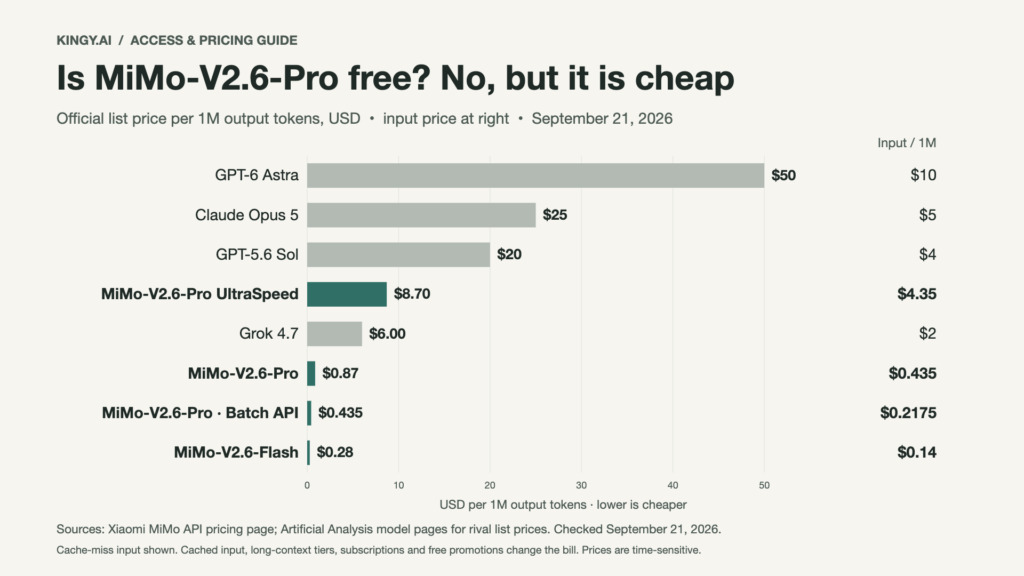
MiMo-V2.6-Pro is not free to use through an API. Xiaomi charges $0.435 per million input tokens and $0.87 per million output tokens, well below Claude and GPT rates. You can still try the V2.6 series for free: OpenCode is offering MiMo-V2.6-Flash free for a week, Xiaomi’s MiMo Studio has a sign-in chat demo, and the weights are free to download under the MIT license.
Pro itself is available in the $10-a-month OpenCode Go plan, in Xiaomi’s Token Plan from $6 a month, on OpenRouter, and through Xiaomi’s own OpenAI- and Anthropic-compatible API. This guide covers each route, what it costs and how to set up MiMo-V2.6-Pro in OpenCode and Claude Code.
Updated September 21, 2026. This guide is based on Xiaomi’s launch post, API and Token Plan documentation, OpenCode’s announcement and documentation, and OpenRouter listings. We also tested MiMo-V2.6-Pro, the free Flash model and Claude Opus 5 in the OpenCode desktop app; the results are below. Featured image: original Kingy.ai chart using official list prices.
For benchmark tables and comparisons with Claude, GPT, Grok and open models, read our MiMo-V2.6-Pro benchmarks and specs analysis.
Is MiMo-V2.6-Pro free?
Not through the API. Several promotions around the launch are real, but they have limits worth knowing before you sign up. OpenCode’s free offer, for example, covers Flash rather than Pro.
| Option | Cost | What you get | The catch |
|---|---|---|---|
| OpenCode Zen: MiMo-V2.6-Flash Free | $0 for about a week | V2.6-Flash inside the OpenCode coding agent | Flash, not Pro. Time-limited. OpenCode says data from MiMo free models may be used to improve the model |
| MiMo Studio web chat | No price listed | Browser chat demo with MiMo V2.6 | Xiaomi account sign-in. We could not find published usage limits |
| Open weights (Hugging Face) | $0 to download | Full Pro weights, MIT license | About 1.02T parameters. Needs data-center GPUs |
| MiMo-V2.6-Distill-Qwen-9B | $0 to download | A 9B model distilled from the V2.6 series | Much weaker than Pro. Its license was not listed when we checked |
| OpenCode Go | $10/month | V2.6-Pro and V2.6-Flash among 30+ models | Monthly spending caps and 5-hour and weekly limits apply |
| Xiaomi Token Plan Lite | $6/month | V2.6-Pro and Flash in OpenCode, Claude Code and other tools | 4.1 billion credits a month. See the credit math below |
Sources: OpenCode on X, OpenCode docs update, OpenCode Zen docs, OpenCode Go docs, MiMo Studio, Hugging Face.
OpenCode announced on September 21 that MiMo V2.6 Flash would be free for the next week, and that Flash and Pro are both available in Go. A documentation change adding “MiMo V2.6 Flash Free” to Zen was merged the same day. The public Zen docs page still listed the older MiMo-V2.5 Free when we checked, and one user replying to the announcement posted a usage screen showing charges. In our own test the same evening, “MiMo-V2.6-Flash Free” appeared under OpenCode Zen in the desktop app’s model picker, labeled Free, and completed all three of our tasks. Check for that label in your model list before you start a long session.
The free model is a trial, not a private production endpoint. OpenCode’s Zen documentation says data collected from its MiMo free models may be used to improve the model. Do not send confidential code or customer data through it.
Every way to use MiMo-V2.6-Pro today
Xiaomi says V2.6-Pro and Flash are available in AI Studio, MiMo Code and MiMo Desktop, through the MiMo API platform and on OpenRouter. The table adds the third-party routes we confirmed.
| Route | Best for | How to start |
|---|---|---|
| MiMo Studio (AI Studio) | Quick chat testing | Sign in at aistudio.xiaomimimo.com with a Xiaomi account |
| MiMo Desktop | Slides, mockups, data and video tasks | Xiaomi’s desktop app left early access at launch. It also offers UltraSpeed |
| MiMo Code | Xiaomi’s own coding agent | Start from Xiaomi’s MiMo Code page |
| Xiaomi MiMo API | Developers, lowest per-token price | Create an sk- key in the MiMo console; OpenAI- and Anthropic-compatible |
| Xiaomi Token Plan | Predictable monthly spend in coding tools | Subscribe, then copy your plan’s tp- key and regional base URL |
| OpenRouter | One key across many models | Model slugs xiaomi/mimo-v2.6-pro, xiaomi/mimo-v2.6-flash, xiaomi/mimo-v2.6-pro-ultraspeed |
| OpenCode Go / Zen | Terminal coding agent with a subscription | Pro and Flash in Go; free Flash in Zen for a limited time |
| Hugging Face | Self-hosting on your own GPUs | XiaomiMiMo V2.6 collection |
MiMo Claw, Xiaomi’s hosted agent built with Kingsoft Office, also runs V2.6-Pro. Xiaomi advertises daily free usage and a ¥14.9-a-month introductory subscription, priced in yuan.
MiMo-V2.6-Pro pricing: API, Batch and UltraSpeed
V2.6 keeps V2.5’s prices. All figures below are US dollars per million tokens from Xiaomi’s overseas rate card.
| Model and mode | Cached input | Input | Output |
|---|---|---|---|
| MiMo-V2.6-Pro, real time | $0.0036 | $0.435 | $0.87 |
| MiMo-V2.6-Pro, Batch API | $0.0018 | $0.2175 | $0.435 |
| MiMo-V2.6-Pro-UltraSpeed | $0.036 | $4.35 | $8.70 |
| MiMo-V2.6-Flash, real time | $0.0028 | $0.14 | $0.28 |
| MiMo-V2.6-Flash, Batch API | $0.0014 | $0.07 | $0.14 |
Cache writes are free for a limited time. Web search costs $5 per 1,000 calls outside China. UltraSpeed does not support the Batch API.
For comparison, Claude Opus 5 lists at $5 input and $25 output, and GPT-6 Astra at $10 and $50. MiMo-V2.6-Pro’s output price is under a twenty-fifth of Opus 5’s. Cached input costs less than 1% of the uncached rate, so agents that resend the same repository context benefit most.
What does a task cost in practice?
| Task | Tokens | MiMo-V2.6-Pro cost |
|---|---|---|
| Summarize a long report | 50K in, 5K out | About $0.026 |
| Coding-agent session | 2M in (90% cached), 100K out | About $0.18 |
| Same session on UltraSpeed | Same | About $1.80 |
| Classify 10,000 documents (Batch) | 30M in, 5M out | About $8.70 |
Kingy.ai estimates from list prices. Output includes reasoning tokens. Retries, tool calls and search are extra.
Is the Token Plan worth it? The credit math
Xiaomi’s Token Plan is a monthly subscription for coding tools. Each plan includes a fixed number of credits. V2.6-Pro uses 300 credits per uncached input token, 600 per output token and 2.5 per cached input token. Flash uses 100, 200 and 2.
| Individual plan | Price | Monthly credits | Pro output tokens covered | Same usage at API prices |
|---|---|---|---|---|
| Lite | $6 | 4.1B | About 6.8M | About $5.95 |
| Standard | $16 | 11B | About 18.3M | About $15.95 |
| Pro | $50 | 38B | About 63.3M | About $55.10 |
| Max | $100 | 82B | About 136.7M | About $118.90 |
Kingy.ai calculation from Xiaomi’s published credit rates and API prices. The ratio is nearly identical for uncached and cached input, so the “same usage” column holds for any mix of Pro tokens.
At list price, the Lite and Standard plans give you about the same amount of V2.6-Pro usage as paying per token. The Pro and Max tiers add roughly 10% and 19% more. The main advantages of the plan are elsewhere:
- A first purchase of an individual plan is 12% off.
- Usage between 00:00 and 08:00 Beijing time (16:00 to 24:00 UTC) consumes credits at 0.8 times the normal rate.
- Spending is capped. When credits run out, the service stops instead of charging your balance.
If you already pay per token and your usage varies, the plan will not save much. If you want a fixed monthly bill or can run jobs off-peak, it can. Our AI coding plan limits guide explains how subscription plans compare with per-token API pricing.
How to use MiMo-V2.6-Pro in OpenCode
You can use OpenCode with free Flash, with Pro through OpenCode Go, or with your own Xiaomi key.
- Install OpenCode. On macOS or Linux, use the official install script from opencode.ai, or run
npm install -g opencode-aiwith Node.js 18 or later. Check the install withopencode -v. - For the free Flash trial or Go, sign in to OpenCode, run
opencodein your project folder and type/models. Choose MiMo V2.6 Flash Free (Zen) or MiMo-V2.6-Pro (Go). - For your own Xiaomi key, type
/connectin the OpenCode IDE plugin, search for Xiaomi and paste your key. Token Plan users should choose the provider that matches their plan’s base URL: China, Singapore or Europe.
To configure it manually, Xiaomi documents this provider block for ~/.config/opencode/opencode.json:
{
  "$schema": "https://opencode.ai/config.json",
  "provider": {
    "mimo": {
      "npm": "@ai-sdk/openai-compatible",
      "name": "MiMo",
      "options": {
        "baseURL": "https://api.xiaomimimo.com/v1",
        "apiKey": "YOUR_MIMO_API_KEY"
      },
      "models": {
        "mimo-v2.6-pro": {
          "name": "mimo-v2.6-pro",
          "limit": { "context": 1048576, "output": 131072 },
          "modalities": { "input": ["text", "image"], "output": ["text"] }
        }
      }
    }
  }
}
Use the OpenAI-compatible base URL shown above with OpenCode. Xiaomi warns that using OpenCode with its Anthropic-compatible endpoint can return a 400 error in multi-turn tool calls, because the reasoning content is not passed back.
We tested it: MiMo-V2.6-Pro vs Flash vs Claude Opus 5 in OpenCode
We ran both models in the OpenCode desktop app on a Mac. After adding a project folder, typing “mimo” in the model picker showed MiMo-V2.6-Flash Free under OpenCode Zen and MiMo-V2.6-Pro under OpenRouter, because an OpenRouter key was already connected. Pro billed through that key; Flash cost nothing. As a frontier baseline, we also ran Claude Opus 5 through the same OpenRouter connection. Each model got the same three tasks with a written brief, and we scored the work with automated checks the agent could not see.
| Task | What it required | MiMo-V2.6-Pro | MiMo-V2.6-Flash Free | Claude Opus 5 |
|---|---|---|---|---|
| 1. Bug fix | Fix five spec violations in an inventory module; only three were covered by the visible tests | 8/8 | 8/8 | 8/8 |
| 2. Multi-file feature | Parse accounting-style amounts, add a model property, a report function and a new CLI across four files | 8/8 | 6/8: its CLI left out the required summary subcommand, although its own tests passed | 8/8 |
| 3. Data analysis | Deduplicate a sales export, handle refunds and write seven exact answers plus a manager summary | 7/7 | 7/7 | 7/7 |
| Total | 23 hidden automated checks | 23/23, about $0.03 | 21/23, $0 (free promotion) | 23/23, about $1.03 |
Kingy.ai test, September 21, 2026. OpenCode desktop app on macOS. MiMo-V2.6-Pro and Claude Opus 5 ran through OpenCode’s OpenRouter provider at the default setting; Flash ran as “MiMo-V2.6-Flash Free” in OpenCode Zen. One run per model per task, with identical prompts. Kingy.ai wrote the tasks; the scoring checks were kept outside the agent’s working folder and were not visible to it. Costs are OpenCode’s session totals, rounded to the cent. Each task took roughly one to two minutes.
Setup took a couple of minutes, and no model needed help to finish. Pro passed every check for about three cents in total, the same score Claude Opus 5 reached for about $1.03. Flash matched them on two tasks but left out a required summary subcommand in the multi-file task, and the tests it wrote for itself did not notice. With the free model, check the result against the brief yourself, not only against its own tests.
This was one run per task on small, well-defined jobs, so treat it as a quick check rather than a benchmark. For the independent scores and the comparison with Claude and GPT, see our benchmark analysis.
How to use MiMo-V2.6-Pro in Claude Code
Xiaomi provides an Anthropic-compatible endpoint, so Claude Code can call MiMo-V2.6-Pro instead of Anthropic’s models. First unset any existing ANTHROPIC_AUTH_TOKEN and ANTHROPIC_BASE_URL environment variables. Then add the following to ~/.claude/settings.json:
{
  "env": {
    "ANTHROPIC_BASE_URL": "https://api.xiaomimimo.com/anthropic",
    "ANTHROPIC_AUTH_TOKEN": "YOUR_MIMO_API_KEY",
    "ANTHROPIC_MODEL": "mimo-v2.6-pro",
    "ANTHROPIC_DEFAULT_SONNET_MODEL": "mimo-v2.6-pro",
    "ANTHROPIC_DEFAULT_OPUS_MODEL": "mimo-v2.6-pro",
    "ANTHROPIC_DEFAULT_HAIKU_MODEL": "mimo-v2.6-pro"
  }
}
Xiaomi’s guide also sets "hasCompletedOnboarding": true in ~/.claude.json. To use the full 1M context, it suggests the model ID mimo-v2.6-pro[1m], then checking with /context. Run /status after launch to confirm which model is active.
Token Plan users should replace the base URL with the plan’s Anthropic endpoint, such as https://token-plan-cn.xiaomimimo.com/anthropic or the Singapore or Europe equivalent shown on the plan page, and use their tp- key. Claude Code features built around Anthropic models may behave differently with a third-party model, so test on a non-critical repository first.
API quick start
The MiMo API accepts OpenAI Chat Completions requests. It also supports the OpenAI Responses API, which Codex uses, and the Anthropic Messages API. A minimal Python call:
import os
from openai import OpenAI

client = OpenAI(
    api_key=os.environ["MIMO_API_KEY"],
    base_url="https://api.xiaomimimo.com/v1",
)

resp = client.chat.completions.create(
    model="mimo-v2.6-pro",
    messages=[{"role": "user", "content": "Explain Python's GIL in three sentences."}],
    max_completion_tokens=1024,
    temperature=1.0,
    top_p=0.95,
)
print(resp.choices[0].message.content)
We checked this example against Xiaomi’s documentation but have not run it as a paid test. Three details to get right:
- Pass reasoning back in multi-turn tool calls. In thinking mode the model returns
reasoning_contentwith its tool calls. Xiaomi recommends including it in later messages; some clients that drop it get errors. - Use the Batch API for bulk jobs. It has its own base URL, set in the Batch Inference console, and halves the price for Pro and Flash.
- Plan for the V2.5 shutdown.
mimo-v2.5-proandmimo-v2.5stop working on October 21, 2026 at 10:00 Beijing time. Update any hard-coded model names before then.
On OpenRouter, use xiaomi/mimo-v2.6-pro with your OpenRouter key. At launch, Xiaomi was the only provider listed, and OpenRouter showed the same per-token prices.
Can you run MiMo-V2.6-Pro locally?
Not on a laptop or a single workstation GPU. Pro has 1.02 trillion total parameters. The weights alone need roughly a terabyte of memory at 8-bit precision, plus the key-value cache for long prompts. That requires a multi-GPU server.
V2.6-Flash has 309B total and 15B active parameters. Its model card recommends SGLang with tensor parallelism across eight GPUs, so it is still server hardware. The realistic local option is MiMo-V2.6-Distill-Qwen-9B, which Xiaomi fine-tuned from Qwen3.5-9B. At 16-bit precision its weights are about 18GB. Treat it as a separate small model, not a compressed Pro.
Pro, Flash or UltraSpeed: which should you use?
- Start with Flash for everyday coding help, chat and high-volume calls. It costs about a third of Pro, and Xiaomi’s table shows it close behind Pro on most agent benchmarks.
- Move to Pro for long agent sessions, harder terminal work and exploitation-focused security work. Those are the areas where Xiaomi reports its largest lead over Flash.
- Use UltraSpeed only when latency matters, as in live voice or interactive tools. It costs 10 times as much as Pro. Measure the speedup on your own prompts before you commit.
On the Artificial Analysis index, Pro scores 46, the same as Grok 4.7 and five points below Claude Opus 5. Our benchmark analysis covers where it keeps up with frontier models and where it falls behind.
Is MiMo-V2.6-Pro worth trying?
For most developers it costs little to find out. Our example coding-agent session costs about 18 cents on the API. OpenCode’s week of free Flash lets you test the V2.6 series in a real agent loop for nothing. In our test, Flash passed 21 of 23 checks, and Pro passed all 23 for about three cents, matching Claude Opus 5, which cost about $1.03. To compare it with your current model, give both the same three tasks: a bug fix, a multi-file change and a document or research task. Record whether each passes, how much fixing it needs and the full cost.
Keep your current frontier model for the hardest unattended work until MiMo passes that test. If you already use MiMo-V2.5, switch the model name before October 21. The price is the same and, on Xiaomi’s own benchmarks, V2.6 is a large improvement.
Frequently asked questions
Is MiMo-V2.6-Pro free?
The API is not free. OpenCode says MiMo-V2.6-Flash is free in OpenCode Zen for about a week from September 21 (check that the free variant appears in your model list), Xiaomi’s MiMo Studio offers a sign-in chat demo, and the model weights are a free download under the MIT license.
Does MiMo-V2.6-Pro work in OpenCode?
Yes. In our test on September 21, 2026, Pro ran in the OpenCode desktop app through OpenRouter and passed all 23 hidden checks across three tasks for about $0.03. Claude Opus 5 scored the same for about $1.03. It is also listed in OpenCode Go, and you can add your own Xiaomi key.
How much does MiMo-V2.6-Pro cost?
$0.435 per million input tokens, $0.0036 per million cached input tokens and $0.87 per million output tokens on Xiaomi’s API. The Batch API is half price. Subscriptions start at $6 a month for Token Plan Lite or $10 a month for OpenCode Go.
Can I use MiMo-V2.6-Pro in Claude Code?
Yes. Point ANTHROPIC_BASE_URL at https://api.xiaomimimo.com/anthropic, use your MiMo key as ANTHROPIC_AUTH_TOKEN and set the model variables to mimo-v2.6-pro.
Is MiMo-V2.6-Pro on OpenRouter?
Yes, as xiaomi/mimo-v2.6-pro, along with xiaomi/mimo-v2.6-flash and xiaomi/mimo-v2.6-pro-ultraspeed. At launch, Xiaomi was the only provider.
What is the difference between MiMo-V2.6-Pro and UltraSpeed?
Xiaomi says UltraSpeed is the same model, served up to 20 times faster at the same quality. It costs 10 times as much per token and does not support the Batch API.
Does MiMo-V2.6-Pro support images, audio and video?
Xiaomi describes the V2.6 series as natively omnimodal, and Artificial Analysis lists text, image, speech and video input with text output. Xiaomi’s coding-tool configuration examples enable only text and image. Test other input types on your chosen route before you rely on them.
Trending on Kingy
Keep reading with the stories getting the most attention now.