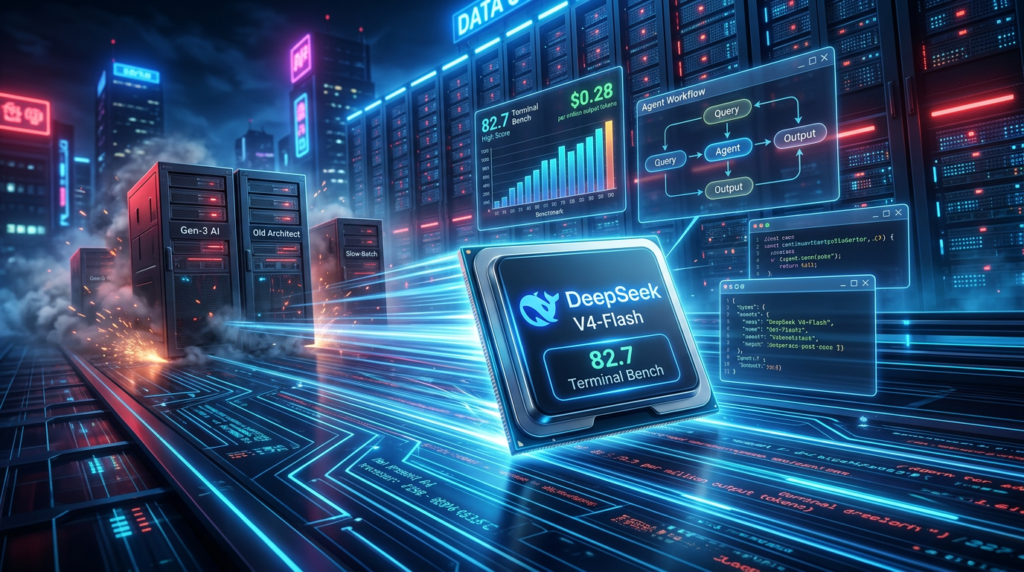
A Flash Update With a Naming Plot Twist
DeepSeek has returned to a familiar trick: make capable artificial intelligence dramatically cheaper, then watch the rest of the industry reach for a calculator.
On July 31, the Chinese AI company moved the official DeepSeek-V4-Flash API into public beta. Some coverage has called it “DeepSeek 2 Flash,” but DeepSeek’s own documentation identifies the model as DeepSeek-V4-Flash-0731. It is not an entirely new generation.
Instead, DeepSeek took the existing V4-Flash Preview, ran a stronger post-training process, and produced much better results on agent-oriented tests. The architecture and model size stayed the same. The API calling method also remained unchanged.
DeepSeek says the revised model now beats its larger V4-Pro-Preview sibling across the agent benchmarks it published. Independent research firm Artificial Analysis also found that V4-Flash costs much less to operate than other widely known models.
So, yes, this update brings faster horses to the AI racetrack. More importantly, DeepSeek appears to have lowered the ticket price to pocket change.
DeepSeek Improved the Driver, Not the Engine
Most major AI launches follow a predictable formula. Add more parameters. Feed the model more data. Rent an alarming number of processors. Then introduce the result with a chart pointing heroically toward the upper right.
DeepSeek chose a different path.
According to the company’s official API changelog, V4-Flash-0731 retains the same architecture and size as V4-Flash Preview. DeepSeek says it “was only re-post-trained.” In plain English, the company did not rebuild the model’s core foundation. It refined how the existing model behaves after its initial training.
That post-training work focused heavily on coding, tool use and agentic workflows.
An analysis published through Hugging Face describes the model as having 284 billion total parameters but activating only 13 billion for a given token.
The lesson: smarter refinement can sometimes deliver a bigger practical jump than simply making a model larger.
The Benchmark Numbers Demand Attention
DeepSeek reported substantial gains across several tests aimed at coding agents and autonomous task completion. The headline result came from Terminal Bench 2.1, where V4-Flash-0731 scored 82.7. The earlier Flash Preview scored 61.8, while V4-Pro-Preview reached 72.1, according to a benchmark comparison compiled by Flowtivity.
The movement on DeepSWE looked even more dramatic. Flash climbed from 7.3 in the preview to 54.4 in the official update. DeepSeek also reported scores of 76.7 on Cybergym, 70.3 on Toolathlon Verified and 54.2 on NL2Repo.
Those numbers suggest that the updated model became much better at navigating repositories, operating tools and completing longer coding sequences. TechNode’s release report highlighted the same 82.7 Terminal Bench result and the 54.4 DeepSWE score.
Still, the fine print deserves sunlight. DeepSeek produced the published results using its own settings and harness. Its changelog says the code-agent evaluations used DeepSeek Harness in minimal mode, with maximum effort and specified sampling settings. Two listed DSBench evaluations are internal tests.
In other words, these are meaningful signals, not stone tablets. Developers should test the model on their actual workloads before planning a victory parade.
Seven Times Better—But Only in the Right Context
The claim that V4-Flash delivers roughly seven times the original performance comes mainly from its DeepSWE result. Moving from 7.3 to 54.4 represents about a 7.45-fold score increase. That is an enormous jump.
It does not mean the model became seven times smarter at everything.
Benchmarks isolate particular skills. DeepSWE targets software-engineering agents, while Terminal Bench measures performance on command-line tasks. Improvements there do not automatically translate into sevenfold gains in factual knowledge, creative writing, translation or every conversation a user might throw at the system.
That nuance makes the update more interesting, not less. DeepSeek appears to have sharpened specific behaviors without increasing the model’s underlying scale. The biggest gains landed in long-horizon workflows where models must keep track of goals, use tools and correct mistakes.
This is exactly where many AI companies now see commercial opportunity. The new Flash build supports the Responses API format and has been adapted for Codex, according to DeepSeek. Existing developers can continue calling deepseek-v4-flash, making the upgrade relatively frictionless.
Same model name. Much sharper tool belt.
Then There Is the Tiny Price Tag
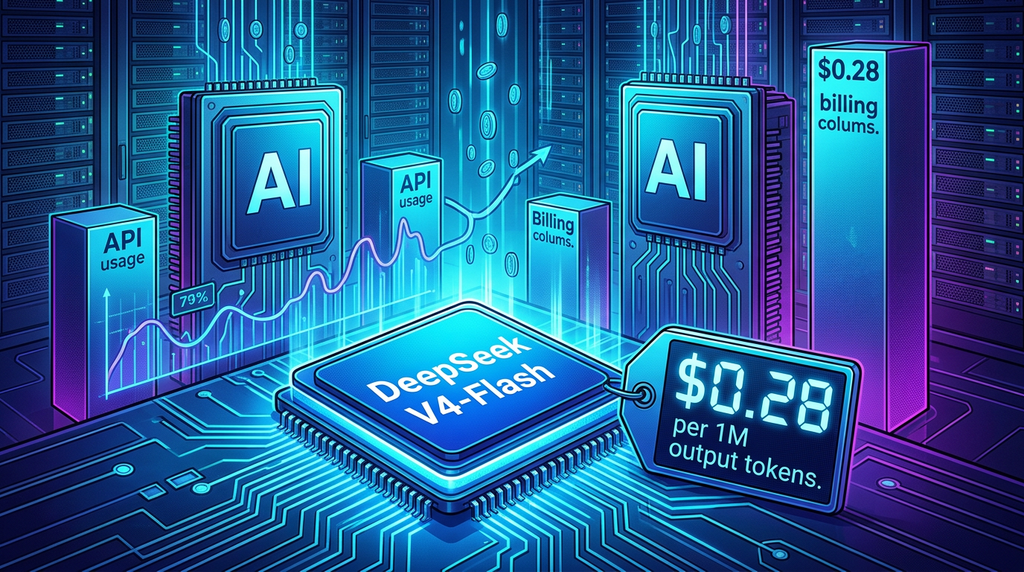
Performance grabs attention, but V4-Flash’s pricing may create the larger industry headache.
DeepSeek charges $0.14 per million input tokens and $0.28 per million output tokens, according to figures reported by Reuters. Artificial Analysis estimated that running V4-Flash through its Intelligence Index battery cost about three cents.
The nearest comparisons were nowhere near it. Moonshot AI’s Kimi K3 cost about $0.86 for the same testing process. OpenAI’s GPT-5.6 Sol cost $1.86, while Anthropic’s Claude Fable 5 reached $3.15.
That does not make V4-Flash the most intelligent model in the group. Artificial Analysis gave it an Intelligence Index score of 50 out of 100. That matched Google’s Gemini 3.6 Flash but trailed Kimi K3 and higher-performing models from OpenAI and Anthropic.
Yet price changes the calculation. Businesses do not always need the absolute smartest model. They often need a model that performs thousands—or millions—of repetitive tasks reliably enough without turning the monthly API invoice into modern art.
For classification, background agents, routine coding jobs and high-volume automation, “good and astonishingly cheap” can beat “excellent and expensive.” Procurement departments everywhere just felt a disturbance in the Force.
Cheap Tokens Do Not Tell the Whole Story
Headline token prices look irresistible, but they can mislead. A low-cost model may take more steps, produce longer answers or repeatedly fail before completing a job. When that happens, cheap tokens multiply into an expensive workflow.
Artificial Analysis tried to address that problem by measuring the approximate cost of completing an entire benchmark suite. As The Next Web explained, V4-Flash finished the test battery for roughly three cents. That calculation matters because it combines price with the amount of processing needed to complete tasks.
Real-world costs remain messier. Agents may call tools, retrieve documents and re-run failed steps. Latency, uptime, privacy and human review matter too.
A model that saves pennies but generates bugs can become a very sophisticated coupon for future trouble.
That is why developers should run side-by-side evaluations using their own codebases and toolchains. Measure completion rate, correction rate, token consumption and elapsed time. Then inspect the output. A benchmark score cannot tell a company whether the model understands its peculiar internal framework or its magnificent collection of undocumented legacy functions.
DeepSeek has earned a serious test. It has not earned blind faith—and neither has any other model.
AI Models Are Sliding Toward Commodity Pricing
V4-Flash arrived during an increasingly aggressive AI price war. The industry keeps spending staggering sums on data centers and chips, yet the cost of using capable models continues to fall.
Axios framed DeepSeek’s release as another step toward the commoditization of intelligence. That comparison makes sense. When several models can handle a task, customers care less about the logo and more about price, speed, reliability and contractual terms.
Model switching is also becoming easier. Compatible APIs and routing systems can send each prompt to the model offering the best balance of ability and cost.
This approach weakens the idea that one AI provider must power an entire application. It also creates a nasty business problem for frontier laboratories. A company can spend billions building the smartest model on Monday, only to watch a smaller rival close much of the practical gap by Friday afternoon.
Falling prices could still expand the total market. Cheaper inference encourages developers to automate tasks that previously made no economic sense. Thin margins may work if usage explodes.
The industry is therefore racing toward abundance while quietly asking an awkward question: can abundant intelligence remain a profitable product?
China’s Crowded AI Race Gets Hotter
DeepSeek no longer competes only against Silicon Valley’s largest laboratories. Its home market has become ferocious.
Reuters noted that Moonshot AI, MiniMax, Z.AI, ByteDance and Alibaba are all fighting for adoption. Several Chinese developers now offer capable models at prices designed to tempt businesses, researchers and independent builders. Alibaba’s Qwen3.8-Max announcement added even more noise to an already crowded week.
V4-Flash delivers a targeted argument: strong agent performance, developer compatibility and prices low enough to make rivals squint at the decimal point.
However, the new model does not sweep every quality comparison. Artificial Analysis ranked it below several leading systems on overall intelligence. DeepSeek must also prove that its benchmark gains survive real deployments, diverse prompts and prolonged use.
Meanwhile, V4-Pro remains unfinished business. DeepSeek’s July 31 changelog said the Pro API and its app and web models were unchanged, adding only that the official V4-Pro release would follow “soon.” No exact date appeared in the announcement.
That creates an unusual situation. The lightweight model has temporarily become the family’s agentic star, while the premium sibling waits backstage for its next costume change.
What the Update Means for Developers
For developers already using the V4-Flash API, the transition should be simple. DeepSeek kept the deepseek-v4-flash model identifier, so existing integrations can receive the updated model without switching to a new endpoint.
The release also adds native support for the Responses API format and specific Codex adaptation. Those additions position V4-Flash for coding assistants and agents that need to manage tools and multi-step tasks. The open weights offer another route for teams willing to handle deployment themselves, although running a model of this scale locally still demands serious hardware and engineering.
The practical strategy is straightforward. Start with a controlled evaluation. Give V4-Flash representative tasks from a real workflow. Compare it with the current model under the same conditions. Track quality, tool-selection accuracy, recovery from errors, latency and total cost per successful completion.
Do not test only polished demo prompts. Give it the ugly jobs. Use tangled repositories, incomplete instructions and tools that occasionally return confusing results. Production rarely resembles a benchmark’s freshly vacuumed living room.
If Flash performs reliably, its low price could make it valuable for high-volume agents. If it struggles with domain knowledge or precision, teams can route harder jobs to a premium model.
The winner may not be one model. It may be the system that knows when to use each one.
The Small Model Just Made a Large Point
DeepSeek-V4-Flash-0731 does not rewrite every rule of artificial intelligence. It does something more immediately useful: it shows how much performance developers may unlock through focused post-training.
The company kept the model’s architecture and size unchanged, then reported major improvements across agent-oriented benchmarks. Independent testing also placed its operating cost far below widely known competitors, although its overall intelligence score remained behind the strongest premium systems.
That combination makes V4-Flash important. It is not simply cheap. It appears capable enough to force developers to reconsider where premium models are genuinely necessary.
The larger story extends beyond DeepSeek. AI providers increasingly compete on efficiency, routing compatibility and cost per completed task—not just parameter counts or leaderboard crowns. As those pressures intensify, model brands may become less important than the invisible software choosing among them.
For now, DeepSeek has delivered a sharp, timely reminder to the market. Bigger does not always mean better. Better does not always need to cost more. And sometimes the budget model walks into the room, outperforms its premium sibling on the family’s own tests, then leaves everyone else arguing over the bill.
Flash may be the lightweight model. Its impact is anything but light.
Sources
- DeepSeek API changelog: DeepSeek-V4-Flash Update
- Reuters: DeepSeek’s new AI model is by far the cheapest of well-known models to run
- The Next Web: DeepSeek’s V4-Flash is the cheapest well-known AI model to run
- TechNode: DeepSeek puts V4-Flash API into public beta
- Axios: DeepSeek’s new bargain model accelerates AI’s race to zero
- Flowtivity: DeepSeek V4-Flash Beats Its Own Pro Model
- Hugging Face: DeepSeek V4 Flash Is Now Official
- Medium: New DeepSeek-V4-Flash-0731 Is Here
- Towards AI: DeepSeek-V4-Flash and the AI Industry’s Pricing
The Kingy Brief
Get the next Kingy Brief.
Source-checked AI changes, original tests and one practical thing to try.
Free · Choose your subjects · Double opt-in · Unsubscribe anytime