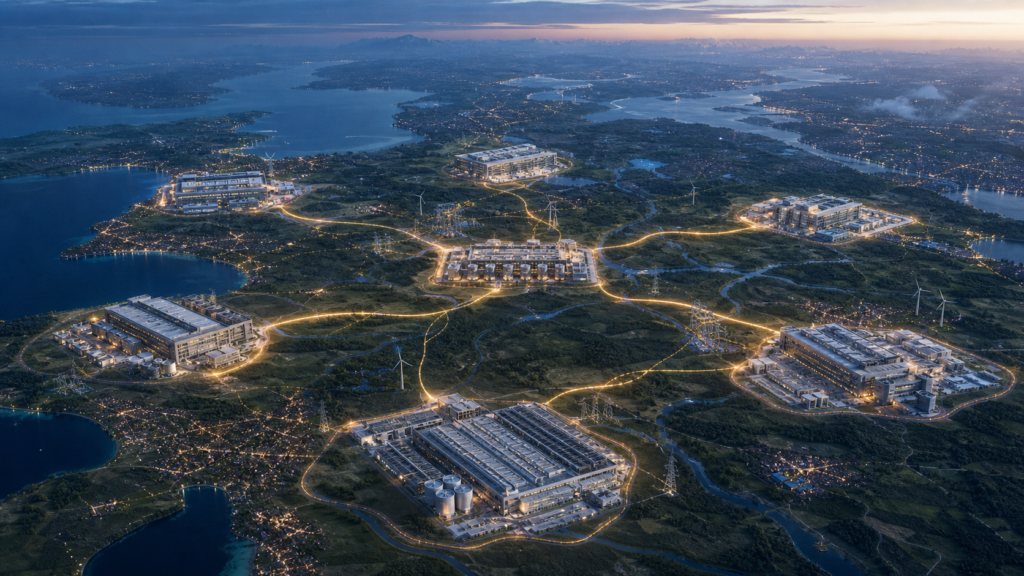
The short version: The European Union has opened a competitive call for up to seven AI gigafactories. The headline is more than €30 billion, but Brussels is not writing that cheque. Up to €10 billion would come from EU and national public funding, while operators and investors are expected to supply at least €20 billion. The call is a serious attempt to turn Europe’s AI-sovereignty ambitions into computing capacity. It is also a test of whether public procurement can overcome the continent’s shortages of capital, power and leading-edge chips.
The European Commission announced the tender on July 30, 2026. Successful consortia would build large computing facilities for training, fine-tuning and running advanced AI models. Startups, scale-ups, universities, public bodies and industrial companies are meant to receive access alongside the operators that finance and run the sites.
That access model is the most important part of the plan. Europe does not need another collection of isolated data centres with impressive specifications and limited public benefit. It needs dependable compute that European model builders and researchers can actually buy or obtain on usable terms. The tender’s success will therefore depend less on the number of processors announced than on who receives capacity, at what price, and under which conditions.
What Europe has put on the table
The procurement is divided into two lots and two development phases. The first lot can support up to four projects, with as much as €100 million in EU funding during phase one and another €400 million per project in phase two. The second can support up to three projects, with up to €200 million in the first phase and €800 million in the second.
Participating member states are expected to match the EU contribution. Eighteen countries have signed a joint procurement agreement with the European High Performance Computing Joint Undertaking, or EuroHPC JU. The public partners would buy compute-access time from selected gigafactories, giving operators an anchor customer while reserving capacity for European users.
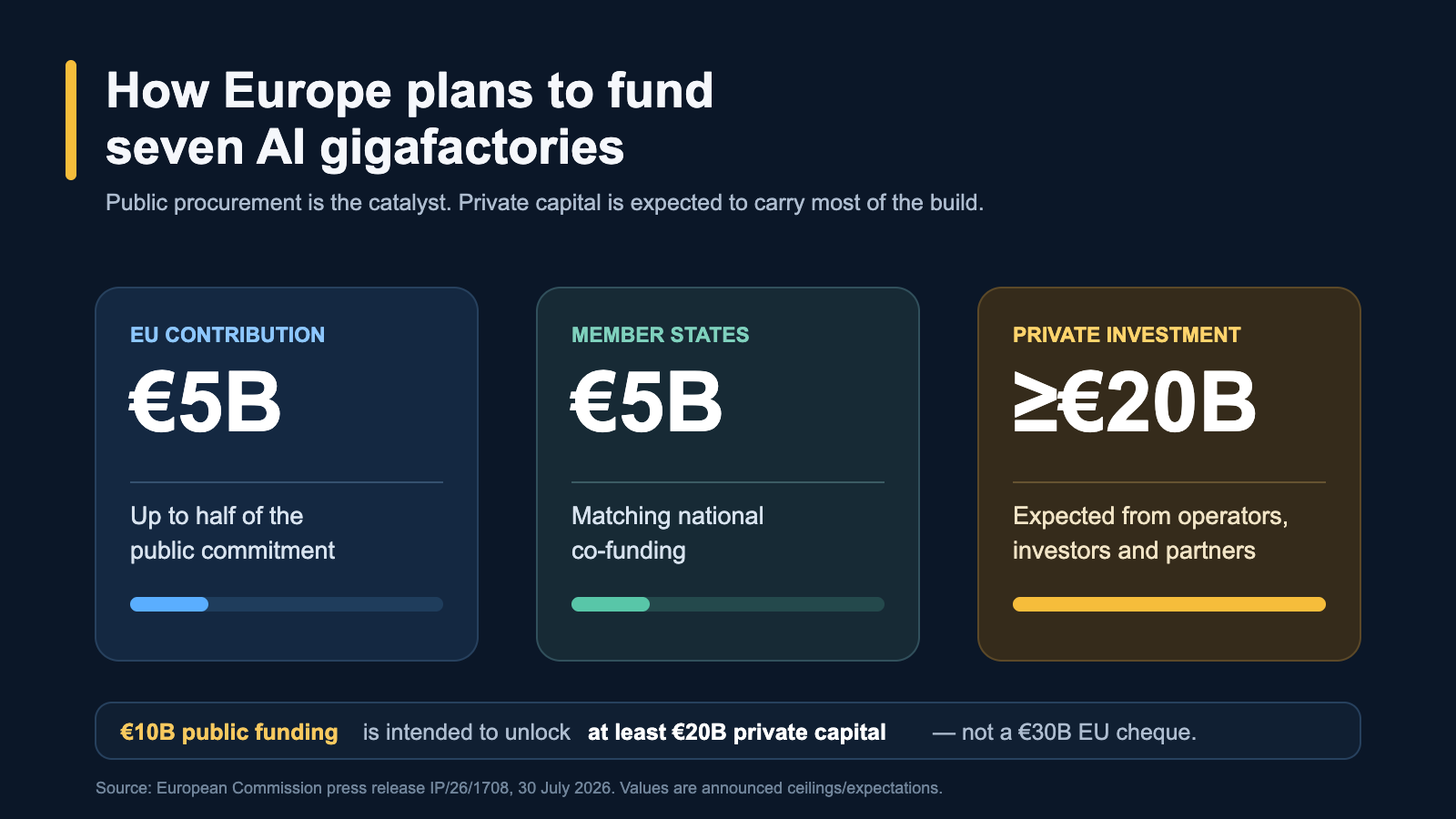
This structure is closer to a public-private infrastructure deal than a conventional grant program. Public money lowers the initial risk and creates demand; private capital is expected to fund most of the construction and operation. That distinction matters because “more than €30 billion in investment” can sound like a settled public budget. It is instead a target that depends on consortia raising at least twice as much private money as the public side contributes.
The Commission says the new facilities will sit alongside Europe’s network of 19 AI Factories and combine advanced processors, software, cloud services, high-speed networking and energy-efficient data centres. Associated Press reports that the planned gigafactories are intended to contain at least 100,000 cutting-edge AI chips and that the seven sites together would more than double the bloc’s current computing power.
The plan addresses a real European bottleneck
Europe has capable researchers, universities and model companies, but the largest commercial AI clouds and most frontier-model infrastructure remain American. Training and serving a competitive model requires more than an algorithm. It requires accelerators, memory, networking, power, cooling, land, permits, software and customers that can keep an expensive facility utilized.
That is why public compute access can matter even if Europe never matches US hyperscalers facility for facility. A startup that can reserve a meaningful training run, a university that can reproduce a frontier-model result, or a manufacturer that can fine-tune a model without exporting sensitive data all gain options they do not have when every serious workload must pass through a foreign cloud account.
Kingy.ai’s analysis of open-weight models and AI capital spending reached a similar conclusion: cheaper or reusable model weights do not remove the need for infrastructure. They shift more spending toward inference, networking, power, cooling and sovereign deployment. The EU tender is a direct bet on that physical layer.
“Sovereign” compute will still rely on American chips
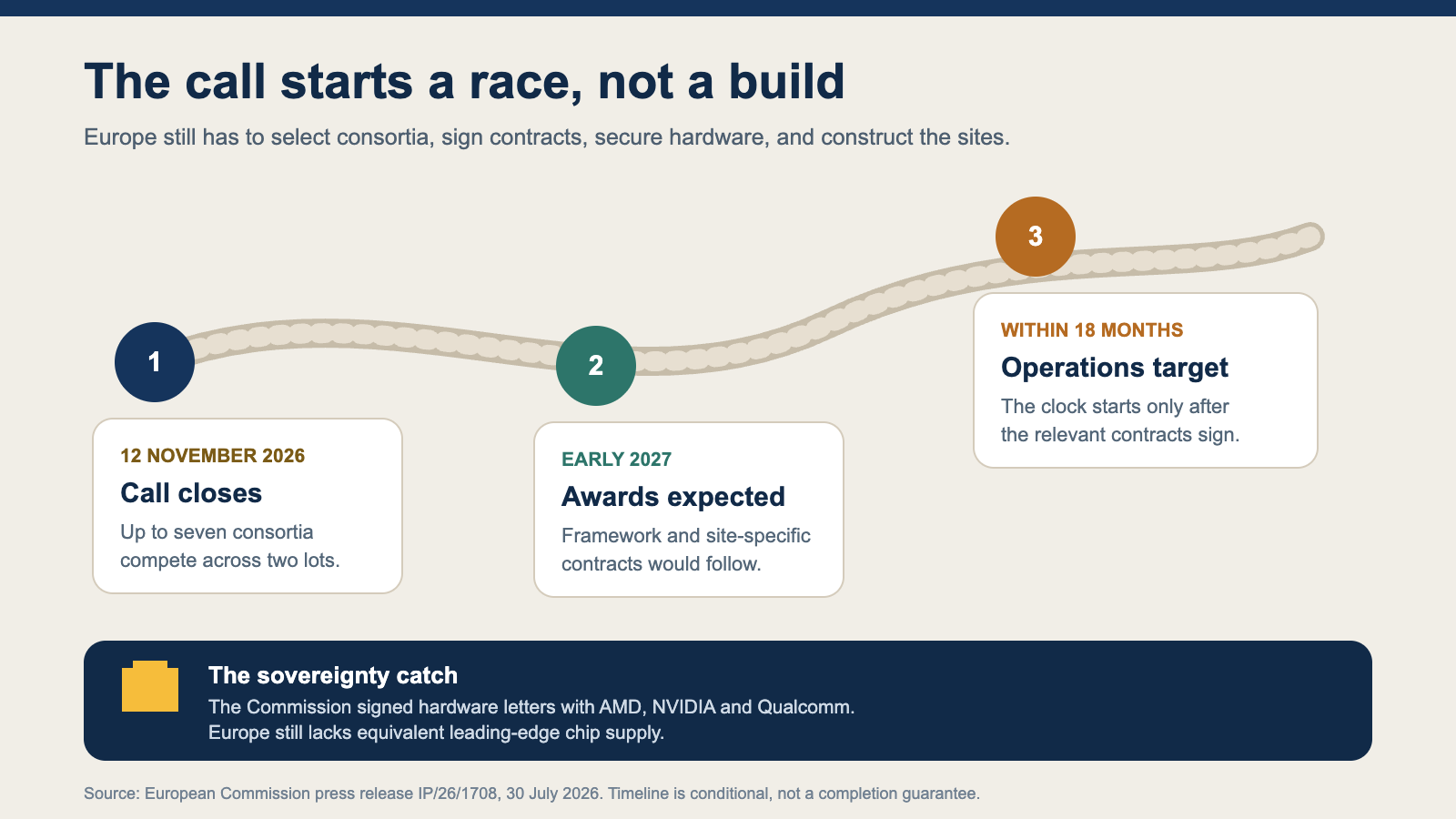
The uncomfortable part of the announcement is in its hardware section. The Commission says it signed letters of intent with AMD, Nvidia and Qualcomm so gigafactory consortia can obtain the processors they need. Those agreements may reduce procurement risk, but they also expose the limit of the sovereignty claim: Europe can own facilities, govern data and allocate capacity while still depending on US-designed accelerators.
That does not make the project pointless. Infrastructure sovereignty is not all-or-nothing. Regional control over sites, workloads, contracts and data can reduce dependence even when the silicon comes from abroad. But the distinction should remain explicit. A European data centre full of imported processors is more operationally independent than renting every workload from a foreign hyperscaler; it is not an autonomous European chip supply chain.
The same tension appears in Kingy.ai’s coverage of Europe’s position between US and Chinese AI systems. Compute access, model access and hardware access are different layers. Progress at one layer does not eliminate exposure at the others.
The €20 billion private-capital assumption is the first big test
Private investors will examine utilization, power prices, grid connections, construction risk and the durability of public contracts before committing billions. Europe’s policy objective may be strategic autonomy, but an operator still needs a facility that can earn a return after accelerators age and electricity bills arrive.
The public access-time commitment helps because it gives selected sites a baseline buyer. It does not guarantee that all seven projects will attract financing on acceptable terms. Nor is every euro of public support locked in. Le Monde reports that €4 billion of the Commission’s planned €5 billion share depends on the EU’s next long-term budget, which member states have not finalized.
The most useful number to watch is therefore not the announced €30 billion. It is the private capital contractually committed at award, followed by the amount that reaches construction and installed compute. Large infrastructure programs often look most certain on launch day, before financing, permitting and grid reality begin to narrow the field.
Energy and water can decide where the projects land
AI facilities need reliable electricity and cooling, and those demands increasingly collide with local power prices, climate commitments and community opposition. Le Monde reports that the tender will favor stronger sustainability performance, while noting that project developers are expected to set some of their own environmental targets. That leaves room for scrutiny when bids become public.
The relevant questions are practical: Will a site bring new low-carbon generation or compete for existing supply? Who pays for transmission upgrades? What cooling design will it use? How much water will it consume during hot periods? Will backup generation add local pollution? Kingy.ai has already examined how power and grid constraints are becoming the unglamorous limit on AI expansion. Europe will face the same physics even when the policy rationale is compelling.
The schedule is ambitious but conditional
Applications close on November 12, 2026. The Commission expects EuroHPC JU to announce awards in early 2027, after which framework and project-specific contracts can be signed. Selected facilities are supposed to begin operating within 18 months of those signatures.
That timeline could put the first sites online around mid-2028 if procurement and contracting move cleanly. It should not be read as a guaranteed completion date. Data-centre projects can be delayed by grid queues, permits, hardware delivery, financing and local challenges. The two-phase structure also means early selection is not the same as reaching full planned capacity.
Who benefits if the model works
European model companies gain a potential alternative to negotiating every large workload with a US cloud provider. Universities and public research groups could gain access to machines beyond ordinary institutional budgets. Industrial companies may be able to train or adapt models under European data, security and procurement rules. Infrastructure suppliers—from networking and cooling vendors to grid developers—gain a large new demand pool.
The policy risk is that capacity becomes concentrated among well-connected incumbents while smaller users receive expensive or inconvenient allocations. The tender’s reader-facing promise is access, not merely construction. EuroHPC should eventually publish enough information to show who can use the facilities, how access is priced, how queues are managed and what portion is reserved for public-interest research and smaller firms.
What to watch next
Four milestones will reveal whether the announcement becomes useful infrastructure. First, the quality and financing of the consortia that submit by November. Second, the contractual amount of private capital behind each winning bid. Third, the power, water and grid plans attached to the sites. Fourth, the access rules for startups, researchers and public bodies.
The EU has moved beyond a slogan by opening a funded procurement with deadlines, lots and capacity requirements. That is meaningful. It has not yet solved the harder problems of financing, energy, hardware dependence or fair access. Europe’s AI gigafactory race begins with €10 billion of public leverage. Its outcome will be measured in usable compute, not press-release capital.
Official sources and original reporting
- European Commission: EU launches the AI Gigafactories call. Official tender structure, funding ceilings, participating states, hardware letters and timeline.
- Associated Press: EU lays out funding for seven AI gigafactories. Original reporting on planned chip scale, current European capacity and infrastructure constraints.
- Le Monde: Europe commits funding to seven AI megafactories. Original reporting on budget uncertainty, energy and water questions, foreign-chip dependence and the expected operating window.
- European Commission: one year of the AI Continent Action Plan. Official context on Europe’s 19 AI Factories and the earlier expressions-of-interest process.
- European Parliament: EuroHPC and AI Gigafactories resolution. Official legal context for interoperability, cybersecurity, data protection and participation.
The Kingy Brief
Get the next Kingy Brief.
Source-checked AI changes, original tests and one practical thing to try.
Free · Choose your subjects · Double opt-in · Unsubscribe anytime