Meta’s AI Ambition Is Becoming Personal
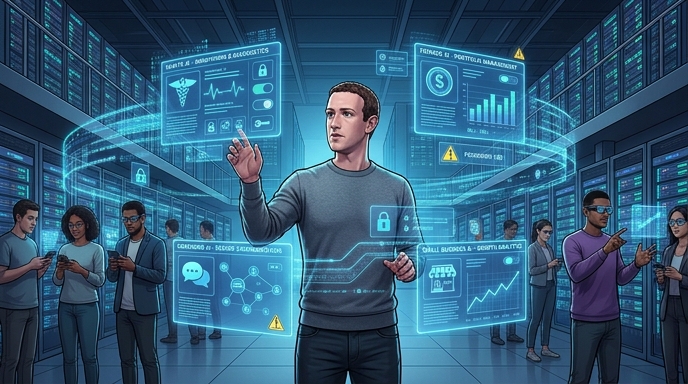
Meta does not merely want its artificial intelligence to answer questions, edit photographs, or recommend another suspiciously addictive Reel. It wants AI to work for you.
During Meta’s second-quarter 2026 earnings call, CEO Mark Zuckerberg outlined plans for personal AI agents that could operate around the clock. These systems, he said, would act on a user’s behalf and help with goals involving health, relationships, finances, and everyday life.
That represents a substantial jump from today’s chatbots. A chatbot waits for a prompt. An agent receives an objective, breaks it into tasks, uses available tools, and keeps working. At least, that is the idea. Reality remains considerably messier.
According to The Verge, Zuckerberg believes successful personal agents must work immediately and require little technical fiddling. Coding agents found an early audience because developers tolerate setup screens, permissions, command lines, and the occasional digital tantrum. Most consumers do not.
Meta therefore wants to turn agentic AI into a polished mass-market product. No elaborate configuration. No miniature software-engineering degree required. Just open the app, state a goal, and let the machinery whir.
Meta says it will reveal more “soon.” That word does heroic amounts of work in Silicon Valley.
From Chatbot to 24-Hour Digital Operator
The distinction between an assistant and an agent matters.
Current AI assistants largely react. You ask for a meal plan, and they produce one. You request budgeting advice, and they create a spreadsheet-shaped wall of good intentions. But they normally stop there.
A genuine personal agent would take the next steps. It might track grocery prices, revise the meal plan around your schedule, remind you to prepare ingredients, and reorder supplies—with permission, one hopes. A financial agent could monitor spending, flag unusual bills, compare subscriptions, and help pursue a savings target.
Zuckerberg described agents that could work “24/7” to improve different areas of a person’s life. Yet Meta has not announced a finished product, release date, pricing model, or complete list of capabilities. The company has presented a direction, not delivered a digital Jeeves.
That distinction prevents the marketing fog from swallowing the facts whole.
The technical challenge also runs deeper than generating intelligent text. A useful agent needs memory, reliable planning, tool access, permissions, error recovery, and a clear understanding of when to stop. One hallucinated restaurant recommendation is annoying. One hallucinated bank transfer is a slightly more exciting afternoon.
Meta must therefore make its agents capable enough to act, predictable enough to trust, and simple enough for billions of people to use.
Easy. Just three small miracles before lunch.
Meta Is Betting on Consumer Scale
OpenAI, Anthropic, Google, and Microsoft have pushed agentic systems into coding and workplace tasks. Meta wants to emphasize the consumer side.
That choice suits the company’s assets. Meta operates Facebook, Instagram, Messenger, WhatsApp, Threads, and a growing range of AI-enabled glasses. It already sits inside people’s conversations, interests, communities, shopping habits, and social relationships.
Google and Microsoft possess a different advantage. They can connect AI to email, calendars, documents, spreadsheets, cloud storage, and enterprise software. The Verge notes that Meta lacks the same direct access to those productivity ecosystems.
Meta’s answer may be context of another kind. It knows what users watch, follow, share, discuss, and photograph. That information could help a personal agent produce unusually relevant recommendations.
It also creates a colossal trust problem.
A personal agent becomes more useful as it learns more about you. But greater knowledge means greater sensitivity. Users must decide whether they want Meta’s systems reasoning across their relationships, health goals, financial priorities, private conversations, and daily routines.
That is not a routine product-permission request. It is closer to handing a digital stranger the keys to your filing cabinet, diary, address book, and refrigerator—then hoping it has excellent boundaries.
Muse Spark Supplies the Engine
Meta has already started assembling the technology beneath this vision.
In April, the company introduced Muse Spark, the first model in a new series developed by Meta Superintelligence Labs. Meta described it as a fast, relatively compact model designed for its own products, with larger successors under development.
Muse Spark currently powers Meta AI and supports reasoning, multimodal tasks, voice interactions, shopping assistance, visual understanding, and parallel subagents. Meta has also begun extending it across WhatsApp, Instagram, Facebook, Messenger, Threads, and its AI glasses.
A later Muse Spark 1.1 update strengthened coding and agentic capabilities. Meta said the upgraded assistant could plan and complete multistep tasks rather than merely explain how a user might complete them.
The company’s official Muse Spark announcement also reveals its strategic advantage: distribution. Meta says its AI products can reach billions of people through services they already use.
That reach could make adoption astonishingly fast. Meta would not need to persuade every user to download a specialist agent application. It could place the technology inside existing chats, feeds, glasses, and social experiences.
However, distribution cannot rescue an unreliable product forever. Putting a confused agent everywhere merely produces confusion at industrial scale.
Business Agents Are Already Finding Users
Meta’s agent strategy is not confined to hypothetical personal assistants.
Zuckerberg said more than one million businesses use Meta’s business agents each week through WhatsApp and Messenger. The company is also rolling them out on Instagram.
These agents can help businesses communicate with customers, answer routine questions, recommend products, and potentially support sales. For small companies, that could provide a cheap, always-available layer of customer service.
This is where Meta’s ambitions become commercially concrete.
Millions of businesses already communicate through WhatsApp, Instagram, and Messenger. If Meta can add useful automation to those conversations, it gains a path toward revenue that extends beyond advertising. It could charge for advanced agents, premium features, transactions, business tools, or increased message volume.
Zuckerberg called personal agents the foundation of Meta’s next wave of products and revenue lines. That wording matters. Meta does not see AI as an ornamental feature sprinkled over its apps like digital parsley. It sees agents as a potential new business platform.
Still, weekly use does not tell us how deeply those one million businesses rely on the agents, how much revenue the tools generate, or how accurately they perform. The figure proves early uptake. It does not yet prove a durable business.
The cash machine remains advertising. The agent economy is still interviewing for the job.
The Advertising Giant Funds the Experiment

Meta can pursue this expensive vision because its core business remains enormous.
The company reported second-quarter revenue of $60.80 billion, up 28 percent from the same quarter a year earlier. Advertising produced $59.36 billion of that total.
Average daily users across Meta’s family of apps reached 3.60 billion in June, a 3 percent annual increase. Ad impressions rose 14 percent, while the average price per advertisement climbed 12 percent.
Those figures explain Meta’s confidence. Its existing platforms generate enough cash to finance a giant AI campaign while simultaneously providing a vast testing and distribution network.
However, the spending side looks considerably less cuddly.
Quarterly costs and expenses surged 55 percent to $42.03 billion. Operating income fell 8 percent to $18.78 billion, while net income declined 14 percent to $15.85 billion. The quarter included $2.40 billion in legal-related charges and $1.18 billion in severance expenses.
Free cash flow dropped to $784 million from $8.55 billion a year earlier. That does not mean Meta is running out of money; it held $90.26 billion in cash, equivalents, and marketable securities. It does show how aggressively infrastructure spending can consume even a spectacular river of operating cash.
Artificial intelligence may feel weightless. Its invoices certainly do not.
The Compute Bill Is Staggering
Meta recorded $31.08 billion in capital expenditures during the second quarter alone. For the full year, the company expects capital expenditure—including finance-lease principal payments—to land between $130 billion and $145 billion.
That money supports data centers, networking equipment, chips, servers, power infrastructure, and the physical machinery required to train and run large AI systems.
Meta has also announced a one-gigawatt data-center campus with BlackRock. One gigawatt is the language of power stations, not ordinary software projects. The cloud, as usual, turns out to be a collection of extremely expensive buildings that become alarmingly warm.
The size of the investment exposes the central contradiction in Zuckerberg’s decentralization argument.
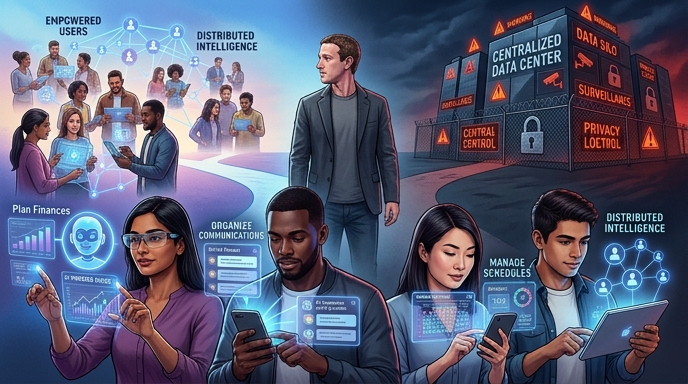
He wants AI power distributed broadly among individuals. Yet creating frontier systems requires capital, compute, energy, specialist talent, data, and infrastructure concentrated inside a very small club of corporations. Meta can advocate widespread access because it possesses centralized resources on a scale almost no other organization can match.
That does not automatically invalidate the argument. Centralized production can support widely distributed use. Smartphone chips come from giant industrial systems but empower individual users.
Still, access is not the same as control. If billions of people use agents that Meta builds, hosts, updates, governs, and potentially monetizes, power has not disappeared. It has simply acquired a friendlier interface.
Zuckerberg’s Case Against AI Concentration
Zuckerberg expanded his argument in a Wall Street Journal opinion article, framing access as the defining question of the AI era.
His preferred model centers on “personal superintelligence”—advanced AI placed in the hands of individuals rather than reserved for governments, major corporations, or a handful of laboratories.
As Entrepreneur summarizes, Zuckerberg considers the idea that AI can remain safe only through extreme concentration of power to be dangerous in itself.
His broader philosophy rests on three themes: individual empowerment, invention, and a balance of power.
He argues that individuals frequently drive progress. Give people capable tools, and some will start companies, conduct research, develop products, create art, or solve local problems that giant institutions overlook.
He also rejects an AI future dominated by passive automation. In his telling, AI should expand what people can accomplish rather than simply replace them. If automation dominates, he warns, the economic consequences could turn negative.
This is Meta’s political and commercial pitch rolled into one tidy burrito: powerful AI should reach everyone, broad access produces innovation, and Meta intends to supply the tools.
It is an attractive thesis. It is also conveniently aligned with Meta’s competitive position.
The Promise of an Entrepreneurial Boom
Zuckerberg predicts that broadly available superintelligence could create more jobs by lowering the cost of starting businesses.
An entrepreneur armed with advanced AI might conduct market research, build software, produce advertising, handle customer inquiries, analyze finances, draft contracts, and manage operations without hiring a large initial team. The founder would still need judgment, customers, and a product people actually want—the traditional graveyard of brilliant pitch decks—but the entry barrier could fall.
Zuckerberg expects this to produce an economy with more small businesses and fewer people concentrated inside large organizations.
The mechanism makes sense. When technology lowers the cost of coordination and production, smaller teams can attempt projects that once required larger companies.
The conclusion, however, remains a prediction.
AI could enable new businesses while simultaneously allowing established corporations to operate with fewer employees. It could distribute productive power while concentrating profits among model providers, chipmakers, cloud companies, and platform owners. Both effects can occur at once.
A founder may gain the equivalent of a digital staff. So may Amazon, Meta, Google, and every multinational with billions available for compute. The little shop receives a power tool. The industrial giant receives an automated factory.
The employment outcome will depend on which effect moves faster: the creation of new work or the elimination and consolidation of existing work. Anyone claiming certainty is selling prophecy by the subscription.
Safety Is Not One Single Problem
Zuckerberg’s position does not treat every AI risk identically.
According to Artificial Intelligence News, he argues that open access can strengthen cybersecurity over time, drawing on the history of open-source software. More people can inspect weaknesses, develop defenses, and prevent a small number of actors from monopolizing protective capabilities.
On biological risks, he takes a more cautious approach and supports greater coordination among governments and institutions when deploying highly capable models.
That split is important. “Open versus closed” is too crude for the real problem. Different capabilities create different risk profiles.
A model that helps defenders examine software vulnerabilities may improve collective security, even though attackers can also use it. A system that meaningfully lowers barriers to designing dangerous biological agents creates a different class of consequence. Distribution may amplify defense in one domain and irreversible harm in another.
Zuckerberg’s public argument does not yet explain exactly where Meta would draw these boundaries, how it would test models, or what capabilities it might restrict. Nor does it provide detailed governance rules for personal agents handling intimate information.
The philosophy is clear. The operational rulebook is not.
That gap will matter more as Meta’s agents graduate from suggesting actions to taking them.
Trust May Be Meta’s Hardest Engineering Problem
Meta can buy chips, recruit researchers, construct data centers, and place AI inside products with billions of users. Trust does not scale quite so obediently.
A personal agent needs access. It may need to read messages, remember preferences, understand relationships, process health information, inspect purchases, and connect to other services. Every extra permission makes the agent more capable. Every permission also creates another path for misuse, leaks, manipulation, or plain old software failure.
Meta’s history makes this especially awkward. Many users associate the company with targeted advertising, aggressive data collection, algorithmic influence, and recurring privacy controversies. Asking those users to install a 24-hour agent inside their personal lives is not a small reputational leap.
Meta must answer practical questions.
What information will an agent retain? Can users inspect and delete its memory? Will agent conversations influence advertising? Which actions require confirmation? Can the system contact people, purchase products, or modify accounts? Who carries responsibility when it fails?
The company has discussed safeguards and privacy protections around Muse Spark, but it has not yet provided a complete framework for the forthcoming personal agents.
Technical intelligence will attract attention. Predictable behavior will determine adoption.
People may tolerate a chatbot that confidently invents the capital of France as “Croissant City.” They will show less patience when an autonomous agent confidently rearranges their finances.
Optimism Meets a Very Convenient Business Model
Zuckerberg has argued that optimism should be the default assumption about AI’s trajectory. A Bioethics.com summary of his accompanying interview says he pointed to historical patterns, employment data, and his own use of AI for parenting and fitness.
His optimism deserves examination, not automatic acceptance or dismissal.
Technological progress has repeatedly expanded productivity, created industries, and placed once-rare capabilities in ordinary hands. Personal computers, internet access, and smartphones all support Zuckerberg’s argument that broadly distributed tools can unlock enormous creativity.
But AI agents introduce a sharper asymmetry. They do not merely provide information. They may observe users continuously, make decisions, mediate relationships, shape purchases, and act across digital systems. The company controlling that layer could acquire extraordinary influence.
Meta’s position therefore contains both a genuine philosophical argument and an obvious strategic interest.
Open or widely accessible AI weakens competitors that rely on selling scarce model access. Personal agents also give Meta new ways to deepen engagement, enter commerce, support businesses, sell services, and strengthen its hardware ecosystem.
Zuckerberg may sincerely believe that distributing AI protects society from concentrated power. Meta may also become one of the largest concentrations of AI power while pursuing that mission.
Both statements can be true. Silicon Valley loves a paradox, especially when it has recurring revenue.
Meta’s Next Test Is Delivery
Meta has described an enormous destination: personal AI agents that work continuously, understand individual context, and help billions of people pursue their goals.
It has several ingredients. Muse Spark provides a new model foundation. Meta’s apps offer unrivaled consumer reach. Business agents supply an early commercial foothold. Its advertising operation provides billions to fund the infrastructure.
The missing pieces are the most difficult ones.
Meta must prove that its agents can complete tasks reliably. It must design permission systems normal people can understand. It must establish clear boundaries around sensitive information. And it must show that “personal” means serving the user—not merely learning more about the user for Meta’s benefit.
Zuckerberg’s warning about concentrated AI power deserves serious attention. A future in which only a few corporations or governments control advanced intelligence could stifle competition, distort institutions, and leave individuals permanently dependent on gatekeepers.
Yet distributing access through a platform controlled by one of the world’s largest technology companies does not resolve that danger by itself.
Meta’s personal-agent push could place extraordinarily useful capabilities in billions of hands. It could also turn the company’s social network into a permanent operating layer for everyday life.
The vision is compelling. The contradictions are enormous. And the agent, naturally, is coming “soon.”
Sources
- The Verge — Mark Zuckerberg is planning a big push into personal AI agents
- Artificial Intelligence News — Zuckerberg details Meta’s personal AI superintelligence strategy
- Entrepreneur — Mark Zuckerberg says concentrating AI power in a few companies is dangerous
- Bioethics.com — Mark Zuckerberg says the U.S. should accelerate AI development
- Meta Investor Relations — Meta reports second-quarter 2026 results
- Meta Newsroom — Introducing Muse Spark
- The Wall Street Journal — The AI Future Is for Everyone
The Kingy Brief
Get the next Kingy Brief.
Source-checked AI changes, original tests and one practical thing to try.
Free · Choose your subjects · Double opt-in · Unsubscribe anytime