Artificial intelligence has spent the past few years dazzling audiences with smarter models, livelier videos, and agents that promise to handle entire workflows. Now comes the less glamorous part: making the business actually work.
At TechCrunch Disrupt 2026, the conversation will shift from “Look what AI can do” to “How do we sell, secure, power, and scale this thing?”
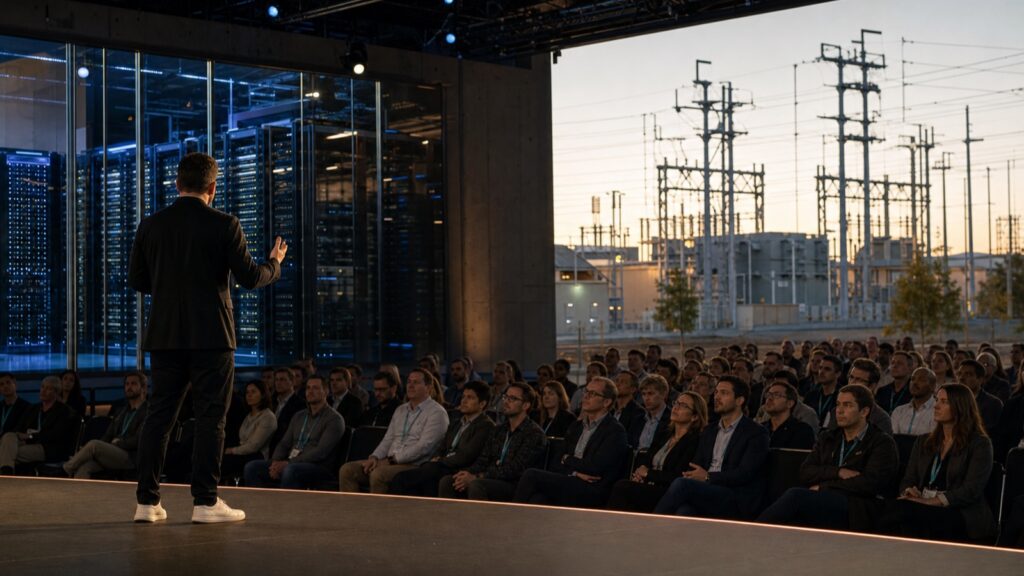
The event’s newly announced programming connects two sides of the AI economy that often live in separate presentations. The AI Stage will examine collapsing software assumptions, autonomous-agent security, real-time video intelligence, and new commercial roles. Meanwhile, the Smart Systems Stage will tackle the decidedly physical problem underneath it all: electricity.
It is an unusually honest combination. AI companies can produce astonishing software, but they still need customers, safeguards, data centers, power plants, and a grid that does not wheeze dramatically whenever another GPU cluster switches on.
TechCrunch Disrupt 2026 will run from October 13 to 15 at San Francisco’s Moscone Center. The agenda remains a preview, not a report of completed discussions or technological breakthroughs. Still, the subjects and confirmed speakers reveal where the industry believes its hardest problems now sit.
Spoiler: they are no longer confined to the model.
AI Has Entered Its Awkward Business Phase
The first AI boom rewarded capability. Companies raced to build larger models, launch chatbots, and sprinkle generative features across practically everything with a login screen.
The next phase looks different.
According to TechCrunch’s AI Stage announcement, artificial intelligence has changed how startups build products while disrupting how they sell, protect data, and expand.
That explains the agenda’s emphasis on business models rather than benchmark scores.
As foundation models become widely available, startups cannot depend forever on privileged access to raw intelligence. A feature that appears magical today may become a standard API call tomorrow. Competitors can catch up. Customers can switch providers. Model developers can also release the same capability directly.
That creates an uncomfortable question: What exactly is the customer buying?
The strongest answer may involve proprietary data, deep workflow integration, specialist knowledge, distribution, trust, or exceptional user experience. “We added AI” will not carry much weight when everybody else has added it too.
The gold rush has reached the spreadsheet phase. Someone finally has to explain the margins.
The SaaS Playbook Needs a Rewrite
Traditional software-as-a-service businesses enjoy relatively predictable economics. They build the software once, operate it centrally, and charge customers a recurring fee—often per user.
Generative AI makes that calculation messier.
Each query, generated video, research job, or agentic task consumes computing resources. A customer can therefore become more expensive precisely because they love the product and use it constantly. That is wonderful for engagement metrics and rather less charming for the cloud bill.
AI also challenges seat-based pricing. If one employee can use an agent to perform work that once required several people, charging per human seat becomes an odd fit. The tool may deliver more value while technically serving fewer users.
Companies could charge by usage, completed task, generated outcome, or some combination of subscription and consumption. None offers a universal solution.
Usage pricing reflects actual consumption but makes customer bills less predictable. Outcome pricing sounds attractive, yet defining a successful outcome can become a contractual wrestling match. Flat subscriptions stay simple, but heavy users can shred margins.
The AI Stage promises to explore how companies should price products as models become commoditized. That discussion matters because pricing is not decorative. It shapes product design, customer behavior, and whether a startup survives its own popularity.
Enterprise AI Security Starts Below the Chat Window
AI agents introduce a security problem with an important twist: they do things.
A standard chatbot might produce a flawed answer. An agent could use that answer to alter a database, contact a customer, approve an expense, or expose protected information. The risk travels from bad text to bad action.
TechCrunch says the enterprise-security session will examine observability, governance, and the architectural foundations required for trusted AI deployments. Arsalan Tavakoli, co-founder and senior vice president of field engineering at Databricks, is scheduled to lead the discussion.
Observability means organizations need to understand what an AI system attempted, which information it accessed, what tools it called, and why the process failed. Without that record, investigating an agent can feel like interviewing a very confident suspect who has misplaced the evidence.
Governance determines which models can touch which resources. It also establishes approval rules, audit trails, access controls, and escalation paths.
These requirements sound familiar because companies already apply them to employees and conventional software. Agents complicate matters by operating at machine speed, responding probabilistically, and potentially chaining many actions together.
The key lesson is simple: businesses cannot secure autonomous AI entirely through better prompts. They need controls around the model, beneath the interface, and across every connected system.
Autonomy Makes Small Errors Much Bigger
An isolated AI mistake can be annoying. An automated mistake repeated 10,000 times can become a board meeting.
That difference explains the so-called agent security gap.
Agents may encounter malicious instructions hidden in websites, emails, shared files, or databases. They can select the wrong tool, misunderstand a request, or reveal information drawn from a protected source. Connecting several agents introduces even more places where permissions and context can leak.
Enterprises therefore need to limit what each agent can access. They must verify important actions before execution and separate low-risk assistance from high-risk authority.
An AI system that drafts a refund email does not require the same controls as one that approves the refund. Likewise, an assistant that summarizes financial records differs sharply from an agent authorized to move money.
Good security will probably depend on layered defenses: narrow permissions, isolated execution environments, human approval for consequential actions, continuous monitoring, and reliable ways to stop a system mid-task.
No single layer eliminates every failure. Together, however, they can prevent an enthusiastic digital intern from accidentally becoming chief chaos officer.
The Disrupt agenda reflects a broader industry realization. Agentic AI will not earn enterprise trust through impressive demos alone. Companies must prove that their systems can remain useful without gaining unlimited freedom.
Video AI Is Leaving the Demo Reel
AI-generated video has advanced from short, surreal clips into a much more serious technical race.
The Disrupt session titled “The Video Intelligence Race” will feature Decart co-founder and CEO Dean Leitersdorf alongside Luma AI co-founder and CEO Amit Jain. TechCrunch says the discussion will cover real-time inference, reasoning, and the point at which visual generation begins displaying more substantial intelligence.
Real-time performance matters because it changes the possible applications.
A model that takes several minutes to produce a clip works for content creation. A system that interprets and generates visual information immediately could support interactive entertainment, simulations, design tools, robotics, or responsive digital environments.
But speed alone does not equal understanding.
Video systems must preserve identities, objects, spatial relationships, and cause-and-effect across time. A generated car should not spontaneously acquire five wheels. A person who places a cup on a table should find the same cup there moments later. Physics remains stubbornly picky.
The phrase “physical reasoning” points toward models that do more than produce attractive pixels. Developers want systems capable of representing how environments change when something acts inside them.
Disrupt will host that debate, but the announced session should not be treated as proof that any participant has already achieved genuine physical understanding. The stage is set for claims, evidence, and—one hopes—appropriately skeptical questions.
AI Has Created a New Kind of Sales Engineer
One of the agenda’s most revealing subjects is not a model or chip. It is a job.
Kareem Amin, co-founder and CEO of Clay, will discuss the rise of the go-to-market engineer. TechCrunch describes GTM engineering as a rapidly growing AI-native role, with some independent practitioners reportedly building million-dollar businesses.
The position sits between sales, marketing, operations, data, and software automation.
A GTM engineer might connect customer databases, enrichment services, language models, and outreach platforms. Instead of manually building one campaign, that person designs a system that finds prospects, evaluates them, personalizes communication, and routes opportunities to the right team.
This does not necessarily remove humans from sales. It changes where they spend their time.
People can focus on strategy, relationships, negotiation, and unusual cases while automated systems handle research and repetitive coordination. At least, that is the cheerful version. Poorly implemented automation can also generate industrial quantities of awkward email. Every revolution has debris.
The emergence of this role shows how AI adoption often happens in practice. Companies do not merely install a model. They need someone who can reshape messy workflows around it.
That integration layer may become one of the most defensible parts of an AI business.
The AI Race Runs on Electricity
Software discussions can make AI seem weightless. It floats in “the cloud,” answers instantly, and arrives through a clean little text box.
Behind that box sits industrial infrastructure.
The Smart Systems Stage preview places power supply at the center of the AI growth story. The supporting reports from Mezha and BitcoinWorld likewise emphasize data-center demand, grid modernization, and fusion.
Training and running AI models require data centers packed with specialized processors. Those processors need electricity, cooling, networking equipment, and dependable connections to regional power systems.
A company might secure every chip it wants yet remain unable to deploy the hardware where and when it planned. Grid connections can take time. New generation projects face regulatory, financial, and construction hurdles. Local communities may also challenge large projects over land, water, emissions, or electricity prices.
That changes the competitive landscape. Access to energy becomes almost as strategically important as access to GPUs.
The next AI bottleneck may not arrive as a software error. It may arrive as a utility timetable.
Fusion Gets a Seat at the AI Table
Commercial fusion remains a formidable scientific and engineering challenge, but AI’s growing appetite for power has given the technology a prominent new audience.
David Kirtley, CEO of Helion, and Brandon Sorbom, chief science officer at Commonwealth Fusion Systems, are scheduled to discuss progress toward commercial fusion and the obstacles to connecting it to the grid at scale.
The distinction between experimental progress and commercial power is crucial.
A fusion company must do more than demonstrate a promising reaction. It must build equipment that operates reliably, produce usable electricity, maintain its systems, satisfy regulators, finance construction, and compete with other energy sources.
In other words, the plasma is only the beginning. Then come approximately seventeen thousand practical details wearing hard hats.
Fusion attracts interest because it could eventually provide large amounts of firm power without the carbon emissions associated with fossil-fuel generation. That prospect naturally appeals to data-center developers searching for dependable electricity.
However, the Disrupt agenda does not establish that fusion will solve AI’s near-term energy demands. The scheduled conversation concerns the path, the remaining challenges, and the infrastructure required.
For today’s AI projects, existing generation, transmission upgrades, storage, fuel cells, and efficiency improvements remain essential. Fusion represents a potentially transformative part of the longer game—not a power cable waiting to be plugged in next Tuesday.
A Cloud Founder Turns Toward Energy
Another Smart Systems session will feature Jeff Lawson, the founder of Twilio and now CEO of fusion startup Inertia.
The transition sounds dramatic, but it also captures a major shift in technology entrepreneurship. Founders who previously built businesses on top of cloud infrastructure increasingly see the physical systems underneath computing as the next frontier.
Lawson is expected to discuss how his Twilio experience influences his approach to hiring, development timelines, and difficult engineering decisions at Inertia.
Some startup lessons transfer neatly. Teams still need capital, talented people, clear priorities, and the ability to learn quickly. Other habits do not travel so well.
Software companies can release updates daily. Energy hardware must obey materials science, manufacturing constraints, safety requirements, and physical construction schedules. “Move fast and break things” becomes less adorable when the thing contains extraordinarily hot plasma.
Lawson’s appearance illustrates how the boundary between tech and industrial infrastructure is fading. AI, cloud services, data centers, chips, and energy can no longer be treated as independent sectors.
The digital economy has rediscovered atoms. Atoms, meanwhile, have declined to support instant deployment.
The Grid May Be the Hardest System to Upgrade
Disrupt’s grid-modernization panel will include Drew Baglino, founder and CEO of Heron Power, and Apoorv Bhargava, co-founder and CEO of WeaveGrid. Additional participants may be announced later.
Their subject is not flashy, but it may prove more urgent than speculative new generation.
Electricity demand can grow faster than utilities can build substations, transmission lines, and interconnections. Meanwhile, the grid must balance supply and demand continuously. AI data centers add large loads that may run around the clock or change quickly.
Modernization could involve smarter load management, improved forecasting, new transmission capacity, distributed energy resources, storage, and better coordination among utilities, customers, regulators, and technology providers.
The difficulty is not purely technical. Infrastructure projects cross jurisdictions and require permits, financing, equipment, land, and public support. A brilliant engineering proposal can still spend years trapped in administrative molasses.
AI developers may respond by choosing regions with available power, signing long-term energy agreements, building generation near data centers, or designing workloads around energy availability.
That would make location a more important AI variable. The best place to build may not simply offer cheap land or tax incentives. It may be the place where electrons can actually show up on schedule.
Data Centers Become Energy Companies’ Biggest Customers
A dedicated panel on AI’s power problem will feature Sara Spangelo, president and co-founder of Ambrosia Energy, and Bill Thayer, senior vice president and head of data-center solutions at Bloom Energy.
The session will examine how data-center operators and energy providers can expand infrastructure before electricity shortages slow AI deployment.
Supporting coverage points to options such as long-term power agreements, on-site generation, fuel cells, and microgrids. Each approach carries trade-offs involving cost, emissions, speed, reliability, regulation, and scalability.
On-site generation can reduce dependence on delayed grid connections, but it does not erase fuel requirements or environmental concerns. Microgrids can improve resilience, yet they require careful design and investment. Long-term agreements can support new projects while locking companies into complicated forecasts about future demand.
Efficiency also belongs in the conversation. More capable chips, improved cooling, smaller specialized models, and smarter workload scheduling could reduce the electricity required for each unit of useful AI work.
Efficiency gains may not reduce total consumption if demand grows even faster—a familiar rebound effect. Still, wasting less energy is better than wasting more. That is not a glamorous conclusion, but the grid appreciates good manners.
Disrupt’s Real Message: AI Is Now a Systems Problem
Taken together, the two stages tell a larger story.
AI’s future will not be decided solely by whichever laboratory produces the most impressive model. Success depends on an entire chain: useful products, sustainable pricing, secure agents, reliable data, skilled operators, processors, data centers, and sufficient electricity.
A failure anywhere can slow everything else.
Cheap models can squeeze software margins. Weak security can block enterprise deployment. Poor integrations can prevent customers from realizing value. Power shortages can leave expensive chips waiting in boxes.
That is why the Disrupt agenda feels more grounded than another parade of model announcements. It frames AI as a systems problem—commercial, organizational, technical, and physical all at once.
The event has not happened yet, so no one should present its announced sessions as settled answers. Speakers may offer competing views, optimistic forecasts, or conclusions that deserve further scrutiny.
Still, the selection of topics is revealing. The industry’s central question has changed.
It is no longer merely, “Can AI do this?”
Now it is: “Can we make it secure, affordable, useful, and physically possible at scale?”
That question is considerably harder. It is also where the next phase of the AI race will become genuinely interesting.
Sources
- TechCrunch — Discover what’s next for AI, from the SaaS reckoning to the agent security gap
- TechCrunch — A first look at the Smart Systems Stage agenda
- Mezha — TechCrunch Disrupt tackles AI’s energy bottleneck
- BitcoinWorld — Disrupt 2026 Smart Systems Stage
The Kingy Brief
Get the next Kingy Brief.
Source-checked AI changes, original tests and one practical thing to try.
Free · Choose your subjects · Double opt-in · Unsubscribe anytime