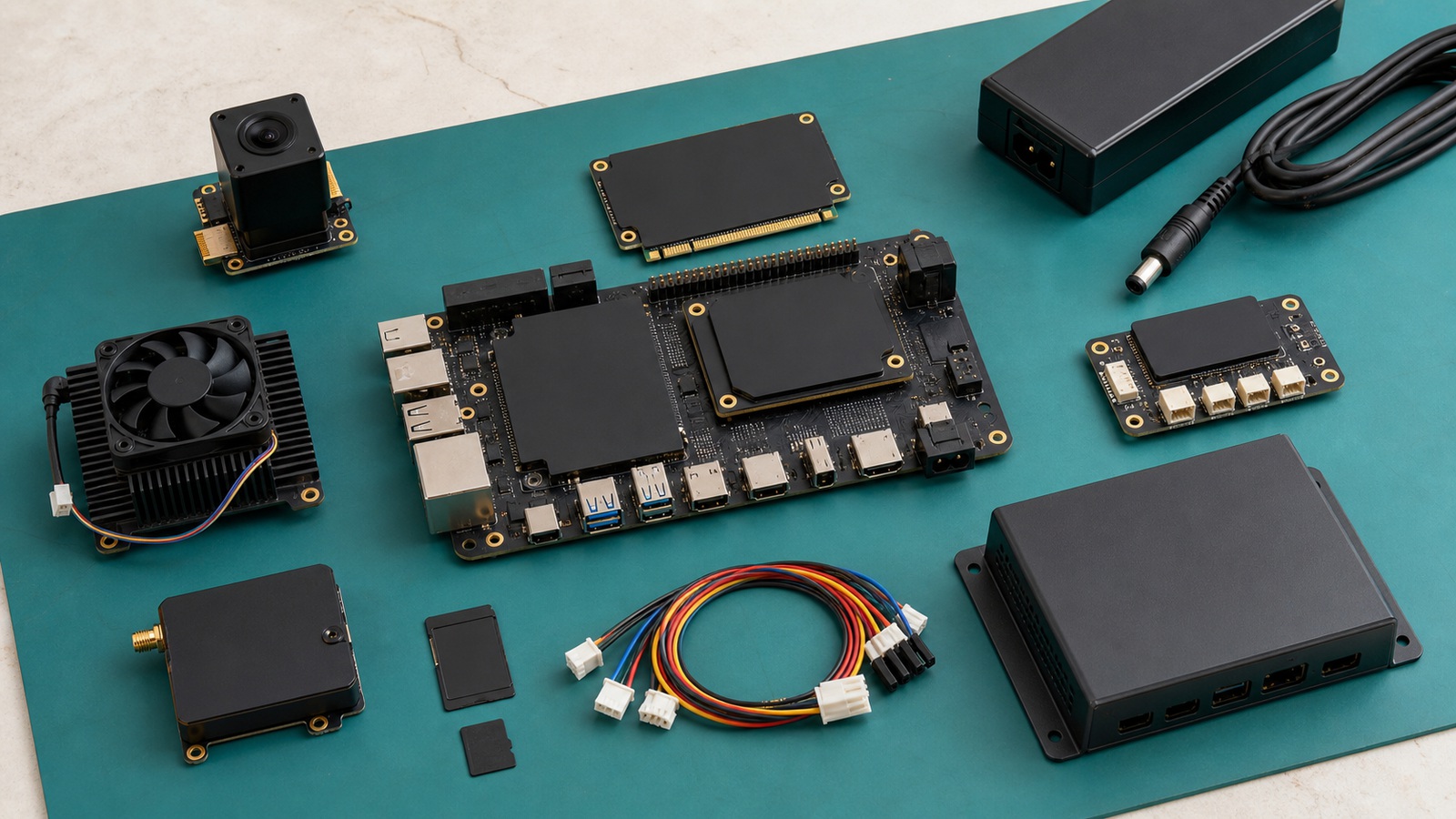
Complete-platform selection guide
A development kit is a temporary system: module, carrier, I/O, power, thermals, boot chain, BSP, drivers, SDK, runtime, licenses, debugging, recovery and a credible production path.
Choose the correct kit class
Education and prototyping board
Optimized for access, community examples and quick experiments. Confirm whether the board, image and software stack have a maintained route beyond the prototype; a convenient header layout is not a production lifecycle.
Edge-AI development kit
Pairs application processors and accelerators with camera, display, storage and networking I/O. Verify exact models, operators, compiler/runtime, sensor path, sustained power and environmental limits.
Robotics or autonomous-system platform
Adds real-time control, synchronized sensors, CAN or industrial networks, safety boundaries and robotics middleware. Keep perception, planning and actuator authority separate; a vision demo is not a safe control system.
Industrial evaluation kit
Exposes a production processor or module and relevant industrial interfaces. The evaluation board itself may not be production-qualified; inspect component grades, certifications, environmental limits, change control and the vendor’s production device.
Module-plus-carrier ecosystem
Uses a removable system-on-module on a reference carrier so software can migrate to a custom or production carrier. Verify pin compatibility, power sequencing, high-speed layout, board support, module lifecycle and carrier-design responsibilities.
Freeze the complete selection packet
| Layer | Record exactly | Reject when |
|---|---|---|
| Compute identity | Kit SKU, board and module revisions, processor/SoC, CPU/GPU/NPU/DSP/FPGA blocks, memory capacities and topology, firmware and security-fuse state. | A family name or TOPS figure substitutes for the delivered board, silicon revision, memory or usable software path. |
| Carrier and I/O | Carrier part number; GPIO, PCIe, USB, display, audio, camera/sensor connectors, lane counts, voltage levels, pin mux, radios, Ethernet/CAN and industrial interfaces. | A connector exists physically but its required mode, lane, driver, bandwidth or electrical level is not supported by the chosen image and revision. |
| Storage and boot | Boot ROM path, removable and soldered storage, recovery media, partition layout, secure boot, update slots, endurance, log growth and field-recovery procedure. | The prototype depends on a developer SD image with no controlled build, update, rollback or corruption-recovery plan. |
| Power, thermals and mechanics | Input range, supply and cable, peak/transient current, power modes, heat sink/fan, airflow, enclosure, mounting, ambient range, vibration and ingress requirements. | Bench operation with an open board is treated as evidence for a closed enclosure or environmental deployment. |
| Software stack | OS image, BSP, kernel, bootloader, firmware, drivers, SDK, toolchain, compiler, model runtime/provider, middleware, container base, packages and licenses. | “SDK available” is not tied to the exact kit revision, target image, host OS, version set, model format, operators and redistribution terms. |
| Operations | Flashing host, debug console/JTAG, logs, profiling, health monitoring, remote management, credentials, keys, vulnerability response, security updates and service access. | The team cannot recover a blank or failed unit, reproduce a build, rotate credentials, collect a fault record or roll back an update. |
| Production migration | Production module/processor, carrier design files and constraints, BOM, component lifecycle, certifications, manufacturing test, provisioning, PCNs, supply and support. | The developer kit is assumed to be the production product without a documented migration, qualification and change-control plan. |
“AI capable” is not a software result
Freeze one exact model artifact and trace conversion, quantization, compiler, runtime and provider to the target accelerator. Record supported operators, shapes, precision, graph partition and fallback. Then verify device placement and output quality on the exact OS/BSP/driver set. A board can contain several accelerators while the selected application uses only its CPU.
Host requirements also belong in the packet. Some targets need a supported x86 Linux host or container to flash firmware, build a board image, compile a model or recover the device. Licensing may differ between evaluation, redistribution and production. Preserve installers, manifests, source revisions, license texts and recovery media before an upstream release disappears.
Version gate: accept a platform only when the vendor’s current hardware documentation, software release notes and compatibility matrix agree on the exact board or module. A working community tutorial is useful evidence for a path, but not a substitute for vendor support boundaries.
Four documented architecture examples
These examples illustrate different platform decisions. Local or distributor stock, region and accessories still require an order-time check.
NVIDIA Jetson Orin Nano Super Developer Kit
NVIDIA documents an Orin Nano 8GB module on a reference carrier that also accepts Orin NX/Orin Nano modules, plus a JetPack software stack. The current JetPack release page is the version boundary for Jetson Linux, CUDA, TensorRT and supported hardware. NVIDIA’s lifecycle page is especially important: commercial Orin Nano modules have stated availability windows, while developer kits have no specified lifecycle and are for development/prototyping. That supports a module-to-custom-carrier plan; it does not prove model compatibility, field reliability or kit supply.
Raspberry Pi 5 with AI HAT+
Raspberry Pi documents AI HAT+ as a Raspberry Pi 5 add-on using Hailo-8L or Hailo-8 for supported vision inference. Its software page names required Raspberry Pi OS packages and warns that Hailo software components must match. The product page gives an obsolescence commitment for AI HAT+, while the documentation marks the earlier AI Kit as no longer in production. This establishes a maintained accessory/software path; it does not make every ONNX model executable or turn the Pi/HAT assembly into a certified production enclosure.
AMD Kria KV260 Vision AI Starter Kit
AMD documents KV260 as a K26 system-on-module plus vision-oriented carrier. The current user guide covers interfaces, power budgets, boot, firmware update/recovery, accelerated applications and tool integration; the data sheet covers electrical, mechanical, thermal, reliability and supported-tool details. The K26 page identifies commercial and industrial production SOMs. This establishes a prototype-to-SOM architecture; it does not prove that an arbitrary model maps to the programmed accelerator or that the starter-kit carrier meets the final product’s environment.
BeagleY-AI
BeagleBoard documents BeagleY-AI as an open-source single-board computer built around TI’s AM67A, with CPUs, DSP/matrix accelerators, vision/media blocks, 4GB memory, camera connectors, PCIe, USB, Ethernet, Wi-Fi/Bluetooth and a 40-pin header. Its quick-start guide records power, boot-media and access requirements. This establishes an accessible embedded-vision board and its physical/software starting point; it does not establish a long production lifecycle, broad model coverage or drop-in compatibility with every Raspberry Pi accessory.
For a direct scope comparison of two common ecosystems, use Jetson vs Raspberry Pi AI Kit. This guide stays focused on the selection and validation process across kit classes.
Turn a demo into an acceptance test
Identity and bring-up
Photograph and inventory every board, module, accessory and revision. Rebuild the documented image from controlled inputs, flash a blank unit, boot without a developer’s personal account, and capture firmware, kernel, package, driver and runtime manifests.
Sensor-to-output path
Exercise the exact camera, sensor, radio, storage and network path at required rates. Record timestamping, copies, preprocessing, accelerator placement, latency distribution, dropped data, output quality and host load.
Power, thermal and failure
Test approved input supplies, startup transients, worst-case sustained workload, enclosure airflow, ambient range, storage exhaustion, network loss, sensor disconnect, process crash, watchdog, brownout and recovery.
Update, security and fleet operations
Verify secure provisioning, unique credentials, signed or controlled updates, rollback, vulnerability ownership, logging, remote support, key rotation, factory reset and decommissioning without exposing retained data.
Production transition
Build the intended carrier or final assembly, rerun electrical/thermal/EMC and software tests, qualify the BOM and manufacturing flow, document licensing and notices, and repeat acceptance after every module, BSP, runtime or model change.
Official and primary documentation
- NVIDIA: Jetson Orin modules, developer kits, carrier relationship and platform overview
- NVIDIA: current JetPack release, supported hardware and component versions
- NVIDIA: Jetson module availability and developer-kit lifecycle boundary
- Raspberry Pi: AI HAT+ hardware variants and supported workload classes
- Raspberry Pi: required OS packages, software-version boundaries and setup
- Raspberry Pi: AI HAT+ product specification and obsolescence statement
- AMD: Kria K26 production SOM and starter-kit architecture
- AMD: KV260 user guide for interfaces, power, boot, firmware and recovery
- AMD: KV260 data sheet for electrical, mechanical, thermal and tool support
- BeagleBoard: BeagleY-AI processor, memory, I/O and accelerator architecture
- BeagleBoard: BeagleY-AI power, boot-media and access requirements