DeepSeek DSpark is the kind of AI release that looks boring for about five seconds. Then the bill lands.
This is not a new frontier base model. It is not DeepSeek suddenly making V4 smarter by bolting a magic module onto it. DSpark is an inference-speed and serving-efficiency play: a speculative decoding framework designed to make DeepSeek-V4 Flash and DeepSeek-V4 Pro generate useful tokens faster while wasting less GPU capacity.
That distinction matters. The AI race is no longer only about who can train the biggest or cleverest model. It is also about who can serve intelligence quickly, reliably, and cheaply at production scale. Decoding, batching, verification, GPU utilization, latency, throughput, and open tooling are now part of the competitive weaponry.
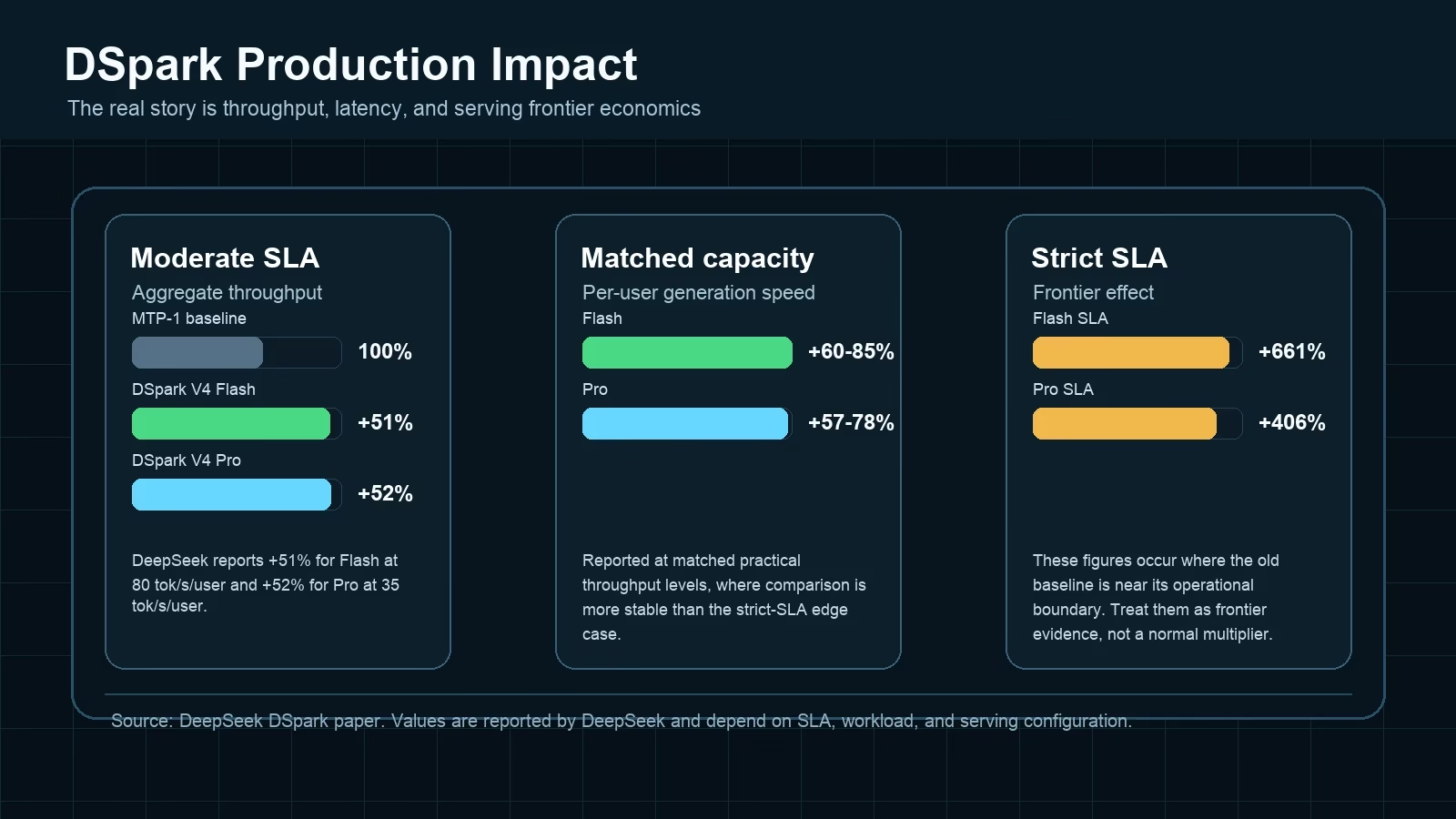
DeepSeek reports that DSpark improves throughput for DeepSeek-V4 Flash and DeepSeek-V4 Pro in live serving, and also shows accepted-length gains on other model families including Qwen and Gemma. The headline numbers are punchy, but the honest version is more interesting: the largest 406% and 661% throughput figures come from strict SLA regimes where the older baseline hits its serving frontier. The more representative production gains are around 51% to 52% aggregate throughput at moderate SLA points, plus 57% to 85% faster per-user generation speed at matched practical throughput levels, according to DeepSeek’s paper.
What DSpark is: DeepSeek’s speculative decoding framework for faster inference.
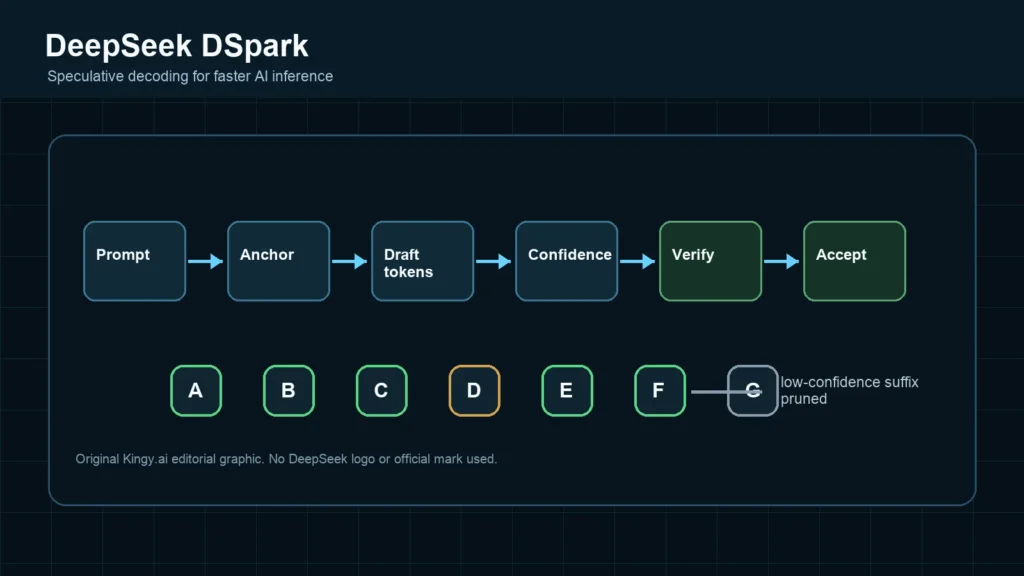
What speculative decoding is: a draft-and-verify method where a faster drafter proposes tokens and the target model verifies them.
Why DSpark is different: it combines semi-autoregressive drafting with confidence-scheduled verification.
What DeepSeek released: DeepSpec, the DSpark paper, and DSpark checkpoints for V4 Flash and V4 Pro preview variants.
Who should care: AI infra teams, model providers, API companies, agent builders, coding-tool teams, and open-source AI researchers.
Main caveat: this is a serving optimization, not a universal 4x local speed button.
Image note: DSpark is best understood as an inference pipeline upgrade, not a replacement for the base model.
What Is DeepSeek DSpark?
DSpark is DeepSeek’s new speculative decoding framework. In the official paper, the full name is Confidence-Scheduled Speculative Decoding with Semi-Autoregressive Generation. That is a mouthful, but the core idea is simple: draft more than one token, verify intelligently, and avoid spending expensive target-model compute on tokens that are unlikely to survive.
DeepSeek has attached DSpark modules to the preview versions of DeepSeek-V4 Flash and DeepSeek-V4 Pro. The Hugging Face model cards say this plainly: the DSpark variants are not new models. They are the same checkpoint with an additional speculative decoding module attached. That is the first myth to kill before it grows legs.
DeepSeek also open-sourced DeepSpec, a training and evaluation codebase for speculative decoding draft models. The repo includes DSpark, DFlash, and Eagle3-style methods, plus data preparation, training, and evaluation scripts. The README warns that the default Qwen3-4B target-cache setting can be massive, roughly 38 TB. Translation: this is open tooling for serious experimentation, not a weekend laptop toy.
What Is Speculative Decoding?
Standard autoregressive generation is painfully sequential. A model predicts token one. Then token two. Then token three. Every next token depends on the previous token, so each step usually requires another target-model forward pass. That is why generation latency scales with output length.
Speculative decoding attacks that bottleneck with a draft-and-verify loop. Think of a fast assistant sitting beside a careful expert. The assistant quickly sketches several likely next words. The expert checks the sketch. If the start of the sketch matches what the expert would have produced, those tokens are accepted. Once a token fails, the rejected suffix is thrown away and the target model supplies the correction.
Implemented correctly, speculative decoding preserves the target model’s output distribution. That is a big deal. The point is not to make the target model “think differently.” The point is to get the same distribution with fewer expensive target-model steps.

The Problem DSpark Is Solving
Speculative decoding sounds clean until production gets involved. Then the edges show.
Parallel drafters can propose many tokens in one shot, which is fast. But because the draft positions are predicted in parallel, later tokens can lose coherence. DeepSeek calls this suffix decay. A phrase might plausibly continue as “of course” or “no problem.” A parallel drafter can accidentally blend modes and draft an awkward suffix that the target model rejects.
Autoregressive drafters can model dependencies better because they generate draft tokens one by one. But then the draft process itself becomes slower, which eats the speedup.
Production serving adds another bottleneck: verification waste. Under light load, verifying extra draft tokens may be cheap. Under heavy load, every low-confidence token sent to the target model consumes batch capacity that could have served another user. In a real API, that can hurt aggregate throughput and push latency over the line.
DSpark’s Two Big Ideas
1. Semi-Autoregressive Generation
DSpark tries to keep the best part of parallel drafting without letting the suffix fall apart. It uses a heavy parallel backbone to generate block representations quickly, then adds a lightweight sequential head that injects local dependency information into the block.
The paper describes two versions of that sequential component: a Markov head and an RNN head. The Markov head looks mainly at the immediately previous token. The RNN head can carry more prefix history inside the block. In both cases, the intent is the same: preserve most of the speed advantage of parallel drafting while helping later draft tokens stay compatible with earlier ones.
Compared with DFlash, DSpark keeps the parallel draft advantage but adds more suffix discipline. Compared with Eagle-style autoregressive drafting, it avoids making the entire draft block sequential. That is the architectural sweet spot DeepSeek is chasing.
2. Confidence-Scheduled Verification
The second idea is more production-minded. DSpark does not blindly verify every drafted token. It predicts which draft tokens are likely to survive target-model verification, then schedules a prefix length based on confidence and system load.
Under light load, the scheduler can afford to verify more tokens. Under heavy load, it prunes more aggressively. The goal is not just token speed for one user. The goal is global serving efficiency: use the expensive target model where the expected return is highest.
This is why DSpark is a serving-stack story. The confidence head is model-side. The hardware-aware scheduler is system-side. The magic is in connecting both.

Benchmark And Production Results
Founder OS next step: To translate inference-speed claims into product decisions, compare economics in the Inference Cost Calculator, pressure-test response time in the Latency Calculator, and build a model shortlist in the Benchmark Explorer.
DeepSeek reports two kinds of results: offline accepted-length tests and live production serving telemetry. These are related, but they are not the same metric.
Qwen3-4B: DSpark improves macro-average accepted length by 30.9% over Eagle3 and 16.3% over DFlash.
Qwen3-8B: 26.7% over Eagle3 and 18.4% over DFlash.
Qwen3-14B: 30.0% over Eagle3 and 18.3% over DFlash.
DeepSeek-V4 Flash production: +51% aggregate throughput at 80 tok/s/user SLA; nominal +661% at the stricter 120 tok/s/user SLA.
DeepSeek-V4 Pro production: +52% aggregate throughput at 35 tok/s/user SLA; nominal +406% at the stricter 50 tok/s/user SLA.
| Result area | What DeepSeek measured | Reported DSpark result | How to read it |
|---|---|---|---|
| Offline Qwen3-4B | Accepted length across math, code, and chat tasks | +30.9% vs Eagle3, +16.3% vs DFlash | Draft quality improved in controlled evaluation. |
| Offline Qwen3-8B | Accepted length | +26.7% vs Eagle3, +18.4% vs DFlash | Gains persist at a larger Qwen target size. |
| Offline Qwen3-14B | Accepted length | +30.0% vs Eagle3, +18.3% vs DFlash | DSpark’s semi-autoregressive structure still helps. |
| Offline Gemma4-12B | Accepted length | Consistent gains across the listed benchmark domains | DeepSeek reports the method generalizes beyond Qwen. |
| V4 Flash serving | Live throughput-interactivity frontier | +51% aggregate throughput at 80 tok/s/user SLA; 60%-85% faster per-user generation at matched practical throughput | Moderate-SLA gain is the cleaner production comparison. |
| V4 Pro serving | Live throughput-interactivity frontier | +52% aggregate throughput at 35 tok/s/user SLA; 57%-78% faster per-user generation at matched capacities | Same pattern, with Pro’s stricter throughput envelope. |
The huge numbers need adult supervision. DeepSeek says V4 Flash shows a nominal 661% aggregate throughput advantage at a 120 tok/s/user SLA, while V4 Pro shows 406% at 50 tok/s/user. Those figures happen where the old MTP-1 baseline is close to its operational boundary and can sustain only a small concurrent batch. They are evidence that DSpark extends the feasible serving frontier, not proof that every deployment suddenly gets a 6.6x speedup.
Why This Matters
Inference cost is the tax on every AI product. Chatbots, coding agents, research agents, customer-support tools, search assistants, and workflow automations all have to serve tokens to users who do not care how elegant the backend is. They care whether the thing responds fast enough to feel alive.
Faster inference can mean lower cost per answer, better margins, higher rate limits, more responsive agents, and more room to serve demanding workloads without overbuying GPUs. For AI companies, that is not a footnote. That is product strategy.
DSpark also points to a broader shift. Model providers are now competing across the full serving stack. Training still matters, but deployment is becoming an engineering battlefield: attention kernels, quantization, routing, batching, cache management, speculative decoding, and scheduler design.
Why This Matters For Open-Source AI
The open-source angle is not only that DeepSeek posted a paper. The more useful release is DeepSpec, a codebase for training and evaluating draft models for speculative decoding. It includes the workflow for data preparation, training, and evaluation, and it names benchmark sets such as GSM8K, MATH500, AIME25, HumanEval, MBPP, LiveCodeBench, MT-Bench, Alpaca, and Arena-Hard-V2.
That gives researchers and infra teams a starting point for comparing speculative decoding approaches instead of only reading performance claims. It also supports model families beyond DeepSeek in the repo’s stated examples, including Qwen and Gemma.
Still, do not confuse open with trivial. The README’s storage warning is enough to cool down casual expectations. Training and evaluating serious draft models can require significant GPU capacity, storage, and serving-engine work. For normal local AI users, DSpark is interesting, but it is not a one-click checkbox in Ollama.
Online Reaction: Infra People Are Paying Attention
Early sentiment is still thin because the release is brand new, but the signals are loud enough to note. The Hacker News thread for the DSpark paper drew hundreds of comments within hours. The discussion is exactly what you would expect from an infra-heavy audience: interest in the open paper and code, excitement about inference cost reduction, and skepticism about how much of the production result will replicate outside DeepSeek’s serving stack.
GitHub attention is also moving quickly. When checked for this article, the DeepSpec repository had more than 1,200 stars and 90 forks shortly after creation. On Hugging Face, both DeepSeek-V4-Flash-DSpark and DeepSeek-V4-Pro-DSpark were already listed with MIT licensing metadata.
The caveats from technical users are fair. Speculative decoding is not new. The biggest gains depend on workload, SLA, and server behavior. Independent deployment results still matter. And DeepSpec is probably too heavy for casual local users. That does not make DSpark unimportant. It makes it an infrastructure release, which is exactly the point.
What DSpark Is Not
DSpark is not a new base model. It does not magically make every local model four times faster. It does not eliminate GPU cost. It does not mean every model can use the same DSpark checkpoint. It is not proof that every benchmark or every serving stack will improve.
It is mainly a serving and inference optimization. That sounds less glamorous than a new model launch, but commercially it may matter more.
Practical Guide: Where To Start
If you want to inspect DSpark directly, start with the official sources. Read the DSpark paper, then the DeepSpec GitHub repo. The model cards for V4 Flash DSpark and V4 Pro DSpark explain that the DSpark variants are additional speculative decoding modules attached to the same checkpoints.
Who can realistically experiment? AI infra teams, research labs, model-serving engineers, and advanced open-source contributors. The things to evaluate are target-model compatibility, available draft checkpoints, GPU memory, storage, serving-engine integration, benchmark workload, latency target, throughput target, and whether the implementation preserves the target distribution correctly.
For broader Kingy.ai context, see the AI models directory, the AI tools directory, and our local AI models guide. DSpark sits closer to model-serving infrastructure than ordinary app tooling, but it will eventually affect the tools people actually use.
Comparison Table
| Method | How it works | Strength | Weakness | Where DSpark differs | Best use case |
|---|---|---|---|---|---|
| Standard autoregressive decoding | The target model generates one token per step. | Simple and faithful to the model. | Slow for long outputs. | DSpark tries to accept multiple tokens per target verification step. | Baseline serving and small systems. |
| Multi-token prediction / MTP | The model predicts more than one future token. | Can improve generation speed. | Static verification can waste capacity under load. | DSpark schedules verification dynamically by confidence and hardware load. | Controlled environments with known traffic. |
| Eagle-style autoregressive drafting | A drafter generates candidate tokens sequentially. | Better dependency modeling. | Drafting latency grows with block length. | DSpark keeps most computation parallel and adds a lightweight sequential head. | Draft quality research and smaller draft blocks. |
| DFlash-style parallel drafting | A parallel drafter proposes a block in one pass. | Fast block proposal. | Later tokens can suffer suffix decay. | DSpark adds semi-autoregressive dependency modeling. | High-throughput drafting where suffix quality is manageable. |
| DSpark | Parallel backbone plus sequential head plus confidence scheduler. | Better accepted length and load-aware verification. | Requires draft module training, calibration, and serving integration. | It combines draft quality and production scheduler design. | Large-scale LLM serving and serious infra experimentation. |
What Feels Proven, And What Still Needs Proof
Strongly supported
DeepSeek’s paper shows offline accepted-length gains across Qwen and Gemma targets. The live telemetry in the paper shows an improved throughput-interactivity frontier for DeepSeek-V4 Flash and Pro. The method directly addresses known speculative decoding bottlenecks: suffix decay and verification waste.
Still needs proof
Independent deployments outside DeepSeek still need to validate the results. We need more data across vLLM, SGLang, TGI, and custom serving stacks. Smaller providers need to know whether the integration cost pays back. And the open-source community needs time to test whether DSpark-style scheduling becomes a common serving primitive.
Verdict
DSpark is less flashy than a new model release. That may be why it matters.
The next AI race is not only who has the smartest model. It is who can serve useful intelligence fastest, cheapest, and most reliably. DeepSeek is making inference efficiency part of the product, the economics, and the open-source story.
If DSpark’s results replicate beyond DeepSeek’s own serving environment, this is the kind of infrastructure work that quietly changes the cost curve. It will not make every model magically smarter. It may make good models cheaper to use at scale. In the AI business, that is sharp enough.
FAQ
What is DeepSeek DSpark?
DeepSeek DSpark is a speculative decoding framework that accelerates LLM inference by combining semi-autoregressive draft generation with confidence-scheduled verification.
Is DSpark a new AI model?
No. The official Hugging Face cards say the DSpark variants are the same DeepSeek-V4 checkpoints with an additional speculative decoding module attached.
What is speculative decoding?
It is a draft-and-verify method where a faster draft model proposes multiple tokens and the larger target model verifies the accepted prefix in parallel.
Does DSpark reduce quality?
Speculative decoding is designed to preserve the target model distribution when implemented correctly. DSpark is an inference method, not a quality-changing fine-tune.
How much faster is DSpark?
DeepSeek reports around 51%-52% aggregate throughput improvements at moderate SLA points for V4 Flash and Pro, with larger nominal gains in stricter SLA regimes where the old baseline hits its frontier.
Does DSpark work with Qwen and Gemma?
DeepSeek reports offline accepted-length gains on Qwen3-4B, Qwen3-8B, Qwen3-14B, and Gemma4-12B targets. That does not mean one checkpoint works universally across all models.
Can I run DSpark locally?
Most casual users should not expect a simple local install. DeepSpec can require significant GPU and storage resources, especially for training and evaluation.
What is DeepSpec?
DeepSpec is DeepSeek’s open-source codebase for training and evaluating speculative decoding draft models, including DSpark, DFlash, and Eagle3-style methods.
Why does DSpark matter for AI companies?
It targets lower inference cost, faster response speed, better GPU utilization, and more stable serving under load.
Is DSpark good for open-source AI?
Yes, if the community can build on it. Open code, papers, and checkpoints help move inference optimization into the public research and engineering stack.
Sources
- DeepSpec GitHub repository
- DSpark paper PDF
- DSpark arXiv technical report
- DeepSeek-V4-Flash-DSpark model card
- DeepSeek-V4-Pro-DSpark model card
- Fast Inference from Transformers via Speculative Decoding
- Accelerating Large Language Model Decoding with Speculative Sampling
- Hacker News discussion of DSpark
Update note: this article should be revisited as DeepSpec evolves, additional DSpark checkpoints appear, and third-party benchmarks test the method outside DeepSeek’s serving stack.
DeepSeek Economics
DeepSeek Models
DeepSeek V4
DeepSeek Model Family
DeepSeek Company
The Kingy Brief
Get The Kingy Brief.
AI changes, original tests and one practical thing to try. Fridays at 09:00 Vancouver time.
Free · Double opt-in · Unsubscribe anytime
Signup help and newsletter schedule
Signup form provided by Beehiiv. After submitting, check your inbox for "Confirm your subscription to The Kingy Brief" and open its confirmation link. Check Spam or Promotions if you cannot find it.
Fridays at 09:00 Vancouver time: source-checked AI changes, original tests and one practical thing to try. The weekly restart begins October 9, 2026. We skip a week when there is not enough verified material. Free. Unsubscribe anytime.