
TL;DR: This daily Radar summarizes source-checked AI launch candidates for Kingy AI readers, with pricing notes, use cases, and human-review caveats where details are still emerging.
Launch Snapshot
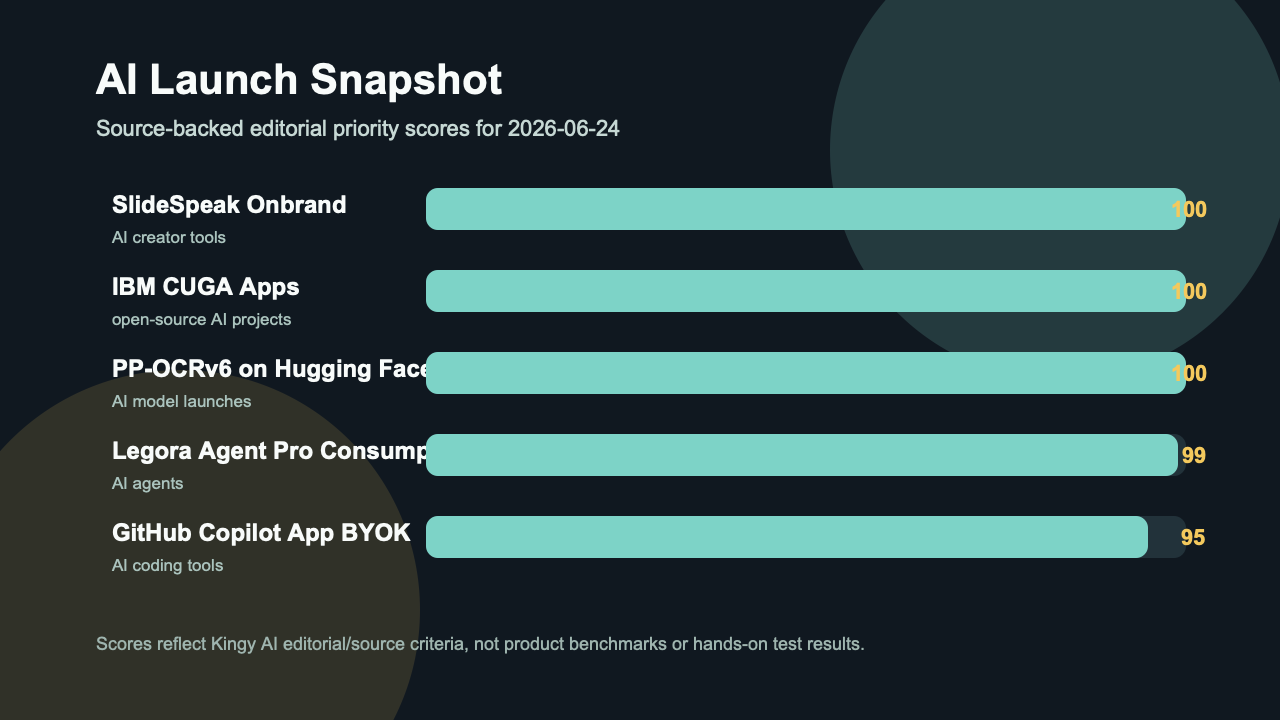
The snapshot below compares the strongest source-checked launches by Kingy AI score. It is a research-priority visual, not a benchmark chart or hands-on test result.
Strongest Launches
SlideSpeak Onbrand
SlideSpeak Onbrand exposes brand assets, tokens, fonts, imagery, and slide layouts to Claude Code, Codex, Cursor, and other MCP clients so AI-generated decks stay on brand.
Checked launch source, docs, GitHub repo for the current Radar entry.
Why it matters: Agent-generated presentations often drift from brand systems; a brand-context MCP gives teams a reusable way to connect agents to approved design assets rather than relying on prompt memory.
Who should care: Enterprises, Creators, Marketers, Designers
For broader Kingy AI context, compare SlideSpeak Onbrand with other AI launch radar coverage and recent AI News before treating this as a standalone buying decision.
Pricing: SlideSpeak lists Premium at $29/month, a Custom Template add-on at $129/template, Enterprise as custom pricing, and says API access requires a SlideSpeak subscription. Confirm current pricing on the official pricing/source page.
What launched: SlideSpeak is promoting Onbrand as a design-context MCP for AI agents, with the product page and supporting agent-presentation guidance live during the June 22-23, 2026 research window. See the official launch source.
What feels promising: Agent-generated presentations often drift from brand systems; a brand-context MCP gives teams a reusable way to connect agents to approved design assets rather than relying on prompt memory.
What feels unproven: [‘The launch date is inferred from live official pages and June support content rather than a dated launch announcement’, ‘Exact Onbrand-specific pricing is not separated from broader SlideSpeak plan pricing’, ‘Teams must avoid exposing licensed assets too broadly through agent permissions’]
IBM CUGA Apps
IBM Research published two dozen CUGA agent app examples showing how to build governed, model-agnostic agentic applications on a lightweight open-source harness.
Checked launch source, docs, GitHub repo, Hugging Face page for the current Radar entry.
Why it matters: Agent builders often spend more time wiring tools, state, streaming, policies, and deployment than defining the actual task; CUGA’s examples make the harness pattern easier to inspect and reuse.
Who should care: AI App Builders, AI Engineers, Developers, Researchers
For broader Kingy AI context, compare IBM CUGA Apps with other AI launch radar coverage and recent AI News before treating this as a standalone buying decision.
Pricing: CUGA is presented as an open-source harness; local or self-hosted use can be free aside from infrastructure/model costs, while provider or hosted deployment costs depend on the selected model and environment. Confirm current pricing on the official pricing/source page.
What launched: The CUGA Apps article and example library were published on Hugging Face on June 23, 2026. See the official launch source.
What feels promising: Agent builders often spend more time wiring tools, state, streaming, policies, and deployment than defining the actual task; CUGA’s examples make the harness pattern easier to inspect and reuse.
What feels unproven: [‘Some example apps are described as more polished than others’, ‘Production safety still depends on sandboxing and tool permissions’, “Model and infrastructure costs depend on the user’s provider choice”]
PP-OCRv6 on Hugging Face
PaddlePaddle released PP-OCRv6 on Hugging Face, a multilingual OCR model family with lightweight tiers, ONNX assets, Paddle inference models, and a Transformers backend path.
Checked launch source, docs, GitHub repo, Hugging Face page for the current Radar entry.
Why it matters: OCR remains a core building block for document AI, search, extraction, RAG, and agent workflows; smaller multilingual OCR models can make deployment easier outside large VLM-only stacks.
Who should care: AI App Builders, AI Engineers, Developers, Researchers
For broader Kingy AI context, compare PP-OCRv6 on Hugging Face with other AI launch radar coverage and recent AI News before treating this as a standalone buying decision.
Pricing: The checked launch materials present PP-OCRv6 model assets and demos on Hugging Face; usage appears free/open-source, while hosting, inference endpoints, or commercial deployment costs depend on the user’s infrastructure and Hugging Face/PaddleOCR setup. Confirm current pricing on the official pricing/source page.
What launched: PP-OCRv6 was published on Hugging Face on June 22, 2026 with model tiers from 1.5M to 34.5M parameters and 50-language OCR support. See the official launch source.
What feels promising: OCR remains a core building block for document AI, search, extraction, RAG, and agent workflows; smaller multilingual OCR models can make deployment easier outside large VLM-only stacks.
What feels unproven: [‘Real-world accuracy needs validation on each document domain’, ‘The launch mentions accuracy improvements but independent benchmarks were not verified in this run’, ‘Operational costs depend on the chosen inference backend and hosting setup’]
Legora Agent Pro Consumption-Based Pricing
Legora launched Agent Pro with consumption-based pricing, real-time dashboards, notifications, and spending controls for complex legal AI work.
Checked launch source, docs for the current Radar entry.
Why it matters: Legal AI pricing is moving from simple seat-based licensing toward usage and matter-level economics, which matters for law firms and in-house teams that need cost attribution and governance.
Who should care: AI Product Teams, Sales Teams, Enterprises, Operators
For broader Kingy AI context, compare Legora Agent Pro Consumption-Based Pricing with other AI launch radar coverage and recent AI News before treating this as a standalone buying decision.
Pricing: Legora describes Agent Pro as consumption-based pricing with dashboards and spending controls, but does not publish per-run or per-unit rates on the checked pages. Confirm current pricing on the official pricing/source page.
What launched: Legora announced consumption-based pricing for Agent Pro on June 23, 2026, alongside the launch of its more capable legal agent product. See the official launch source.
What feels promising: Legal AI pricing is moving from simple seat-based licensing toward usage and matter-level economics, which matters for law firms and in-house teams that need cost attribution and governance.
What feels unproven: [‘Published pricing does not include exact unit rates’, ‘Highly regulated legal workflows require human review’, ‘Availability appears tied to customer or sales-led access’]
GitHub Copilot App BYOK
GitHub added bring-your-own-key model provider support to the Copilot app so agent sessions can run against a user’s own OpenAI-compatible, Anthropic, Azure OpenAI, Microsoft Foundry, LM Studio, or Ollama endpoint.
Checked launch source, docs for the current Radar entry.
Why it matters: BYOK gives developers and enterprises a clearer path to use Copilot’s agent interface while keeping model billing, quotas, regions, data handling, or local model execution under their own provider account.
Who should care: AI Platform Teams, AI Engineers, Developers, Enterprises
For broader Kingy AI context, compare GitHub Copilot App BYOK with other AI launch radar coverage and recent AI News before treating this as a standalone buying decision.
Pricing: GitHub Copilot plan pricing and AI-credit usage apply separately from any third-party model provider costs; BYOK traffic may also be billed by the selected provider. Confirm current plan and usage terms in GitHub’s official billing docs. Confirm current pricing on the official pricing/source page.
What launched: Bring-your-own-key support launched for the GitHub Copilot app on June 23, 2026. See the official launch source.
What feels promising: BYOK gives developers and enterprises a clearer path to use Copilot’s agent interface while keeping model billing, quotas, regions, data handling, or local model execution under their own provider account.
What feels unproven: [‘Actual model quality and tool behavior vary by provider’, ‘Business or Enterprise access can depend on admin policy’, ‘Third-party provider cost, retention, and compliance terms still need separate review’]
Tracker-Only Mentions
- GitHub Copilot CLI Terminal Interface: GitHub made the redesigned Copilot CLI terminal interface generally available with tabs for issues, pull requests, and gists plus in-session tool configuration.
- GitHub Copilot Claude Agent Provider for JetBrains: GitHub added a public preview that lets JetBrains IDE users choose Claude Code as an agent provider inside GitHub Copilot.
- Lovable Workspace Insights: Lovable launched Workspace Insights for Enterprise customers to help admins see every AI-built project, spot PII and security exposure, and export governance data.
Related Kingy AI Links
For more launch tracking and founder resources, see AI Launches, AI Tools, and the AI News archive. Founders can also use the AI Sponsored Video ROI Calculator.
Sponsor path
Sponsor Kingy AI launch coverage
Launching an AI product that needs clear demos, creator education, and buyer trust? Sponsor a Kingy AI video or launch feature.
The Kingy Brief
Get the next Kingy Brief.
Source-checked AI changes, original tests and one practical thing to try.
Free · Choose your subjects · Double opt-in · Unsubscribe anytime