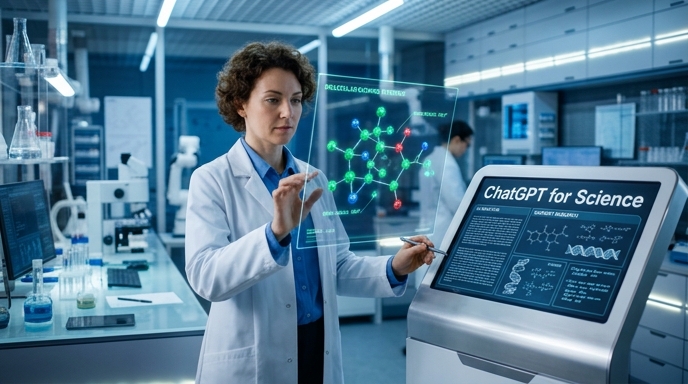
The Rumor That Walked Into the Lab Coat

OpenAI appears to be preparing a new subscription plan called ChatGPT for Science, and no, this does not mean ChatGPT suddenly grew safety goggles and started labeling beakers with suspicious confidence.
The story began with references found inside the ChatGPT web build. According to reports from BleepingComputer and TestingCatalog, OpenAI is testing language that points to a science-focused ChatGPT plan. The company has not officially announced the product. It has not confirmed pricing. It has not published eligibility rules. It has not given a launch date.
That matters. A web-build leak is a clue, not a contract.
Still, the clue is unusually interesting. OpenAI already sells ChatGPT to individuals, teams, schools, enterprises, and other specialized customers. A plan built specifically for researchers would fit that pattern neatly. It would also match OpenAI’s recent push into scientific discovery, where the company has been busy publishing benchmarks, research demos, and domain-specific tools.
So the question is not just, “Is ChatGPT for Science real?”
The better question is sharper: what kind of science product is OpenAI trying to build?
What the Leak Actually Suggests
The leak points to a dedicated plan for scientific institutions. TestingCatalog reported that the plan appears aimed at universities, national laboratories, and R&D groups. BleepingComputer noted that the subscription may come with restrictions, possibly limiting access to verified institutions rather than everyday consumers.
That would make sense. Scientific AI tools are not the same as general chatbots. They need stronger controls. They may touch proprietary research, unpublished findings, chemical synthesis, clinical data, biological systems, and sensitive experimental workflows. In plain English: this is not “write me a poem about mitochondria.” This is “help me reason through a drug discovery workflow without turning the lab into a flaming spreadsheet.”
The reports also suggest that ChatGPT for Science may include more specialized grounding in scientific topics. That could mean better access to research workflows, improved scientific reasoning, deeper integrations, or purpose-built models. But right now, that part remains unconfirmed.
The safest reading is this: OpenAI seems to be packaging its science ambitions into something institutions can buy, manage, and govern.
That is less flashy than “AI scientist replaces everyone.”
It is also more believable.
Why OpenAI Would Do This Now
OpenAI has spent the last year sending very loud signals that science is becoming a major product lane.
On June 17, OpenAI introduced LifeSciBench, a benchmark designed to test whether AI systems can handle realistic life-science research tasks. This is not trivia-night biology. The benchmark includes expert-written tasks based on actual research workflows, including evidence handling, experimental design, scientific reasoning, translation, and communication.
The timing is hard to ignore. On the same day outside reports spotted the ChatGPT for Science references, OpenAI published fresh work aimed directly at scientific evaluation.
That does not prove a subscription launch is imminent. But it does show strategic alignment. OpenAI is not merely saying, “Trust us, the model is good at science.” It is building public machinery to measure scientific usefulness.
That is important because science punishes bluffing. A model can sound brilliant while being wrong in a way that ruins a protocol, misreads a paper, or sends a researcher down a three-week rabbit hole wearing clown shoes.
Benchmarks like LifeSciBench try to separate charming nonsense from useful reasoning.
The Bigger Pattern: Vertical ChatGPT
The likely ChatGPT for Science plan fits a broader commercial pattern: OpenAI keeps carving ChatGPT into vertical products.
There is ChatGPT for individuals. There is ChatGPT for Education. There is ChatGPT Business. There is ChatGPT Enterprise. Each plan wraps the same general idea—frontier AI assistance—inside different permissions, data controls, admin tools, and market promises.
A science plan would take that logic into the lab.
That may sound boring, but it is the whole game. Researchers do not just need a smarter chatbot. They need a system that can live inside institutional rules. Universities care about access management. Pharma companies care about intellectual property. Hospitals care about privacy. Labs care about reproducibility. Compliance teams care about everything, including the font on the compliance memo.
So a science plan would probably not win on model capability alone. It would win if it solves the ugly operational mess around scientific AI: who gets access, what data can be used, what tools can connect, what logs are kept, what safeguards exist, and what happens when the model is confidently wrong.
In science, the wrapper matters.
Sometimes the wrapper is the product.
GPT-Rosalind Is the Obvious Clue

The biggest hint comes from OpenAI’s earlier release of GPT-Rosalind, a purpose-built model for life sciences research. GPT-Rosalind focuses on biology, drug discovery, chemistry, protein engineering, genomics, evidence synthesis, hypothesis generation, and experimental planning.
That is a mouthful. It is also exactly the sort of thing a “ChatGPT for Science” plan might eventually package.
OpenAI did not launch GPT-Rosalind as a free-for-all toy. It placed the model behind a trusted-access structure for qualified customers. That tells us something important. OpenAI views serious scientific AI as powerful enough to require gatekeeping, governance, and organizational accountability.
BleepingComputer connected the possible science subscription to this trusted-access model. TestingCatalog similarly framed the rumored plan as a way to formalize access for universities, national labs, and corporate R&D teams.
That would be a practical move. OpenAI could use ChatGPT for Science as the front door, while GPT-Rosalind and related tools serve as the machinery behind the counter.
Not confirmed. But plausible.
The AI Chemist Enters the Chat
Also on June 17, OpenAI published research about a near-autonomous AI chemist connected to Molecule.one’s Maria platform. In that project, GPT-5.4 helped improve a difficult medicinal chemistry reaction, specifically a Chan–Lam coupling involving primary sulfonamides.
This is where the story gets spicy.
The system did more than summarize papers. It generated proposals, designed experiments, analyzed data, and suggested follow-up experiments. Humans still stayed in the loop. They selected proposals, corrected plans, helped with lab operations, and validated results. But the AI contributed to a real experimental cycle.
That is the direction OpenAI clearly wants to go: not just answering science questions, but helping run pieces of scientific work.
A ChatGPT for Science plan could become the interface for that future. Imagine a researcher asking ChatGPT to review a protocol, compare papers, design a screening run, troubleshoot poor yields, or draft a regulatory-style critique.
That is not science fiction anymore.
It is early. It is imperfect. But the shape is visible.
The Benchmark Reality Check
Now for the cold water, because every AI hype story needs some or it starts smelling like a conference keynote.
LifeSciBench shows progress, but it also shows limits. OpenAI reported that GPT-Rosalind improved over GPT-5.5 on the benchmark, but the overall pass rates remained far from perfect. The model performed better on scientific communication and translation tasks than on artifact-heavy or design-heavy work.
That matters. Real science is full of artifacts: PDFs, figures, tables, sequence files, structure files, spreadsheets, messy lab notes, contradictory results, and the occasional chart that looks like it was exported from a toaster.
If a model struggles with artifacts, it can still be useful. But researchers must treat it as an assistant, not an oracle.
This is the central tension behind ChatGPT for Science. The product could be valuable even if the model is not “autonomous.” In fact, the best version probably would not pretend to be autonomous. It would help experts move faster while keeping humans responsible for judgment, validation, and experimental decisions.
That is less dramatic.
It is also how labs actually work.
Who Would Buy It?
The most obvious buyers are universities, pharmaceutical companies, biotech startups, national labs, contract research organizations, and corporate R&D teams.
Universities may want broad access for faculty, graduate students, and research staff. Pharma companies may want more secure tools for literature review, target discovery, assay planning, and translational research. National labs may want AI support for materials, physics, chemistry, climate, and computational science.
But eligibility may become the sticky issue.
If OpenAI restricts access to verified institutions, independent researchers could be left outside. That would frustrate some users. It might also be unavoidable. Scientific AI can touch dual-use areas, especially in biology and chemistry. OpenAI has already shown with GPT-Rosalind that it prefers controlled access for higher-risk research capabilities.
Pricing is another unknown. A science plan may not look like a standard consumer subscription. It could involve institutional contracts, seat-based pricing, usage limits, compliance reviews, or custom deployment terms.
In other words: expect fewer “$20 a month” vibes and more “please contact sales.”
The lab coat may come with paperwork.
What Researchers Might Actually Get
A useful ChatGPT for Science plan would need more than a new name. Scientists already know how to use general AI tools. To justify a dedicated subscription, OpenAI would need to offer real advantages.
The obvious features would include stronger literature synthesis, better citation handling, integrations with scientific databases, support for data analysis, workflow templates, lab notebook compatibility, code generation, experiment planning, and domain-specific evaluation.
The deeper value would come from trust. Can the model show uncertainty clearly? Can it distinguish evidence from speculation? Can it flag weak assumptions? Can it read a figure correctly? Can it avoid inventing papers? Can it cite sources that actually say what it claims?
That last one is not optional. Scientific hallucination is not a cute quirk. It is intellectual malware.
The best scientific AI tools will not merely sound confident. They will make it easier to audit every step. They will show their work, expose uncertainty, and invite correction.
That is how AI earns a place in serious research.
The Competitive Pressure Is Real
OpenAI is not moving in a vacuum. Every major AI company wants a seat at the science table.
Google has pushed AI into scientific discovery through systems such as AlphaFold and other research projects. Anthropic has targeted enterprise and specialized professional use cases. Microsoft has deep ties to research institutions and enterprise workflows. Smaller AI labs and scientific software companies are also building tools for biology, chemistry, materials, and medicine.
The prize is enormous. Scientific work is slow, expensive, and full of bottlenecks. Literature review takes time. Experiments fail. Drug discovery is brutally costly. Materials research can involve endless search spaces. Researchers spend too much of their lives wrestling with files, formats, databases, and half-broken scripts.
AI will not magically erase those problems. But even modest speedups can matter.
If ChatGPT for Science helps researchers find better hypotheses faster, eliminate dead ends earlier, or design cleaner experiments, institutions will listen.
They may complain about pricing first.
Then they will ask for a pilot.
The Unanswered Questions
The leak leaves several major questions open.
First, is ChatGPT for Science a subscription tier, a model option, an enterprise bundle, or all three? The reports point to a plan, but the final product could look different.
Second, who gets access? OpenAI may restrict it to verified universities, labs, and companies. Or it may offer a lighter version to broader academic users.
Third, what models power it? The plan could rely on general frontier models, GPT-Rosalind-style domain models, or a mix of tools.
Fourth, what data sources will it connect to? Scientific usefulness depends heavily on access to papers, databases, lab systems, code, and structured research artifacts.
Fifth, how will OpenAI handle safety? Biology and chemistry are productive fields, but also sensitive ones. Strong access controls may become a central selling point.
Finally, when does it launch? Neither BleepingComputer nor TestingCatalog reported a confirmed date. OpenAI has not announced one.
So the only honest answer is: soon, maybe. But not confirmed.
Why This Could Matter

ChatGPT for Science, if launched, would mark another step in AI’s migration from general assistant to specialized collaborator.
That shift matters. General chatbots are useful because they can do many things reasonably well. Specialized scientific tools are useful because they can do narrower things with more rigor, better workflows, and stronger controls.
Science does not need a chatbot that sounds clever. It needs a system that can help researchers make fewer mistakes, test more ideas, and move through complex evidence faster.
OpenAI seems to understand this. Its recent posts on LifeSciBench, GPT-Rosalind, AI chemistry, health intelligence, and rare-disease diagnosis all point in the same direction: build models that can work inside expert domains, then wrap them in products institutions can actually deploy.
That is the real story.
The leak is not just about another subscription. It is about OpenAI trying to turn ChatGPT into infrastructure for research.
And if that works, the next lab assistant may not wear a white coat.
It may live in a browser tab.
Sources
- BleepingComputer: “Leak confirms OpenAI is testing a ChatGPT for Science subscription”
- TestingCatalog: “OpenAI readies ChatGPT for Science subscription plan”
- OpenAI: “Introducing LifeSciBench”
- OpenAI: “A near-autonomous AI chemist improves a challenging reaction in medicinal chemistry”
- OpenAI: “Introducing GPT-Rosalind for life sciences research”
- OpenAI: “Improving health intelligence in ChatGPT”
- OpenAI: “Using AI to help physicians diagnose rare genetic diseases affecting children”
The Kingy Brief
Get the next Kingy Brief.
Source-checked AI changes, original tests and one practical thing to try.
Free · Choose your subjects · Double opt-in · Unsubscribe anytime