A Robot Enters the Chat—Without a Head
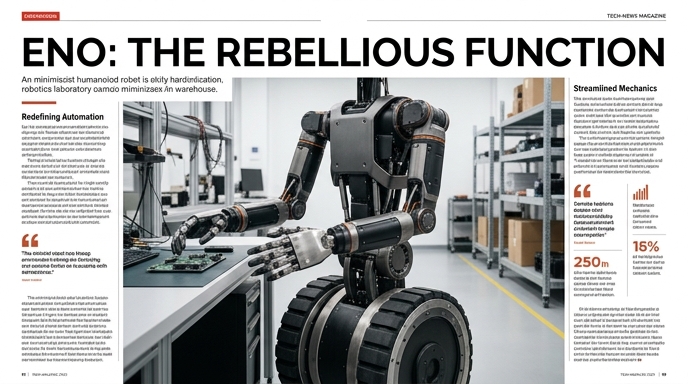
The humanoid robot race has a familiar look. Two legs. Two arms. A head. Maybe a face. Maybe a slightly unsettling smile that says, “I have read your emails and judged your posture.”
Then Genesis AI rolled in with Eno.
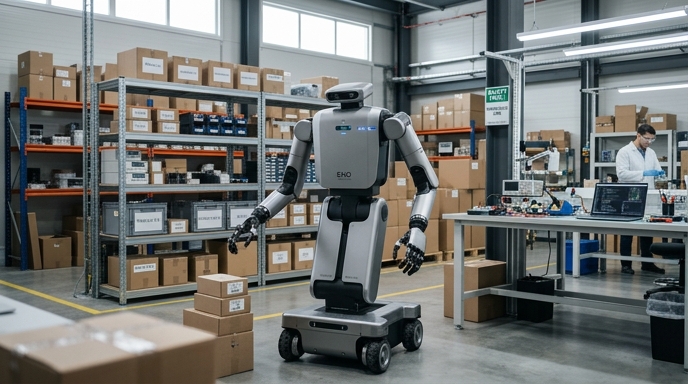
And yes, “rolled” is the right word. Eno, the new general-purpose robot from Paris-based Genesis AI, does not chase the full human cosplay routine. It does not need a head. It does not need legs. It does not need to stride dramatically through a warehouse like it is auditioning for a prestige sci-fi series.
Instead, Eno sits on a wheeled base. It uses a foldable, articulated body. It has two arms. Most importantly, it has highly dexterous hands designed to work with the tools, objects, and spaces humans already use.
Genesis AI’s bet is simple: a robot does not need to look like a person to do useful work for people. That sounds obvious. Somehow, in the robot world, it still feels like a minor rebellion.
Genesis AI’s Big Bet: Capability Over Costume
Genesis AI describes Eno as a general-purpose robot designed around “human capability,” not human appearance. That phrase matters. It tells us what the company is rejecting.
Many humanoid robotics companies start with the human body as the template. Genesis AI starts with the job. What does the robot need to reach? What should it pick up? Where will it move? How should it store itself when nobody needs it?
That produces a very different machine. Eno has a wheeled base instead of legs. It has an adjustable tower of articulated panels instead of a torso that imitates a human frame. It can change height and reach as needed. It can also fold down when not in use, which is deeply unglamorous and deeply practical.
This is not “Terminator chic.” It is more like: what if a high-end lab cart drank three espressos, learned dexterity, and joined the workforce?
The result looks less theatrical than many humanoid robots. That may be the point. Theater is expensive. Wheels are efficient.
The Hands Are the Human Part
Eno may reject the human silhouette, but it keeps one very human feature: hands.
Genesis AI says Eno’s robotic hands are designed to match the form and function of human hands. That detail is not cosmetic. It is strategic.
The modern world is built around human grip. Door handles. Pipettes. Boxes. Tools. Kitchen objects. Lab equipment. Factory components. Hotel carts. The list goes on. If a robot can use human-style hands well, it can interact with existing environments without requiring every workplace to rebuild itself around robots.
That is the hidden magic trick. A robot with wheels may not look humanoid. But if it can manipulate the world like a human, it can still operate in human spaces.
This also explains why Genesis AI keeps putting dexterity near the center of the story. Playing piano, moving boxes, handling lab materials, and organizing objects are not random demo stunts. They are signals. Genesis AI wants Eno to look useful before it looks adorable.
Good. The world has enough cute machines. It needs machines that can pick up the right thing without causing a tiny disaster.
Meet GENE, the Brain Behind the Body
Hardware gets attention because it has elbows. But Eno’s real ambition lives in its AI system.
Genesis AI says Eno is designed together with GENE, its robotics-native AI model. The company frames GENE as the “brain” that lets Eno handle longer, more complex workflows instead of simply executing isolated commands.
That is a major distinction. A traditional industrial robot might repeat a fixed motion thousands of times. Eno is pitched as something more flexible. Given a higher-level goal, it should understand context, plan steps, adapt when conditions change, and continue working through a task over time.
That is the dream, anyway.
In practical terms, Genesis AI says this could mean a robot that keeps a production line stocked, prepares a facility for the next shift, or works through a lab process. Those are not single motions. They are chains of decisions. They require perception, memory, planning, and manipulation.
That is why “general-purpose” is such a loaded phrase. It does not mean Eno can do everything. It means Genesis AI wants one platform that can learn and operate across many useful tasks.
Teaching the Robot, Not Worshipping the Demo
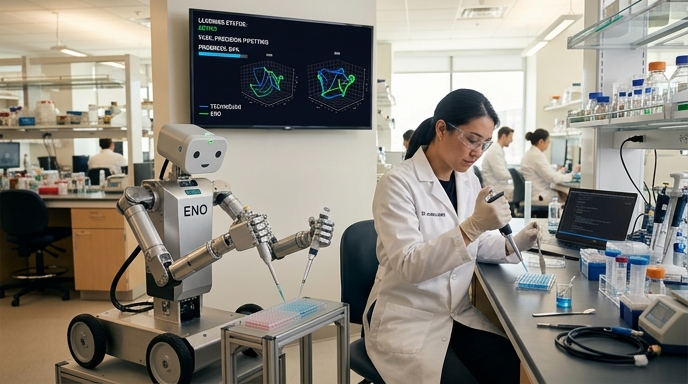
One of the more grounded details in the reporting is that Eno still needs training from users.
Eric Schmidt, the former Google CEO and Genesis AI backer, described the system as one that does not simply wake up knowing every answer. Show it a demo, and it can learn quickly. That is less magical than some AI marketing. It is also more believable.
Robots live in the physical world, and the physical world is a goblin. Objects slip. Lighting changes. Liquids splash. Boxes crumple. Humans leave things in stupid places because humans are, regrettably, humans.
So a useful robot must learn from demonstration. In highly specialized work, that could matter a lot. Schmidt pointed to lab tasks such as pipetting, where precision matters and the environment is controlled enough to make automation plausible.
That is probably where Eno makes the most sense first. Not as a butler. Not as a cheerful home companion folding your novelty socks. As a worker in structured environments where a trained robot can deliver repeatable value.
LG CNS Gives Eno a Door Into Industry
A robot launch is one thing. Getting the robot into real customer environments is another. That is where LG CNS enters the story.
Genesis AI has announced a strategic partnership with LG CNS, the AI transformation and consulting arm of South Korea’s LG Group. The partnership aims to evaluate and deploy Eno in enterprise settings, especially manufacturing and logistics.
This matters because robots do not succeed by being impressive in videos. They succeed by surviving deployment. That means integration with existing systems. It means safety. It means maintenance. It means training workers. It means boring procurement conversations that quietly decide the future.
LG CNS brings enterprise integration experience. Genesis AI brings the robot and AI platform. Together, they are trying to move Eno out of the “cool prototype” zone and into the “actually useful system” zone.
That is the hard part. Every robotics company wants the second category. Far fewer earn it.
The Rollout Plan Starts Where Robots Make Sense
Genesis AI plans to begin production and targeted customer deployments by the end of 2026. The first focus areas are manufacturing, logistics, and laboratories.
That order makes sense.
Factories and warehouses have structured layouts. Labs have specialized, repeatable tasks. These environments also have clear economic pressure. If a robot saves time, increases consistency, or helps with labor shortages, buyers can measure the value.
Later, Genesis AI expects to move toward hospitals, hotels, consumers, and home use. That is the more glamorous path, but also the messier one. Homes are chaos engines with Wi-Fi. Hospitals are complex, regulated, and crowded. Hotels require a robot to navigate service expectations, public spaces, and unpredictable guests.
So the industrial-first strategy looks rational. Start with places where the floor is flat, the work is defined, and the customer can justify the cost.
The home robot dream can wait. Your laundry is safe from Eno for now. Tragically, so is your pile of dishes.
Why Wheels May Beat Legs
The obvious question is: why not build a walking humanoid?
Because legs are hard. Legs consume energy. Legs create safety challenges. Legs make sense for stairs, rough terrain, and human-like mobility. But many workplaces are built with flat floors for wheels. Warehouses, factories, hospitals, hotels, and labs already use carts, trolleys, forklifts, and rolling equipment.
So why force a robot to walk if rolling gets the job done?
Genesis AI’s design seems to treat bipedal movement as optional, not sacred. That is a sharp contrast with companies that believe the robot worker should mimic the human body as closely as possible.
The wheeled approach may look less exciting, but it could offer better reliability and easier deployment. It may also lower the complexity of the machine. That matters because robotics is already brutally difficult. Adding legs can turn a hard problem into a circus act with invoices.
Eno’s design says: keep the hands, ditch the walking theater. That is a provocative bet. It might also be a smart one.
The “Cognitive Interface” Is the Face Replacement
Eno does not have a conventional head, but Genesis AI has discussed an optional “cognitive interface.” This screen can display the robot’s intent, reasoning, and operating state in real time.
That sounds like a small design feature. It is not.
Robots working around people need to communicate. A person needs to know whether the robot is waiting, moving, confused, planning, or about to do something with a box near someone’s foot. A screen can make the robot less mysterious.
It also avoids the uncanny valley problem. Instead of a rubber face pretending to understand your feelings, Eno can show practical status information. That is more useful and less haunted-mannequin.
The design philosophy remains consistent: do not mimic humans unless the imitation helps. Human hands help. Human legs may not. A human face may not. A transparent status screen might.
That is a tidy little thesis. Robots should be legible, not necessarily lifelike.
Funding, Momentum, and the Bigger Robotics Boom
Genesis AI has serious money behind it. Reports say the company raised $105 million from investors including Khosla Ventures, Eclipse, HSG, and Eric Schmidt. That is not pocket change. It is rocket fuel, though robotics has a gift for burning rocket fuel quickly.
The larger market context also matters. Robotics is heating up because AI companies want to move beyond text, images, and chatbots into the physical world. The next frontier is not just software that talks. It is software that acts.
That makes general-purpose robots one of the most tempting—and dangerous—bets in tech. The opportunity is huge. So is the graveyard.
Robots must work in reality, not just in pitch decks. They must handle edge cases, safety demands, hardware wear, customer skepticism, and real economics. A robot that dazzles on launch day can still fail in a loading dock at 2:13 p.m. because someone left a pallet in the wrong place.
Eno enters that arena with a design that looks deliberately practical. That is refreshing. It is also unproven.
What Eno Really Signals
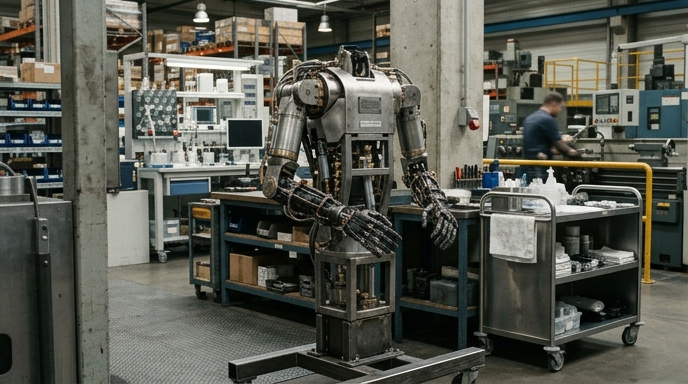
The most interesting thing about Eno is not that it is a robot. It is that it challenges the industry’s visual obsession.
For years, the public imagination has expected useful robots to look like us. Genesis AI is arguing that usefulness matters more than resemblance. That should not be controversial, but in robotics, it is almost spicy.
Eno suggests that the first widely deployed general-purpose robots may not be charming humanoids walking among us. They may be wheeled, foldable, quiet, tool-using machines that look more like appliances than androids.
That would be less cinematic. It might also be more commercially sane.
The big unknown is performance. Can Eno learn quickly enough? Can it manipulate objects reliably? Can it adapt outside demos? Can Genesis AI and LG CNS integrate it into real workflows without drowning in complexity?
Those answers will not come from launch videos. They will come from deployments.
Still, Eno gives the robotics world a useful shove. It says the future robot worker does not need a face. It needs good hands, good software, safe movement, and a business case that does not collapse under scrutiny.
That may not make for the flashiest sci-fi poster. But it could make for a better robot.
Sources
- The Verge: “The next humanoid robot might not look human at all”
- BusinessKorea: “Schmidt-Backed Startup Unveils AI Robot With LG”
- The Robot Report: “Genesis AI launches Eno general-purpose robot”
- Humanoids Daily: “Genesis AI Unveils Eno: The Minimalist Robot Making an ‘Opposite Bet’ on Humanoid Design”
The Kingy Brief
Get the next Kingy Brief.
Source-checked AI changes, original tests and one practical thing to try.
Free · Choose your subjects · Double opt-in · Unsubscribe anytime