
Facebook Search Just Got a Brain Transplant
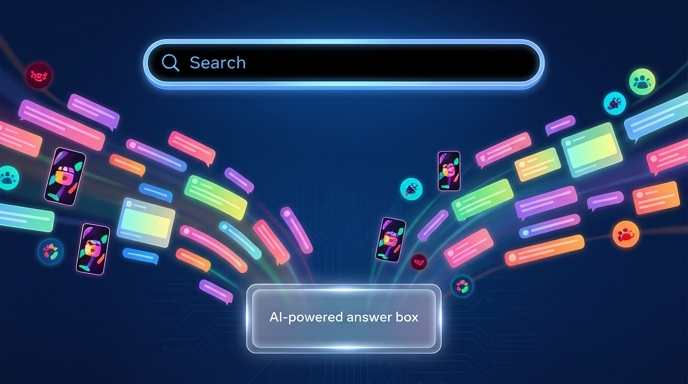
Facebook has spent years trying to convince people it is more than a place for birthday reminders, neighborhood drama, and that one uncle who posts like the caps lock key owes him money. Now Meta wants Facebook to become something else too: an AI-powered answer engine.
On June 15, 2026, Meta announced a new feature called AI Mode for Facebook Search. The idea sounds simple. Instead of typing a question and getting a list of links, users can ask Facebook a question and get an AI-generated answer based on public posts and conversations across Meta’s apps.
That is the big twist. Facebook does not want to answer questions only from websites. It wants to answer them from people.
Meta says AI Mode draws from public posts, recommendations, opinions, Groups, and Reels. In plain English, Facebook is turning its giant archive of social chatter into searchable fuel for Meta AI. Search for dinner ideas, local tips, event chatter, fandom debates, travel suggestions, or product opinions, and Facebook wants to give you something that feels less like a blue-link directory and more like a friend who has read every public comment thread on the platform.
That friend may be useful. That friend may also be messy.
Either way, Facebook Search just became far more interesting.
What AI Mode Actually Does
AI Mode appears as a new search option inside Facebook, alongside familiar categories such as People and Marketplace. Users can ask natural-language questions and receive synthesized responses from Meta AI.
That means the search bar starts acting less like a filing cabinet and more like a conversation. Ask something broad, and AI Mode can summarize what people are publicly saying. Ask a follow-up, and Meta AI can keep going.
Meta’s pitch is clear: regular search gives you links, while AI Mode gives you answers “rooted” in public culture, opinions, and recommendations across its apps. So instead of scrolling through a pile of posts, Groups, Reels, and pages, users can get a compact response.
The difference matters. Facebook has never lacked content. It has a content ocean. The problem has always been fishing anything useful out of it without getting attacked by seaweed, spam, or a comment section with the emotional stability of a raccoon in a vending machine.
AI Mode tries to solve that. It takes the public material people already post and turns it into a more direct answer.
That could make Facebook more useful. It could also make it more powerful, because the platform no longer has to send people elsewhere to find answers.
Meta Is Betting on “Real People,” Not Just Links
Google built its empire by organizing the web. Meta is trying something slightly different. It wants to organize the social web it already owns.
That is the strategic heart of AI Mode. Meta can claim that Facebook answers are not generic because they come from public posts, Groups, Reels, and other user-generated content. It can say the results reflect what people are actually discussing.
That is a sharp positioning move. People often search Google and add “Reddit” to the end because they want lived experience, not polished marketing sludge. Meta clearly sees the same opening. If users want restaurant tips, parenting hacks, product recommendations, or local advice, Facebook Groups already contain years of that material.
The advantage is obvious. Facebook has communities. It has local knowledge. It has personal posts. It has recommendations. It has the weirdly specific stuff search engines sometimes struggle to surface.
But the weakness sits right next to the advantage. Public posts are not automatically accurate. A confident stranger in a group is still a stranger. AI Mode may summarize real people, but real people can be wrong at Olympic-medal level.
So Meta’s pitch is exciting. It is also risky.
Muse Spark Is the Engine Under the Hood
AI Mode runs on Meta AI, powered by Meta’s Muse Spark model. Meta introduced Muse Spark earlier in 2026 as a model designed for its own products, including Facebook, Instagram, WhatsApp, Messenger, Threads, and AI glasses.
That product-first design matters. Meta is not merely dropping a chatbot into Facebook and calling it innovation. It is weaving AI into the surfaces people already use: search bars, posts, group chats, shopping tools, camera features, and creative editing flows.
Muse Spark also fits Meta’s larger strategy. The company wants AI to feel native across its apps. Users should not have to open a separate assistant every time they need help. The assistant should appear where the action already happens.
That is why AI Mode is more than a search update. It is a distribution play.
Facebook still has massive reach. If Meta can make AI useful inside a habit that already exists, it can push Meta AI into daily behavior without begging users to download another app. That is the beauty of owning the pipes. Meta does not need to build a new city. It can install AI plumbing inside the old one.
Whether the water tastes good is another question.
The “Answering Genie” Has Competition
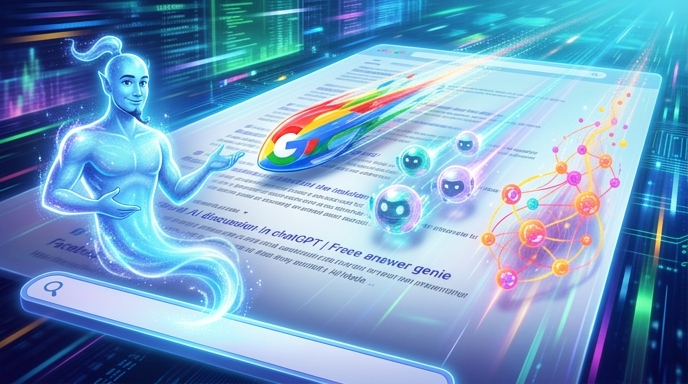
Digital Trends described Facebook’s new feature as an answering genie for burning questions, similar to Google Search. That comparison lands because Google has also pushed hard into AI-generated search answers.
The race now looks simple: every major tech platform wants to become the place where users ask questions and get immediate answers. Google has AI Overviews and AI Mode. OpenAI has ChatGPT. Perplexity built its identity around answer search. Reddit has become a valuable source of human discussion. Meta wants Facebook to join that fight.
But Facebook enters with a strange advantage. It owns a mountain of social context. People do not just post articles there. They ask for recommendations. They complain about restaurants. They review contractors. They argue about sports. They swap parenting advice. They organize local events. They post Reels. They sell used furniture. They join Groups for every topic under the sun.
That gives Meta a different kind of search corpus. Less polished. More chaotic. Often more personal.
And maybe that is the point. AI search does not only need facts. Sometimes it needs texture. It needs “what are people saying?” Meta has plenty of that.
Possibly too much of it. Facebook has never suffered from a shortage of opinions.
The Business Case Is Huge
The money angle is not subtle. According to Forbes reporting cited by Benzinga, Morgan Stanley analyst Brian Nowak estimated that if AI Mode reaches 1 billion users and Meta monetizes just 10% of daily searches, the tool could generate more than $10 billion in annual revenue.
That is not a guarantee. It is an analyst scenario. The assumptions matter. Meta would need enormous usage, meaningful search volume, and a monetization strategy that does not wreck the experience.
Still, the number explains why Meta cares.
Search is one of the internet’s greatest money machines. When people search, they reveal intent. Intent is gold. Someone scrolling a feed may be bored. Someone searching “best running shoes near me” may be ready to buy. Advertisers love that difference.
Meta already dominates social advertising. If it can make Facebook Search more useful, conversational, and commercially relevant, it may unlock a new layer of ad revenue.
That would also help justify Meta’s heavy AI spending. Investors have watched the company pour money into models, infrastructure, talent, and AI products. A search tool with a credible path to billions would change the mood fast.
Nothing calms Wall Street like a new cash register.
The Privacy Line Is Public Content
Meta says AI Mode pulls from public information across its apps. That detail matters.
The company is not framing the feature as a tool that mines private messages or locked-down posts. The emphasis is on public culture, public opinions, public recommendations, and publicly shared content.
That is the right line to draw, but it will not end the debate. Many users do not think deeply about how public their posts are, how AI systems may summarize them, or whether their old comments could become part of a future answer.
This is where Meta needs clarity. Users should know what content can appear in AI Mode, how attribution works, and whether creators or posters get credit. Meta has said Muse Spark will eventually support features that cite recommendations and content people share across Instagram, Facebook, and Threads. That could help.
It needs to happen cleanly.
Because the trust issue is not abstract. If AI Mode summarizes public posts without clear sourcing, users may ask: Who said this? When did they say it? Was it accurate? Was it satire? Was it a 2019 rant from a guy named Dale who thinks every restaurant is “not what it used to be”?
AI search needs answers. It also needs receipts.
The Reliability Problem Is Real
TechCrunch raised the key concern: AI-generated answers based on public posts can become unreliable if the underlying chatter is outdated, misleading, exaggerated, or just plain wrong.
That is not nitpicking. It is the central weakness of social AI search.
Public discussion can be valuable because it captures lived experience. But lived experience does not equal verified truth. A Facebook Group may know which plumber shows up on time. It may not know whether a medical claim, legal claim, or breaking-news rumor is accurate.
AI can make this worse by smoothing rough comments into a confident answer. A messy thread looks messy. A polished AI summary can look authoritative even when it rests on shaky material.
That is the danger. The machine may launder uncertainty.
Meta can reduce the problem with citations, freshness indicators, source links, and limits around sensitive topics. It can show where answers came from. It can make follow-up questions easy. It can avoid pretending that crowd sentiment equals fact.
But the risk will never vanish. Facebook is using public human conversation as raw material. Human conversation is useful. It is also a circus with Wi-Fi.
AI Is Moving Into Creation, Too
AI Mode grabbed the headline, but Meta also announced creative tools for Facebook.
The company is adding AI-powered editing features for photos and videos, including collage cutout templates, transition effects for video montages, and photo presets that can change clothing, hair, and accessories. Sports fans can use a “Wear It” option to virtually dress themselves in team jerseys through Stories or profile-picture tools.
This reveals Meta’s broader plan. It does not want AI to sit in one chatbot box. It wants AI to touch the whole Facebook loop: search, create, edit, post, share, and repeat.
That is smart product design. People do not open Facebook only to ask questions. They browse, react, post, lurk, message, and occasionally create a birthday collage that looks like it was assembled by a very sentimental intern.
AI can reduce friction in all of that. It can suggest a montage. It can restyle an image. It can help someone turn a camera roll into a shareable post.
Meta also says camera roll sharing suggestions remain opt-in and can be turned off. That point deserves attention, because camera roll features can make users twitchy. Nobody wants surprise AI rummaging through personal photos like a nosy roommate.
Opt-in is the sane approach.
Why This Is Bigger Than Facebook
AI Mode is part of a larger shift across the internet. Search is becoming conversational. Feeds are becoming more generative. Creative tools are becoming automatic. Social platforms are turning their own content archives into AI databases.
That changes how people discover information.
For years, the internet trained users to click through results. Now tech companies want to collapse the journey into one answer. That may feel convenient. It may also reduce traffic to publishers, creators, and websites if platforms keep users inside their own walls.
Meta has an especially strong incentive to do that. If Facebook can answer questions inside Facebook, users stay longer. More time means more data, more engagement, and more ad opportunities.
That is the platform logic. It is not mysterious. It is not sentimental. It is business.
The more interesting question is whether users will prefer answers based on public social content. For some searches, yes. Local tips, recommendations, trends, fandom debates, product chatter, and community advice may fit Facebook perfectly.
For hard facts, breaking news, health, finance, law, and science, users should expect stronger sourcing than “people are saying.”
That distinction will define whether AI Mode feels helpful or reckless.
The Bottom Line
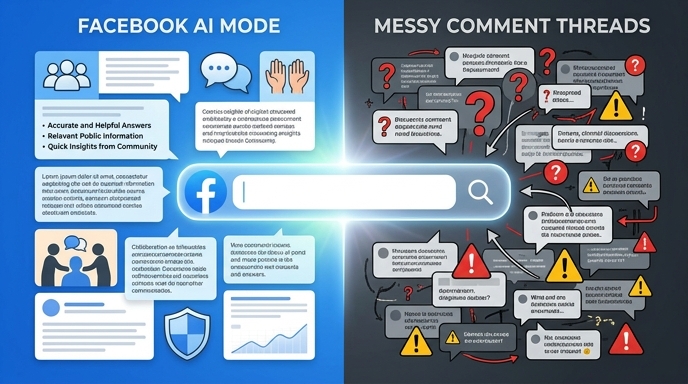
Facebook’s AI Mode is not just a new search tab. It is Meta’s attempt to turn Facebook’s public conversation layer into an answer engine.
That is a big swing. It gives Meta a chance to compete more directly with Google-style search, keep users inside Facebook, make Meta AI more visible, and maybe create a major new revenue stream. It also gives users a faster way to tap into public recommendations, Groups, Reels, and social chatter.
But the same thing that makes AI Mode compelling makes it dangerous. Public posts are rich, weird, current, emotional, useful, biased, outdated, brilliant, and wrong—sometimes all before breakfast.
Meta’s challenge is not only to generate answers. Any AI company can do that now. The real challenge is to generate answers people can trust, trace, and understand.
If Meta gets that right, Facebook Search may become surprisingly useful again. If it gets it wrong, AI Mode could become the world’s most confident comment-section blender.
Either way, Facebook just made search social. Now it has to prove that social search can be smart.
Sources
- Meta Newsroom: New AI Tools to Help You Make Things Happen on Facebook
- The Verge: Facebook’s new AI Mode search gets its info from public posts
- TechCrunch: Meta’s new ‘AI Mode’ on Facebook pulls from public info across its platforms
- Digital Trends: Facebook now has an answering genie for all your burning questions, just like Google Search
- WERSM: Facebook Wants AI To Help You Do Things, Not Just Find Them
- BitcoinEthereumNews: Facebook Launches Search Engine AI Tool That Could Make Meta $10 Billion A Year, Analyst Says
- Benzinga: Meta’s New AI Search Could Generate $10 Billion A Year—and Challenge Google’s Dominance
- Meta Newsroom: Introducing Muse Spark
The Kingy Brief
Get the next Kingy Brief.
Source-checked AI changes, original tests and one practical thing to try.
Free · Choose your subjects · Double opt-in · Unsubscribe anytime