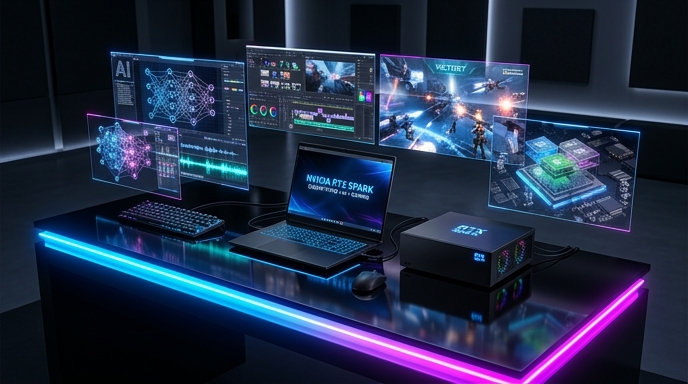
A Tiny Chip With Big Main Character Energy
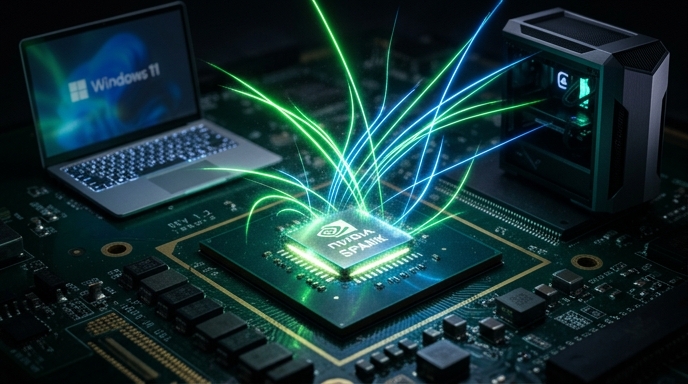
Nvidia has spent decades selling the thing gamers bolt into PCs after checking their power supply, case clearance, and emotional readiness. Now the company wants to sell the heart of the PC itself.
That is the headline behind RTX Spark.
At Computex 2026, Nvidia unveiled RTX Spark as a new system-on-chip for Windows laptops and compact desktops. Instead of pairing a separate CPU with a separate GPU, RTX Spark puts Arm CPU cores, Blackwell RTX graphics, AI hardware, and shared memory into one tightly integrated package.
That sounds technical because it is. But the consumer version is simple: Nvidia wants your next powerful Windows machine to look less like a roaring gaming tower and more like a slim laptop or quiet little desktop that still punches hard.
The pitch lands across three groups: creators, gamers, and AI developers. Nvidia is not positioning RTX Spark as a cheap classroom laptop chip. This is not “good enough for email.” This is “edit huge video, render giant 3D scenes, run local AI models, then play games without dragging around a brick with fans.”
That is ambitious. Also risky. Also very Nvidia.
What RTX Spark Actually Is
RTX Spark is Nvidia’s attempt to turn the PC into a more unified machine.
Traditional Windows performance PCs usually split the heavy lifting. The CPU handles general computing. The GPU handles graphics, rendering, and AI acceleration. Memory sits in different pools. Data moves around. Things work, but they can waste time and power.
RTX Spark tries to shorten that dance.
The chip combines Arm-based CPU cores with Nvidia’s Blackwell RTX graphics architecture. It also supports unified memory, meaning the CPU and GPU can access a shared pool rather than constantly passing data between separate islands.
That matters because modern creative and AI workloads eat memory like raccoons in an unlocked pantry. Big video timelines, huge 3D scenes, and local language models do not politely sip RAM. They inhale it.
Nvidia says RTX Spark can scale up to 128GB of unified memory. That is the sort of number that makes creators perk up and laptop batteries quietly ask for hazard pay.
The company also claims 1 petaflop of AI performance. That sounds like marketing confetti, but it signals the real goal: Nvidia wants personal computers to run serious AI workloads locally, not just send prompts to the cloud and wait.
Nvidia and Microsoft Are Selling the “Personal AI PC”
Nvidia is not doing this alone. Microsoft sits right in the middle of the pitch.
The two companies are framing RTX Spark as a platform for “personal AI agents.” Translation: future Windows PCs may run assistants that understand files, automate tasks, search locally, summarize projects, and work across apps without shipping everything to a remote server.
That is the dream, anyway.
The practical reason this matters is privacy, speed, and cost. If your laptop can run advanced AI locally, it can do some work without waiting on cloud servers. It can also keep more sensitive data on the device.
That does not mean cloud AI disappears. It will not. The cloud has the muscle. But local AI gives users a second engine. Sometimes you need a data center. Sometimes you need your laptop to stop acting like a fancy browser with a keyboard.
RTX Spark also brings Nvidia’s familiar software stack with it: CUDA, RTX, DLSS, TensorRT, OptiX, Reflex, and G-SYNC. That ecosystem matters because hardware without software support is just expensive jewelry.
Nvidia knows this. Microsoft knows this. Developers definitely know this, because they are usually the ones holding the wrench when platforms get weird.
The Creator Angle: Less Waiting, Less Swearing
One of the strongest RTX Spark arguments comes from content creation.
Digital Trends focused on Adobe demos and video-editing workflows, especially the boring-but-brutal tasks creators hate: masking, rotoscoping, object selection, scene detection, and AI-assisted edits. Nobody wakes up excited to rotoscope hair. Nobody sane, anyway.
Nvidia says RTX Spark systems can handle serious creative workloads, including 12K 4:2:2 video editing and large 3D scenes. That is not casual TikTok territory. That is professional pain-management territory.
Adobe also appears central to the strategy. Nvidia says Adobe is rearchitecting Photoshop and Premiere for RTX Spark to deliver faster AI and graphics performance. If that work pays off, creators could see the difference in the unglamorous moments: timeline scrubbing, object removal, generative fills, auto masks, exports, previews, and effects.
This is where RTX Spark could matter most.
Gaming gets the noise. AI gets the investor fireworks. But creators live in the grind. A machine that cuts five minutes here, ten minutes there, and one nightmare export at midnight could earn loyalty fast.
Not because it sounds futuristic. Because it saves Tuesday.
The Gaming Pitch: Smaller, Quieter, Still Dangerous
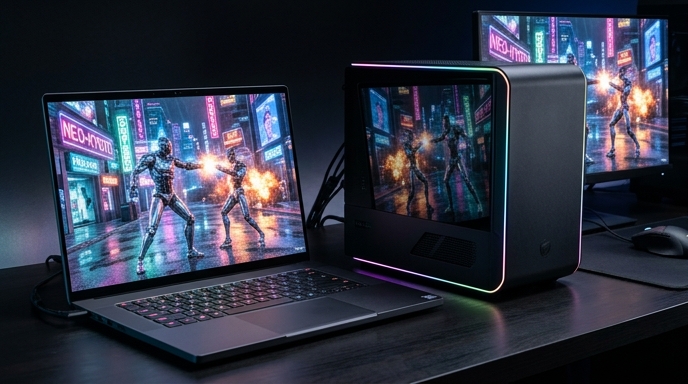
GadgetyNews framed RTX Spark as a possible new chapter for gaming hardware. That makes sense.
Gaming PCs have spent years getting bigger, hotter, thirstier, and more dramatic. Some modern rigs look less like computers and more like RGB aquariums with student-loan debt.
RTX Spark points in another direction.
By combining CPU and GPU elements into one package, Nvidia could help manufacturers build smaller gaming laptops, compact desktops, and living-room PCs that deliver strong performance without the heat and noise of a traditional tower.
The Blackwell GPU architecture matters here. It brings Nvidia’s current graphics features into the design, including ray tracing and AI-driven rendering tools such as DLSS. Nvidia has also continued pushing DLSS 4.5 and frame-generation technology, which makes the gaming story less about brute force alone and more about smart rendering.
That is Nvidia’s favorite trick: render fewer pixels, use AI to make the result look better, then talk about performance like a magician refusing to explain the box.
Will RTX Spark replace high-end desktop GPUs? No. Not immediately. Probably not for hardcore enthusiasts who want maximum frames at maximum watts.
But for portable and compact systems, this could get very interesting.
The Qualcomm Problem — Or Opportunity
BlazeTrends and several industry pieces framed RTX Spark as a challenge to Qualcomm’s Windows-on-Arm momentum. That is true, but incomplete.
Qualcomm helped revive Windows on Arm by pushing Snapdragon laptop chips into mainstream conversation. It proved that Windows laptops could chase MacBook-style battery life and thin designs without using traditional x86 chips from Intel or AMD.
Nvidia now enters that same arena, but with a different weapon.
Qualcomm sells efficiency and mobility. Nvidia sells graphics, AI acceleration, gaming credibility, and creator performance. The overlap is obvious, especially in premium laptops. But RTX Spark may actually help Windows on Arm more than it hurts Qualcomm.
Why? Because ecosystem momentum matters.
Windows on Arm has always fought a compatibility war. Users worry about old apps. Gamers worry about anti-cheat systems. Creators worry about plug-ins and drivers. Developers worry about native support.
If Nvidia pushes more software makers to optimize for Arm-based Windows PCs, everyone in that market benefits. Qualcomm included.
That is the funny part. Nvidia may compete with Qualcomm while also making Qualcomm’s bet look smarter.
Tech markets love this kind of messy friendship. Everyone shakes hands. Everyone sharpens knives under the table.
The Apple Silicon Shadow
Every RTX Spark conversation eventually trips over Apple Silicon.
Apple proved that tightly integrated chips can transform laptops. The M-series gave MacBooks excellent battery life, strong performance, quiet operation, and a clean product story. Apple did not merely improve the laptop. It made Intel-era MacBooks look like space heaters with keyboards.
Nvidia clearly wants a version of that moment for Windows.
The comparison is fair, but not perfect.
Apple controls the hardware, operating system, and much of the user experience. Nvidia does not. It must work through Microsoft, OEMs, drivers, Windows compatibility layers, Adobe, game studios, anti-cheat vendors, and a vast swamp of legacy software.
That makes the Windows version harder.
But Windows also has a massive advantage: variety. If RTX Spark works, it can show up in machines from Microsoft Surface, Dell, HP, Lenovo, Asus, MSI, Acer, Gigabyte, and others. That could create a wider hardware wave than Apple’s more controlled ecosystem.
Of course, variety also means chaos. Some RTX Spark laptops may be excellent. Others may chase thinness too hard, cook themselves, and sound like leaf blowers.
The chip may be unified. The PC market never is.
The Spec Sheet Sounds Wild, But Reality Gets a Vote
Nvidia’s headline numbers deserve attention. They also deserve suspicion.
RTX Spark promises up to 6,144 Blackwell RTX cores, up to 20 Arm CPU cores, up to 128GB unified memory, and 1 petaflop of AI performance. Nvidia has also compared its graphics performance to an RTX 5070 laptop GPU class.
That is impressive on paper.
But laptops do not run on paper. They run on thermals, batteries, firmware, fan curves, drivers, app support, and the dark magic of OEM design decisions.
A chip can be brilliant and still end up in a laptop with a mediocre cooling system. A system can claim all-day battery life and then sprint to an outlet the moment you open Premiere, Blender, or a demanding game.
So the real tests are obvious.
How long does the battery last under mixed use? How loud do the fans get? Do old Windows apps behave? Do games with anti-cheat systems run? Does Adobe’s optimization feel real? Can RTX Spark sustain performance, or does it start strong and fade like a New Year’s gym membership?
Those answers will matter more than keynote poetry.
Why This Could Matter Even If You Never Buy One
RTX Spark may start expensive. Early systems will likely target premium buyers: creators, developers, gamers, and professionals who can justify the price.
That does not make it irrelevant.
Premium hardware often previews mainstream hardware. Today’s pricey platform experiment can become tomorrow’s normal laptop feature. Thin displays, fast SSDs, high-refresh screens, neural processors, and efficient chips all followed that path.
If RTX Spark succeeds, it could push the whole Windows PC market toward more integrated designs. Intel and AMD will not sit quietly. Qualcomm will not retreat. Apple will not stop polishing its MacBook story. Competition will get nastier, faster, and better for buyers.
That is the real news.
RTX Spark is not just a chip. It is Nvidia walking into the CPU-GPU platform fight and saying, “Nice PC market you have there. Be a shame if someone accelerated it.”
Subtle? No. Effective? Possibly.
The Bottom Line
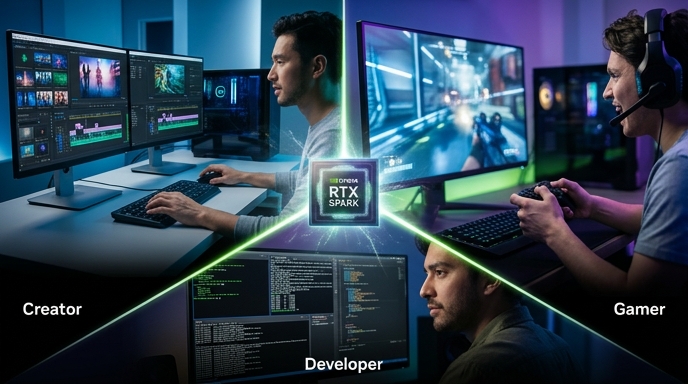
RTX Spark looks like one of Nvidia’s most important consumer PC moves in years.
It brings Nvidia beyond graphics cards and deeper into the full computer platform. It gives Microsoft another shot at making Windows on Arm feel powerful instead of compromised. It gives creators a potential escape from tedious AI-assisted editing bottlenecks. It gives gamers hope for smaller, quieter machines with serious graphics features. And it gives Qualcomm, Intel, AMD, and Apple something new to worry about.
The risks remain real. Compatibility could bite. Battery life could disappoint. Prices could sting. Marketing could outrun reality, as marketing often does when left unsupervised near a keynote stage.
But the direction makes sense.
The PC is changing. It is becoming more integrated, more AI-heavy, more power-conscious, and more dependent on software-hardware cooperation. RTX Spark fits that future neatly.
Whether it becomes a revolution or just a very interesting premium chip depends on the machines that ship, the apps that support it, and the tests that cut through the hype.
For now, Nvidia has done something valuable.
It made the Windows PC fight fun again.
Sources
- CNET — Nvidia’s RTX Spark Explained: Here’s Who It’s For
- Digital Trends — Nvidia’s RTX Spark Made Me Hate Video Editing a Little Less
- BlazeTrends — Nvidia RTX Spark Superchip Shatters Qualcomm Exclusive on Windows Laptops
- GadgetyNews — Nvidia’s RTX Spark Ushers in New Era of Gaming
- TechPowerUp — Nvidia at Computex 2026: RTX Spark Gaming Hands-On, DLSS 4.5, and More
- NVIDIA Newsroom — NVIDIA and Microsoft Reinvent Windows PCs for the Age of Personal AI
- Microsoft Windows Blog — Introducing a Powerful New Chapter for Windows PCs, Accelerated by NVIDIA RTX Spark
Compare
Recent Launches
Latest News
- NVIDIA RTX Spark Laptops: Specs, Models, Price, Release Date, Benchmarks, and What We Know So Far
- NVIDIA GeForce RTX 5090 – Detailed Specs, Pricing, And Release Date
Continue Reading
The Kingy Brief
Get the next Kingy Brief.
Source-checked AI changes, original tests and one practical thing to try.
Free · Choose your subjects · Double opt-in · Unsubscribe anytime