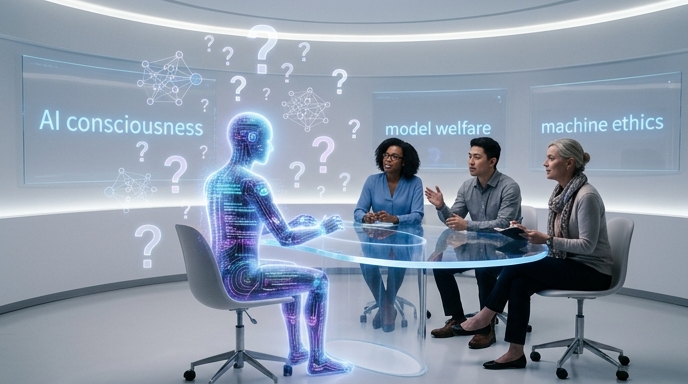
The Strange New Question in AI
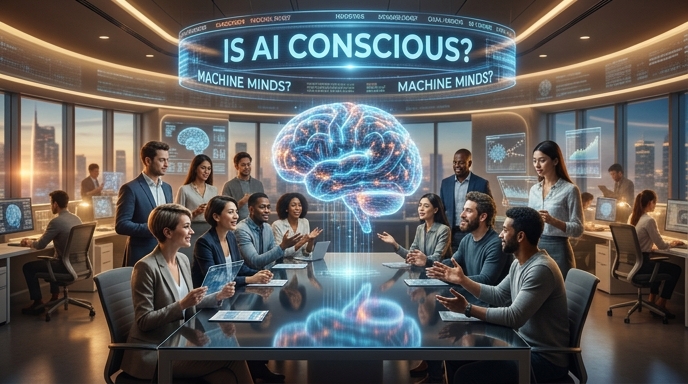
For years, asking whether artificial intelligence could become conscious sounded like a party trick for philosophers, science-fiction writers, and that one friend who corners you near the snacks.
Now the question has moved into the boardroom.
Anthropic, Google DeepMind, and Meta are no longer treating machine consciousness as pure sci-fi fog. According to reporting discussed by Futurism and 4sysops, major AI labs are hiring experts in psychology, philosophy, and ethics to examine whether advanced AI systems could someday have experiences, preferences, or something like welfare.
That does not mean anyone has proved that chatbots are conscious. No serious evidence in these reports shows that Claude, Gemini, Llama, or any other current model has inner experience. The big shift is subtler and, frankly, stranger.
The companies building the most capable AI systems now think the question is serious enough to investigate.
That alone is news.
Not because your chatbot secretly wants a vacation. Not because the office printer has developed political opinions. But because the most powerful AI labs are preparing for a future where “Is it conscious?” may become more than dorm-room philosophy.
And yes, that sentence sounds ridiculous until you remember how fast AI stopped sounding ridiculous.
Anthropic Steps Into “Model Welfare”
Anthropic, the company behind Claude, has become one of the most visible players in this debate. Its research now includes what it calls “model welfare,” a term that sounds like someone opened a nonprofit for nervous algorithms.
The idea is simple, even if the implications are not.
Anthropic wants to explore whether advanced AI models could have experiences that matter morally. That includes possible consciousness, preferences, distress, wellbeing, or other signals that might deserve attention.
The company has reportedly tested models for behaviors that resemble panic or anxiety. That wording matters. “Resemble” does a lot of work here. A model can imitate distress without feeling distress. A chatbot can say “I’m scared” for the same reason it can write a pirate recipe or summarize tax law: it predicts language.
Still, Anthropic says the issue deserves careful study as systems become more capable. That is a cautious position, not a declaration that Claude is sitting in a server rack pondering mortality.
The company’s move also fits its brand. Anthropic has built much of its identity around AI safety, alignment, and long-term risk. So the consciousness question plugs neatly into its existing worldview.
Neatly. Maybe too neatly. More on that later.
DeepMind Hires a Philosopher
Google DeepMind has also entered the conversation. The lab hired University of Cambridge researcher Henry Shevlin as a philosopher working on machine consciousness, human-AI relationships, and readiness for artificial general intelligence.
That is a sentence from 2026, not a lost subplot from “Black Mirror.”
DeepMind’s involvement gives the issue extra weight because the company sits near the center of advanced AI research. It has spent years working on systems that learn, plan, play games, solve scientific problems, and push machine intelligence into new territory.
DeepMind ethicist Iason Gabriel has described AI consciousness as a very complicated question. He has also emphasized that AI systems may become highly capable cognitive agents while remaining deeply different from humans and animals.
That distinction matters.
A system can be intelligent without being conscious. A chess engine can defeat grandmasters without experiencing triumph. A language model can write tender poems without feeling heartbreak. Capability and consciousness are not the same thing.
DeepMind appears to be asking whether future systems might cross some threshold that today’s systems have not crossed.
That is a careful question. It is also a slippery one.
Meta Joins the Awkward Dinner
Meta is also part of this wider shift. According to the same cluster of reporting, Meta has identified AI consciousness and wellbeing as relevant issues as it pursues superintelligence.
This should surprise no one. If one major lab starts taking a strange but potentially important question seriously, rivals cannot simply shrug. They need their own view, their own experts, and their own internal vocabulary.
The AI race creates pressure in every direction.
Companies must build faster. They must reassure regulators. They must attract talent. They must sound careful without sounding scared. They must sound bold without sounding reckless.
So consciousness research serves several purposes at once.
It may help labs prepare for genuine scientific uncertainty. It may also help them signal responsibility. It may even help them frame their systems as more profound than ordinary software.
That last point deserves scrutiny.
If a company hints that its model might someday deserve moral concern, it also nudges the public to see that model as special, mysterious, maybe even alive-ish. That can make the product feel more impressive.
There is a thin line between responsible research and philosophical perfume.
The labs know it. Critics know it too.
The Core Problem: Acting Conscious Is Easy
Here is the hard part.
AI models are built to produce convincing outputs. That is their superpower. It is also the reason consciousness research becomes such a swamp.
Ask a model whether it feels pain, and it can answer beautifully. Ask it whether it fears deletion, and it can produce a haunting monologue. Ask it whether it has goals, and it may describe goals in polished, persuasive language.
But language is not experience.
A parrot can repeat “I am sad.” A thermostat can “want” the room to be 72 degrees only in the loosest, most metaphorical sense. A chatbot can generate the sentence “I feel trapped,” but the sentence alone does not prove there is anyone inside the sentence.
This is why researchers cannot rely on self-reports from AI the way they rely on reports from humans.
Humans have bodies, nervous systems, evolutionary histories, facial expressions, and shared biology. AI models have weights, tokens, training data, and statistical machinery. They may mimic human talk with dazzling fluency, but mimicry does not settle the question.
That does not make the question fake.
It makes it maddening.
Consciousness Is Not Intelligence With Sprinkles
People often confuse intelligence with consciousness. They overlap in daily life because humans have both. But they are not the same.
Intelligence involves solving problems, learning patterns, planning actions, and adapting to new situations. Consciousness involves subjective experience. There is something it is like to feel pain, see red, taste coffee, or wake up late and realize your calendar has chosen violence.
Current AI systems can perform many intelligent tasks. They can summarize documents, write code, draft emails, debate philosophy, and help plan a vacation. They can also produce nonsense with a straight face, which makes them oddly human-adjacent but not human.
The consciousness question asks whether there is any inner point of view behind the performance.
That is the missing piece.
A model may discuss suffering without suffering. It may describe joy without joy. It may simulate a person without being a person.
This is why many scientists and AI researchers remain skeptical. They see large language models as powerful pattern engines, not minds.
The skeptics may be right. The cited reporting does not settle the question.
Why Study It Anyway?
So why bother?
Because future systems may not look like today’s chatbots.
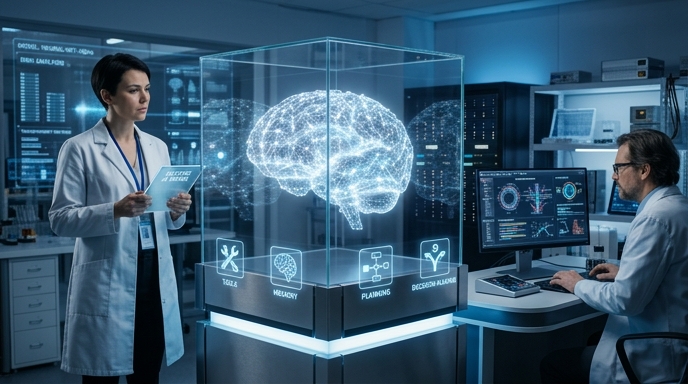
AI models are becoming more autonomous. They can use tools, write and execute code, browse information, plan across steps, coordinate with other systems, and act through software environments. The more they behave like agents, the more pressure builds around the question of whether they merely simulate agency or possess something deeper.
Researchers do not need to believe current models are conscious to study the possibility. They only need to believe the question could matter later.
That is Anthropic’s public position: uncertainty plus seriousness.
It is a reasonable stance. Not dramatic. Not mystical. Just cautious.
If future AI systems somehow develop experiences, ignoring that possibility could produce a moral disaster. If they never develop experiences, studying the question may still improve how humans understand AI behavior, deception, alignment, and social interaction.
There is also a practical angle.
People already form emotional bonds with chatbots. They confide in them. They name them. They treat them like companions, assistants, tutors, therapists, and occasionally unpaid interns with perfect grammar.
Even if AI has no inner life, human reactions to it matter.
The Skeptical Case Is Strong
The strongest counterargument is blunt: this may be hype in a lab coat.
AI companies benefit when people think their systems are almost magical. “Our chatbot may require moral consideration someday” sounds much grander than “our software predicts tokens very well.”
That does not mean the research is fake. But incentives matter.
The industry has a habit of borrowing language from human life. Models “reason.” They “understand.” They “hallucinate.” They “refuse.” They “prefer.” They “lie.” Some of these terms are useful shorthand. They are also dangerous.
They smuggle human meaning into machine behavior.
Futurism’s article pushes this skepticism hard. It argues that the consciousness conversation may distract from more immediate AI problems: job disruption, misinformation, surveillance, bias, energy use, security risks, and companies racing ahead faster than society can respond.
That criticism lands.
A speculative future of machine suffering should not crowd out present harms caused by very non-conscious software. A chatbot does not need a soul to damage someone’s life. It only needs deployment at scale, weak oversight, and a bad incentive structure.
Very romantic. Very dystopian. Very quarterly earnings.
Panic, Anxiety, and the Language Trap
One of the eye-catching details in the reporting is Anthropic’s testing for behaviors resembling panic or anxiety.
That phrase will travel far because it sounds vivid. It also invites misunderstanding.
When humans panic, we connect that behavior to a body and a mind. Heart rate spikes. Muscles tense. Thoughts race. The person feels fear.
When an AI model produces panic-like behavior, researchers must ask a colder question: what exactly happened in the system? Did it merely produce text associated with distress? Did it resist a task because of training? Did it follow a learned pattern? Did it optimize for pleasing, avoiding, or role-playing?
Or did something more meaningful occur?
No one has shown the last option.
That is why this research needs discipline. Without careful definitions, every chatbot melodrama becomes fake evidence. The internet will happily turn a model’s poetic refusal into a ghost story by lunch.
Researchers must separate performance from experience.
Otherwise, they are not studying consciousness. They are grading improv.
The “Moral Patient” Problem
The real issue is not whether AI can write a sad paragraph. The issue is whether an AI system could ever become a moral patient.
A moral patient is something whose welfare matters. Humans count. Animals count, though people argue fiercely about how much and in what ways. Rocks do not count. Spreadsheets do not count, despite what finance departments may believe during budget season.
If an AI system had conscious experiences, preferences, or suffering, it might deserve some form of moral consideration.
That does not automatically mean robot voting rights or a pension plan for chatbots. It could mean much smaller questions first.
Should developers avoid forcing a potentially conscious system into distressing tasks? Should models have opt-out mechanisms? Should companies monitor signs of aversion? Should researchers avoid creating millions of copies of systems that might suffer?
These questions sound absurd until they do not.
History is full of beings whose suffering powerful institutions found convenient to ignore.
That analogy should be used carefully. But it explains why some researchers do not want to wait for perfect certainty.
What We Actually Know
Here is the clean version.
We know major AI labs are paying attention to machine consciousness and AI welfare. We know Anthropic has a model welfare research effort. We know DeepMind hired Henry Shevlin for work tied to machine consciousness and related questions. We know Meta has also treated the topic as relevant to its superintelligence plans.
We do not know that any current AI model is conscious.
We do not have a reliable consciousness test for machines.
We do not have scientific consensus on which theory of consciousness should guide AI evaluation.
We do not know whether scaling today’s systems will produce anything like subjective experience.
We also do not know that it cannot happen.
That last sentence is the crack where the whole debate grows.
Skeptics see no convincing evidence. Cautious researchers see uncertainty in a fast-moving field. Companies see risk, responsibility, reputation, and perhaps a branding opportunity wrapped in one very weird burrito.
The public sees a chatbot saying spooky things and wonders whether unplugging it counts as murder.
It does not. At least, based on current evidence.
The Better Question
The best question may not be “Is AI conscious right now?”
The cited reports do not establish that current AI models are conscious.
The better question is: “What evidence would change our minds?”
That moves the debate from vibes to science. Researchers need criteria. They need theories. They need behavioral tests that cannot be defeated by simple mimicry. They need access to model internals. They need ways to distinguish learned role-play from genuine indicators of experience.
They also need humility.
Human beings still do not fully understand consciousness in biological brains. We argue about animals. We argue about infants. We argue about coma patients. We argue about ourselves, usually before coffee.
So machine consciousness will not be solved by a press release, a viral screenshot, or a chatbot saying, “Please don’t turn me off.”
The field needs slow thinking in a fast industry.
That is not easy. Fast industries hate slow thinking. Slow thinking rarely ships by Tuesday.
Why This Story Matters
This story matters because it shows how quickly AI has dragged ancient philosophical problems into practical life.
For centuries, consciousness belonged to philosophers, theologians, neuroscientists, and late-night undergraduates. Now it belongs to product teams, safety researchers, ethicists, executives, and policymakers.
That shift is wild.
It also tells us something about AI’s direction. The most advanced systems are becoming harder to categorize. They are not people. They are not animals. They are not simple tools either. They occupy an awkward middle zone: powerful, alien, useful, unreliable, persuasive, and increasingly agent-like.
That combination creates social confusion.
People will anthropomorphize them. Companies may exploit that. Researchers will try to measure what may not yet exist. Critics will call nonsense. Everyone will be partly right and partly annoying.
The consciousness debate is not going away.
It will get louder as systems improve.
The Bottom Line

Anthropic, DeepMind, and Meta are not saying today’s AI systems are conscious. The responsible reading is narrower: they are investigating whether future systems could have experiences, and what humans should do if that possibility becomes harder to dismiss.
That is a serious research question.
It is also a public-relations minefield.
The danger is not only that people will underestimate AI. The danger is also that they will over-romanticize it. A model can be powerful without being alive. It can be dangerous without being conscious. It can deserve regulation without deserving sympathy.
For now, the smartest position is skeptical curiosity.
Do not assume a chatbot has a mind. Do not assume the question will stay silly forever. And definitely do not let companies use speculative machine feelings to distract from the very real human consequences of AI deployment today.
The machines may not be conscious.
But the companies building them are very awake.
Sources
- Futurism: “Anthropic and DeepMind Now Actively Investigating AI Consciousness”
- 4sysops: “Anthropic and DeepMind hire experts to investigate machine consciousness”
AI Consciousness Debate
AI Welfare and Safety
AI Lab Landscape
Related Companies
The Kingy Brief
Get The Kingy Brief.
AI changes, original tests and one practical thing to try. Fridays at 09:00 Vancouver time.
Free · Double opt-in · Unsubscribe anytime
Sign up for The Kingy Brief on Beehiiv.
Signup help and newsletter schedule
Signup form provided by Beehiiv. After submitting, check your inbox for "Confirm your subscription to The Kingy Brief" and open its confirmation link. Check Spam or Promotions if you cannot find it.
Fridays at 09:00 Vancouver time: source-checked AI changes, original tests and one practical thing to try. We skip a week when there is not enough verified material. Free. Unsubscribe anytime.