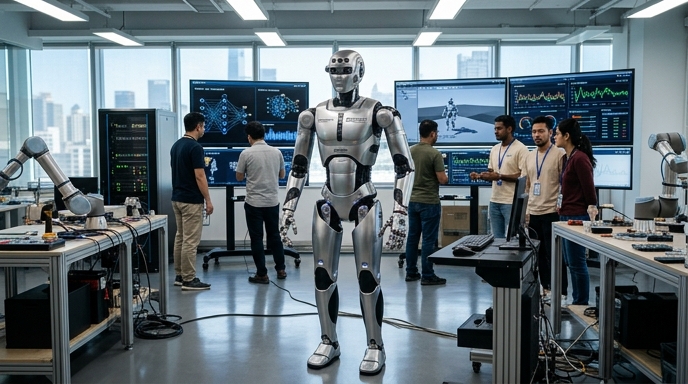
The Robot Walks Into the Room
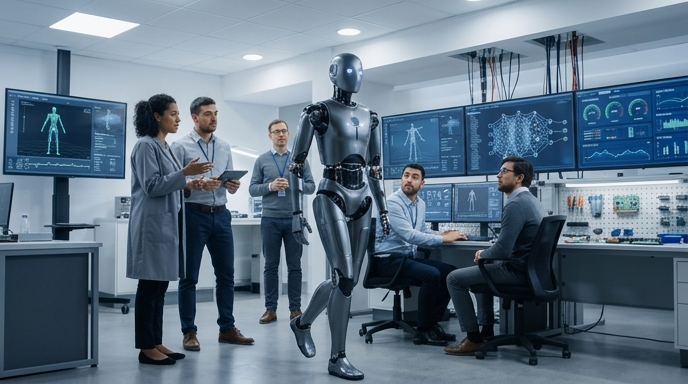
The humanoid robot race just got a new main character.
Nvidia has teamed up with China’s Unitree Robotics to create the NVIDIA Isaac GR00T Reference Humanoid Robot, a research platform built around Unitree’s H2 Plus humanoid body, Sharpa’s five-fingered robotic hands, and Nvidia’s Jetson Thor compute system. That is a very technical way of saying: the robot has a Chinese-built body, dexterous hands from Singapore, and an American AI brain.
The package targets universities, labs, and robotics developers that want to work on humanoids without spending months wrestling with basic hardware integration. Instead of forcing researchers to build a robot from scratch, Nvidia wants to hand them a serious starting point.
The robot stands nearly six feet tall and weighs about 150 pounds. So, yes, it has “guy blocking the grocery aisle” proportions. But this is not a consumer gadget. Nvidia calls it a reference design, meaning it serves as a standard platform for research, testing, simulation, training, and real-world robot behavior.
That matters because humanoid robotics has a giant bottleneck: everyone wants smart robots, but almost nobody wants to spend half the project just making the thing stand up without face-planting.
The Body Comes From Unitree
Unitree has become one of the most visible names in Chinese robotics. Its robots appear constantly in viral videos, usually doing things that make normal machines look lazy: flips, kicks, dances, parkour moves, and other feats that scream “engineering demo with a gym membership.”
For Nvidia’s new reference robot, Unitree provides the H2 Plus humanoid chassis. According to NVIDIA’s announcement, the body stands nearly six feet tall, weighs around 150 pounds, and has 31 degrees of freedom across the body. That gives researchers a human-scale machine for testing movement, balance, manipulation, and whole-body control.
This matters because size changes everything. A small tabletop robot can learn cute tricks. A full-size humanoid has to deal with gravity, weight, reach, torque, safety, battery life, sensors, and the ancient enemy of all robots: stairs.
Unitree brings the mechanical side. Motors. Joints. Sensors. Actuators. The stuff that makes the robot more than a fancy chatbot wearing sneakers.
The company also brings cost pressure to the market. WIRED noted that Unitree’s G1 humanoid has been far cheaper than many competing robots, which often cost hundreds of thousands of dollars. That cheaper-hardware angle could help more labs get actual robots into actual rooms.
And actual rooms beat PowerPoint. Every time.
Nvidia Supplies the Brain
Nvidia is not just tossing a chip into a metal person and calling it innovation. The company wants to own the “brain” layer of physical AI.
At the center of this platform sits NVIDIA Jetson AGX Thor T5000. Nvidia says the module includes a Blackwell GPU, 2,070 FP4 teraflops of AI performance, a 14-core Arm CPU, 128GB of unified memory, and a configurable 40- to 130-watt power range. Translation: the robot can process sensor data and run AI models onboard, rather than outsourcing every thought to a distant cloud server.
That matters. Robots do not have the luxury of pondering forever. If a humanoid slips, reaches for a tool, sees a person nearby, or bumps into a messy table, it needs to react fast.
Nvidia also brings the Isaac GR00T platform. That includes tools for data capture, simulation, model training, evaluation, and deployment. Researchers can teleoperate the robot, collect demonstrations, train policies, test them in simulation, and then move them onto the physical machine.
This is Nvidia’s familiar playbook. In AI, the company did not only sell chips. It built the software ecosystem around them. Now it wants to do the same for robots.
The pitch is simple: do not just buy the brain. Build your robot world around it.
The Hands Are a Big Deal
Humanoid robots usually look impressive until they try to use their hands. Then things get awkward fast.
Walking is hard. Balance is hard. But manipulation is a special kind of robotic nightmare. Human hands are absurdly capable. We open jars, peel fruit, hold mugs, shuffle papers, tie knots, grab slippery objects, and somehow pick one tortilla chip from a bag without pulverizing the whole snack ecosystem.
The Nvidia-Unitree reference design uses Sharpa Wave tactile five-finger hands. Nvidia says the hands add 22 degrees of freedom and bring the total system to 75 degrees of freedom across body and hands. The platform also includes wrist cameras for close-range manipulation, plus a head-mounted stereo camera with a wide field of view.
That combination gives researchers a better shot at studying the messy intersection of seeing, reaching, grasping, and adjusting.
This is where humanoids become more than walking demos. A robot that only strolls around is interesting. A robot that can pick up tools, sort objects, open doors, carry items, and recover from small mistakes starts to look economically useful.
The hands make the machine less like a mascot and more like a worker-in-training.
Still, nobody should pretend the dexterity problem is solved. It is not. Robots remain clumsy compared with humans. But better hands give researchers better experiments, and better experiments move the field faster.
Why Researchers Care
Nvidia says the reference robot targets academic research. That phrase sounds polite, but the ambition is enormous.
Humanoid robotics has been a rich-company sport. Big technology firms, deep-pocketed startups, and elite labs have had the best shot because the entry ticket has been brutal. Teams need hardware, simulation software, data pipelines, control systems, safety procedures, compute, cameras, hands, middleware, and engineers who can debug all of it before lunch. Good luck.
A standard reference design changes the rhythm.
Researchers can spend less time asking, “Why is the robot’s left elbow behaving like a haunted fishing rod?” and more time asking, “Can this machine learn a useful physical skill?”
Nvidia says leading institutions including Ai2, ETH Zurich, Stanford Robotics Center, and UC San Diego’s Advanced Robotics and Controls Laboratory plan to use the design. That gives the project credibility beyond corporate sizzle.
The real value comes from shared baselines. If multiple labs use similar hardware and software, they can compare results more easily. They can share code, reproduce experiments, and have productive arguments the kind about ideas, not about whose custom robot platform broke first.
Science loves standards. Robots need them badly.
The “Open” Pitch
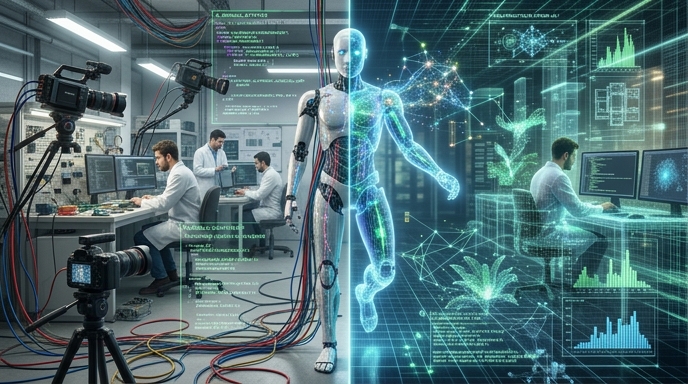
Nvidia describes the Isaac GR00T Reference Humanoid Robot as an open humanoid robot reference design. That word, “open,” carries weight in robotics.
Robotics research often fragments into private platforms. One team trains on one robot. Another team trains on a different robot. A third team uses a simulation environment that behaves like physics after three coffees and a bad night’s sleep. Results do not always transfer cleanly.
Nvidia wants to make the workflow more unified. Its platform includes Isaac Teleop for collecting demonstration data, Isaac GR00T open foundation models for reasoning and multitask behavior, Isaac Sim and Isaac Lab for simulation and training, Isaac ROS middleware, and Jetson Thor for real-time deployment.
That stack turns the robot into more than hardware. It becomes a full research pipeline.
Researchers can capture human demonstrations. They can generate or refine training data, evaluate models, and simulate risky behavior safely—before letting expensive hardware become the crash-test dummy. Then they can deploy them to the robot.
That sounds boring until you remember what the alternative looks like: ten incompatible tools, three panicked graduate students, and a robot that refuses to pick up a sponge.
The open-platform pitch is Nvidia’s attempt to make humanoid development less artisanal and more scalable.
The Security Question Walks In
Of course, this story has a geopolitical plot twist.
The robot combines Chinese hardware and American AI compute at a time when the United States and China are locked in a high-stakes technology rivalry. That makes the partnership both logical and politically uncomfortable.
WIRED reported that some U.S. politicians have floated restrictions on Chinese humanoid robots, and researchers have raised concerns about data risks involving Unitree robots. Nvidia appears aware of those anxieties. Its official announcement emphasizes that researchers retain control over robot data, training data, telemetry, and logs.
That line is not decorative. It is doing work.
Robots are not just laptops with knees. They sense physical spaces. They may collect images, maps, movements, voice interactions, and operational data. In factories, labs, warehouses, hospitals, and homes, that data could become sensitive quickly.
So the security question will not disappear. The more capable humanoids become, the more important data governance becomes.
Still, the partnership makes industrial sense. China has a powerful robotics hardware supply chain. Nvidia has world-class AI compute and software. Put those together, and you get a machine that looks like the future and a policy headache wearing sneakers.
The Market Smells Money
Nvidia CEO Jensen Huang has framed humanoid robots as part of a much larger “physical AI” opportunity. The company sees a future where AI does not just write emails, generate images, and summarize meetings. It moves through warehouses, handles tools, sorts parts, and helps make things, basically, the quiet coworker that never asks where the tape is.
That is the real commercial dream.
Industrial robots already transformed manufacturing, but most of them live in controlled environments. They repeat narrow tasks with excellent precision. Humanoids promise something different: general-purpose physical labor in spaces designed for humans.
That is why humanoid companies keep attracting attention. A robot shaped roughly like a person can use stairs, doors, shelves, carts, tools, and workstations built for people. In theory, businesses would not need to redesign every workplace around machines.
In practice, that theory still needs a lot of engineering. Humanoids must become reliable, safe, affordable, durable, and useful. One impressive demo does not equal a business case. A robot doing a backflip on social media does not mean it can handle an eight-hour shift without drama.
But Nvidia does not need humanoids to become perfect tomorrow. It needs developers to build on its platform today.
That is how ecosystems form.
Unitree Gets a Global Boost
This partnership also gives Unitree a sharper international profile.
MK reported that Unitree is pursuing a listing on Shanghai’s STAR Market and that a large share of its revenue already comes from outside China. A collaboration with Nvidia can help Unitree look less like a viral robotics company and more like a serious supplier to global research institutions.
That does not mean everyone will cheer.
Western robotics companies may see Unitree as a formidable rival. Policymakers may worry about dependency on Chinese hardware. Security experts may push for strict controls. Universities may love the capabilities but tread carefully around procurement rules and data policies.
Still, Unitree’s advantage is obvious: it can build capable robot bodies at prices that make research adoption more realistic.
That could reshape the humanoid market. If labs can buy more robots, they can run more experiments. If they run more experiments, models improve faster. If models improve faster, applications arrive sooner.
The feedback loop matters.
Robotics progress does not come from one glorious robot strutting across a keynote stage. It comes from thousands of hours of ugly testing, failed grasps, bad falls, broken assumptions, and better software.
Cheaper, standardized hardware feeds that grind.
Late 2026 Is the Date to Watch
Nvidia says the Isaac GR00T Reference Humanoid Robot will be available from Unitree in late 2026. That gives the robotics world a concrete timeline, but also a reality check.
This is not a robot army shipping tomorrow. It is a research platform expected later this year. Its first big impact will likely happen in labs, not living rooms.
That distinction matters.
Consumer humanoids still face massive hurdles: cost, safety, usefulness, maintenance, insurance, privacy, regulation, and the basic question of whether normal people actually want a six-foot machine wandering around the kitchen. The answer may be yes eventually, but let’s not pretend everyone wants a metal roommate named Kevin.
Research platforms move differently. They do not need to be polished consumer products. They need to be capable, programmable, measurable, and flexible. They need to let smart teams test hard ideas.
That is what Nvidia and Unitree are offering: not a finished future, but a better launchpad.
The robot may look like a beefcake. The real product is the ecosystem underneath.
Why This Could Matter
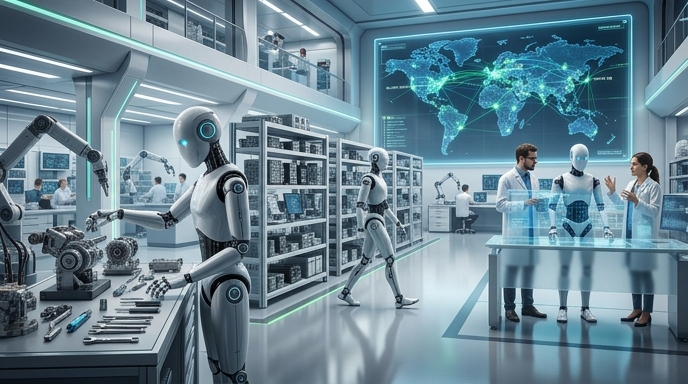
The Nvidia-Unitree robot matters because it bundles several trends into one machine.
First, AI is leaving the screen. Software intelligence wants a body. Second, robotics needs better common platforms. Third, China’s hardware strength and America’s AI-chip strength remain deeply intertwined, even when politics tries to pull them apart. Fourth, universities need access to serious humanoid systems if they want to compete with private labs.
This robot does not prove humanoids will take over factories. It does not prove general-purpose robots are close. It does not prove Unitree will dominate, Nvidia will own physical AI, or every warehouse will soon look like a sci-fi casting call.
But it does prove something important: the humanoid race is moving from isolated demos toward standardized development platforms.
That is usually when a field starts to accelerate.
The smartphone needed app stores. AI needed GPUs, frameworks, and cloud infrastructure. Humanoid robots may need reference designs, shared tools, and enough real machines in enough labs to turn research chaos into momentum.
Nvidia knows this game. It has played it before.
Now the company wants to turn robots into the next platform war. Unitree brought the body. Sharpa brought the hands. Nvidia brought the brain.
The rest of the industry just got a very tall homework assignment.
Sources
- WIRED: “The Humanoid Robot of the Future Is a 6-Foot-Tall Beefcake With a Chinese Body and an American Brain”
- DNYUZ: “The Humanoid Robot of the Future Is a 6-Foot-Tall Beefcake With a Chinese Body and an American Brain”
- Infomax AI News
- MK: “Robot Investment Is Booming These Days… Did Jensen Huang Team Up With This Chinese Company?”
- NVIDIA Newsroom: “NVIDIA Announces NVIDIA Isaac GR00T Reference Humanoid Robot for Academic Research”
Physical AI
Humanoid Robotics
Nvidia Robotics
OpenAI Robotics
AI Robotics Impact
Open-Source Humanoids
The Kingy Brief
Get The Kingy Brief.
AI changes, original tests and one practical thing to try. Fridays at 09:00 Vancouver time.
Free · Double opt-in · Unsubscribe anytime
Sign up for The Kingy Brief on Beehiiv.
Signup help and newsletter schedule
Signup form provided by Beehiiv. After submitting, check your inbox for "Confirm your subscription to The Kingy Brief" and open its confirmation link. Check Spam or Promotions if you cannot find it.
Fridays at 09:00 Vancouver time: source-checked AI changes, original tests and one practical thing to try. We skip a week when there is not enough verified material. Free. Unsubscribe anytime.