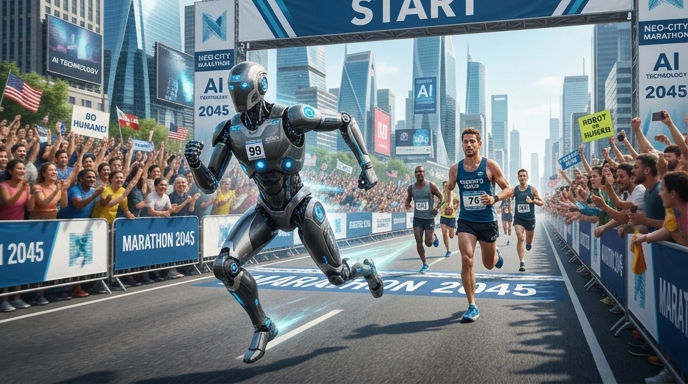
A humanoid robot crushed the human half-marathon world record in Beijing. Here’s why that should both excite and unsettle you.
The Day a Robot Left Humanity in the Dust
Picture this. It’s a crisp Sunday morning in Beijing. Twelve thousand human runners are lacing up their shoes, stretching their hamstrings, and mentally preparing for 13.1 miles of pain. Right next to them, on a separate course, thankfully, stand over 100 humanoid robots, motors humming, sensors calibrating, AI algorithms quietly doing math that no human brain could process in real time.
Then the starting gun fires.
And a bright red, 5-foot-5 robot named Lightning absolutely bolts.
On April 19, 2026, at the second annual Beijing E-Town Half Marathon and Humanoid Robot Half Marathon, Lightning crossed the finish line in 50 minutes and 26 seconds. That’s not just a robot record. That’s faster than any human being has ever run a half marathon. The current human world record, set just a month earlier by Ugandan Olympic medalist Jacob Kiplimo, stands at 57 minutes and 20 seconds.
Lightning beat it by nearly seven full minutes.
Let that sink in for a second.
Meet Lightning — The Robot That Rewrote History
So who or what exactly is Lightning?
Developed by Chinese smartphone manufacturer Honor (yes, the phone company), Lightning is a bipedal humanoid robot with stubby arms, three-foot legs, and what can only be described as a head topped with a straw boater hat. It looks a little goofy, honestly. But don’t let the aesthetics fool you.
According to WIRED, the robot incorporated features directly inspired by elite human runners. We’re talking nearly meter-long legs for maximum stride efficiency, advanced balance systems to keep it upright at speed, and here’s the wild part, a liquid cooling mechanism similar to the kind used in smartphones, to prevent the robot from overheating mid-race.
Lightning ran the entire course autonomously. No remote control. No human joystick operator. Just AI algorithms adjusting pace, maintaining balance, and adapting to the terrain in real time. And it did all of this while colliding with a barricade and falling down during the final sprint, then getting back up and still finishing first.
That’s not just impressive. That’s kind of terrifying.
Honor also entered a remote-controlled robot in the event, which clocked an even faster time of 48 minutes and 19 seconds. But it’s the autonomous finish that really matters here. A machine that thinks for itself just outran the fastest humans alive.
From 2 Hours 40 Minutes to 50 Minutes — In One Year
Here’s the part that should really make your jaw drop.
Last year, at the inaugural Beijing robot half marathon, the fastest robot finished in 2 hours, 40 minutes, and 42 seconds. That’s a respectable time for a human recreational runner. For a robot, it was considered a breakthrough.
One year later? The winning time dropped to 50 minutes and 26 seconds.
That’s nearly three times faster in a single year.
The Times of India drew a sharp comparison to another historic moment: February 10, 1996, when IBM’s Deep Blue defeated chess champion Garry Kasparov. That was the day the world realized computers could beat humans at complex cognitive tasks. The Beijing half marathon might be this generation’s Deep Blue moment, except instead of chess pieces, we’re talking about legs, lungs, and 13.1 miles of asphalt.
Alan Fern, a robotics professor at Oregon State University, offered a grounded take to the New York Times. “What appears to have changed this year is that some of China’s many humanoid companies have invested the engineering effort needed to make these systems robust enough for a long-duration race,” he said. “That is genuinely impressive.”
Not a scientific revolution, he clarified. But a massive engineering leap. And in the real world, those two things often feel the same.
It Wasn’t Just Lightning — Over 100 Robots Showed Up
Lightning grabbed the headlines, but the event was much bigger than one robot.
More than 100 humanoid robots from 76 institutions across China lined up at the starting line. They ran on a separate course from the 12,000 human participants, a smart safety call, given that several robots fell, veered off course, or needed technical assistance along the way. Some needed to be carried off on stretchers.
The robots competed in two categories: autonomous and remote-controlled. The contrast between the two was fascinating. Autonomous robots had to rely entirely on their onboard AI to navigate the course. Remote-controlled ones had human operators guiding them, and they were faster, but arguably less impressive from a technological standpoint.
According to Deseret News, the top three finishing robots were all developed by Honor. The company didn’t just win it dominated.
And while the laughter and jeers that used to greet stumbling robots have largely faded, they’ve been replaced by something more complex: applause mixed with a quiet, creeping unease.
China’s Bigger Play: Robotic Dominance on the World Stage
Let’s be real. This race wasn’t just about running.
China has been making a very deliberate, very public push to establish itself as the global leader in humanoid robotics. The Beijing half marathon is part of that strategy. So was last summer’s World Humanoid Robot Games, where over 500 robots from 16 countries competed in soccer, ping-pong, long jump, and even office tasks and housekeeping.
The message China is sending is clear: We’re not just building robots. We’re building the future.
Of the roughly 14,500 humanoid robots sold worldwide last year, the majority were manufactured in China. That number sounds small right now. But analysts aren’t sleeping on what comes next.
A Morgan Stanley report predicted that humanoid robot adoption will accelerate dramatically in the coming decades, potentially reaching 1 billion machines by 2050, driven by a market worth $5 trillion, primarily in commercial and industrial applications. Adoption will be slow through the mid-2030s, the report notes, then accelerate sharply in the late 2030s and 2040s.
One billion humanoid robots. By 2050. Let that number roll around in your head for a moment.
Okay, But Should We Actually Be Worried?
Here’s where it gets philosophical and a little uncomfortable.
The Times of India makes a point worth sitting with: when the word “robot” was first coined in 1920, it literally meant “forced labour.” Back then, people worried that factories were turning humans into machines. Now the fear has flipped entirely, machines might replace humans altogether.
Think about why humanoid robots have hands and fingers. They don’t need them to weld car parts on an assembly line. They need them to use things designed for humans, microwaves, dishwashers, TV remotes, door handles. They’re being built to operate in our world, in our homes, doing our jobs.
Some people hoped that “caring” professions nursing, teaching, social work would remain safely human. But tech companies are already building robots for those roles too.
WIRED puts it bluntly: running in a straight line is very different from performing complex real-world activities, like manipulating delicate objects or interacting socially. Lightning can crush a half marathon. It probably can’t comfort a grieving patient or read a room. Yet.
But the trajectory is undeniable. And the pace of improvement, from 2 hours 40 minutes to 50 minutes in a single year suggests we shouldn’t get too comfortable.
The Bottom Line: The Robots Are Running. Fast.
Here’s the honest truth. A robot just beat the fastest human half-marathon time ever recorded. It did it autonomously. It fell down and got back up. And it did it in front of 12,000 human runners who were still out there grinding through the same course.
That’s not science fiction. That’s April 2026.
The humanoid robotics market is growing. China is leading the charge. AI is getting smarter. And the gap between what robots can do and what only humans could do is narrowing faster than most people realize.
We might be grateful when these machines rescue people from earthquakes or handle dangerous jobs that put human lives at risk. But as they become more capable, faster, smarter, more autonomous we’ll be watching them with a mixture of wonder and wariness.
The robots are running. And they’re not slowing down.
Sources
- WIRED — A Humanoid Robot Set a Half-Marathon Record in China
- Times of India — Robots Are Coming
- Deseret News — A Race in Beijing Just Showcased How Fast a Robot Can Run
- WebProNews — Beijing’s Bots Outrun Humans: Honor Robot Shatters Half Marathon Record
- Morgan Stanley — Humanoid Robot Market Could Reach $5 Trillion by 2050
The Kingy Brief
Get future Kingy Brief editions.
Source-checked AI changes, original tests and one practical thing to try.
Free · Choose your subjects · Double opt-in · Unsubscribe anytime
Regular sending is paused; no restart date is set.